2022 SUZUKI JIMNY Hill
[x] Cancel search: HillPage 17 of 421

1. Instrument cluster
(P.2-15, 2-25)/ VIEW C Information display (P.2-18, 2-28) 2. Windshield wiper and washer lever (P.2-67)/ Rear window wiper/ washer switch (P.2-69) 3. Audio (if equipped) (P.5-31) 4. Hazard warning switch (P.2-67) 5. Ignition switch (P.3-2) 6. Gearshift lever (P.3-8) 7. Transfer lever (P.3-16) 8. Electric window control (Driver's door) (if e~ipped) (P.2-11) 9. ESP OFF switch (P.3-58) 10. Hill descent control switch (P.3-59) 11. Electric window control (Passenger's door) (if equipped) (P.2-11) 12. USB socket (if equipped) (P.5-7) 13. Accessory socket (P.5-6) 14. Heating and air conditioning system (P.5-16) / Heated rear window switch/ Heated outside rearview mirrors switch (if equipped) (P.2-71)
1 2 3 4
7 6 12 13
ILLUSTRATED TABLE OF CONTENTS
14
~m0~
-P-~ ¥ -1-
8 9 10 11
78RB01007
Page 109 of 421

BEFORE DRIVING
Vehicle with ESP® system
Warning and indicator Master warning Sound Cause and remedy message indicator light
Blinks Beep (one time from interior There may be a problem with ESP® system.
-
' I buzzer) Have your vehicle inspected by a SUZUKI
'A' dealer. --I '
78RB02053
Hill hold control system / Blinks Beep (one time from interior There may be a problem with hill hold control
Hill descent control system ' I buzzer) system or hill descent control system.
'A' Have your vehicle inspected by a SUZUKI --
-
I ' dealer.
78RB02054
Hill hold control system Blinks Beep (one time from interior When the transfer lever is in "4L" position and
' I buzzer) ESP® OFF switch is pushed and turned off the
-
-:A:-ESP® systems, the hill hold control system is deactivated and this message appears. This is I ' not a malfunction and check that the hill hold control system is deactivated.
78RB02054
2-38
Page 113 of 421

Anti-lock brake system {ABS) warn
ing light
(8)
65D529
When the ignition switch is turned "ON", this light comes on briefiy so you can check that the light is working. If the light stays on or comes on when driving, there may be something wrong with the ABS.
If this happens: 1) Pull off the road and stop carefully. 2) Turn the ignition switch to "LOCK" and then start the engine again.
If the warning light comes on briefiy and then turns off, the system is normal. If the warning light still stays on, something is wrong with the system.
If the light and the brake system warning light stay on or come on simultaneously when driving, your ABS system is equipped with the rear brake force control function (proportioning valve function) and there may be something wrong with both the rear brake force control function and the anti-lock function of the ABS system.
If one of the above occurs, have the system inspected by a SUZUKI dealer. If the ABS becomes inoperative, the brake system will function as an ordinary brake system that does not have this ABS sys
tem.
For details of ABS system, refer to "Antilock brake system (ABS)" in "OPERATING YOUR VEHICLE" section.
ESP® warning light
52KM133
ESP® is a registered trademark of Daimler
AG.
This light blinks 5 times per second when one of the following systems is activated. Stability control system • Traction control system • Hill descent control system
If this light blinks, drive carefully.
BEFORE DRIVING
When the ignition switch is turned "ON", the light comes on briefiy so you can check that the light is working. If the light stays on or comes on when driving, there may be something wrong with the ESP® systems (other than ABS). You should have the system inspected by a SUZUKI dealer.
For details of the ESP® systems, refer to "Electronic stability program (ESP®)" in "OPERATING YOUR VEHICLE" section.
The ESP® systems cannot prevent accidents. Always drive carefully.
2-42
Page 114 of 421

BEFORE DRIVING
ESP® OFF indicator light
57L30045
When the ignition switch is turned "ON", this light comes on briefiy so you can check that the light is working.
When the ESP® OFF switch is pushed to turn off the ESP® systems (other than ABS), the ESP® OFF indicator light comes on and stays on.
For details of the ESP® systems, refer to "Electronic stability program (ESP®)" in "OPERATING YOUR VEHICLE" section.
NOTE: If the vehicle speed is greater than approximately 30 km/h (19 mph}, the ESF'® systems (other than ABS) will be activated automatically and the light will go out. When the transfer lever is in "4L" (4-wheel drive low range) position, the ES?® system (other than ABS) will be canceled automatically. The light will come on and stay on.
2-43
Hill hold control OFF indicator light
(@)
OFF
78RB02086
When the ignition switch is turned "ON", this light comes on briefly so you can check that the light is working. This light comes on when the hill hold control system is deactivated.
For details of the hill hold control system, refer to "Hill hold control system" in the "OPERATING YOUR VEHICLE" section.
Hill descent control indicator light
79K050
When the ignition switch is turned "ON", this light comes on briefiy so you can check that the light is working. When you push the hill descent control switch and the hill descent control operating conditions are fulfilled, the hill descent control indicator comes on. If the hill descent control indicator blinks, the hill descent control will not be activated.
For details of the hill descent control system, refer to "Hill descent control system" in the "OPERATING YOUR VEHICLE" section.
Page 144 of 421

BEFORE DRIVING
Maximum towing capacity (gross trailer weight; trailer with integrated drawbar, and cargo)
Braked trailer: 1300 kg (2866 lbs) Unbraked trailer: 350 kg (772 lbs)
To load your vehicle and trailer properly, you must know how to measure gross trailer weight and trailer nose weight.
78RB02083
(1) Gross trailer weight Gross trailer weight is the weight of the trailer with integrated drawbar plus all the cargo in it. You can measure gross trailer weight by putting the fully loaded trailer on a vehicle scale.
2-73
(2) Permissible nose weight Nose weight is the downward force applied on the towing hitch ball by the trailer coupler, with the trailer fully loaded and the coupler at its normal towing height. This weight can also be measured using a bathroom scale.
The maximum towing capacity listed above(1300kg) is only applicable up to 1 000m above sea level. In high altitude regions above 1 000m, combined weight of the maximum towing capacity (gross trailer weight) and permissible gross vehicle weight (GVWR) must be reduced by 10% for every extra 1 000m.
A WARNING
For vehicles equipped with the dual sensor brake support, if your vehicle is used to tow a trailer, press the dual sensor brake support OFF switch to turn off the dual sensor brake support. If not, accidents related to the system being turned on may occur.
A CAUTION
When towing by your vehicle equipped with automatic transmission on a long steep uphill, try to take some rest on the way at a safe place to prevent overheat or damage of the engine or transmission.
NOTICE
Trailer towing puts additional stress on the engine, transmission and brakes of your vehicle. Never tow a trailer during the first 1000 km (600 miles) of vehicle operation.
Page 147 of 421
A WARNING
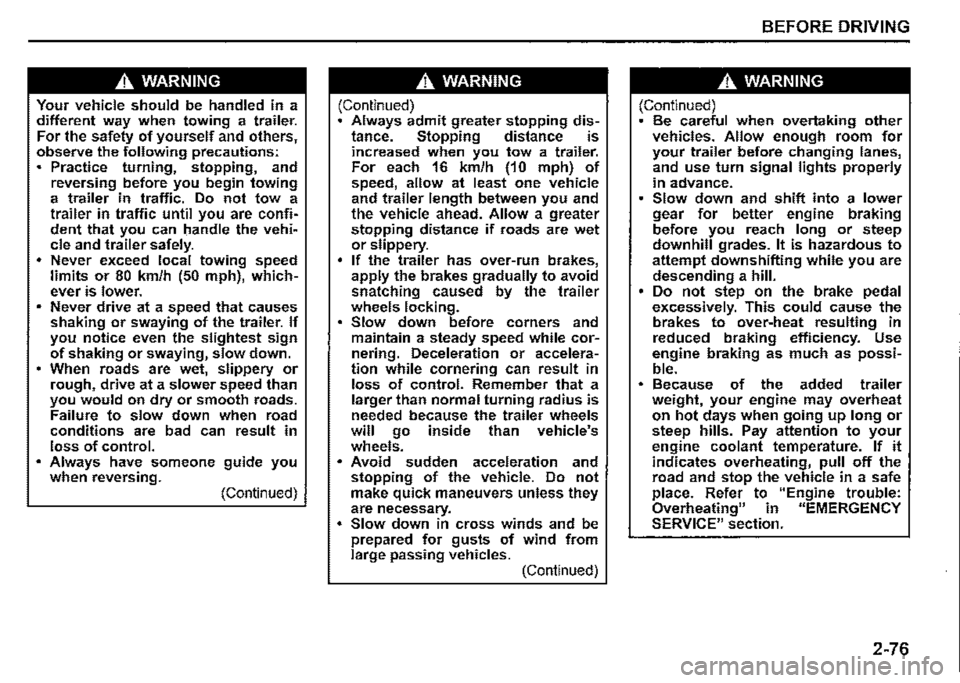
Your vehicle should be handled in a different way when towing a trailer. For the safety of yourself and others, observe the following precautions: Practice turning, stopping, and reversing before you begin towing a trailer in traffic. Do not tow a trailer in traffic until you are confident that you can handle the vehicle and trailer safely. Never exceed local towing speed limits or 80 km/h (50 mph), whichever is lower. Never drive at a speed that causes shaking or swaying of the trailer. If you notice even the slightest sign of shaking or swaying, slow down. • When roads are wet, slippery or rough, drive at a slower speed than you would on dry or smooth roads. Failure to slow down when road conditions are bad can result in loss of control. Always have someone guide you when reversing. (Continued)
A WARNING
(Continued) Always admit greater stopping distance. Stopping distance is increased when you tow a trailer. For each 16 km/h (10 mph) of speed, allow at least one vehicle and trailer length between you and the vehicle ahead. Allow a greater stopping distance if roads are wet or slippery. If the trailer has over-run brakes, apply the brakes gradually to avoid snatching caused by the trailer wheels locking. Slow down before corners and maintain a steady speed while cornering. Deceleration or acceleration while cornering can result in loss of control. Remember that a larger than normal turning radius is needed because the trailer wheels will go inside than vehicle's wheels. Avoid sudden acceleration and stopping of the vehicle. Do not make quick maneuvers unless they are necessary. Slow down in cross winds and be prepared for gusts of wind from large passing vehicles. (Continued)
BEFORE DRIVING
A WARNING
(Continued) Be careful when overtaking other vehicles. Allow enough room for your trailer before changing lanes, and use turn signal lights properly in advance. Slow down and shift into a lower gear for better engine braking before you reach long or steep downhill grades. It is hazardous to attempt downshifting while you are descending a hill. Do not step on the brake pedal excessively. This could cause the brakes to over-heat resulting in reduced braking efficiency. Use engine braking as much as possible. Because of the added trailer weight, your engine may overheat on hot days when going up long or steep hills. Pay attention to your engine coolant temperature. If it indicates overheating, pull off the road and stop the vehicle in a safe place. Refer to "Engine trouble: Overheating" in "EMERGENCY SERVICE" section.
2-76
Page 156 of 421

OPERATING YOUR VEHICLE
Parking brake lever
(1) To set (2) To release (3) To release
The parking brake lever is located between the front seats. To set the parking brake, depress the brake pedal and pull the parking brake lever all the way up. To release the parking brake, depress the brake pedal and pull up slightly on the parking brake lever, push the button on the end of the lever with your thumb, and lower the lever to its original position.
3-5
For automatic transmission vehicles, always set the parking brake before moving the gearshift lever to "P" (PARK) position. If you park on an incline and shift into "P" before setting the parking brake, the weight of the vehicle may make it difficult to shift out of "P" when you are ready to drive the vehicle.
When preparing to drive the vehicle, move the gearshift lever out of "P" position before releasing the parking brake.
A WARNING
• Whenever parking, make sure the gearshift lever for manual transmission vehicles is in 1st gear or "R" (Reverse) and the gearshift lever for automatic transmission or automatic transmission vehicles is in 11P" {Park). Remember, even though the transmission is in gear or in Park, you must set the parking brake fully. • When parking on an uphill, turn the steering wheel so that the front wheels point to the center of the
road. • When parking on a downhill, turn the steering wheel so that the front wheels point to the curb. • Never drive your vehicle with the parking brake on: rear brake effectiveness can be reduced from overM heating, brake life may be shortened, or permanent brake damage may result. • If the parking brake does not hold the vehicle securely or does not fully release, have your vehicle inspected immediately by a SUZUKI dealer.
Page 160 of 421

OPERATING YOUR VEHICLE
Starting off To start off, depress the clutch pedal all the way to the floor and shift into 1 st gear. After releasing the parking brake, gradually release the clutch. When you hear a change in the engine's sound, slowly press the accelerator while continuing to gradually release the clutch.
Shifting All forward gears are synchronized and provide quiet and easy shifting. Always depress the clutch pedal all the way to the floor before shifting gears. Keep the engine speed from rising into the red zone of the tachometer.
Downshifting maximum allowable speeds
Transfer lever in "2H" or "4H" position
Downshifting km/h (mph)
2nd to 1st 40 (25)
3rd to 2nd 75 (47)
4th to 3rd 105 (65)
5th to 4th 150 (93)*
3-9
Transfer lever in "4L" position
Downshifting km/h (mph)
2ndto1st 20 (12)
3rd to 2nd 35 (22)
4th to 3rd 50 (31)
5th to 4th 75 (47)*
*NOTE: You may not accelerate to the maximum allowable speed because of the driving situation and/or the vehicle condition.
NOTICE
Do not downshift to a lower gear at the speed faster than the maximum allowable speeds for the next lower speed) or severe damage to engine and transmission can result.
A WARNING
• Reduce your speed and downshift to a lower gear before going down a long or steep hill. A lower gear will allow the engine to provide braking. Avoid riding the brakes or they may overheat, resulting in brake failure. When driving on slippery roads, slow down before downshifting. Excessive and/or sudden changes in engine speed may cause loss of traction, which could cause you to lose control.
NOTICE
Check that the vehicle is completely stationary before you shift into reverse.
NOTICE
To help avoid clutch damage, do not use the clutch pedal as a footrest while driving or use the clutch to keep the vehicle stationary on a slope. Depress the clutch fully when shifting. • When shifting or starting off, do not race the engine. Racing the engine can shorten engine life and cause negative effect to smooth shifting.