2022 SUZUKI JIMNY Changing wheels
[x] Cancel search: Changing wheelsPage 147 of 421
A WARNING
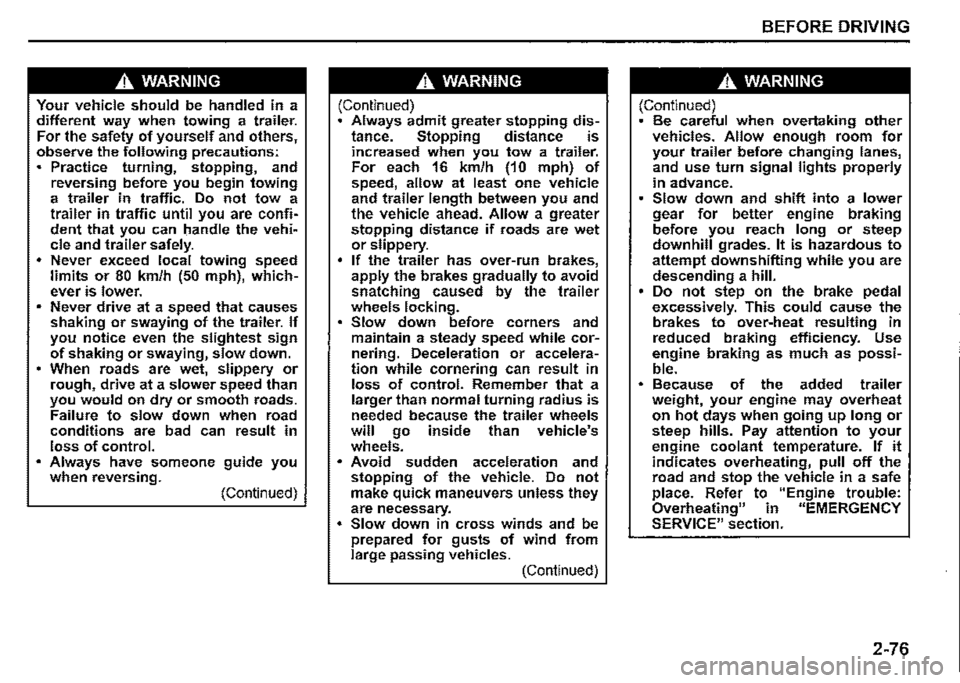
Your vehicle should be handled in a different way when towing a trailer. For the safety of yourself and others, observe the following precautions: Practice turning, stopping, and reversing before you begin towing a trailer in traffic. Do not tow a trailer in traffic until you are confident that you can handle the vehicle and trailer safely. Never exceed local towing speed limits or 80 km/h (50 mph), whichever is lower. Never drive at a speed that causes shaking or swaying of the trailer. If you notice even the slightest sign of shaking or swaying, slow down. • When roads are wet, slippery or rough, drive at a slower speed than you would on dry or smooth roads. Failure to slow down when road conditions are bad can result in loss of control. Always have someone guide you when reversing. (Continued)
A WARNING
(Continued) Always admit greater stopping distance. Stopping distance is increased when you tow a trailer. For each 16 km/h (10 mph) of speed, allow at least one vehicle and trailer length between you and the vehicle ahead. Allow a greater stopping distance if roads are wet or slippery. If the trailer has over-run brakes, apply the brakes gradually to avoid snatching caused by the trailer wheels locking. Slow down before corners and maintain a steady speed while cornering. Deceleration or acceleration while cornering can result in loss of control. Remember that a larger than normal turning radius is needed because the trailer wheels will go inside than vehicle's wheels. Avoid sudden acceleration and stopping of the vehicle. Do not make quick maneuvers unless they are necessary. Slow down in cross winds and be prepared for gusts of wind from large passing vehicles. (Continued)
BEFORE DRIVING
A WARNING
(Continued) Be careful when overtaking other vehicles. Allow enough room for your trailer before changing lanes, and use turn signal lights properly in advance. Slow down and shift into a lower gear for better engine braking before you reach long or steep downhill grades. It is hazardous to attempt downshifting while you are descending a hill. Do not step on the brake pedal excessively. This could cause the brakes to over-heat resulting in reduced braking efficiency. Use engine braking as much as possible. Because of the added trailer weight, your engine may overheat on hot days when going up long or steep hills. Pay attention to your engine coolant temperature. If it indicates overheating, pull off the road and stop the vehicle in a safe place. Refer to "Engine trouble: Overheating" in "EMERGENCY SERVICE" section.
2-76
Page 356 of 421

INS.PECTION AND MAINTENANCE
4-tyre rotation
65D459
To avoid uneven wear of your tyres and to prolong their life, rotate the tyres as illustrated. Tyres should be rotated every 10000 km (6000 miles). After rotation, adjust front and rear tyre pressures to the specification listed on your vehicle's Tyre Information Label.
6-39
Changing Wheels
78RB07014
To change a wheel, use the following procedure:
1) Remove the jack, tools and spare wheel from the vehicle.
NOTE: How to remove the spare wheel:
78RB07052
1. Remove the center nut (1 ), then remove the spare wheel half cover (2) (if equipped). 2. Remove the wheel nuts of the spare wheel, then remove the spare wheel with both hands.
2) Loosen, but do not remove the wheel nuts. 3) Jack up the vehicle (follow the jacking instructions in the "EMERGENCY SERVICE" section in this manual) 4) Remove the wheel nuts and wheel. 5) Before installing the new wheel, clean any mud or dirt off from the surface of the wheel and hub with a clean cloth. Clean the hub carefully; it may be hot from driving.
Page 357 of 421

6) Install the new wheel and replace the wheel nuts with their cone shaped end facing the wheel. Tighten each nut snugly by hand until the wheel is securely seated on the hub.
78RB07017
Tightening torque for wheel nut: 100 Nm (10.0 kg-m, 72.3 lb-ft)
7) Lower the jack and fully tighten the nuts in a crisscross fashion with a wrench as shown in the illustration.
A WARNING
Use genuine wheel nuts and tighten them to the specified torque as soon as possible after changing wheels. Incorrect wheel nuts or improperly tightened wheel nuts may come loose or fall off, which can result in an accident. If you do not have a torque wrench, have the wheel nut torque checked by a SUZUKI dealer.
INSPECTION AND MAINTENANCE
NOTE: How to install the spare wheel:
(3)
78RB07053
When you install a 195/B0R 15 spare wheel to the vehicle, set the spare tyre bracket (3) (if equipped) with the mark of "195" on up position, and handle it in the reverse order of removal. For vehicles equipped with the spare wheel half cover; when you install the spare wheel half cover, check that the hollow (4) of the cover is positioned below the center of the spare wheel half cover.
6-40
Page 381 of 421

NOTICE
Never apply a garage jack to the exhaust pipe, front fender splash guard, side sill splash, rear fender splash guard, front differential or rear differential.
NOTE: For more details, contact a SUZUKI dealer.
Changing wheels
To change a wheel, use the following pro
cedure: 1) Prepare the jack, tools and spare tyre. 2) Loosen, but do not remove the wheel nuts. 3) Jack up the vehicle (follow the jacking instructions in this section).
A WARNING
Shift into "P" (Park) for an automatic transmission, or into 11R" (Reverse) for a manual transmission vehicle when you jack up the vehicle. Never jack up the vehicle with the transmission in "N" (Neutral). OthR erwise, unstable jack may cause an accident.
4) Remove the wheel nuts and wheel.
65J4033
5) Clean any mud or dirt off from the surface of the wheel (1 ), hub (2), thread part (3) and surface of the wheel nuts (4) with a clean cloth. Clean the hub carefully; it may be hot from driving.
EMERGENCY SERVICE
6) Install the new wheel and replace the wheel nuts with their cone shaped end facing the wheel. Tighten each nut snugly by hand until the wheel is securely seated on the hub.
78RB08003
Tightening torque for wheel nut 100 Nm (10.0 kg-m, 72.3 lb-ft)
7) Lower the jack and fully tighten the nuts with a wheel wrench in numerical order as shown in the illustration.
7-4
Page 382 of 421

EMERGENCY SERVICE
A. WARNING
Use genuine wheel nuts and tighten them to the specified torque as soon as possible after changing wheels. Incorrect wheel nuts or improperly tightened wheel nuts may come loose or fall off, which can result in an accident. If you do not have a torque wrench, have the wheel nut torque checked by a SUZUKI dealer.
7-5
Jump-starting instructions
A. WARNING
Never attempt to jump-start your vehicle if the lead-acid battery appears to be frozen. Batteries in this condition may explode. When making jump lead connections, check that your hands and the jump leads remain clear from pulleys, belts or fans. Lead-acid batteries produce flammable hydrogen gas. Keep flames and sparks away from the battery or an explosion may occur. Never smoke when working near the battery. If the booster battery you use for jump-starting is installed in another vehicle, check that the two vehicles are not touching each other. If your lead-acid battery discharges repeatedly, for no apparent reason, have your vehicle inspected by a SUZUKI dealer. • To avoid harm to yourself or damage to your vehicle or battery, follow the jump-starting instructions below. If you are in doubt, call for qualified road service.
NOTICE
Your vehicle should not be started by pushing or towing. This starting method could result in permanent damage to the catalytic converter. Use jump leads to start a vehicle with a weak or flat battery.
1) Use only a 12-volt lead-acid battery to jump-start your vehicle. Position the good 12-volt lead-acid battery close to your vehicle so that the jump leads will reach both batteries. When using a battery installed on another vehicle, check that two vehicles do not touch each other. Set the parking brakes fully on both vehicles. 2) Turn off all vehicle accessories, except those necessary for safety reasons (for example, headlights or hazard lights).
Page 411 of 421

INDEX
INDEX Brake system warning light ................................................ 2-41
Brakes ................................................................................... 6-33 Symbols Braking .................................................................................. 3-53 "SOS" button ..................................................................... 10-12 Brightness control ...................................................... 2-17. 2-26
A Built date ............................................................................... 10-1
Accelerator pedal ................................................................... 3-7 Bulb replacement ................................................................. 6-47
Accessory socket .................................................................. 5-6 C Adding coolant. .................................................................... 6-29 Catalytic converter ................................................................. 4-9 Adjusting headlight pattern ................................................ 2-60 Central door locking system ................................................. 2-3
Air cleaner ............................................................................ 6-30 Changing engine oil and filter ............................................. 6-26 Air conditioning system ...................................................... 6-58 Changing wheels .................................................................... 7-4 AIRBAG light ............................................................... 1-36. 2-45 Charging light ....................................................................... 2-44
Anti-lock brake system (ABS) ................................... 3-54. 3-56 Chassis serial number ........................................................... 9-1 Anti-lock brake system (ABS) warning light.. ................... 2-42 Child restraint ....................................................................... 10-1 Anti-theft feature .................................................................. 5-76 Child restraint system for countries applied Assist grips ............................................................................ 5-8 for UN Regulation No.16 ............................................. 1-20. 10-7 Automatic headlight leveling system warning light.. ....... 2-50 Child restraint systems ....................................................... 1-18
Automatic heating and air conditioning system Clock ............................................................................ 2-19. 2-29 (climate control) ................................................................... 5-23 Clutch pedal ................................................................... 3-7. 6-33 Automatic light operation ................................................... 2-56 Coolant level check .............................................................. 6-29 Automatic transmission ...................................................... 3-1 O Coolant replacement... ......................................................... 6-29 Average fuel consumption ......................................... 2-20. 2-30 Corrosion prevention ............................................................. 8-1 Average speed ..................................................................... 2-30 Cup holder ............................................................................ 5-11
8 Cup holder and storage area .............................................. 5-1 O
Battery .................................................................................. 6-41 D
Battery replacement .............................................................. 2-7
Bluetooth® audio ................................................................. 5-71
Bluetooth® hands-free ......................................................... 5-62
Daily inspection check list ..................................................... 3-1
Daytime running light .......................................................... 6-50
Daytime running light (D.R.L.) system ............................... 2-58 Brake assist system ............................................................ 3-53 Door locks ............................................................................... 2-2
Brake fluid ............................................................................ 6-33 Drive belt ............................................................................... 6-23 Brake pedal ................................................................... 3-7. 6-34
11-1