2022 SUZUKI IGNIS before driving
[x] Cancel search: before drivingPage 68 of 505
2-45BEFORE DRIVING
75RM4-01E
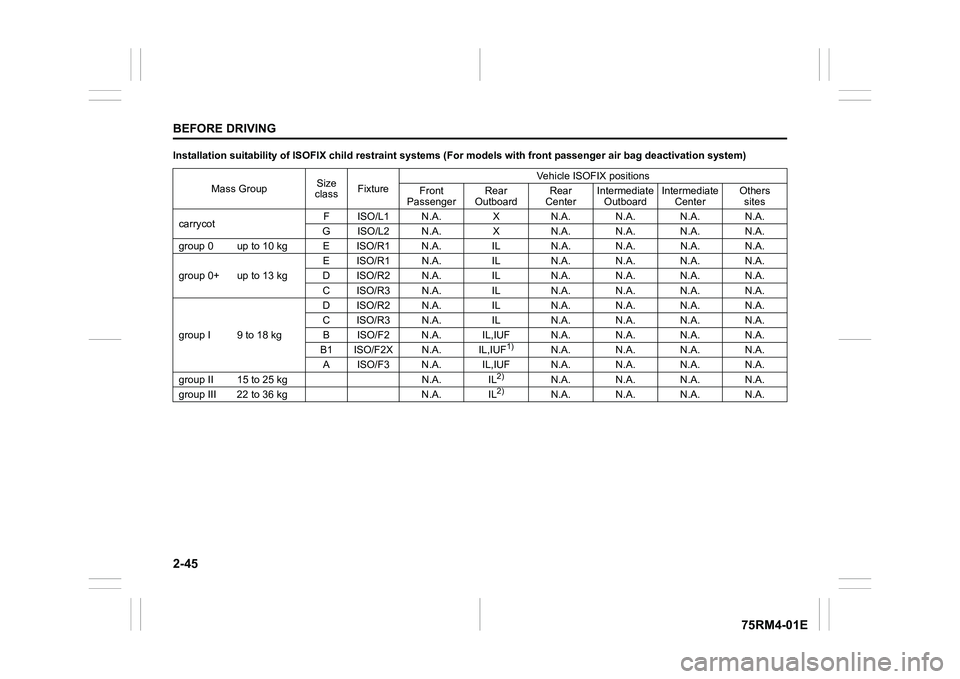
Installation suitability of ISOFIX child restraint systems (For models with front passenger air bag deactivation system)
Mass Group Size
class Fixture Vehicle ISOFIX positions
Front
Passenger Rear
Outboard Rear
Center Intermediate
Outboard Intermediate
Center Others
sites
carrycot F ISO/L1 N.A. X N.A. N.A. N.A. N.A.
G ISO/L2 N.A. X N.A. N.A. N.A. N.A.
group 0 up to 10 kg E ISO/R1 N.A. IL N.A. N.A. N.A. N.A.
group 0+ up to 13 kg E ISO/R1 N.A. IL N.A. N.A. N.A. N.A.
D ISO/R2 N.A. IL N.A. N.A. N.A. N.A.
C ISO/R3 N.A. IL N.A. N.A. N.A. N.A.
group I 9 to 18 kg D ISO/R2 N.A. IL N.A. N.A. N.A. N.A.
C ISO/R3 N.A. IL N.A. N.A. N.A. N.A.
B ISO/F2 N.A. IL,IUF N.A. N.A. N.A. N.A.
B1 ISO/F2X N.A. IL,IUF
1)
N.A. N.A. N.A. N.A.
A ISO/F3 N.A. IL,IUF N.A. N.A. N.A. N.A.
group II 15 to 25 kg N.A. IL
2)
N.A. N.A. N.A. N.A.
group III 22 to 36 kg N.A. IL
2)
N.A. N.A. N.A. N.A.
Page 69 of 505

2-46
BEFORE DRIVING
75RM4-01E
Installation suitability of ISOFIX child restraint systems (For models without front passenge r air bag deactivation system)
Mass Group Size
class Fixture Vehicle ISOFIX positions
Front
Passenger Rear
Outboard Rear
Center Intermediate
Outboard Intermediate
Center Others
sites
carrycot F ISO/L1 N.A. X N.A. N.A. N.A. N.A.
G ISO/L2 N.A. X N.A. N.A. N.A. N.A.
group 0 up to 10 kg E ISO/R1 N.A. IL N.A. N.A. N.A. N.A.
group 0+ up to 13 kg E ISO/R1 N.A. IL N.A. N.A. N.A. N.A.
D ISO/R2 N.A. IL N.A. N.A. N.A. N.A.
C ISO/R3 N.A. IL N.A. N.A. N.A. N.A.
group I 9 to 18 kg D ISO/R2 N.A. IL N.A. N.A. N.A. N.A.
C ISO/R3 N.A. IL N.A. N.A. N.A. N.A.
B ISO/F2 N.A. IL,IUF N.A. N.A. N.A. N.A.
B1 ISO/F2X N.A. IL,IUF
1)
N.A. N.A. N.A. N.A.
A ISO/F3 N.A. IL,IUF N.A. N.A. N.A. N.A.
group II 15 to 25 kg N.A. X N.A. N.A. N.A. N.A.
group III 22 to 36 kg N .A. X N.A. N.A. N.A. N.A.
Page 70 of 505

2-47BEFORE DRIVING
75RM4-01E
Key of letters to be inserted in the above table
IUF =Suitable for ISOFIX forward child restraints systems of universal category approved for use in this mass group
IL =Suitable for particular ISOFI X CRS are those of “specific vehicle”, “restricted” or “semi-universal” categories.
X =ISOFIX position not suitable fo r ISOFIX child restraint systems in this mass group and/or this size class.
NOTE:
1) SUZUKI recommends “Britax Römer Duo Plus” child seat.
2) SUZUKI recommends “Britax Römer KidFix XP” child seat.
These child restraint systems are SUZUKI Ge nuine Accessory, refer to the accessories catalog. However, there are countries which do
not sell these child restraint system.
NOTE:
‘universal’ is the category in UN Regulation No. 44.
Installation suitability of i-Size child restraint systems
Key of letters to be inse rted in the above table
i-U =Suitable for i-Siz e “universal” Child Restraint Systems for ward and rearward facing.
i-UF =Suitable for forward-facing i-Size “universal” Child Restraint Systems only.
X =Seating position not suitable for i-Size “universal” Child Re straint Systems.
NOTE:
‘universal’ is the category in UN Regulation No. 44. Seating position
Front
Passenger Outboard Rear
Outboard Left Rear
Outboard Right Rear
Center Intermediate
Outboard Left Intermediate
Outboard Right Intermediate
Center
i-Size Child
Restraint N.A. i-U i-U N.A. N.A. N.A. N.A.
Page 71 of 505

2-48
BEFORE DRIVING
75RM4-01E
Installation with lap-shoulder seat beltsNOTE:
Stow the removed head restraint in the lug-
gage compartment so it will not cause
inconvenience to the occupants.ELR type belt
80JC021
(For models with front passenger air bag
deactivation system)
Whenever possible, SUZUKI recom-
mends that child restraint systems be
installed on the rear seat. According to
accident statistics, children are safer when
properly restrained in rear seating posi-
tions than in front seating positions.
• If you must install the child restraint sys-
tem on the front passe nger’s seat, follow
instructions below.
– Deactivate the front passenger’s front air bag by the front passenger air bag
deactivation system.
– Slide the seat to t he most rear position
by the seat position adjustment lever.
– Adjust the seatba ck at the 5th step
inclined position (counted from most
upright position) w ith the seatback
angle adjustment lever. – If your vehicle is equipped with the
seat height adjustment lever, raise the
seat to the uppermost position by the
seat height adjustment lever.
Install your child restraint system accord-
ing to the instructions provided by the child
restraint system manufacturer.
Check that the seat belt is securely
latched.
Move the child restraint system in all direc-
tions to check that it is securely installed.
When you put your child in the child
restraint system, appr opriately slide the
front seat forward not to touch a part of
your child’s body.
CAUTION
Adjust the height of the rear head
restraint or remove it for fitting the
child restraint, as necessary. How-
ever, if a booster cushion not
equipped with the head restraint is
fitted, the rear seat head restraint
should not be removed. If the rear
head restraint is removed for fitting
the child restraint, you need to install
it again after removing the child
restraint.
If the child restraint is fitted improp-
erly, a child sitting in it could be
injured in a crash.
EXAMPLE
Page 72 of 505

2-49BEFORE DRIVING
75RM4-01E
Installation with ISOFIX type anchorages
75RM040
Your vehicle is equipped with the lower
anchorages in the rear seat outboard seat-
ing positions for securing a ISOFIX type of
child restraints with the connecting bars.
The lower anchorages are located where
the rear of the seat cushion meets the bot-
tom of the seatback.Install the ISOFIX type child restraint sys-
tem according to the instructions provided
by the child restraint system manufacturer.
After installation, try moving the child
restraint system in all
directions especially
forward to check that connecting bars are
securely latched t o the anchorages.
84MM00252
Your vehicle is equipped with the top tether
anchorages. Use the top tether strap of the
child restraint according to the instructions
provided by the child restraint system man-
ufacturer. Here is a genera
l instruction:
NOTE:
Stow the removed head restraint in the lug-
gage compartment so it will not cause
inconvenience to the occupants.
WA R N I N G
Install the ISOFIX type of child
restraint(s) in the o nly outboard seat-
ing positions, not in the central posi-
tion for the rear seat.
EXAMPLE
EXAMPLE
CAUTION
Adjust the height of the rear head
restraint or remove it for fitting the
child restraint, as necessary. How-
ever, if a booster cushion not
equipped with the head restraint is
fitted, the rear seat head restraint
should not be removed. If the rear
head restraint is removed for fitting
the child restraint, you need to install
it again after removing the child
restraint.
If the child restraint is fitted improp-
erly, a child sitting in it could be
injured in a crash.
Page 73 of 505

2-50
BEFORE DRIVING
75RM4-01E
78F114
1) Place the child restraint in the rear seat,inserting the connecting bars to the
anchorages between the seat cushion
and the seatback.
68LM268
2) Use your hands to carefully align theconnecting bar tips with the anchor-
ages. Take care not to pinch your fin-
gers.
54G184
3) Push the child restraint toward the anchor- ages so that the connecting bar tips are
partially hooked to the anchorages. Use
your hands to confirm the position.
54G185
4) Grasp the front of the child restraint and
push the child restraint forcefully to
latch the connecting bars. Check that
they are securely latched by trying to
move the child restraint system in all
directions, especially forward.
5) Attach the top tether strap referring to
“Installation of child restraint with top
tether” section below.
When you put your child in the child
restraint system, appropriately slide the
front seat forward not to touch a part of
your child’s body.
EXAMPLE
EXAMPLEEXAMPLE
EXAMPLE
Page 74 of 505

2-51BEFORE DRIVING
75RM4-01E
Installation of child restraint with top tether
75RM105
Some child restraint systems require the
use of a top tether strap. Top tether anchor-
age brackets are provided in your vehicle at
the locations shown in the illustrations.
The number of the top tether anchorage
brackets provided in your vehicle depends
on the vehicle specification. Install the child
restraint system as follows:
1) Remove the luggage compartment cover
(if equipped).2) Secure the child restraint on the rear
seat using the procedure described
above for securing a restraint system
that does not require a top tether strap.
3) Hook the top tether strap to the top tether anchorage bracket and tighten
the top tether strap according to the
instructions provided by the child
restraint system manufacturer. Attach
the top tether strap to the correspond-
ing top tether anchorage bracket
located directly behind the child
restraint. Do not attach the top tether
strap to the luggage restraint loops (if
equipped).
54P000264
4) When routing the top tether strap, passthe top tether strap as shown in the
illustration. (Refer to “Head restraints”
section for details on how to remove the
head restraint.)
5) Check that cargo does not interfere with routing of the top tether strap.
NOTE:
For Australia:
For additional information, refer to the
“SUPPLEMENT” section at the end of this
book.
NOTICE
When installing a child restraint sys-
tem to the rear seat, adjust the front
seat position so that the front seat
does not interfer e with the child
restraint system.EXAMPLE
Front
WA R N I N G
Do not attach the child restraint top
tether strap t o the luggage restraint
loops (if equipped). Incorrectly
attached top tether strap will reduce
the intended effectiveness of the
child restraint system.
NOTICE
When installing a child restraint sys-
tem to the rear seat, adjust the front
seat position so that the front seat
does not interfer e with the child
restraint system.EXAMPLE
Page 75 of 505

2-52
BEFORE DRIVING
75RM4-01E
Seat belt pretensioner system
63J269
To determine if your vehicle is equipped
with a seat belt pretensioner system at the
front or rear seating positions, check the
label on the seat belt at the bottom part. If
the letters “p” and/or “PRE” appear as illus-
trated, your vehicle is equipped with the
seat belt pretensioner system. You can use
the pretensioner seat belts in the same
manner as ordinary seat belts.
Read this section and “Supplemental
restraint system (air bags)” section to learn
more about the pretensioner system.
The seat belt pretensioner system works
with the supplemental r estraint system (air
bags). The crash sensors and the elec-
tronic controller of t he air bag system also
control the seat belt pretensioners. The
pretensioners are triggered only when
there is a frontal or side crash severe
enough to trigger the air bags and the seat
belts are fastened. For precautions and
general information including servicing the
pretensioner system, refer to “Supplemen-
tal restraint system (air bags)” section in
addition to this “Seat belt pretensioner sys-
tem” section, and follow all those precau-
tions.
The pretensioner is located in each front
seat belt retractor and both side of the rear
seat belt retractor (if equipped). The pre-
tensioner tightens the seat belt so the belt
fits the occupant’s body more snugly in the
event of a frontal or side crash. The retrac-
tors will remain locked after the pretension-
ers are activated. Upon activation, some noise will occur and some smoke may be
released. These conditions are not harmful
and do not indicate a fire in the vehicle.
The driver and all passengers must be
properly restrained by fastening seat belts
at all times, whether or not a pretensioner
is equipped at their seating position, to
minimize the risk of severe injury or death
in the event o
f a crash.
Sit fully back in the seat; sit up straight; do
not lean forward or sideways. Adjust the
belt so the lap portion of the belt is worn
low across the pelvis , not across the waist.
Please refer to “Seat adjustment” section
and the instructions and precautions about
the seat belts in this “Seat belts and child
restraint systems” section for details on
proper seat and seat belt adjustments.
Please note that the pretensioners along
with the air bags will activate in severe
frontal or side crashes. They are not
designed to activate in rear impacts, roll-
overs, or minor frontal side crashes. The
pretensioners can be activated only once.
If the pretensioners are activated (that is, if
the air bags are activated), have the pre-
tensioner system serviced by an autho-
rized SUZUKI dealer as soon as possible.
If AIR BAG light on the instrument cluster
does not blink or come on briefly when the
ignition switch is turned to “ON” position or
the engine switch is pressed to change the
WA R N I N G
This section describes your SUZUKI
vehicle’s seat belt pretensioner sys-
tem. Read and follow all these
instructions carefully to minimize
your risk of severe injury or death.
and/or
Label
EXAMPLE