Page 239 of 346
∙ The spare tire is designed for emer-gency use. For additional information
refer to “Wheels and tires” in the “Do-
it-yourself ” section of this manual.
∙ When reinstalling the spare tire bas- ket under the vehicle af ter use, be
sure that the hook engages the bas-
ket from the inside. If the spare tire
basket hook is not engaged properly,
there is an increased risk of the spare
tire separating from the vehicle in a
crash and causing injury.
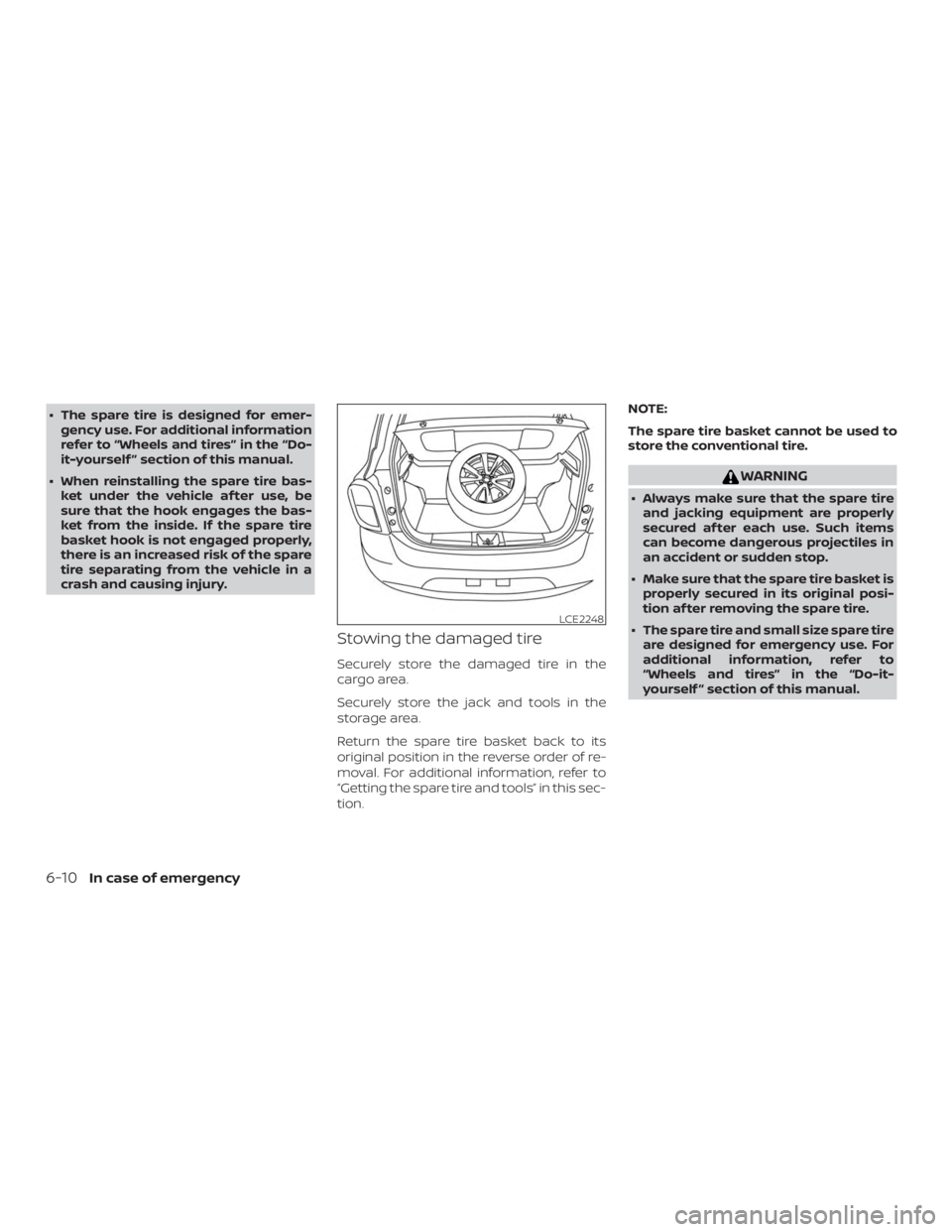
Stowing the damaged tire
Securely store the damaged tire in the
cargo area.
Securely store the jack and tools in the
storage area.
Return the spare tire basket back to its
original position in the reverse order of re-
moval. For additional information, refer to
“Getting the spare tire and tools” in this sec-
tion. NOTE:
The spare tire basket cannot be used to
store the conventional tire.
Page 242 of 346
CAUTION
∙ Do not push start this vehicle. Thethree-way catalyst may be damaged.
∙ Automatic Transmission (AT) models and Manual Transmission (MT) cannot
be push-started or tow-started. At-
tempting to do so may cause trans-
mission damage.
∙ For Manual Transmission (MT) mod- els, never try to start the vehicle by
towing it. When the engine starts, the
forward surge could cause the vehicle
to collide with the tow vehicle. If your vehicle is overheating (indicated by a
red high temperature warning light
Page 243 of 346

WARNING
Be careful not to allow your hands, hair,
jewelry or clothing to come into contact
with, or get caught in, engine belts or
the engine cooling fan. The engine cool-
ing fan can start at any time.6. Af ter the engine cools down, check the coolant level in the engine coolant res-
ervoir tank with the engine running.
Add coolant to the engine coolant res-
ervoir tank if necessary. Have your ve-
hicle repaired. It is recommended that
you visit a NISSAN dealer for this ser-
vice. When towing your vehicle, all Provinces in
Canada and local regulations for towing
must be followed. Incorrect towing equip-
ment could damage your vehicle. Towing
instructions are available from a NISSAN
dealer. Local service operators are gener-
ally familiar with the applicable laws and
procedures for towing. To assure proper
towing and to prevent accidental damage
to your vehicle, NISSAN recommends hav-
ing a service operator tow your vehicle. It is
advisable to have the service operator
carefully read the following precautions:
Page 244 of 346
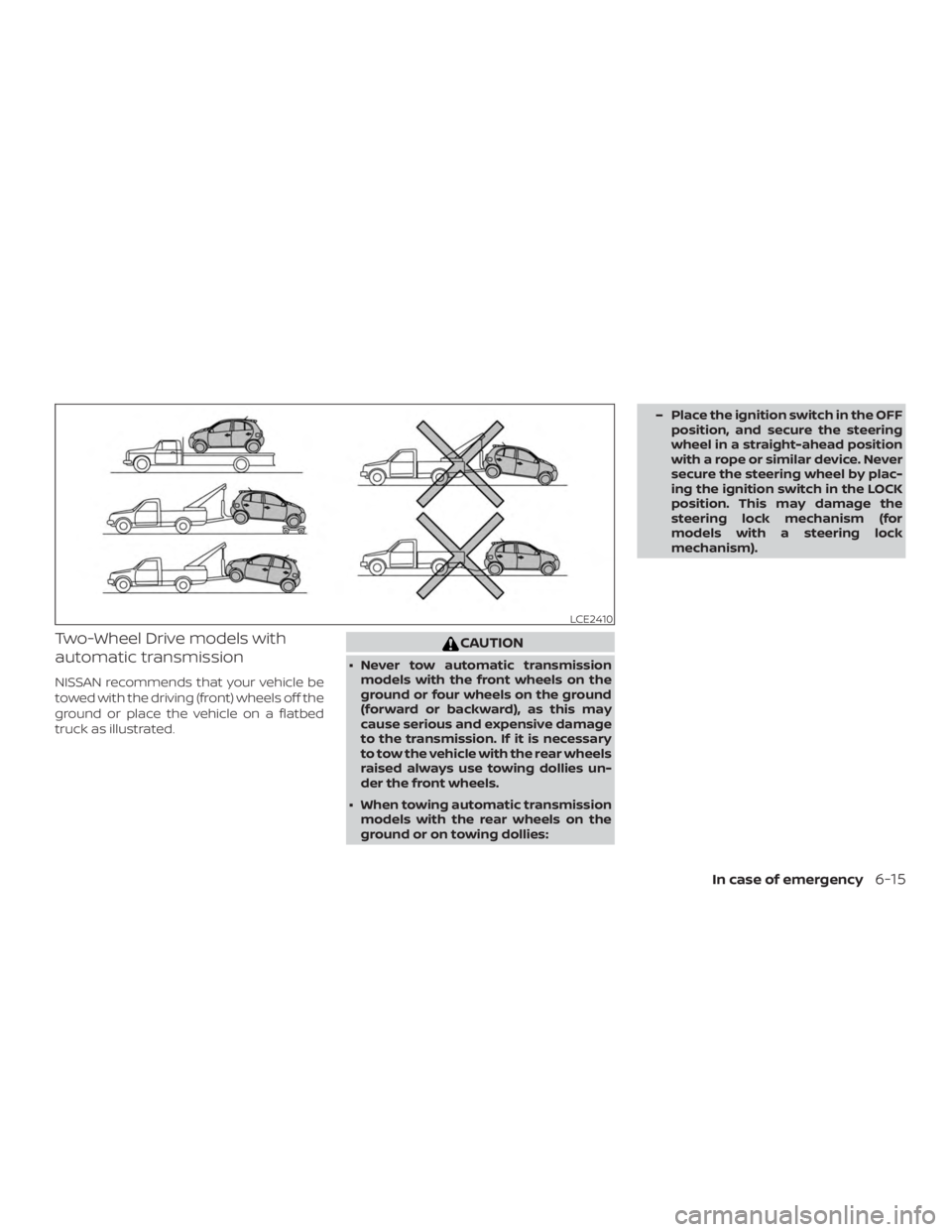
Two-Wheel Drive models with
automatic transmission
NISSAN recommends that your vehicle be
towed with the driving (front) wheels off the
ground or place the vehicle on a flatbed
truck as illustrated.
Page 245 of 346
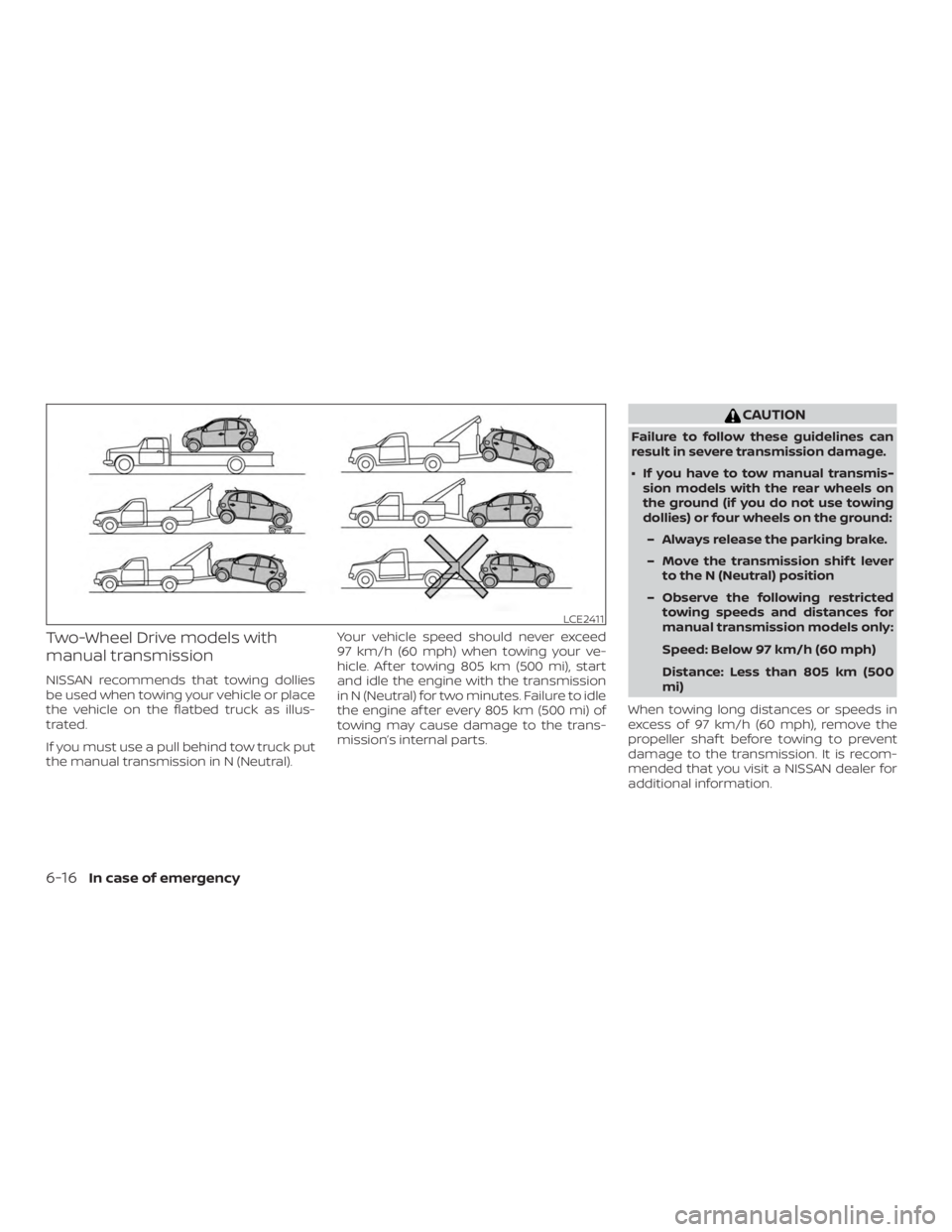
Two-Wheel Drive models with
manual transmission
NISSAN recommends that towing dollies
be used when towing your vehicle or place
the vehicle on the flatbed truck as illus-
trated.
If you must use a pull behind tow truck put
the manual transmission in N (Neutral).Your vehicle speed should never exceed
97 km/h (60 mph) when towing your ve-
hicle. Af ter towing 805 km (500 mi), start
and idle the engine with the transmission
in N (Neutral) for two minutes. Failure to idle
the engine af ter every 805 km (500 mi) of
towing may cause damage to the trans-
mission’s internal parts.
Page 251 of 346
If you choose to use a tire dressing, take the
following precautions:∙ Use a water-based tire dressing. The coating on the tire dissolves more easily
than with an oil-based tire dressing.
∙ Apply a light coat of tire dressing to help prevent it from entering the tire
tread/grooves (where it would be diffi-
cult to remove).
∙ Wipe off excess tire dressing using a dry towel. Make sure the tire dressing is
completely removed from the tire
tread/grooves.
∙ Allow the tire dressing to dry as recom- mended by the tire dressing manufac-
turer. Occasionally remove loose dust from the
interior trim, plastic parts and seats using a
vacuum cleaner or sof t bristled brush. Wipe
the vinyl and leather (if so equipped) sur-
faces with a clean, sof t cloth dampened in
mild soap solution, then wipe clean with a
dry, sof t cloth.
Regular care and cleaning is required in
order to maintain the appearance of the
leather (if so equipped).
Before using any fabric protector, read the
manufacturer’s recommendations. Some
fabric protectors contain chemicals that
may stain or bleach the seat material.
Use a cloth dampened only with water to
clean the meter and gauge lens.
Page 327 of 346
WARNING
∙ It is extremely dangerous to ride in a cargo area inside a ve-
hicle. In a collision, people riding
in these areas are more likely to
be seriously injured or killed.
∙ Do not allow people to ride in any area of your vehicle that is
not equipped with seats and
seat belts.
∙ Be sure everyone in your vehicle is in a seat and using a seat belt
properly.
TERMS
It is important to familiarize yourself
with the following terms before
loading your vehicle:
∙ Curb Weight (actual weight of your vehicle) - vehicle weight in-
cluding: standard parts, fluids,
emergency tools, and spare tire
assembly. This weight does not
include passengers and cargo. ∙ GVW (Gross Vehicle Weight) - curb
weight plus the combined weight
of passengers and cargo.
∙ GVWR (Gross Vehicle Weight Rat- ing) - maximum total combined
weight of the unloaded vehicle,
passengers, luggage, hitch, trailer
tongue load and any other op-
tional equipment. This informa-
tion is located on the C.M.V.S.S.
certification label.
∙ GAWR (Gross Axle Weight Rating) - maximum weight (load) limit
specified for the front or rear axle.
This information is located on the
C.M.V.S.S. certification label.
∙ GCWR (Gross Combined Weight rating) - The maximum total
weight rating of the vehicle, pas-
sengers, cargo, and trailer. ∙ Vehicle Capacity Weight, Load
limit, Total load capacity - maxi-
mum total weight limit specified
of the load (passengers and
cargo) for the vehicle. This is the
maximum combined weight of
occupants and cargo that can be
loaded into the vehicle. If the ve-
hicle is used to tow a trailer, the
trailer tongue weight must be in-
cluded as part of the cargo load.
This information is located on the
Tire and Loading Information la-
bel.
∙ Cargo capacity - permissible weight of cargo, the subtracted
weight of occupants from the
load limit.
VEHICLE LOADING INFORMATION
10-14Technical and consumer information
Page 331 of 346
Do not tow a trailer with your vehicle.
FLAT TOWING
Towing your vehicle with all four wheels on
the ground is sometimes called flat towing.
This method is sometimes used when
towing a vehicle behind a recreational ve-
hicle, such as a motor home.