&
W
W ARNI NG
ARNI NGRisk of accident when using
tyre sealant
The tyre sealant may be unable toseal the
tyre proper ly, especially in thefo llowing cases:
R there are lar gecuts or punctures in the
tyre (la rger than damage pr eviously men-
tioned)
R the wheel rims ha vebeen damaged
R a�Ter journe yswith very low tyre pressure
or with �0at tyres #
Do not continue driving. #
Consult a quali�/ed specialist workshop. &
W
W ARNING
ARNING Risk of injury and poisoning
from tyre sealant
Ty re sealant is hazardous tohealth and causes
ir rita tion. Do not allow it tocome into contact
with your skin, eyes or clo thing, and do not
swallow it. Do not inhale any vapours. Keep
th e tyre sealant away from children. Obser
vethefo llowing if you come into contact
with the tyre sealant: #
Rinse o�. the tyre sealant from your skin
using water immediatel y. #
If tyre sealant gets into your eyes, thor-
oughly rinse them using clean water
immediatel y. #
If tyre sealant has been swallo wed,thor-
oughly rinse out your mouth immediately
and drink plenty of water. Do not induce
vo miting and seek medical attention
immediatel y. #
Change out of clo thing which has come
into contact with tyre sealant immedi-
atel y. #
If an alle rgic reaction occurs, seek medi-
cal attention immediatel y. *
N NO
OTE
TE Overheating due tothe tyre in�0ation
compressor running too long #
Do not runth e tyre in�0ation compressor
fo r longer than ten minutes without inter-
ru ption. Comply with
the manufacturer's saf ety no tes on
th e stic ker on the tyre in�0ation compressor.
Ha ve the tyre sealant bottle replaced in a quali�/ed
specialist workshop every �/ve years. #
Do not remo veany fore ign objects which ha ve
entered the tyre. #
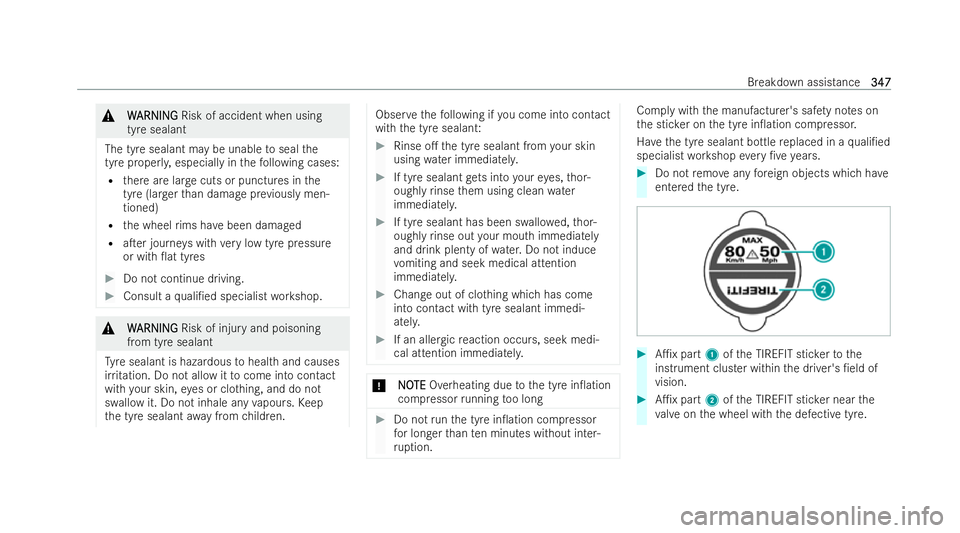
A�1x part 1ofthe TIREFIT stic kerto the
inst rument cluster within the driver's �/eld of
vision. #
A�1x part 2ofthe TIREFIT stic ker near the
va lve on the wheel with the defective tyre. Breakdown assistance
347 347
&
W
WARNI NG
ARNI NGRisk of accident due torepea-
te d pressure drop in the tyres
The wheels, valves or tyres could be damaged.
To o low a tyre pressure can lead tothe tyres
bursting. #
Examine the tyres forfo re ign objects. #
Check whe ther the tyre has a puncture
or theva lve has a leak. #
Ifyo u are unable torectify the damage,
contact a quali�/ed specialist workshop. Information on
there commended tyre pressure
fo rth eve hicle's factor y-�/tted tyres can be found
on the tyre pressure table on the inside of the fuel
�/ller �0ap (/ page 366).
Use a suitable pressure gauge tocheck the tyre
pressure. The outer appearance of a tyre does not
permit any reliable conclusion about the tyre pres-
sure.
Only cor rect tyre pressures when the tyres are
cold. Conditions for cold tyres:
R The vehicle has been par ked with the tyres out
of direct sunlight for at least thre e hours. R
The vehicle has tr avelled less than 1.6 km.
The vehicle's tyres heat up when driving. As the
te mp erature of the tyres increases, so too does
th e tyre pressure.
V
V ehicles wit ehicles wit h a tyr
h a tyre pr
e pressur
essur e monit
e monit or
oring syst
ing syst em:
em:
yo u can also check the tyre pressure using the
on-board computer (/ page 367).
Not
Not es on tr
es on tr ailer oper
ailer oper ation
ation
Alw ays in�0ate there ar axle tyres tothere com-
mended tyre pressures on the tyre pressure table
fo r increased load. T
T
yr
yr e pr
e pr essur
essur e t
e table
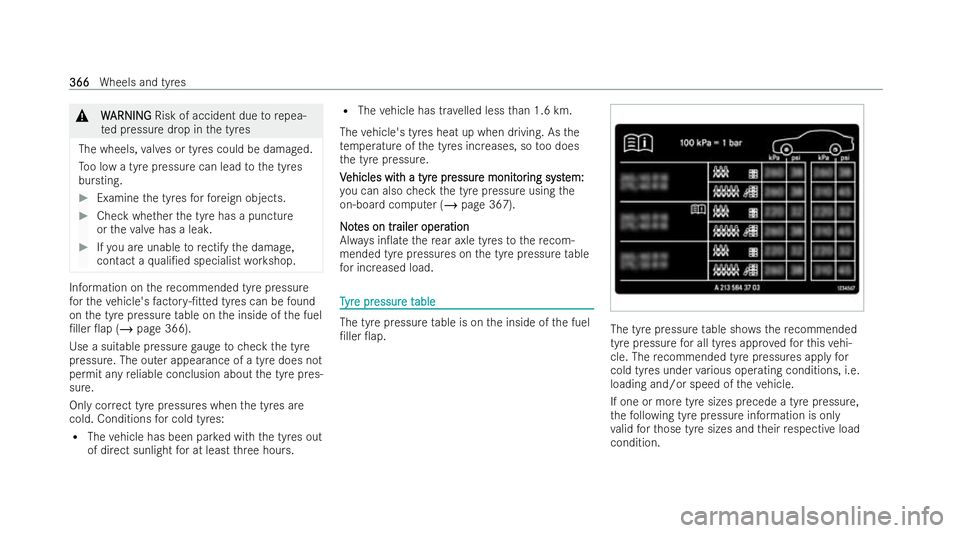
able The tyre pressure
table is on the inside of the fuel
�/ller �0ap. The tyre pressure
table sho ws there commended
tyre pressure for all tyres appr ovedfo rth is vehi-
cle. The recommended tyre pressures apply for
cold tyres under various operating conditions, i.e.
loading and/or speed of theve hicle.
If one or more tyre sizes precede a tyre pressure,
th efo llowing tyre pressure information is only
va lid forth ose tyre sizes and their respecti veload
condition. 366
366
Wheels and tyres