Page 190 of 557
*
N
N O
OTE
TE Reduced battery life due tofrequent
short-distance trips The 12 V battery may not be su�1cien
tly
ch arge d when theve hicle is used only for
short-dis tance trips. This reduces the life of
th e batter y. #
Drive longer distances regula rly to
ch arge the batter y. *
N
N O
OTE
TE Damage totheve hicle due tonot
observing the maximum permitted head-
ro om clearance If
th eve hicle height is greater than the maxi-
mum permitted headroom clearance, thero of
and other parts of theve hicle may be dam-
aged. #
Obser vethe signposted headroom clear-
ance. #
Ifth eve hicle height is greater than the
permitted headroom clearance, do not
enter. #
Obser vethech anged vehicle height with
add-on roof equipment. N No
ot
tes on dr
es on dr iving wit
iving with a r
h a roof load, tr
oof load, tr ailer or fully
ailer or fully
laden v
laden v ehicle
ehicle
When driving with a loaded roof luggage rack or
trailer as well as with a fully laden or fully occu-
pied vehicle, theve hicle's driving and steering
ch aracteristics change.
Yo u should bear thefo llowing in mind:
R Do not exceed the permissible roof load and
to wing capacity. Also obser vethete ch nical
data in the printed Owner's Manual.
R Evenly distribute thero of load, and place
heavy objects at the bottom. Also comply with
th e no tes on loading theve hicle
(/ page 126).
R Drive attentivel y,and avoid suddenly pulling
awa y,braking and steering as well as rapid
cornering.
Not
Not es on dr
es on dr iving on salt-tr
iving on salt-tr eat
eated r
ed r oads
oads
The braking e�.ect is limited on salt-treated roads. Therefore, obser
vethefo llowing no tes:
R due tosalt build-up on the brake disks and
brakepads, the braking distance can increase
considerably or result in braking only on one
side
R maintain a much greater safe distance tothe
ve hicle in front
To remo vesalt build-up:
R brake occasionally while paying attention to
th e tra�1c conditions
R carefully depress the brake pedal at the end of
th e journey and when starting the next jour-
ney
N
No ot
tes on aq
es on aq uaplaning
uaplaning
Aq uaplaning can take place once a cer tain
amount of water has accumulate d onthero ad
sur face.
Obser vethefo llowing no tes during heavy precipi-
ta tion or in conditions in whi chaquaplaning may
occur:
R reduce speed
R avoid tyre ruts Driving and parking
187
187
Page 216 of 557
av
ailable, you can also top up AdBlue ®
using a
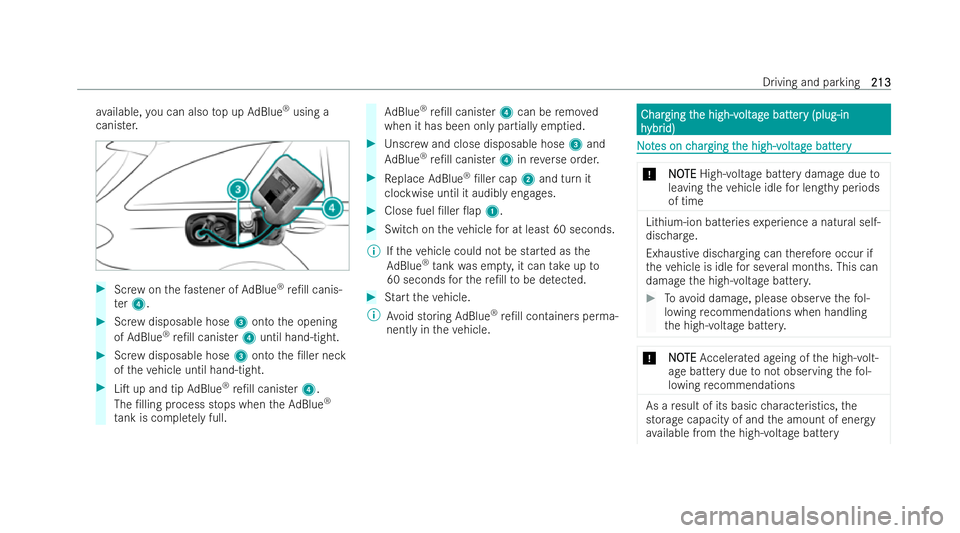
canister. #
Screw onthefa stener of AdBlue ®
re�/ll canis-
te r4. #
Screw disposable hose 3onto the opening
of Ad Blue ®
re�/ll canis ter4 until hand-tight. #
Screw disposable hose 3onto the �/ller neck
of theve hicle until hand-tight. #
Li�T up and tip AdBlue ®
re�/ll canis ter4.
The �/lling process stops when theAd Blue ®
ta nk is comple tely full. Ad
Blue ®
re�/ll canis ter4 can be remo ved
when it has been only partial lyem ptied. #
Unscr ewand close disposable hose 3and
Ad Blue ®
re�/ll canis ter4 inreve rse order. #
Replace AdBlue ®
�/ller cap 2and turn it
clo ckwise until it audibly engages. #
Close fuel �/ller �0ap 1. #
Switch on theve hicle for at least 60 seconds.
% Ifth eve hicle could not be star ted as the
Ad Blue ®
tank was em pty, it can take up to
60 seconds forth ere �/ll tobe de tected. #
Start theve hicle.
% Avoid storing AdBlue ®
re�/ll con tainers perma-
nently in theve hicle. Char
Char
ging t
ging t he high-v
he high-v olt
oltag
age batt
e batt er
ery (plug-in
y (plug-in
h
h ybr
ybr id)
id) N
No
ot
tes on c
es on c har
harging t
ging t he high-v
he high-v olt
oltag
age batt
e batt ery
ery *
N
NOOTE
TE High-voltage battery damage due to
leaving theve hicle idle for lengt hyperiods
of time Lithium-ion batteries
experience a natural self-
dischar ge.
Exhausti vedischarging can therefore occur if
th eve hicle is idle for se veral months. This can
damage the high-voltage batter y. #
Toavo id damage, please obser vethefo l-
lowing recommendations when handling
th e high-voltage batter y. *
N
NO
OTE
TE Accelerated ageing of the high-volt-
age battery due tonot observing thefo l-
lowing recommendations As a
result of its basic characteristics, the
storage capacity of and the amount of energy
av ailable from the high-voltage battery Driving and parking
213
213
Page 430 of 557
R
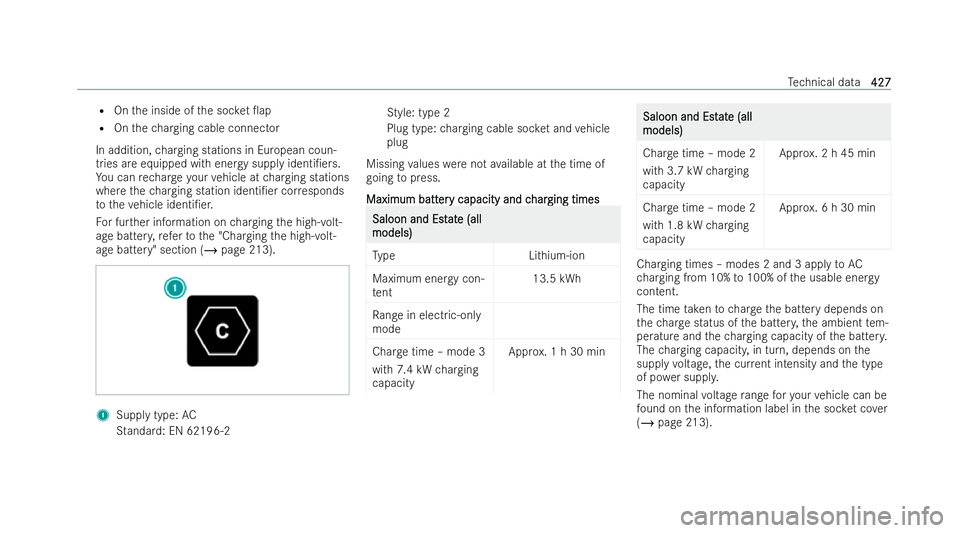
Onthe inside of the soc ket �0ap
R Onthech arging cable connector
In addition, charging stations in European coun-
tries are equipped with ene rgy supp lyidenti�/ers.
Yo u can rech arge your vehicle at charging stations
where thech arging station identi�/er cor responds
to theve hicle identi�/er.
Fo r fur ther information on charging the high-volt-
age batter y,referto the "Charging the high-volt-
age battery" section (/ page 213).1
Supply type: AC
St andard: EN 62196-2 St
yle: type 2
Plug type: charging cable soc ket and vehicle
plug
Missing values werenot available at the time of
going topress.
Maximum batt
Maximum batt er
ery capacity and c
y capacity and c har
harging times
ging times Saloon and Est
Saloon and Est
at
ate (all
e (all
models)
models)
Ty pe Lithium-ion
Maximum energy con-
te nt 13.5 kWh
Ra nge in electric-only
mode
Cha rge time – mode 3
with 7.4 kW charging
capacity App
rox. 1 h 30 min Saloon and Est Saloon and Est
at
ate (all
e (all
models)
models)
Char getime – mode 2
with 3.7 kW charging
capacity App
rox. 2 h 45 min
Char getime – mode 2
with 1.8 kW charging
capacity App
rox. 6 h 30 min Charging times – modes 2 and 3 apply
toAC
ch arging from 10% to100% of the usable energy
content.
The time take nto charge the battery depends on
th ech arge status of the batter y,the ambient tem-
perature and thech arging capacity of the batter y.
The charging capacit y,in turn, depends on the
supply voltage, the cur rent intensity and the type
of po wer suppl y.
The nominal voltage range foryo ur vehicle can be
fo und on the information label in the soc ket co ver
( / page 213). Te
ch nical data
427 427