2022 LEXUS RX350 brake
[x] Cancel search: brakePage 418 of 508

4167-2. Steps to take in an emergency
■The compact spare tire
●The compact spare tire is identified by the
label “TEMPORARY USE ONLY” on
the tire sidewall. Use the compact spare
tire temporarily, and only in an emer-
gency.
●Make sure to check the tire inflation pres-
sure of the compact spare tire. (P.436)
■When using the compact spare tire
As the compact spare tire is not equipped
with a tire pressure warning valve and trans-
mitter, low inflation pressure of the spare
tire will not be indicated by the tire pressure
warning system. Also, if you replace the
compact spare tire after the tire pressure
warning light comes on, the light remains
on.
■When the compact spare tire is
equipped
When driving with the compact spare tire
installed, the vehicle he ight will be different
than when driving with standard tires.
■If you have a flat fron t tire on a road cov-
ered with snow or ice
Install the compact spar e tire on one of the
rear wheels of the vehicle. Perform the fol-
lowing steps and fit tire chains to the front
tires:
1 Replace a rear tire with the compact
spare tire.
2 Replace the flat front tire with the tire
removed from the rear of the vehicle.
3 Fit tire chains to the front tires.
WARNING
■When using the compact spare tire
●Remember that the compact spare tire
provided is specifically designed for
use with your vehicle. Do not use your
compact spare tire on another vehicle.
●Do not use more than one compact
spare tire simultaneously.
●Replace the compact spare tire with a
standard tire as soon as possible.
●Avoid sudden acceleration, abrupt
steering, sudden braking and shifting
operations that cause sudden engine
braking.
■When the compact spare tire is
attached
The vehicle speed may not be correctly
detected, and the following systems may
not operate correctly:
• ABS & Brake assist
•VSC
•TRAC
• Trailer Sway Control
•EPS
•VDIM (if equipped)
• Adaptive Variable Suspension System (if equipped)
• Dynamic radar cruise control with full-speed range
• PCS (Pre-Collision System)
• LTA (Lane Tracing Assist)
• RSA (Road Sign Assist) (if equipped)
• Automatic High Beam
• AFS (Adaptive Fron t-lighting System)
(if equipped)
• Tire pressure warning system
• Intuitive parking assist (if equipped)
• PKSB (Parking Support Brake) (if equipped)
• Lexus parking assist monitor (if equipped)
• Panoramic view monitor (if equipped)
• BSM (Blind Spot Monitor) (if equipped)
• Navigation system (if equipped)
Page 421 of 508

4197-2. Steps to take in an emergency
7
When trouble arises
the parking brake is set. (P.173,
179)
2 Shift the shift lever to P.
3 Turn the engine switch to ACCES-
SORY mode.
4 Press and hold the engine switch
for about 15 seconds while
depressing the brake pedal firmly.
Even if the engine can be started using
the above steps, the system may be
malfunctioning. Have the vehicle
inspected by your Lexus dealer.If you lose your keys
New genuine mechanical keys can
be made by your Lexus dealer using
another mechanical key and the
key number stamped on your key
number plate.
Keep the plate in a safe place such
as your wallet, not in the vehicle.
NOTICE
■When an electronic key is lost
If the electronic key remains lost, the risk
of vehicle theft increases significantly.
Visit your Lexus deal er immediately with
all remaining electron ic keys that were
provided with your vehicle.
Page 424 of 508

4227-2. Steps to take in an emergency
■Key linked functions
1 Closes the windows and the moon
roof
* or panoramic moon roof* (turn
and hold)
2 Opens the windows and the moon
roof
* or panoramic moon roof* (turn
and hold)
These settings must be customized at your
Lexus dealer.
*:If equipped
1 Ensure that the shift lever is in P and
depress the brake pedal.
2 Touch the Lexus emblem side of the
electronic key to the engine switch.
When the electronic key is detected, a
buzzer sounds and the engine switch will
turn to IGNITION ON mode. When the smart access system with
push-button start is deactivated in
customization setting,
the engine switch
will turn to ACCESSORY mode.
3 Firmly depress the brake pedal and
check that is shown on the
multi-information display.
4 Press the engine switch shortly and
firmly.
In the event that the engine still cannot
be started, contact your Lexus dealer.
■Stopping the engine
Shift the shift lever to P, set the parking
brake, and press the engine switch as you
normally do when st opping the engine.
■Replacing the key battery
As the above procedure is a temporary
measure, it is recommended that the elec-
tronic key battery be replaced immediately
when the battery is depleted. ( P.369)
■Alarm (For Canada)
Using the mechanical key to lock the doors
will not set the alarm system.
If a door is unlocked using the mechanical
key when the alarm system is set, the alarm
may be triggered. ( P.67)
■Changing engine switch modes
Release the brake pe dal and press the
engine switch in step 3 above. The engine
does not start and modes will be changed
each time the switch is pressed. ( P.173)
WARNING
■When using the mechanical key and
operating the power windows or the
moon roof or panoramic moon roof
Operate the power window or the moon
roof or panoramic moon roof after
checking to make sure that there is no
possibility of any passe nger having any of
their body parts caught in the window or
the moon roof or panoramic moon roof.
Also, do not allow ch ildren to operate the
mechanical key. It is possible for children
and other passengers to get caught in
the power window or the moon roof or
panoramic moon roof.
Starting the engine
Page 430 of 508

4287-2. Steps to take in an emergency
1Stop the engine. Shift the shift lever
to P and set the parking brake.
2 Remove the mud, snow or sand
from around the front wheels.
3 Place wood, stones or some other
material under the front wheels to
help provide traction.
4 Restart the engine.
5 AWD models: Activate all-wheel
drive lock mode. ( P.264)
6 Shift the shift lever to D or R and
release the parking brake. Then,
while exercising caution, depress
the accelerator pedal.
■When it is difficult to free the vehicle
Press to turn off TRAC.
If the vehicle becomes stuck
Carry out the following proce-
dures if the tires spin or the vehicle
becomes stuck in mud, dirt or snow:
Recovering procedure
WARNING
■When attempting to free a stuck vehi-
cle
If you choose to push the vehicle back
and forth to free it, make sure the sur-
rounding area is clear to avoid striking
other vehicles, obje cts or people. The
vehicle may also lunge forward or lunge
back suddenly as it becomes free. Use
extreme caution.
■When shifting the shift lever
Be careful not to shift the shift lever with
the accelerator pedal depressed.
This may lead to un expected rapid accel-
eration of the vehicle that may cause an
accident resulting in death or serious
injury.
NOTICE
■To avoid damage to the transmission
and other components
●Avoid spinning the front wheels and
depressing the accelerator pedal
more than necessary.
●If the vehicle remains stuck even after
these procedures are performed, the
vehicle may require towing to be freed.
Page 438 of 508
4368-1. Specifications
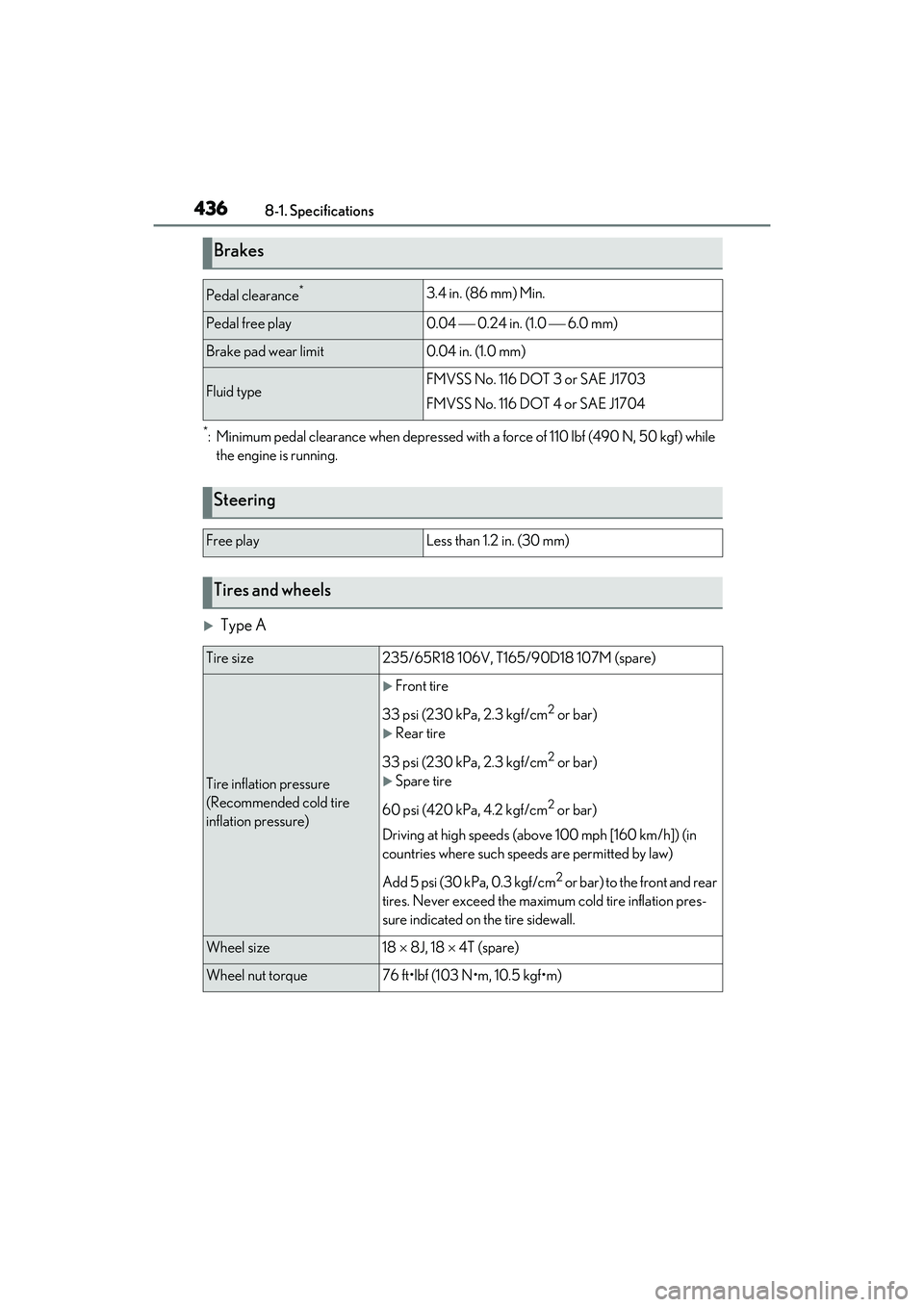
*: Minimum pedal clearance when depressed with a force of 110 lbf (490 N, 50 kgf) while
the engine is running.
Type A
Brakes
Pedal clearance*3.4 in. (86 mm) Min.
Pedal free play0.04 0.24 in. (1.0 6.0 mm)
Brake pad wear limit0.04 in. (1.0 mm)
Fluid typeFMVSS No. 116 DOT 3 or SAE J1703
FMVSS No. 116 DOT 4 or SAE J1704
Steering
Free playLess than 1.2 in. (30 mm)
Tires and wheels
Tire size235/65R18 106V, T165/9 0D18 107M (spare)
Tire inflation pressure
(Recommended cold tire
inflation pressure)
Front tire
33 psi (230 kPa, 2.3 kgf/cm
2 or bar)
Rear tire
33 psi (230 kPa, 2.3 kgf/cm
2 or bar)
Spare tire
60 psi (420 kPa, 4.2 kgf/cm
2 or bar)
Driving at high speeds (above 100 mph [160 km/h]) (in
countries where such speeds are permitted by law)
Add 5 psi (30 kPa, 0.3 kgf/cm
2 or bar) to the front and rear
tires. Never exceed the maximum cold tire inflation pres-
sure indicated on the tire sidewall.
Wheel size18 8J, 18 4T (spare)
Wheel nut torque76 ft•lbf (103 N•m, 10.5 kgf•m)
Page 446 of 508

4448-1. Specifications
Glossary of tire terminology
Tire related termMeaning
Cold tire inflation pressure
Tire pressure when the vehicle has been parked for
three hours or more, or has not been driven more
than 1 mile or 1.5 km under that condition
Maximum inflation pressureThe maximum cold inflated pressure to which a tire
may be inflated, shown on the sidewall of the tire
Recommended inflation pressureCold tire inflation pressure recommended by a
manufacturer
Accessory weight
The combined weight (in excess of those standard
items which may be replaced) of automatic trans-
mission, power steering, power brakes, power win-
dows, power seats, radio and heater, to the extent
that these items are available as factory-installed
equipment (whether installed or not)
Curb weight
The weight of a motor vehicle with standard equip-
ment, including the maximum capacity of fuel, oil
and coolant, and if so equipped, air conditioning
and additional weight optional engine
Maximum loaded vehicle weight
The sum of:
(a) Curb weight
(b) Accessory weight
(c) Vehicle capacity weight
(d) Production options weight
Normal occupant weight
150 lb. (68 kg) times the number of occupants
specified in the second column of Table 1
* that fol-
lows
Occupant distributionDistribution of occupants in a vehicle as specified in
the third column of Table 1
* below
Production options weight
The combined weight of installed regular produc-
tion options weighing over 5 lb. (2.3 kg) in excess of
the standard items which they replace, not previ-
ously considered in curb weight or accessory
weight, including heavy duty brakes, ride levelers,
roof rack, heavy duty battery, and special trim
Page 461 of 508

4598-2. Customization
8
Vehicle specifications
■PKSB (Parking Support Brake)* ( P.251)
*:If equipped
■Driving mode select switch ( P.262)
*:If equipped
■Front automatic air conditioning system ( P.284)
*:If equipped
■Seat heaters*/seat ventilators* ( P.297)
*:If equipped
FunctionDefault settingCustomized setting
PKSB (Parking Support Brake)
functionOnOff—O—
FunctionDefault settingCustomized setting
Powertrain control in custom-
ized mode
*NormalPowerO——Eco
Chassis control in customized
mode
*NormalSportO——
Air conditioning operation in
customized mode
*NormalEcoO——
FunctionDefault settingCustomized setting
A/C auto switch operationOnOffO—O
Exhaust gas sensor sensitivity*Standard-3 to 3O—O
FunctionDefault settingCustomized setting
Driver’s seat temperature pref-
erence in automatic modeStandard-2 (cooler) to 2
(warmer)O—O
Front passenger’s seat tem-
perature preference in auto-
matic mode
Standard-2 (cooler) to 2 (warmer)O—O
ABC
ABC
ABC
ABC
Page 464 of 508
4628-3. Initialization
8-3.Initialization
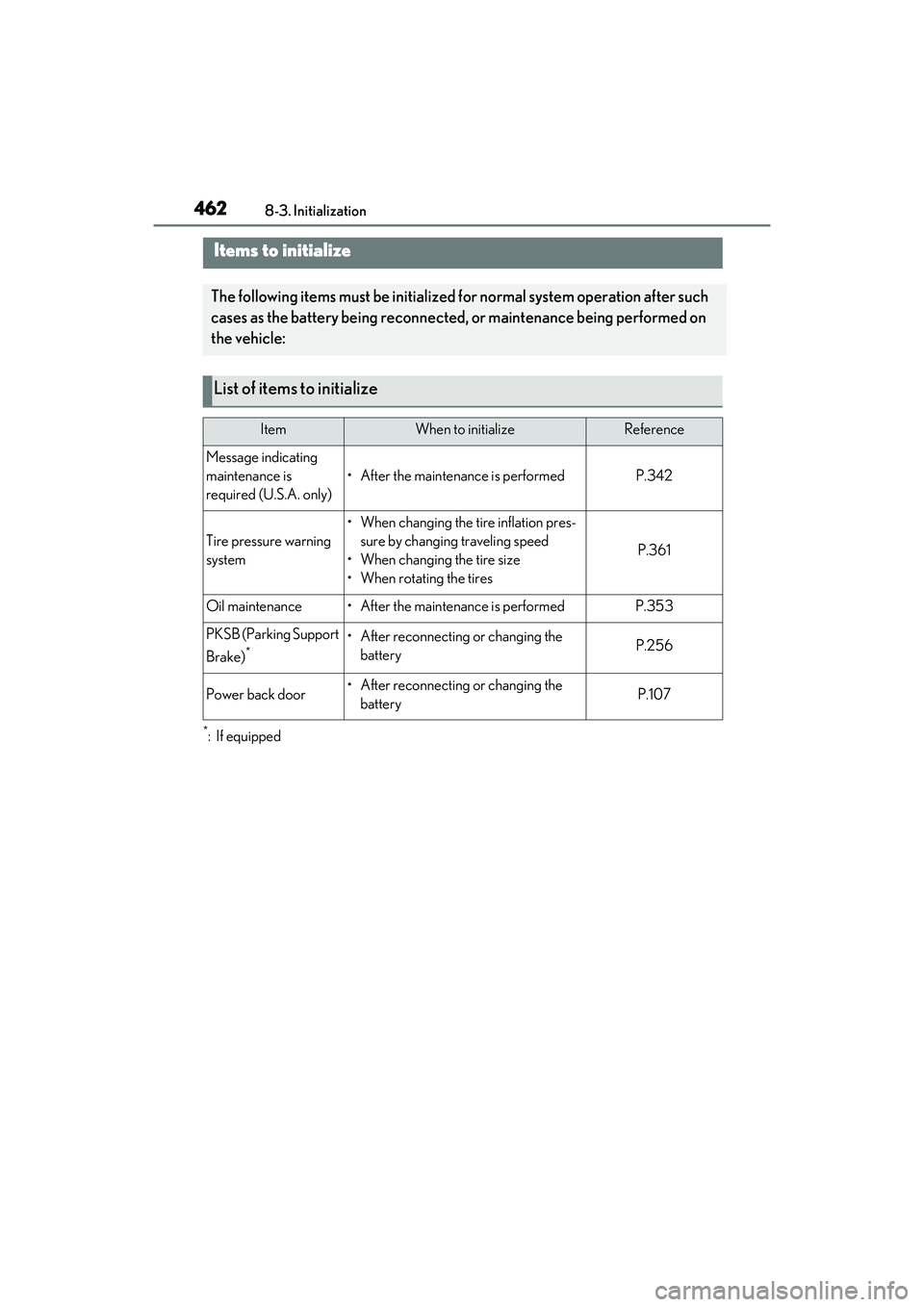
*:If equipped
Items to initialize
The following items must be initialized for normal system operation after such
cases as the battery being reconnecte d, or maintenance being performed on
the vehicle:
List of items to initialize
ItemWhen to initializeReference
Message indicating
maintenance is
required (U.S.A. only)
• After the maintenance is performedP.342
Tire pressure warning
system
• When changing the tire inflation pres- sure by changing traveling speed
• When changing the tire size
• When rotating the tires
P.361
Oil maintenance• After the maintenance is performedP.353
PKSB (Parking Support
Brake)
*• After reconnecting or changing the
batteryP.256
Power back door• After reconnecting or changing the
batteryP.107