2022 LEXUS IS350 pre collision
[x] Cancel search: pre collisionPage 233 of 440

2314-5. Using the driving support systems
4
Driving
■Automatic system cancelation of
hill-start assist control
The hill-start assist control will turn off in any
of the following situations:
●The shift lever is shifted to P or N
●The accelerator pedal is depressed
●The parking brake is engaged
●2 seconds at maximum elapsed after the
brake pedal is released
●Engine switch is turned to ACCESSORY
mode or turned off
■Sounds and vibrations caused by the
ABS, brake assist, VSC, TRAC and
hill-start assist control systems
●A sound may be heard from the engine
compartment when the brake pedal is
depressed repeatedly, when the engine is
started or just after the vehicle begins to
move. This sound does not indicate that a
malfunction has occurred in any of these
systems.
●Any of the following conditions may
occur when the above systems are oper-
ating. None of these indicates that a mal-
function has occurred.
• Vibrations may be felt through the vehicle
body and steering.
• A motor sound may be heard also after the vehicle comes to a stop.
• The brake pedal may pulsate slightly after the ABS is activated.
• The brake pedal may move down slightly
after the ABS is activated.
■Active Cornering Assist operation
sounds and vibrations
When the Active Cornering Assist is oper-
ated, operation sounds and vibrations may
be generated from the brake system, but
this is not a malfunction.
■Automatic reactivation of TRAC and
VSC systems
After turning the TRAC and VSC systems
off, the systems w ill be automatically
re-enabled in the following situations:
●When the engine switch is turned off
●If only the TRAC system is turned off, the
TRAC will turn on when vehicle speed
increases If both the TRAC and VSC systems are
turned off, automatic re-enabling will not
occur when vehicle speed increases.
■EPS operation sound
When the steering wheel is operated, a
motor sound (whirring sound) may be
heard. This does not indicate a malfunction.
■Reduced effectiveness of the EPS sys-
tem
The effectiveness of the EPS system is
reduced to prevent the system from over-
heating when there is frequent steering
input over an extended period of time. The
steering wheel may feel heavy as a result.
Should this occur, re frain from excessive
steering input or stop the vehicle and turn
the engine off. The EPS system should
return to normal within 10 minutes.
■Operating conditions of Active Corner-
ing Assist
The system operates when the following
occurs.
●TRAC/VSC can operate
●The driver is attempting to accelerate
while turning
●The system detects th at the vehicle is
drifting to the outer side
●The brake pedal is released
■Secondary Collision Brake operating
conditions
The system operates when the SRS airbag
sensor detects a collision while the vehicle
is in motion.
However, the system does not operate in
any of the following situations.
●The vehicle speed is below 6 mph (10
km/h)
●Components are damaged
■Secondary Collision Brake automatic
cancellation
The system is automatically canceled in any
of the following situations.
●The vehicle speed drops below approxi-
mately 6 mph (10 km/h)
●A certain amount of time elapses during
operation
Page 256 of 440

2545-3. Using the interior lights
Turns the door position on/off
On
Off
■Rear interior light
The rear interior light turns on/off
together with the front interior light.
■Front personal lights
Turns the lights on/off (touch the light)
■Rear personal lights
Turns the light on/off
■Illuminated entry system
The lights automatically turn on/off accord-
ing to engine switch mode, the presence of
the electronic key, whether the doors are
locked/unlocked, and whether the doors
are opened/closed.
■To prevent the battery from being dis-
charged
If the interior lights remain on when the
engine switch is turned off, the lights will go
off automatically after 20 minutes.
■When front interior light or front per-
sonal lights do not respond as normal
In the following cases, the interior lights and
front personal lights may not respond as
normal.
●When water, dirt, etc., have adhered to
the lens surface
●When operated with a wet hand
●When wearing gloves, etc.
■The interior lights may turn on automati-
cally when
If any of the SRS airbag s deploy (inflate) or
in the event of a strong rear impact, the inte-
rior lights will turn on automatically.
The interior lights will turn off automatically
after approximately 20 minutes.
The interior lights can be turned off manu-
ally. However, in order to help prevent fur-
ther collisions, it is recommended that they
be left on until sa fety can be ensured.
(The interior lights may not turn on auto-
matically depending on the force of the
impact and conditions of the collision.)
Operating the personal lights
A
B
Page 336 of 440
3347-2. Steps to take in an emergency
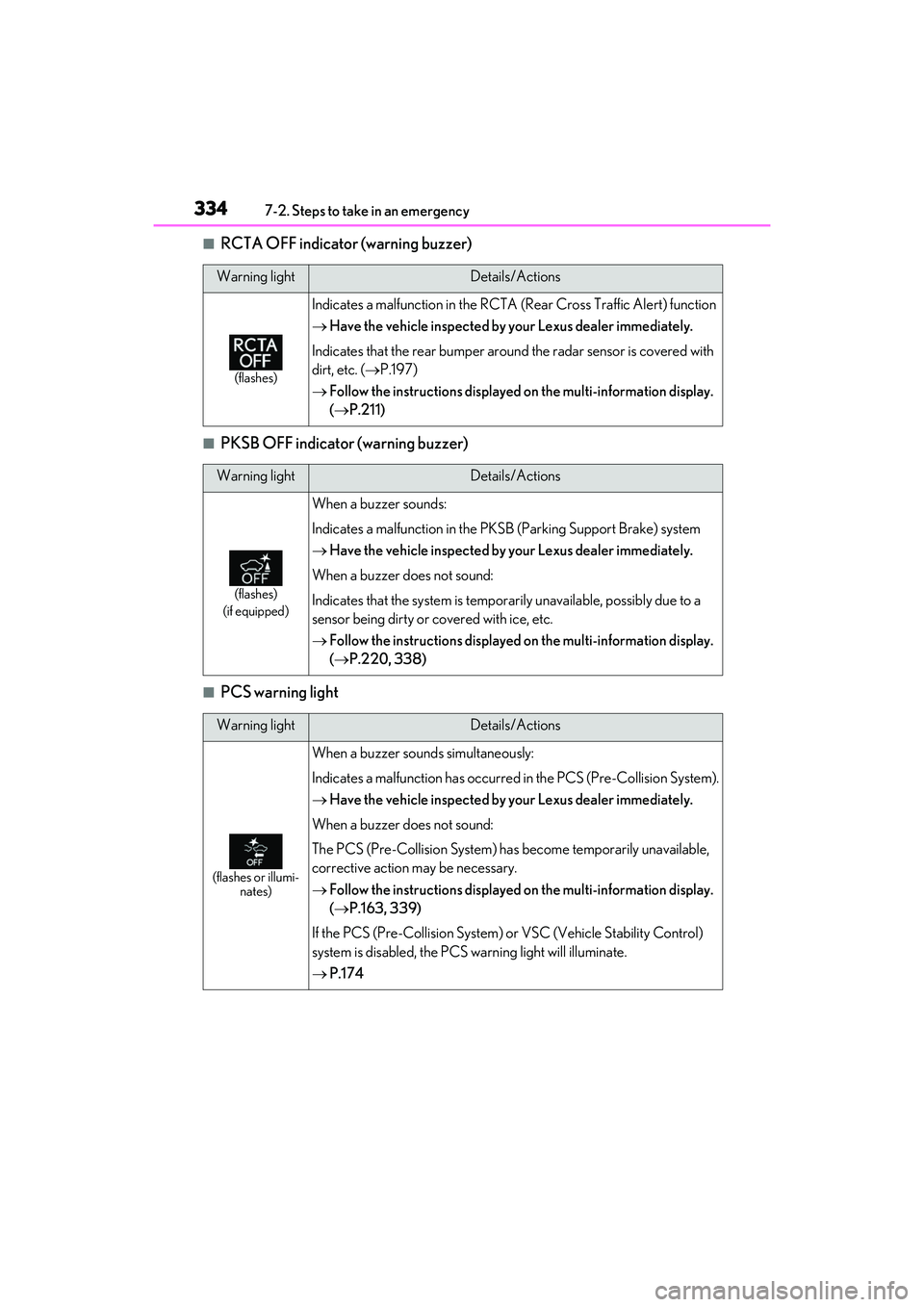
■RCTA OFF indicator (warning buzzer)
■PKSB OFF indicator (warning buzzer)
■PCS warning light
Warning lightDetails/Actions
(flashes)
Indicates a malfunction in the RCTA (Rear Cross Traffic Alert) function
Have the vehicle inspected by your Lexus dealer immediately.
Indicates that the rear bumper around the radar sensor is covered with
dirt, etc. ( P.197)
Follow the instructions displayed on the multi-information display.
( P.211)
Warning lightDetails/Actions
(flashes)
(if equipped)
When a buzzer sounds:
Indicates a malfunction in the PKSB (Parking Support Brake) system
Have the vehicle inspected by your Lexus dealer immediately.
When a buzzer does not sound:
Indicates that the system is temporarily unavailable, possibly due to a
sensor being dirty or covered with ice, etc.
Follow the instructions displayed on the multi-information display.
( P.220, 338)
Warning lightDetails/Actions
(flashes or illumi-
nates)
When a buzzer sounds simultaneously:
Indicates a malfunction has occurred in the PCS (Pre-Collision System).
Have the vehicle inspected by your Lexus dealer immediately.
When a buzzer does not sound:
The PCS (Pre-Collision System) has become temporarily unavailable,
corrective action may be necessary.
Follow the instructions displayed on the multi-information display.
( P.163, 339)
If the PCS (Pre-Collision System) or VSC (Vehicle Stability Control)
system is disabled, the PCS warning light will illuminate.
P.174
Page 341 of 440

3397-2. Steps to take in an emergency
7
When trouble arises
■If “Engine Stopped Steering Power
Low” is displayed
This message is displa yed if the engine is
stopped while driving.
When steering wheel operations are
heavier than usual, gr ip the steering wheel
firmly and operate it using more force than
usual.
■If “Auto Power Off to Conserve Battery”
is displayed
Power was turned off due to the automatic
power off function. Next time when starting
the engine, increase the engine speed
slightly and maintain that level for approxi-
mately 5 minutes to recharge the battery.
■If “Headlight System Malfunction Visit
Your Dealer” is displayed
The following systems may be malfunction-
ing. Have the vehicle inspected by your
Lexus dealer immediately.
●The LED headlight system
●The automatic headlig ht leveling system
(if equipped)
●Automatic High Beam
■If “Radar Cruise Control Unavailable
See Owner's Manual” is displayed
The dynamic radar cruise control with
full-speed range system is suspended tem-
porarily or until the problem shown in the
message is resolved. (causes and coping
methods: P.163)
■If “Radar Cruise Control Unavailable” is
displayed
The dynamic radar cruise control with
full-speed range system cannot be used
temporarily. Use the system when it
becomes available again.
■If a message that indicates the malfunc-
tion of front camera is displayed
The following systems may be suspended
until the problem shown in the message is
resolved. ( P.163, 329)
●PCS (Pre-Collision system)
●LTA (Lane Tracing Assist)
●Automatic High Beam
●RSA (Road Sign Assi st) (if equipped)
●Dynamic radar cruise control with
full-speed range
■If a message that indicates the malfunc-
tion of radar sensor is displayed
The following systems may be suspended
until the problem show n in the message is
resolved. ( P.163, 329)
●PCS (Pre-Collision system)
●LTA (Lane Tracing Assist)
●Dynamic radar cruise control with
full-speed range
■If “Maintenance Required Soon” is dis-
played
Indicates that all maintenance according to
the driven distance on the maintenance
schedule
* should be performed soon.
Comes on approximately 4500 miles
(7200 km) after the message has been
reset. If necessary, perform maintenance.
Please reset the message after the mainte-
nance is performed. (P.278)
*: Refer to the separate “Scheduled Main-
tenance” or “Owner’s Manual Supple-
ment” for the main tenance interval
applicable to your vehicle.
■If “Maintenance Required Visit Your
Dealer” is displayed
Indicates that all mainte nance is required to
correspond to the driven distance on the
maintenance schedule
*.
Comes on approximately 5000 miles
(8000 km) after the message has been
reset. (The indicator will not work properly
unless the message has been reset.) Per-
form the necessary maintenance. Please
reset the message after the maintenance is
performed. ( P.278)
*: Refer to the separate “Scheduled Main-
tenance” or “Owner’s Manual Supple-
ment” for the main tenance interval
applicable to your vehicle.
■If “Oil Maintenance Required Soon” is
displayed
Indicates that the engine oil should be
scheduled to be changed.
Page 350 of 440

3487-2. Steps to take in an emergency
WARNING
• Dynamic radar cruise control with full-speed range
•PCS
•EPS
• Tire pressure warning system
• Adaptive Variable Suspension System
(if equipped)
• LTA (Lane Tracing Assist)
• Lexus parking assist monitor (if equipped)
• Panoramic view monitor (if equipped)
• Intuitive parking assist (if equipped)
• PKSB (Parking Support Brake) (if equipped)
• BSM (Blind Spot Monitor)
• Navigation system (if equipped)
Also, not only can the following system
not be utilized fully, but it may even nega-
tively affect the drive-train components:
• AWD system
■Speed limit when using the compact
spare tire
Do not drive at speeds in excess of 50
mph (80 km/h) when a compact spare
tire is installed on the vehicle.
The compact spare tire is not designed
for driving at high speeds. Failure to
observe this precaution may lead to an
accident causing deat h or serious injury.
■After using the tools and jack
Before driving, make sure all the tools
and jack are securely in place in their
storage location to reduce the possibility
of personal injury during a collision or
sudden braking.
NOTICE
■Be careful when driving over bumps
with the compact spare tire installed
on the vehicle
When driving with the compact spare
tire installed, the vehicle height will be
different than when driving with standard
tires. Be careful when driving over
uneven road surfaces, etc.
■Driving with tire chains and the com-
pact spare tire
Do not fit tire chains to the compact
spare tire.
Tire chains may damage the vehicle body
and adversely affect driving perfor-
mance.
■When replacing the tires
When removing or fitting the wheels,
tires or the tire pr essure warning valve
and transmitter, contact your Lexus
dealer as the tire pressure warning valve
and transmitter may be damaged if not
handled correctly.
Page 396 of 440

3948-2. Customization
■Lights (P.145)
*: U.S.A. only
■PCS (Pre-Collision System) ( P.165)
*: The system is automatically enabled each time the engine switch is turned to IGNITION
ON mode.
■LTA (Lane Tracing Assist) ( P.175)
■RSA (Road Sign Assist)* ( P.184)
*:If equipped
FunctionDefault settingCustomized setting
Daytime running lights*OnOffO—O
FunctionCustomized setting
PCS (Pre-Collision System)*On, Off—O—
Adjust alert timingEarly, Middle, Late—O—
FunctionCustomized setting
Lane centering functionOn, Off—O—
Alert typeSteering wheel vibration,
Buzzer—O—
Alert sensitivityHigh, Standard—O—
Vehicle sway warning functionOn, Off—O—
Vehicle sway warning sensitivityHigh, Standard, Low—O—
FunctionCustomized setting
RSA (Road Sign Assist)On, Off—O—
Excess speed notification
methodDisplay only, Display and buzzer, No notifi- cation—O—
Excess speed notification
level1 mph (2 km/h), 3 mph (5 km/h), 5 mph (10 km/h)—O—
Other notifications method
(No-entry notification)Display only, Display and buzzer, No notifi- cation—O—
ABC
ABC
ABC
ABC
Page 407 of 440

4059-1. For owners
9
For owners
AVERTISSEMENT
• Inclinez légèrement le dossier du siège.
Bien que les véhicules aient une con-
ception différente, un grand nombre
de conducteurs peuvent s'asseoir à
une distance de 10 in. (250 mm),
même avec le siège conducteur com-
plètement avancé, simplement en
inclinant un peu le dossier de siège. Si
vous avez des difficultés à voir la route
après avoir incliné le dossier de votre
siège, utilisez un coussin ferme et
antidérapant pour vous rehausser ou
remontez le siège si votre véhicule est
équipé de cette fonction.
• Si votre volant est réglable, inclinez-le
vers le bas. Cela a pour effet d'orienter
le coussin gonflable en direction de
votre poitrine plutôt que de votre tête
et de votre cou.
Réglez votre siège selon les recomman-
dations de la NHTSA ci-dessus, tout en
conservant le contrôle des pédales, du
volant et la vue des commandes du tab-
leau de bord.
●Si vous attachez une rallonge de cein-
ture de sécurité au x boucles de cein-
ture de sécurité avant, sans l'attacher
au pêne de la ceinture de sécurité, les
coussins gonflables frontaux SRS
déterminent que le conducteur et le
passager avant ont attaché leur cein-
ture de sécurité, bi en que la ceinture
de sécurité ne soit pas attachée. Dans
ce cas, les coussins gonflables frontaux
SRS peuvent ne pas se déployer cor-
rectement en cas de collision, pouvant
occasionner des blessures graves,
voire mortelles. Ve illez à porter la
ceinture de sécurité avec la rallonge
de ceinture de sécurité.
●Le coussin gonflable passager avant
SRS se déploie également avec une
force considérable, pouvant occasion-
ner des blessures graves, voire mor-
telles, si le passager avant se trouve
très près du coussin gonflable. Le
siège du passager avant doit être éloi-
gné le plus possible du coussin gon-
flable en réglant le dossier de siège de
façon à ce que le passager avant soit
assis bien droit dans le siège.
Page 409 of 440

4079-1. For owners
9
For owners
AVERTISSEMENT
●Ne fixez rien et ne posez rien sur des
emplacements tels que la planche de
bord, la garniture du volant et la partie
inférieure du tableau de bord.
Ces éléments peuvent se transformer
en projectiles lorsque les coussins
gonflables conducteur, passager avant
et genoux SRS se déploient.
●Ne fixez rien aux portes, à la vitre du
pare-brise, aux vitres latérales, aux
montants avant et arrière, au rail latéral
de toit et à la poignée de maintien.
●Ne suspendez aucun cintre ou objet
dur aux crochets à vêtements. Tous
ces objets pourraient se transformer
en projectiles et causer des blessures
graves, voire mortelles en cas de
déploiement des coussins gonflables
rideaux SRS.
●Si un cache en vinyle est placé sur la
zone où le coussin gonflable de
genoux SRS se dépl oie, assurez-vous
de le retirer.
●N'utilisez aucun accessoire de siège
recouvrant les zones de déploiement
des coussins gonflables latéraux SRS,
car il risque de gêner le déploiement
des coussins gonflables SRS. De tels
accessoires peuven t empêcher les
coussins gonflables latéraux de
fonctionner correctement, désactiver
le système ou entraîner le déploiement
accidentel des coussins gonflables
latéraux, occasionna nt des blessures
graves, voire mortelles.
●Évitez de faire subir des chocs ou des
pressions excessives aux parties ren-
fermant les composants de coussins
gonflables SRS. En ef fet, cela pourrait
entraîner un dysfonctionnement des
coussins gonflables SRS.
●Ne touchez aucun composant
immédiatement après le déploiement
(gonflage) des coussins gonflables
SRS, car ils peuv ent être chauds.
●Si vous avez des di fficultés à respirer
après le déploiement des coussins
gonflables SRS, ouvrez une porte ou
une vitre pour faire entrer de l'air frais,
ou bien descendez du véhicule si cela
ne présente pas de danger. Essuyez
tout résidu dès que possible afin
d'éviter d'éventuelle s irritations de la
peau.
●Si les partie s renfermant les coussins
gonflables SRS, comme les garnitures
du volant et des montants avant et
arrière, sont endommagées ou cra-
quelées, faites-les remplacer par votre
concessionnaire Lexus.
●Ne placez rien sur le siège du pas-
sager avant, comme un coussin par
exemple. Cela a pour conséquence de
répartir le poids du passager sur toute
la surface du siège, ce qui empêche le
capteur de détecter correctement le
poids du passager. En conséquence,
les coussins gonflables frontaux SRS
du passager avant risquent de ne pas
se déployer en cas de collision.