2022 LEXUS IS350 vsc
[x] Cancel search: vscPage 231 of 440
2294-5. Using the driving support systems
4
Driving
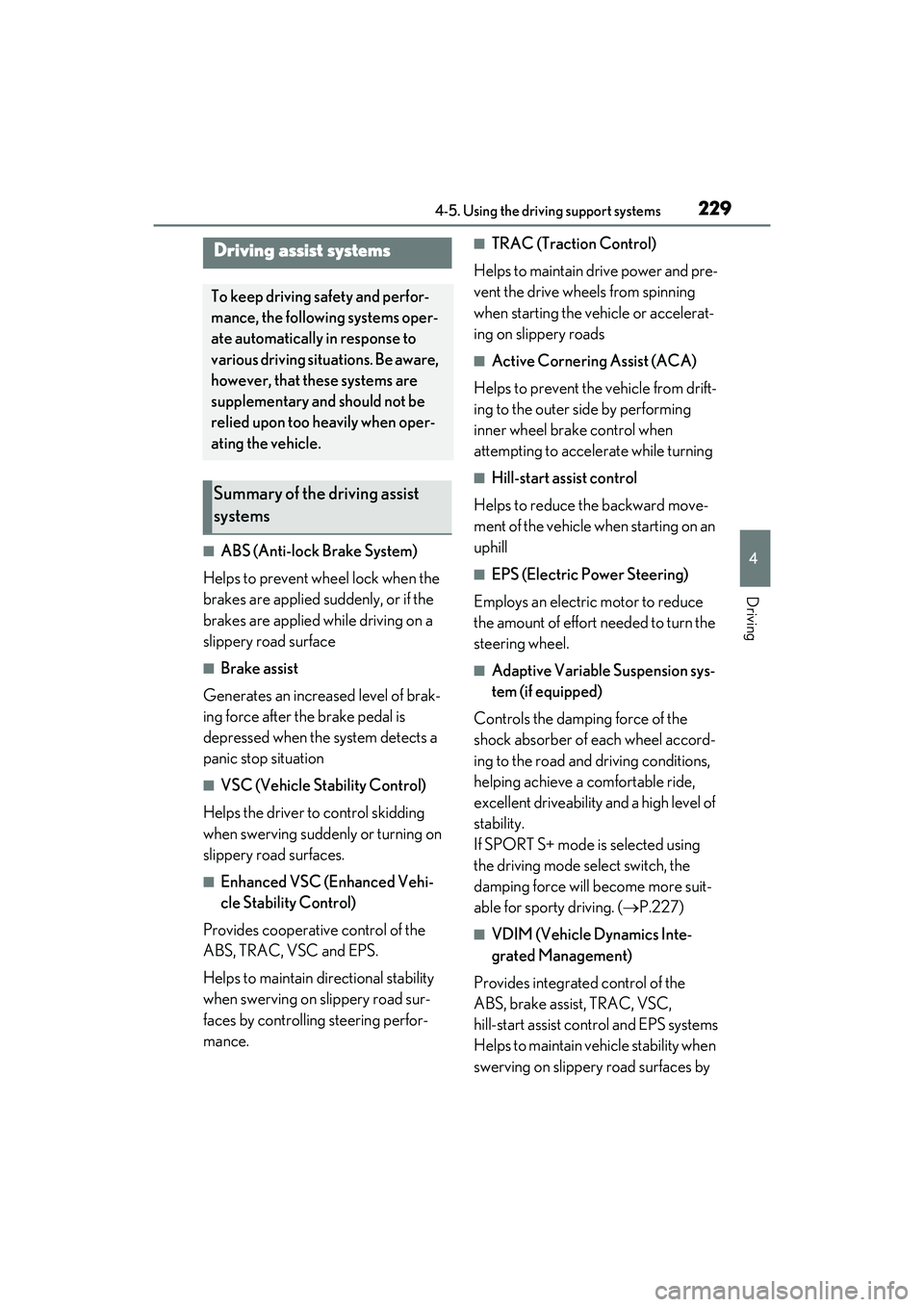
■ABS (Anti-lock Brake System)
Helps to prevent wheel lock when the
brakes are applied suddenly, or if the
brakes are applied while driving on a
slippery road surface
■Brake assist
Generates an increased level of brak-
ing force after the brake pedal is
depressed when the system detects a
panic stop situation
■VSC (Vehicle Stability Control)
Helps the driver to control skidding
when swerving sudden ly or turning on
slippery road surfaces.
■Enhanced VSC (Enhanced Vehi-
cle Stability Control)
Provides cooperative control of the
ABS, TRAC, VSC and EPS.
Helps to maintain directional stability
when swerving on slippery road sur-
faces by controlling steering perfor-
mance.
■TRAC (Traction Control)
Helps to maintain drive power and pre-
vent the drive wheels from spinning
when starting the vehicle or accelerat-
ing on slippery roads
■Active Cornering Assist (ACA)
Helps to prevent the vehicle from drift-
ing to the outer side by performing
inner wheel brake control when
attempting to accele rate while turning
■Hill-start assist control
Helps to reduce the backward move-
ment of the vehicle when starting on an
uphill
■EPS (Electric Power Steering)
Employs an electric motor to reduce
the amount of effort needed to turn the
steering wheel.
■Adaptive Variable Suspension sys-
tem (if equipped)
Controls the damping force of the
shock absorber of each wheel accord-
ing to the road and driving conditions,
helping achieve a comfortable ride,
excellent driveability and a high level of
stability.
If SPORT S+ mode is selected using
the driving mode select switch, the
damping force will become more suit-
able for sporty driving. ( P.227)
■VDIM (Vehicle Dynamics Inte-
grated Management)
Provides integrated control of the
ABS, brake assist, TRAC, VSC,
hill-start assist control and EPS systems
Helps to maintain vehicle stability when
swerving on slippery road surfaces by
Driving assist systems
To keep driving safety and perfor-
mance, the following systems oper-
ate automatically in response to
various driving situations. Be aware,
however, that these systems are
supplementary and should not be
relied upon too heavily when oper-
ating the vehicle.
Summary of the driving assist
systems
Page 232 of 440

2304-5. Using the driving support systems
controlling the brakes, engine output
and steering assist.
■The Secondary Collision Brake
When the SRS airbag sensor detects a
collision and the system operates, the
brakes and brake lights are automati-
cally controlled to reduce the vehicle
speed and help redu ce the possibility
of further damage due to a secondary
collision.
■When the TRAC/VSC systems are
operating
The slip indicator light will flash while the
TRAC/VSC systems are operating.
■Disabling the TRAC system
If the vehicle gets stuck in mud, dirt or snow,
the TRAC system may reduce power from
the engine to the wheels. Pressing the
switch to turn the sy stem off may make it
easier for you to rock the vehicle in order to
free it.
To turn the TRAC system off, quickly press
and release switch.
The “Traction Control Turned Off” will be
shown on the multi-information display.
Press the switch again to turn the sys-
tem back on.
■Turning off both TRAC and VSC sys-
tems
To turn the TRAC and VSC systems off,
press and hold the switch for more
than 3 seconds while the vehicle is stopped.
The VSC OFF indicator light will come on
and the “Traction Control Turned Off” will
be shown on the multi-information display.
*
Press the switch again to turn the sys-
tem back on.
*: Pre-collision brake assist and pre-colli- sion braking will also be disabled. The
pre-collision system warning light will
come on and the messa ge will be shown
on the multi-information display.
( P.174)
■When the message is displayed on the
multi-information display showing that
TRAC has been disabled even if the
VSC OFF switch has not been pressed
TRAC is temporary deactivated. If the infor-
mation continues to show, contact your
Lexus dealer.
■Operating conditions of hill-start assist
control
When the following four conditions are met,
the hill-start assist control will operate:
●The shift lever is in a position other than P
or N (when starting off forward/back-
ward on an upward incline)
●The vehicle is stopped
●The accelerator pedal is not depressed
●The parking brake is not engaged
●Engine switch is turned to IGNITION
ON mode
Page 233 of 440

2314-5. Using the driving support systems
4
Driving
■Automatic system cancelation of
hill-start assist control
The hill-start assist control will turn off in any
of the following situations:
●The shift lever is shifted to P or N
●The accelerator pedal is depressed
●The parking brake is engaged
●2 seconds at maximum elapsed after the
brake pedal is released
●Engine switch is turned to ACCESSORY
mode or turned off
■Sounds and vibrations caused by the
ABS, brake assist, VSC, TRAC and
hill-start assist control systems
●A sound may be heard from the engine
compartment when the brake pedal is
depressed repeatedly, when the engine is
started or just after the vehicle begins to
move. This sound does not indicate that a
malfunction has occurred in any of these
systems.
●Any of the following conditions may
occur when the above systems are oper-
ating. None of these indicates that a mal-
function has occurred.
• Vibrations may be felt through the vehicle
body and steering.
• A motor sound may be heard also after the vehicle comes to a stop.
• The brake pedal may pulsate slightly after the ABS is activated.
• The brake pedal may move down slightly
after the ABS is activated.
■Active Cornering Assist operation
sounds and vibrations
When the Active Cornering Assist is oper-
ated, operation sounds and vibrations may
be generated from the brake system, but
this is not a malfunction.
■Automatic reactivation of TRAC and
VSC systems
After turning the TRAC and VSC systems
off, the systems w ill be automatically
re-enabled in the following situations:
●When the engine switch is turned off
●If only the TRAC system is turned off, the
TRAC will turn on when vehicle speed
increases If both the TRAC and VSC systems are
turned off, automatic re-enabling will not
occur when vehicle speed increases.
■EPS operation sound
When the steering wheel is operated, a
motor sound (whirring sound) may be
heard. This does not indicate a malfunction.
■Reduced effectiveness of the EPS sys-
tem
The effectiveness of the EPS system is
reduced to prevent the system from over-
heating when there is frequent steering
input over an extended period of time. The
steering wheel may feel heavy as a result.
Should this occur, re frain from excessive
steering input or stop the vehicle and turn
the engine off. The EPS system should
return to normal within 10 minutes.
■Operating conditions of Active Corner-
ing Assist
The system operates when the following
occurs.
●TRAC/VSC can operate
●The driver is attempting to accelerate
while turning
●The system detects th at the vehicle is
drifting to the outer side
●The brake pedal is released
■Secondary Collision Brake operating
conditions
The system operates when the SRS airbag
sensor detects a collision while the vehicle
is in motion.
However, the system does not operate in
any of the following situations.
●The vehicle speed is below 6 mph (10
km/h)
●Components are damaged
■Secondary Collision Brake automatic
cancellation
The system is automatically canceled in any
of the following situations.
●The vehicle speed drops below approxi-
mately 6 mph (10 km/h)
●A certain amount of time elapses during
operation
Page 234 of 440

2324-5. Using the driving support systems
●The accelerator pedal is depressed a
large amount
WARNING
■The ABS does not operate effectively
when
●The limits of tire gripping performance
have been exceeded (such as exces-
sively worn tires on a snow covered
road).
●The vehicle hydroplanes while driving
at high speed on wet or slick roads.
■Stopping distance when the ABS is
operating may exceed that of normal
conditions
The ABS is not designed to shorten the
vehicle’s stopping di stance. Always main-
tain a safe distance from the vehicle in
front of you, especially in the following
situations:
●When driving on dirt, gravel or
snow-covered roads
●When driving with tire chains
●When driving over bumps in the road
●When driving over roads with potholes
or uneven surfaces
■TRAC/VSC may not operate effec-
tively when
Directional control and power may not
be achievable while driving on slippery
road surfaces, even if the TRAC/VSC
system is operating. Drive the vehicle
carefully in conditions where stability and
power may be lost.
■Active Cornering Assist does not
operate effectively when
●Do not overly rely on Active Corner-
ing Assist. Active Cornering Assist
may not operate effectively when
accelerating down slopes or driving on
slippery road surfaces.
●When Active Cornering Assist fre-
quently operates, Active Cornering
Assist may temporarily stop operating
to ensure proper operation of the
brakes, TRAC and VSC.
■Hill-start assist control does not oper-
ate effectively when
●Do not overly rely on hill-start assist
control. Hill-start assist control may
not operate effectively on steep
inclines and roads covered with ice.
●Unlike the parking brake, hill-start
assist control is not intended to hold
the vehicle stationary for an extended
period of time. Do not attempt to use
hill-start assist control to hold the vehi-
cle on an incline, as doing so may lead
to an accident.
■When the TRAC/VSC is activated
The slip indicator light flashes. Always
drive carefully. Reck less driving may
cause an accident. Exercise particular
care when the indicator light flashes.
■When the TRAC/VSC systems are
turned off
Be especially careful and drive at a speed
appropriate to the road conditions. As
these are the systems to help ensure
vehicle stability and driving force, do not
turn the TRAC/VSC systems off unless
necessary.
■Replacing tires
Make sure that all ti res are of the speci-
fied size, brand, tread pattern and total
load capacity. In addition, make sure that
the tires are inflated to the recom-
mended tire inflat ion pressure level.
The ABS, TRAC and VSC systems will
not function correctly if different tires are
installed on the vehicle.
Contact your Lexus dealer for further
information when replacing tires or
wheels.
Page 336 of 440
3347-2. Steps to take in an emergency
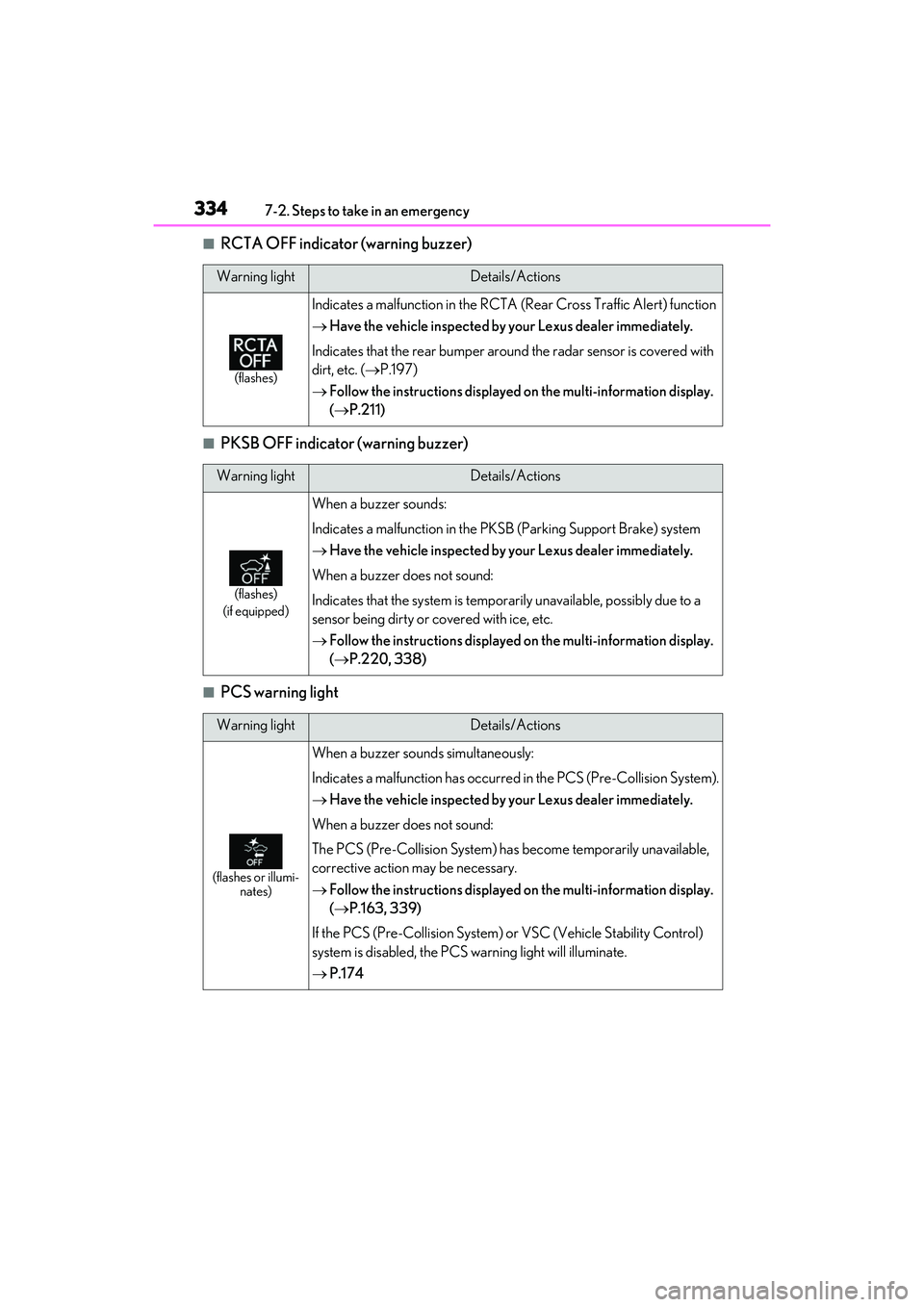
■RCTA OFF indicator (warning buzzer)
■PKSB OFF indicator (warning buzzer)
■PCS warning light
Warning lightDetails/Actions
(flashes)
Indicates a malfunction in the RCTA (Rear Cross Traffic Alert) function
Have the vehicle inspected by your Lexus dealer immediately.
Indicates that the rear bumper around the radar sensor is covered with
dirt, etc. ( P.197)
Follow the instructions displayed on the multi-information display.
( P.211)
Warning lightDetails/Actions
(flashes)
(if equipped)
When a buzzer sounds:
Indicates a malfunction in the PKSB (Parking Support Brake) system
Have the vehicle inspected by your Lexus dealer immediately.
When a buzzer does not sound:
Indicates that the system is temporarily unavailable, possibly due to a
sensor being dirty or covered with ice, etc.
Follow the instructions displayed on the multi-information display.
( P.220, 338)
Warning lightDetails/Actions
(flashes or illumi-
nates)
When a buzzer sounds simultaneously:
Indicates a malfunction has occurred in the PCS (Pre-Collision System).
Have the vehicle inspected by your Lexus dealer immediately.
When a buzzer does not sound:
The PCS (Pre-Collision System) has become temporarily unavailable,
corrective action may be necessary.
Follow the instructions displayed on the multi-information display.
( P.163, 339)
If the PCS (Pre-Collision System) or VSC (Vehicle Stability Control)
system is disabled, the PCS warning light will illuminate.
P.174
Page 337 of 440

3357-2. Steps to take in an emergency
7
When trouble arises
■Slip indicator
■Parking brake indicator (warning buzzer)
■Brake hold operated indicator (warning buzzer)
■Warning buzzer
In some cases, the bu zzer may not be heard
due to being in a noisy location or audio
sound.
■Front passenger detection sensor, seat
belt reminder and warning buzzer
●If luggage is placed on the front passen-
ger seat, the front passenger detection
sensor may cause the warning light to
flash and the warning buzzer to sound
even if a passenger is not sitting in the
seat.
●If a cushion is placed on the seat, the sen-
sor may not detect a passenger, and the
warning light may not operate properly.
■SRS warning light
This warning light system monitors the
airbag sensor assembly, front impact sen-
sors, side impact sensor s (front door), side
impact sensors (front), side impact sensors
(rear), driver’s seat position sensor, driver’s
seat belt buckle sw itch, front passenger
occupant classification system (ECU and
sensors), “AIR BAG ON” indicator light,
“AIR BAG OFF” indicator light, front pas-
senger’s seat belt buckle switch, seat belt
pretensioners and force limiters, airbags,
interconnecting wiring and power sources.
( P.28)
■If the malfunction in dicator lamp comes
on while driving
First check the following:
Warning lightDetails/Actions
Indicates a malfunction in:
The VSC system;
The TRAC system; or
The hill-start assist control system
Have the vehicle inspected by your Lexus dealer immediately.
Warning lightDetails/Actions
(flashes)
(U.S.A.)
or
(flashes)
(Canada)
It is possible that the parking brake is not fully engaged or released
Operate the parking brake switch once again.
This light comes on when the parking brake is not released. If the light
turns off after the parking brake is fu lly released, the system is operating
normally.
Warning lightDetails/Actions
(flashes)
Indicates a malfunction in the brake hold system
Have the vehicle inspected by your Lexus dealer immediately.
Page 349 of 440

3477-2. Steps to take in an emergency
7
When trouble arises
WARNING
●Never apply oil or grease to the wheel
bolts or their contact surface on the
wheel .
Doing so may cause the wheel bolts to
be tightened excessively, leading to
damage to the wheel bolts, the
threaded portion the wheel bolts install
to , or the wheel.
Also, the wheel bolts may come loose,
possibly leading to the wheel coming
off, causing a serious accident.
If oil or grease is at tached to either of
these parts, remove it.
Steel wheel
Aluminum wheel
●When installing a wheel, use the same
wheel bolts that we re removed with
the wheel. Also, do not use any wheel
bolts other than Lexus Genuine wheel
bolts.
●Do not attach a heavily damaged
wheel ornament, as it may fly off the
wheel while the vehicle is moving.
●If a wheel bolt hole in a wheel or the
threads of a wheel bolt or the wheel
hub are deformed, cracked, rusty or
otherwise damaged, have the vehicle
inspected by your Lexus dealer.
A
B
■When tightening the wheel bolts
Do not tighten the wheel bolts exces-
sively. Doing so may cause the wheel
bolts, the threads of the wheel hub, or the
wheel to be damaged.
■Guide pin
When removing or inst alling a tire, make
sure to use the guide pin.
Also, the guide pin is made of resin. It
may be damaged if the wheel is placed
anywhere other than or if a large
amount of force is applied to the guide
pin.
■When using the compact spare tire
●Remember that the compact spare tire
provided is specific ally designed for
use with your vehicle. Do not use your
compact spare tire on another vehicle.
●Do not use more than one compact
spare tires simultaneously.
●Replace the compact spare tire with a
standard tire as soon as possible.
●Avoid sudden acceleration, abrupt
steering, sudden braking and shifting
operations that cause sudden engine
braking.
■When the compact spare tire is
attached
The vehicle speed may not be correctly
detected, and the following systems may
not operate correctly:
• ABS & Brake assist
•VSC
•TRAC
A
Page 420 of 440

418Alphabetical Index
Hood................................................................285
How to start the engine ........................... 130
Identification number ...............................365
If the engine will not start ....................... 349
If your vehicle has to be stopped in an
emergency ................................................ 320
Ignition switch (engine switch) ............ 130
Overheating................................................. 357
Tachometer ............................................ 69, 70
Engine coolant Capacity .........................................................369
Checking ....................................................... 292
Preparing and checking before winter......................................................................... 234
Engine coolant temperature gauge 69, 70
Engine immobilizer system ........................ 60
Engine oil Capacity ......................................................... 367
Checking .......................................................289
Preparing and checking before winter......................................................................... 234
Warning light ...............................................330
Engine oil maintenance data ....................291
Engine oil pressure gauge ...........................79
Engine oil temperature gauge ...................79
Engine switch ................................................. 130 Auto power off function ........................... 132
Changing the engine switch modes.. 132
If your vehicle has to be stopped in an
emergency ................................................ 320
Enhanced Vehicle Stability Control (Enhanced VSC) ...................................... 229
Enhanced VSC (Enhanced Vehicle Stabil- ity Control) .................................................. 229
EPS (Electric Power Steering) .............. 229 Warning light ............................................... 332
Event data recorder (EDR) ............................7
F
First-aid kit storage belt ............................ 258
Flat tire Tire pressure warning system ............. 299 Vehicles with a spare tire.........................341
Floor mats ...........................................................22
Fluid Automatic transmission ..........................370
Brake ..................................................................371
Washer ...........................................................296
Footwell lights ............................................... 253 Wattage ..........................................................375
Front passenger occupant classification system .............................................................. 36
Front seats Adjustment ..................................................... 102
Cleaning ......................................................... 274
Correct driving posture ............................ 23
Driving position memory ........................ 104
Head restraints............................................. 107
Memory recall function............................ 105
Power easy access system .................... 104
Seat heaters ................................................... 251
Seat position memory .............................. 104
Seat ventilators ............................................. 251
Front side marker light Light switch .................................................... 145
Replacing light bulbs ..................................314
Front turn signal lights Replacing light bulbs....................... 314, 315
Turn signal lever .......................................... 138
Wattage ..........................................................375
Fuel Capacity ......................................................... 367
Fuel gauge............................................... 69, 70
Fuel pump shut off system.....................328
Information .................................................... 376
Refueling...........................................................157
Type .................................................................. 367
Warning light ............................................... 332
Fuel consumption Average fuel economy .............................. 78
Current fuel consumption ........................ 78
Fuel filler door If the fuel filler do or cannot be opened
........................................................................... 351