2022 LEXUS ES350 AUX
[x] Cancel search: AUXPage 278 of 468
2765-5. Using the storage features
5-5.Using the storage features
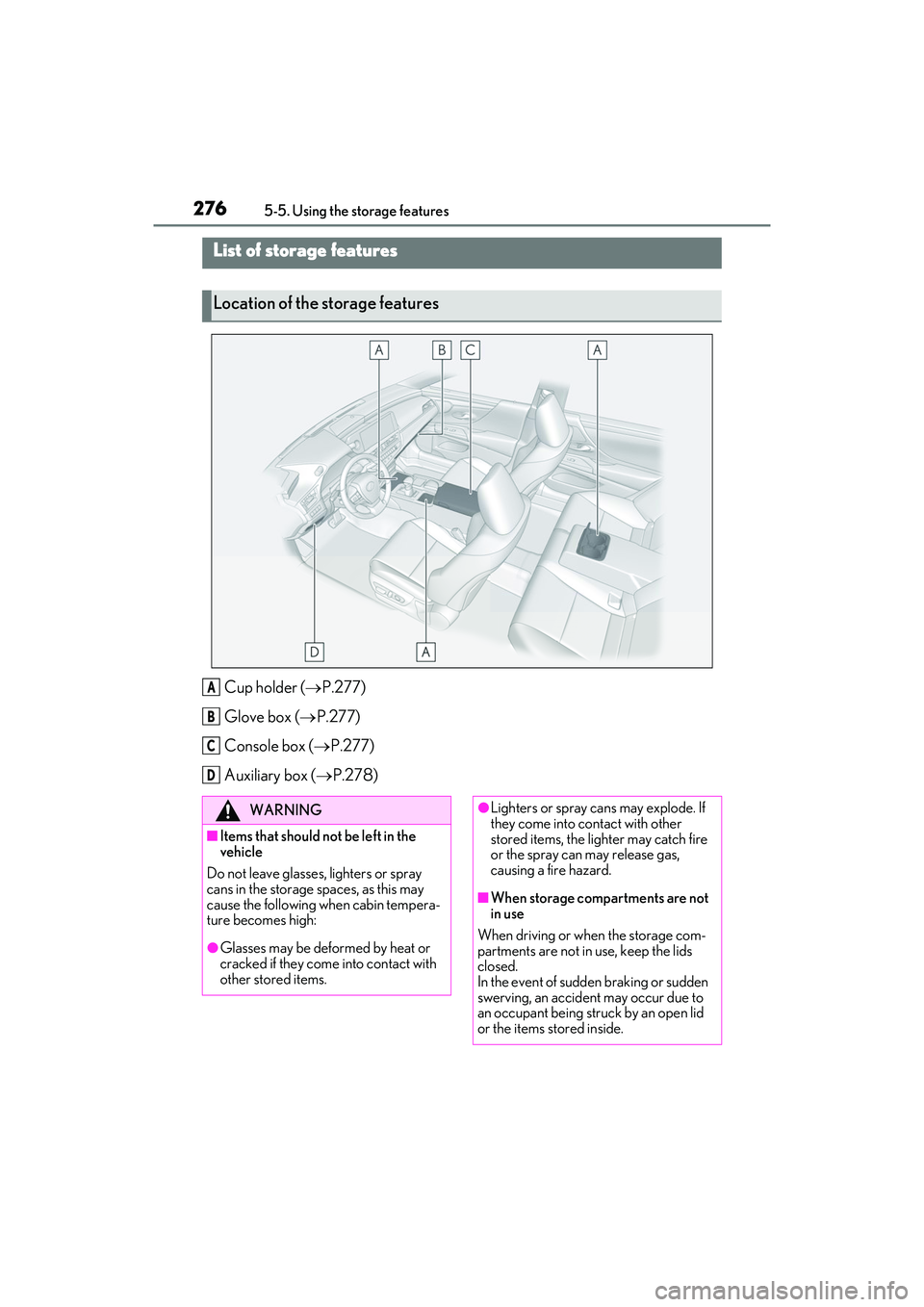
Cup holder (P.277)
Glove box ( P.277)
Console box ( P.277)
Auxiliary box ( P.278)
List of storage features
Location of the storage features
A
B
C
D
WARNING
■Items that should not be left in the
vehicle
Do not leave glasses, lighters or spray
cans in the storage spaces, as this may
cause the following when cabin tempera-
ture becomes high:
●Glasses may be deformed by heat or
cracked if they come into contact with
other stored items.
●Lighters or spray cans may explode. If
they come into contact with other
stored items, the lighter may catch fire
or the spray can may release gas,
causing a fire hazard.
■When storage compartments are not
in use
When driving or when the storage com-
partments are not in use, keep the lids
closed.
In the event of sudden braking or sudden
swerving, an accident may occur due to
an occupant being struck by an open lid
or the items stored inside.
Page 280 of 468
2785-5. Using the storage features
Deepen
Rear
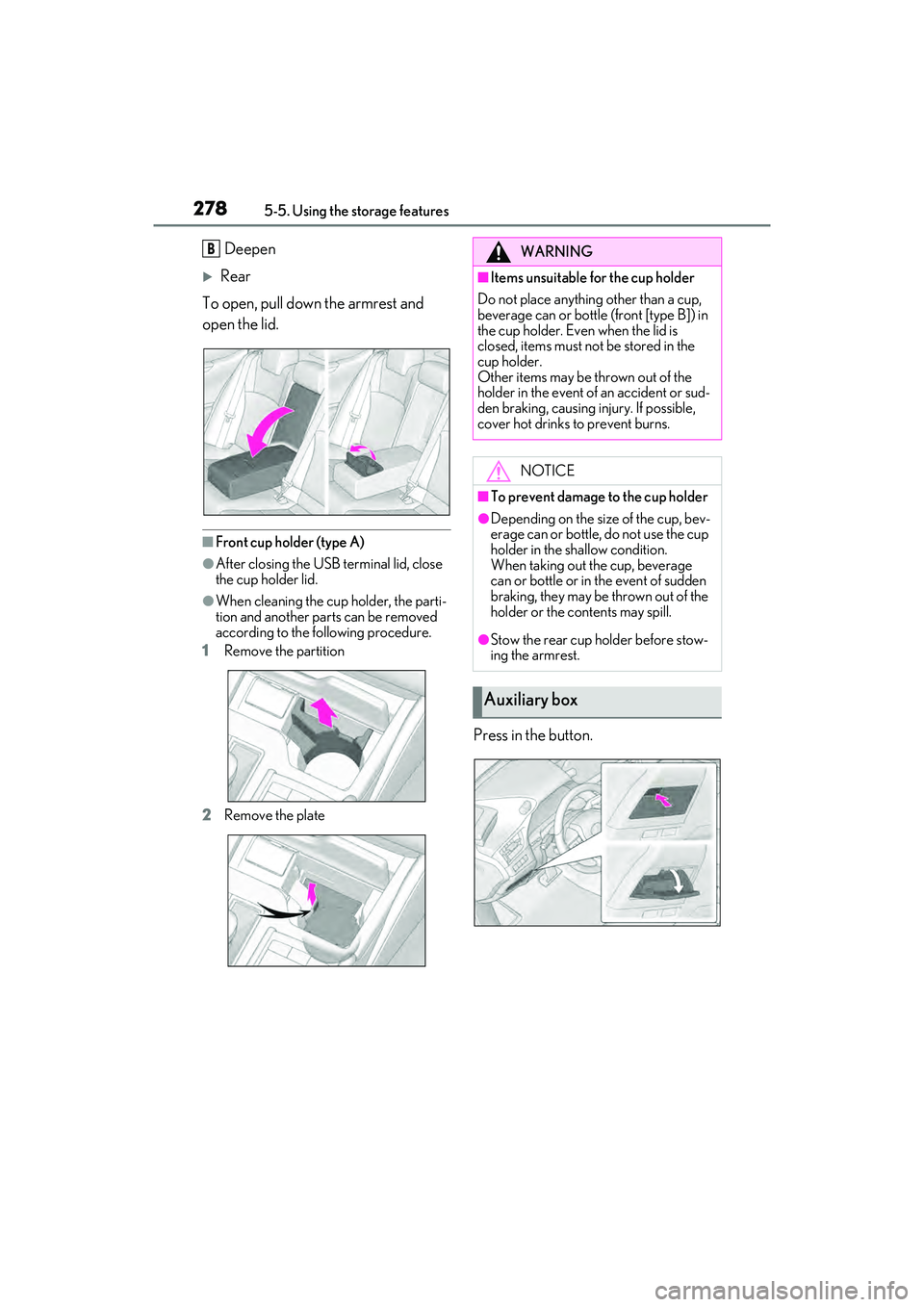
To open, pull down the armrest and
open the lid.
■Front cup holder (type A)
●After closing the USB terminal lid, close
the cup holder lid.
●When cleaning the cup holder, the parti-
tion and another parts can be removed
according to the following procedure.
1 Remove the partition
2 Remove the plate
Press in the button.
BWARNING
■Items unsuitable for the cup holder
Do not place anything other than a cup,
beverage can or bottle (front [type B]) in
the cup holder. Even when the lid is
closed, items must not be stored in the
cup holder.
Other items may be thrown out of the
holder in the event of an accident or sud-
den braking, causing injury. If possible,
cover hot drinks to prevent burns.
NOTICE
■To prevent damage to the cup holder
●Depending on the size of the cup, bev-
erage can or bottle, do not use the cup
holder in the shallow condition.
When taking out the cup, beverage
can or bottle or in the event of sudden
braking, they may be thrown out of the
holder or the contents may spill.
●Stow the rear cup holder before stow-
ing the armrest.
Auxiliary box
Page 312 of 468
3106-3. Do-it-yourself maintenance
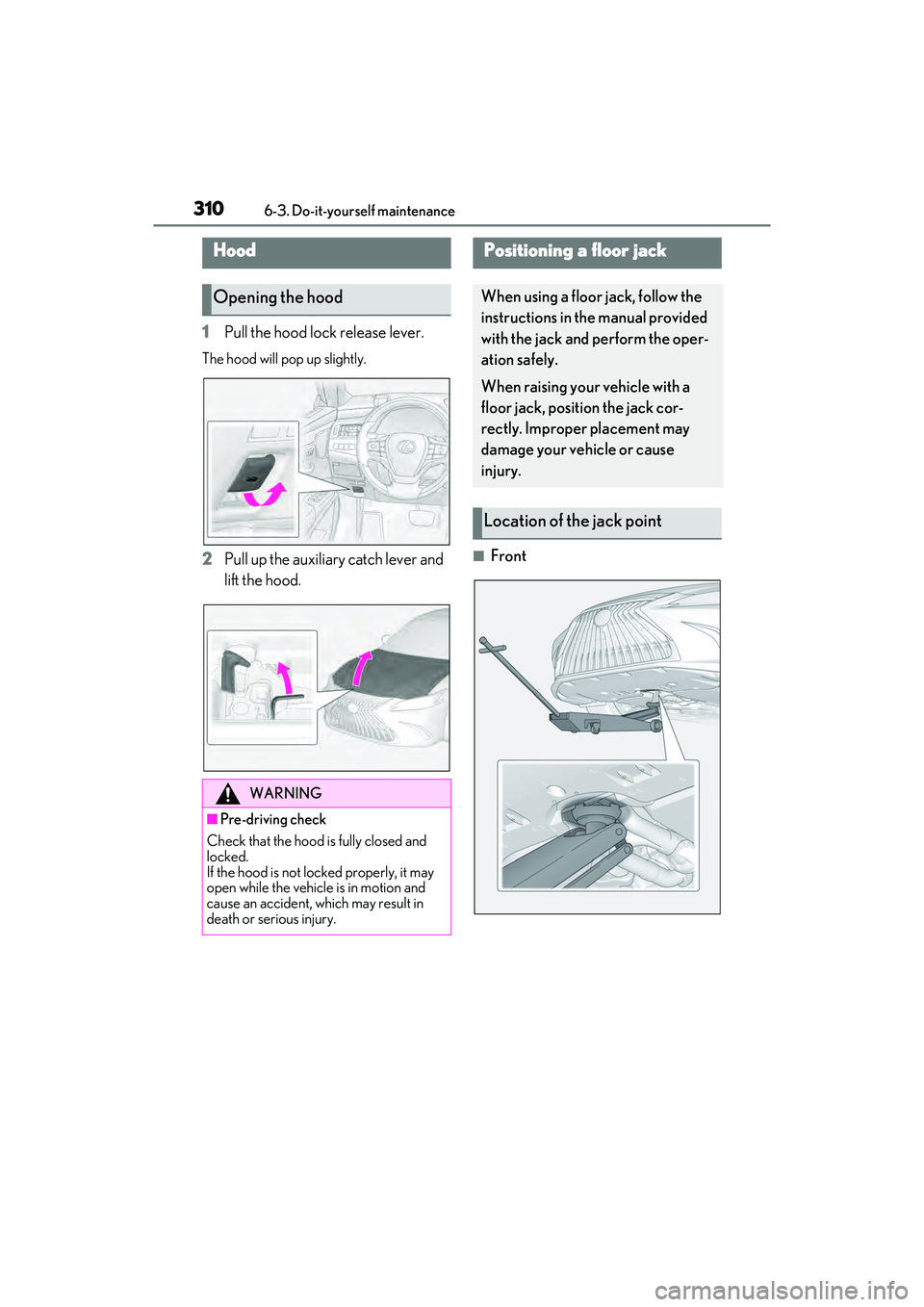
1Pull the hood lock release lever.
The hood will pop up slightly.
2Pull up the auxiliary catch lever and
lift the hood.■Front
Hood
Opening the hood
WARNING
■Pre-driving check
Check that the hood is fully closed and
locked.
If the hood is not locked properly, it may
open while the vehicle is in motion and
cause an accident, which may result in
death or serious injury.
Positioning a floor jack
When using a floor jack, follow the
instructions in the manual provided
with the jack and perform the oper-
ation safely.
When raising your vehicle with a
floor jack, position the jack cor-
rectly. Improper placement may
damage your vehicle or cause
injury.
Location of the jack point
Page 325 of 468

3236-3. Do-it-yourself maintenance
6
Maintenance and care
●Tire inflation pressure changes with tem-
perature. The displayed values may also
be different from the values measured
using a tire pressure gauge.
■Situations in which the tire pressure
warning system may not operate prop-
erly
●In the following cases, the tire pressure
warning system may not operate prop-
erly.
• If non-genuine Lexus wheels are used.
• A tire has been replaced with a tire that is
not an OE (Original Equipment) tire.
• A tire has been replaced with a tire that is not of the specified size.
• Tire chains etc. are equipped.
• An auxiliary-supported run-flat tire is equipped.
• If a window tint that affects the radio wave signals is installed.
• If there is a lot of snow or ice on the vehi-
cle, particularly around the wheels or
wheel housings.
• If the tire inflation pressure is extremely
higher than the specified level.
• If wheel without tire pressure warning valves and transmitters are used.
• If the ID code on the tire pressure warn- ing valves and transmitters is not regis-
tered in the tire pressure warning
computer.
●Performance may be affected in the fol-
lowing situations.
• Near a TV tower, electric power plant, gas station, radio station, large display,
airport or other facility that generates
strong radio waves or electrical noise
• When carrying a portable radio, cellular
phone, cordless phone or other wireless
communication device
If tire position information is not correctly
displayed due to the radio wave conditions,
the display may be corrected by driving and
changing the radio wave conditions.
●When the vehicle is parked, the time
taken for the warning to start or go off
could be extended.
●When tire inflation pressure declines rap-
idly for example when a tire has burst, the
warning may not function.
■Warning performance of the tire pres-
sure warning system
The warning of the tire pressure warning
system will change in accordance with driv-
ing conditions. For this reason, the system
may give a warning even if the tire pressure
does not reach a low enough level, or if the
pressure is higher than the pressure that
was adjusted to when the system was initial-
ized.
When replacing tires or wheels, tire
pressure warning valves and transmit-
ters must also be installed.
When new tire pressure warning
valves and transmitters are installed,
new ID codes must be registered in the
tire pressure warning computer and
the tire pressure warning system must
be initialized. ( P.326)
■When replacing the tires and wheels
If the ID code of the tire pressure warning
valve and transmitter is not registered, the
tire pressure warning system will not work
properly. After driving for about 20 min-
utes, the tire pressure warning light blinks
for 1 minute and stays on to indicate a sys-
tem malfunction.
Installing tire pressure warning
valves and transmitters
NOTICE
■Repairing or replacing tires, wheels,
tire pressure warning valves, trans-
mitters and tire valve caps
●When removing or fitting the wheels,
tires or the tire pressure warning
valves and transmitters, contact your
Lexus dealer as the tire pressure warn-
ing valves and transmitters may be
damaged if not handled correctly.
Page 371 of 468
3697-2. Steps to take in an emergency
7
When trouble arises
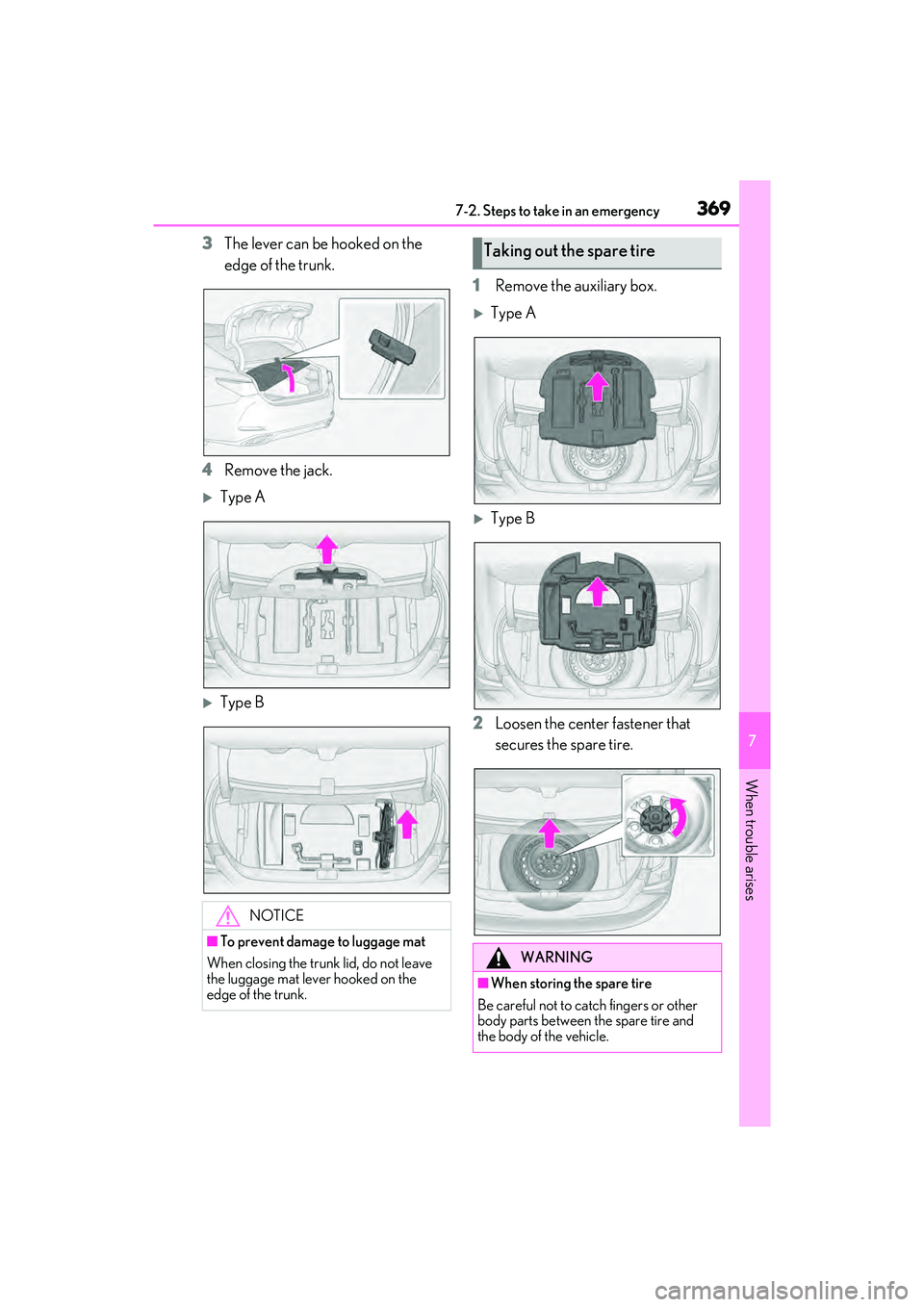
3The lever can be hooked on the
edge of the trunk.
4 Remove the jack.
Type A
Type B 1
Remove the auxiliary box.
Type A
Type B
2 Loosen the center fastener that
secures the spare tire.
NOTICE
■To prevent damage to luggage mat
When closing the trunk lid, do not leave
the luggage mat lever hooked on the
edge of the trunk.
Taking out the spare tire
WARNING
■When storing the spare tire
Be careful not to catch fingers or other
body parts between the spare tire and
the body of the vehicle.
Page 426 of 468
4249-1. For owners
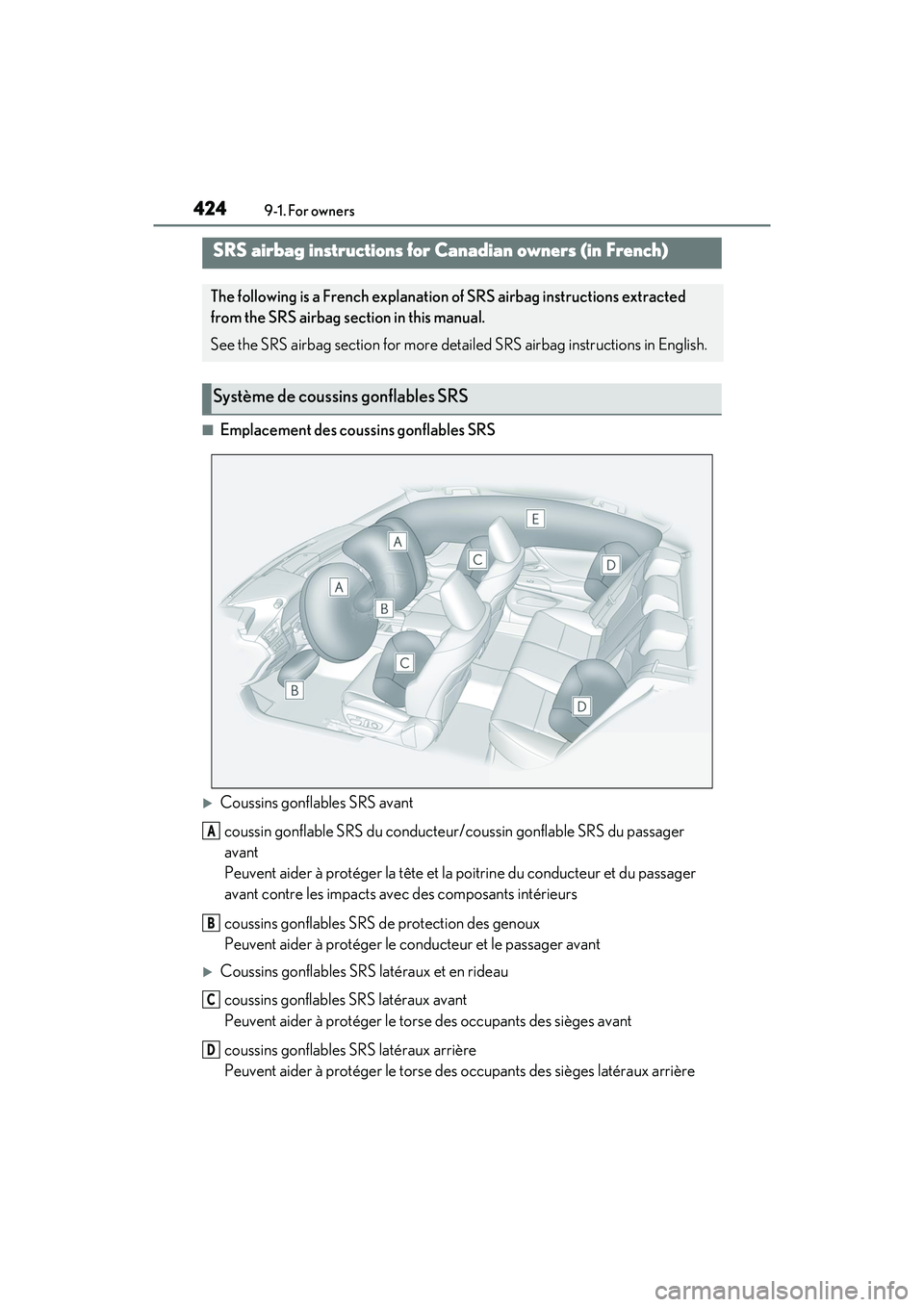
■Emplacement des coussins gonflables SRS
Coussins gonflables SRS avant
coussin gonflable SRS du conducteur /coussin gonflable SRS du passager
avant
Peuvent aider à protéger la tête et la poitrine du conducteur et du passager
avant contre les impacts avec des composants intérieurs
coussins gonflables SRS de protection des genoux
Peuvent aider à protéger le conducteur et le passager avant
Coussins gonflables SRS latéraux et en rideau
coussins gonflables SRS latéraux avant
Peuvent aider à protéger le torse des occupants des sièges avant
coussins gonflables SRS latéraux arrière
Peuvent aider à protéger le torse des occupants des sièges latéraux arrière
SRS airbag instructions fo r Canadian owners (in French)
The following is a French explanation of SRS airbag instructions extracted
from the SRS airbag section in this manual.
See the SRS airbag section for more detailed SRS airbag instructions in English.
Système de coussins gonflables SRS
A
B
C
D
Page 427 of 468
4259-1. For owners
9
For owners
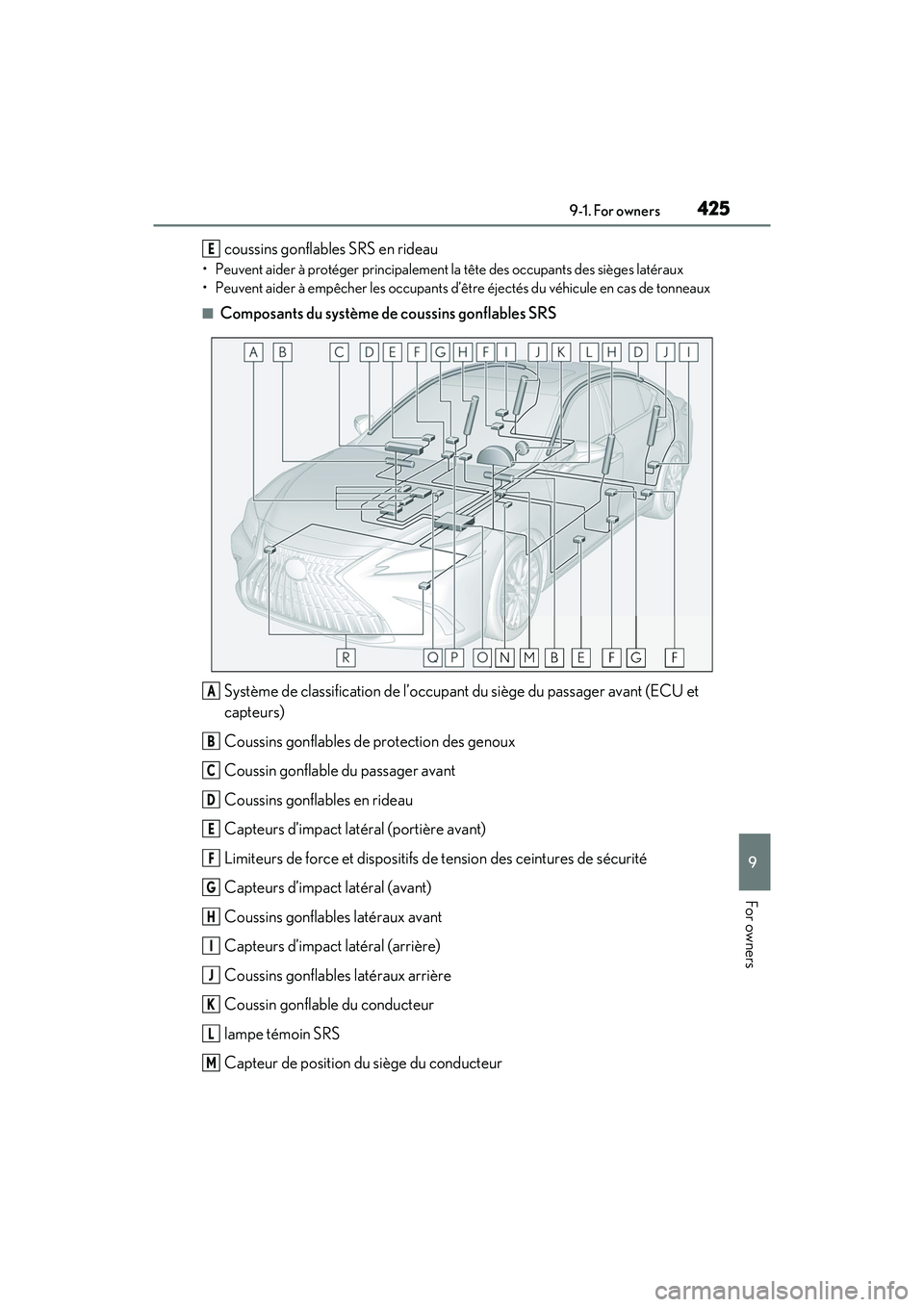
coussins gonflables SRS en rideau
• Peuvent aider à protéger principalement la tête des occupants des sièges latéraux
• Peuvent aider à empêcher les occupants d’être éjectés du véhicule en cas de tonneaux
■Composants du système de coussins gonflables SRS
Système de classification de l’occupant du siège du passager avant (ECU et
capteurs)
Coussins gonflables de protection des genoux
Coussin gonflable du passager avant
Coussins gonflables en rideau
Capteurs d’impact latéral (portière avant)
Limiteurs de force et dispositifs de tension des ceintures de sécurité
Capteurs d’impact latéral (avant)
Coussins gonflables latéraux avant
Capteurs d’impact latéral (arrière)
Coussins gonflables latéraux arrière
Coussin gonflable du conducteur
lampe témoin SRS
Capteur de position du siège du conducteur
E
A
B
C
D
E
F
G
H
I
J
K
L
M
Page 428 of 468
4269-1. For owners
Contacteur de boucle de ceinture de sécurité du conducteur
Module de capteur de coussin gonflable
Voyants “PASSENGER AIR BAG”
Contacteur de boucle de ceinture de sécurité du passager avant
Capteurs d’impact avant
Votre véhicule est doté de COUSSINS GONFLABLES ÉVOLUÉS dont la con-
ception s’appuie sur les normes de sécurité des véhicules à moteur américains
(FMVSS208). Le module de capteur de coussin gonflable (ECU) contrôle le
déploiement des coussins gonflables en fonction des informations obtenues des
capteurs et d’autres éléments affichés dans le diagramme des composants du sys-
tème ci-dessus. Ces informations comprennent des données relatives à la gravité
de l’accident et aux occupants. Au mome nt du déploiement des coussins gonfla-
bles, une réaction chimique se produit dans les gonfleurs de coussin gonflable et
les coussins gonflables se remplissent ra pidement d’un gaz non toxique pour aider
à limiter le mouvement des occupants.N
O
P
Q
R
AVERTISSEMENT
■Précautions relatives aux coussins
gonflables SRS
Observez les précautions suivantes en
ce qui concerne les coussins gonflables
SRS.
Négliger de le faire pourrait occasionner
des blessures graves, voire mortelles.
●Le conducteur et tous les passagers
du véhicule doivent porter leur cein-
ture de sécurité de la manière appro-
priée.
Les coussins gonflables SRS sont des
dispositifs supplémen taires qui doivent
être utilisés avec les ceintures de sécu-
rité.