2022 LEXUS ES350 belt
[x] Cancel search: beltPage 360 of 468

3587-2. Steps to take in an emergency
■Brake hold operated indicator (warning buzzer)
■Master warning light (warning buzzer)
■Warning buzzer
In some cases, the buzzer may not be heard
due to being in a noisy location or audio
sound.
■Front passenger detection sensor, seat
belt reminder and warning buzzer
●If luggage is placed on the front passen-
ger seat, the front passenger detection
sensor may cause the warning light to
flash and the warning buzzer to sound
even if a passenger is not sitting in the
seat.
●If a cushion is placed on the seat, the sen-
sor may not detect a passenger, and the
warning light may not operate properly.
■SRS warning light
This warning light system monitors the air-
bag sensor assembly, front impact sensors,
side impact sensors (front door), side
impact sensors (front), side impact sensors
(rear), driver’s seat position sensor, driver’s
seat belt buckle switch, front passenger
occupant classification system (ECU and
sensors), “PASSENGER AIR BAG” indica-
tor lights, front passenger’s seat belt buckle
switch, seat belt pret ensioners, airbags,
interconnecting wiring and power sources.
( P.28)
■Electric power steering system warning
light (warning buzzer)
When the battery charge becomes insuffi-
cient or the voltage temporarily drops, the electric power steering system warning
light may come on and the warning buzzer
may sound.
■When the tire pressure warning light
comes on
Inspect the tires to check if a tire is punc-
tured.
If a tire is punctured: P.365
If none of the tires are punctured:
Turn the engine switch off then turn it to
IGNITION ON mode. Check if the tire
pressure warning light comes on or blinks.
If the tire pressure warning light blinks for
approximately 1 minute then stays on
There may be a malfunction in the tire pres-
sure warning system. Have the vehicle
inspected by your Lexus dealer immedi-
ately.
If the tire pressure warning light comes
on
1 After the temperature of the tires has
lowered sufficiently, check the inflation
pressure of each tire and adjust them to
the specified level.
2 If the warning light does not turn off
even after several minutes have
elapsed, check that the inflation pres-
sure of each tire is at the specified level
and perform initialization. ( P.324)
■The tire pressure warning light may
come on due to natural causes
The tire pressure warning light may come
on due to natural causes such as natural air
Warning lightDetails/Actions
(flashes)
Indicates a malfunction in the brake hold system
Have the vehicle inspected by your Lexus dealer immediately.
Warning lightDetails/Actions
A buzzer sounds and the warning light comes on and flashes to indicate
that the master warning system has detected a malfunction.
P.361
Page 384 of 468

3827-2. Steps to take in an emergency
1Stop the vehicle in a safe place and
turn off the air conditioning system,
and then stop the engine.
2 If you see steam:
Carefully lift the hood after the
steam subsides.
If you do not see steam:
Carefully lift the hood.
3 After the engine has cooled down
sufficiently, inspect the hoses and
WARNING
●When working with the battery, always
wear safety glasses and take care not
to allow any battery fluids (acid) to
come into contact with skin, clothing
or the vehicle body.
●Do not lean over the battery.
●In the event that battery fluid comes
into contact with the skin or eyes,
immediately wash the affected area
with water and seek medical attention.
Place a wet sponge or cloth over the
affected area until medical attention
can be received.
●Always wash your hands after han-
dling the battery support, terminals,
and other battery-related parts.
●Do not allow children near the battery.
■When replacing the battery
When the vent plug and indicator are
close to the hold down clamp, the battery
fluid (sulfuric acid) may leak.
NOTICE
■When handling jumper cables
When connecting the jumper cables,
ensure that they do not become entan-
gled in the cooling fan or engine drive
belt.
If your vehicle overheats
The following may indicate that
your vehicle is overheating.
The engine coolant temperature
gauge ( P.68, 71) is in the red
zone or a loss of engine power is
experienced. (For example, the
vehicle speed does not increase.)
“Engine Coolant Temp High Stop
in a Safe Place See Owner’s
Manual” is shown on the multi-
information display.
Steam comes out from under the
hood.
Correction procedures
Page 386 of 468

3847-2. Steps to take in an emergency
6Start the engine and turn the air
conditioning system on to check
that the radiator cooling fan oper-
ates and to check for coolant leaks
from the radiator or hoses.
The fan operates when the air conditioning
system is turned on immediately after a
cold start. Confirm that the fan is operating
by checking the fan sound and air flow. If it
is difficult to check these, turn the air con-
ditioning system on and off repeatedly.
(The fan may not operate in freezing tem-
peratures.)
7 If the fan is not operating:
Stop the engine immediately and
contact your Lexus dealer.
If the fan is operating:
Have the vehicle inspected at the
nearest Lexus dealer.
WARNING
■When inspecting under the hood of
your vehicle
Observe the following precautions.
Failure to do so may result in serious
injury such as burns.
●If steam is seen coming from under the
hood, do not open the hood until the
steam has subsided. The engine com-
partment may be very hot.
●Keep hands and clothing (especially a
tie, a scarf or a muffler) away from the
fan and belts. Failure to do so may
cause the hands or clothing to be
caught, resulting in serious injury.
●While the engine and radiator are hot,
do not loosen or remove the coolant
inlet cap or coolant reservoir cap.
High temperature steam or coolant
could spray out.
NOTICE
■When adding engine coolant
Add coolant slowly after the engine has
cooled down sufficiently. Adding cool
coolant to a hot engine too quickly can
cause damage to the engine.
■To prevent damage to the cooling
system
Observe the following precautions:
●Avoid contaminating the coolant with
foreign matter (such as sand or dust
etc.).
●Do not use any coolant additive.
Page 391 of 468
3898-1. Specifications
8
Vehicle specifications
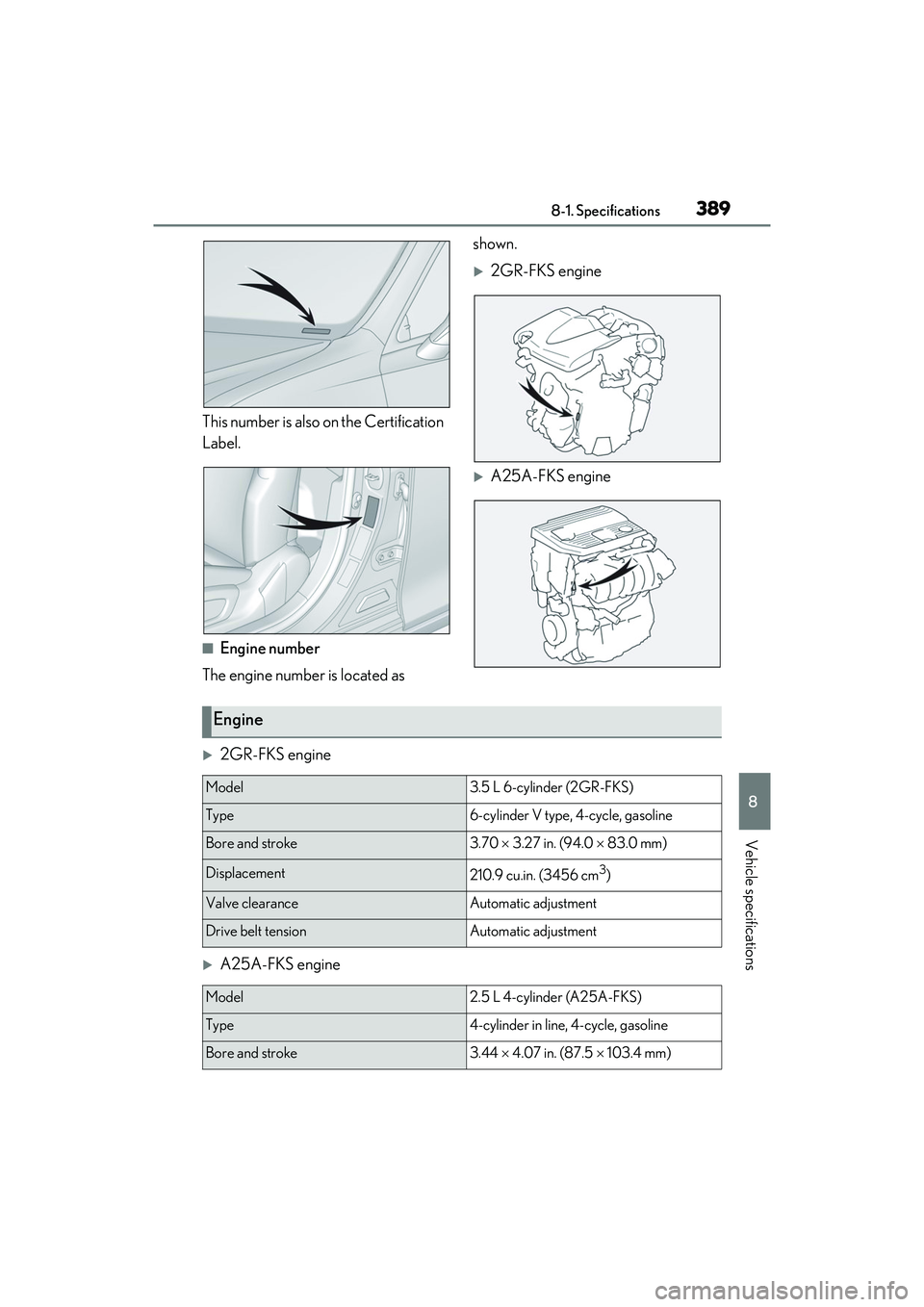
This number is also on the Certification
Label.
■Engine number
The engine number is located as shown.
2GR-FKS engine
A25A-FKS engine
2GR-FKS engine
A25A-FKS engine
Engine
Model3.5 L 6-cylinder (2GR-FKS)
Type6-cylinder V type, 4-cycle, gasoline
Bore and stroke3.70
3.27 in. (94.0 83.0 mm)
Displacement210.9 cu.in. (3456 cm3)
Valve clearanceAutomatic adjustment
Drive belt tensionAutomatic adjustment
Model2.5 L 4-cylinder (A25A-FKS)
Type4-cylinder in line, 4-cycle, gasoline
Bore and stroke3.44 4.07 in. (87.5 103.4 mm)
Page 392 of 468
![LEXUS ES350 2022 Owners Manual 3908-1. Specifications
2GR-FKS engine
■Oil capacity (Drain and refill [Ref-
erence
*])
*: The engine oil capacity is a reference quantity to be used when changing the
engine oil. Warm up and tur](/manual-img/36/58919/w960_58919-391.png "LEXUS ES350 2022 Owners Manual 3908-1. Specifications
2GR-FKS engine
■Oil capacity (Drain and refill [Ref-
erence
*])
*: The engine oil capacity is a reference quantity to be used when changing the
engine oil. Warm up and tur")
3908-1. Specifications
2GR-FKS engine
■Oil capacity (Drain and refill [Ref-
erence
*])
*: The engine oil capacity is a reference quantity to be used when changing the
engine oil. Warm up and turn off the
engine, wait more than 5 minutes, and
check the oil level on the dipstick.
■Engine oil selection
“Toyota Genuine Motor Oil” is used in
your Lexus vehicle. Use Lexus
approved “Toyota Genuine Motor
Oil” or equivalent to satisfy the follow-
ing grade and viscosity.
Oil grade:
ILSAC GF-6A multigrade engine oil
Recommended viscosity: SAE 0W-20
SAE 0W-20 is the best choice for
good fuel economy
and good starting
in cold weather.
If SAE 0W-20 is not available, SAE
5W-20 oil may be used. However, it
must be replaced with SAE 0W-20 at
the next oil change.
Outside temperature
Oil viscosity (0W-20 is explained here
as an example):
• The 0W in 0W-20 indicates the
Displacement151.8 cu.in. (2487 cm3)
Valve clearanceAutomatic adjustment
Drive belt tensionAutomatic adjustment
Fuel
Fuel typeUnleaded gasoline only
Octane Rating87 (Research Octane Number 91) or
higher
Fuel tank capacity (Reference)
2WD models:
16.0 gal. (60.6 L, 13.3 Imp.gal.)
AWD models:
14.4 gal. (54.5 L, 12.0 Imp.gal.)
Lubrication system
With filter5.7 qt. (5.4 L, 4.8 Imp.qt.)
Without filter5.6 qt. (5.3 L, 4.7 Imp.qt.)
A
Page 404 of 468
4028-1. Specifications
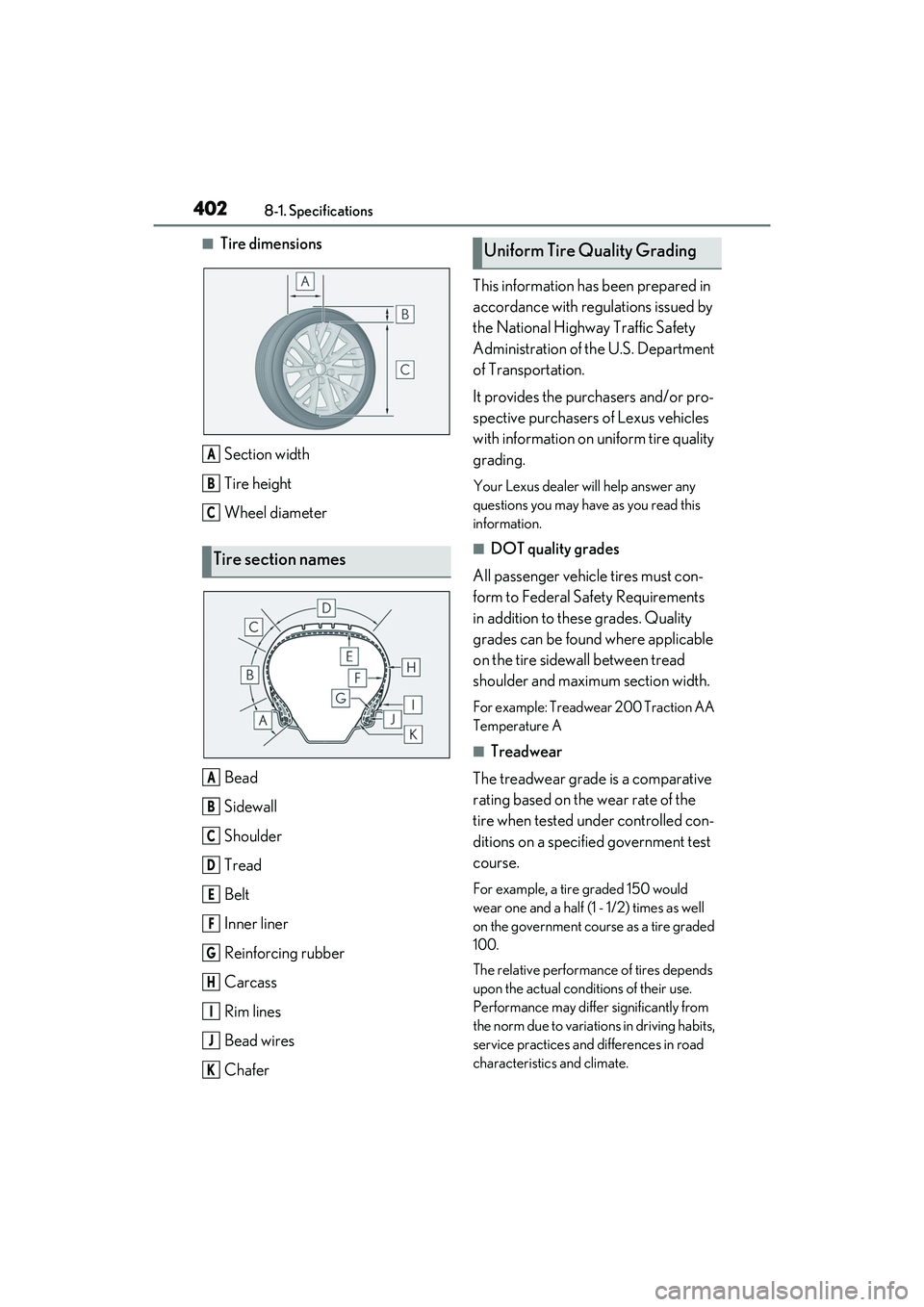
■Tire dimensionsSection width
Tire height
Wheel diameter
Bead
Sidewall
Shoulder
Tread
Belt
Inner liner
Reinforcing rubber
Carcass
Rim lines
Bead wires
Chafer This information has been prepared in
accordance with regulations issued by
the National Highway Traffic Safety
Administration of th
e U.S. Department
of Transportation.
It provides the purchasers and/or pro-
spective purchasers of Lexus vehicles
with information on uniform tire quality
grading.
Your Lexus dealer will help answer any
questions you may have as you read this
information.
■DOT quality grades
All passenger vehicle tires must con-
form to Federal Safety Requirements
in addition to these grades. Quality
grades can be found where applicable
on the tire sidewall between tread
shoulder and maximum section width.
For example: Treadwear 200 Traction AA
Temperature A
■Treadwear
The treadwear grade is a comparative
rating based on the wear rate of the
tire when tested under controlled con-
ditions on a specified government test
course.
For example, a tire graded 150 would
wear one and a half (1 - 1/2) times as well
on the government course as a tire graded
100.
The relative performance of tires depends
upon the actual conditions of their use.
Performance may differ significantly from
the norm due to variations in driving habits,
service practices and differences in road
characteristics and climate.
Tire section names
A
B
C
A
B
C
D
E
F
G
H
I
J
K
Uniform Tire Quality Grading
Page 423 of 468
421
9
9
For owners
For owners
9-1. For ownersReporting safety defects for U.S. owners ........................................ 422
Reporting safety defects for Canadian owners................... 422
Seat belt instructions for Cana- dian owners (in French)....... 423
SRS airbag instructions for Cana- dian owners (in French)....... 424
Headlight aim instructions for Canadian owners (in French)........................................................ 430
Page 425 of 468
4239-1. For owners
9
For owners
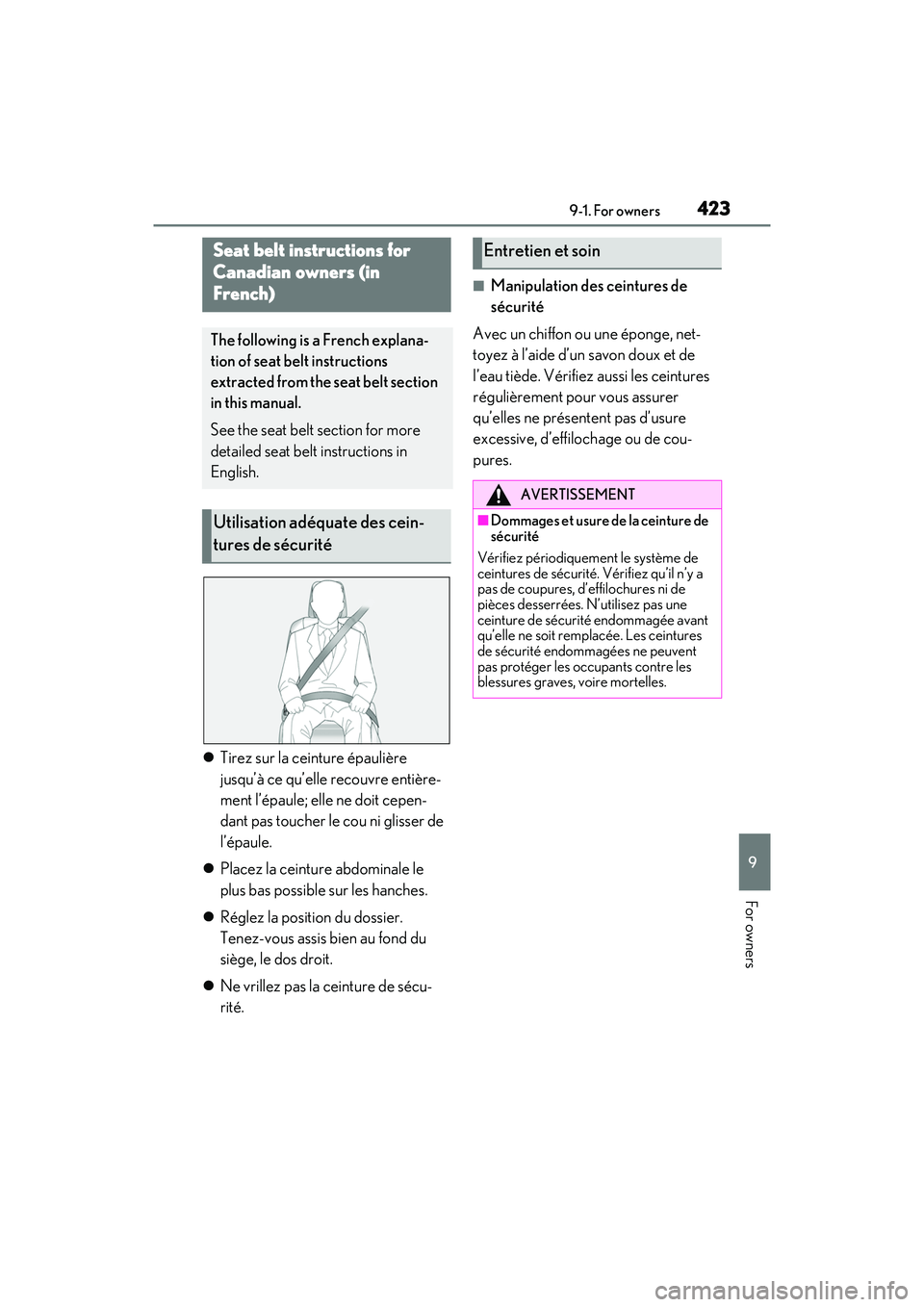
Tirez sur la ceinture épaulière
jusqu’à ce qu’elle recouvre entière-
ment l’épaule; elle ne doit cepen-
dant pas toucher le cou ni glisser de
l’épaule.
Placez la ceinture abdominale le
plus bas possible sur les hanches.
Réglez la position du dossier.
Tenez-vous assis bien au fond du
siège, le dos droit.
Ne vrillez pas la ceinture de sécu-
rité.
■Manipulation des ceintures de
sécurité
Avec un chiffon ou une éponge, net-
toyez à l’aide d’un savon doux et de
l’eau tiède. Vérifiez aussi les ceintures
régulièrement pour vous assurer
qu’elles ne présentent pas d’usure
excessive, d’effilochage ou de cou-
pures.
Seat belt instructions for
Canadian owners (in
French)
The following is a French explana-
tion of seat belt instructions
extracted from the seat belt section
in this manual.
See the seat belt section for more
detailed seat belt instructions in
English.
Utilisation adéquate des cein-
tures de sécurité
Entretien et soin
AVERTISSEMENT
■Dommages et usure de la ceinture de
sécurité
Vérifiez périodiquement le système de
ceintures de sécurité. Vérifiez qu’il n’y a
pas de coupures, d’effilochures ni de
pièces desserrées. N’utilisez pas une
ceinture de sécurité endommagée avant
qu’elle ne soit remp lacée. Les ceintures
de sécurité endommagées ne peuvent
pas protéger les occupants contre les
blessures graves, voire mortelles.