Page 372 of 468
3707-2. Steps to take in an emergency
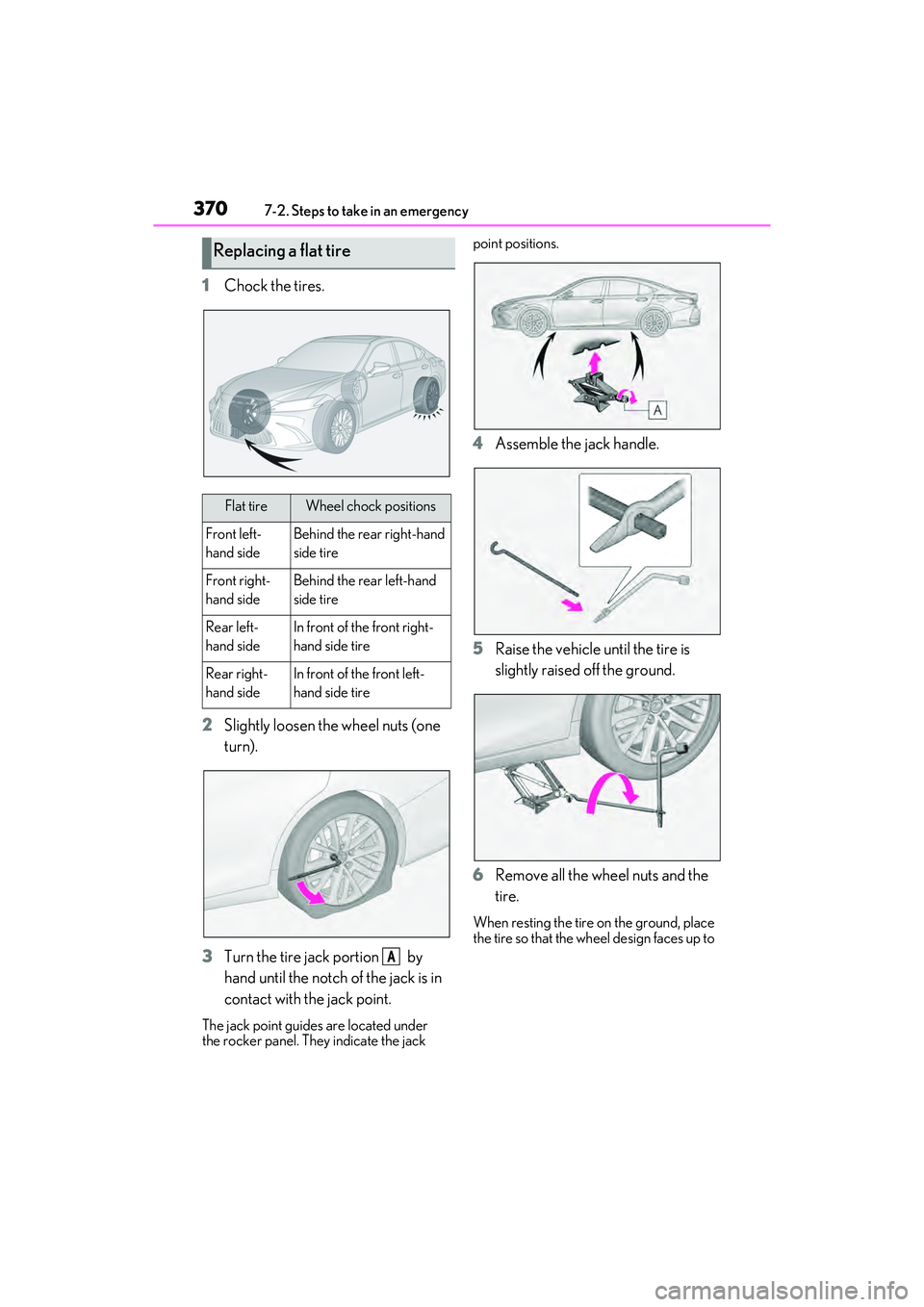
1Chock the tires.
2 Slightly loosen the wheel nuts (one
turn).
3 Turn the tire jack portion by
hand until the notch of the jack is in
contact with the jack point.
The jack point guides are located under
the rocker panel. They indicate the jack point positions.
4
Assemble the jack handle.
5 Raise the vehicle until the tire is
slightly raised off the ground.
6 Remove all the wheel nuts and the
tire.
When resting the tire on the ground, place
the tire so that the wheel design faces up to
Replacing a flat tire
Flat tireWheel chock positions
Front left-
hand sideBehind the rear right-hand
side tire
Front right-
hand sideBehind the rear left-hand
side tire
Rear left-
hand sideIn front of the front right-
hand side tire
Rear right-
hand sideIn front of the front left-
hand side tire
A
Page 374 of 468

3727-2. Steps to take in an emergency
3Lower the vehicle.
4 Firmly tighten each wheel nut two
or three times in the order shown in
the illustration.
Tightening torque:
76 ft•lbf (103 N•m, 10.5 kgf•m)
5Stow the flat tire, tire jack and all
tools.
■The compact spare tire
●The compact spare tire is identified by
the label “TEMPORARY USE ONLY”
on the tire sidewall.
Use the compact spare tire temporarily,
and only in an emergency.
●Make sure to check the tire inflation
pressure of the compact spare tire.
( P.395)
■After completing the tire change
The tire pressure warning system must be
reset. ( P.324)
■When using the compact spare tire
As the compact spare tire is not equipped
with a tire pressure warning valve and
transmitter, low inflation pressure of the spare tire will not be indicated by the tire
pressure warning system. Also, if you
replace the compact spare tire after the tire
pressure warning light comes on, the light
remains on.
■When the compact spare tire is
attached
The vehicle becomes lower when driving
with the compact spare tire compared to
when driving with standard tires.
■If you have a flat front tire on a road cov-
ered with snow or ice (vehicles with 17-
inch tires)
Install the compact spare tire on one of the
rear wheels of the vehicle. Perform the fol-
lowing steps and fit tire chains to the front
tires:
1 Replace a rear tire with the compact
spare tire.
2 Replace the flat front tire with the tire
removed from the rear of the vehicle.
3 Fit tire chains to the front tires.
WARNING
■When using the compact spare tire
●Remember that the compact spare tire
provided is specifically designed for
use with your vehicle. Do not use your
compact spare tire on another vehicle.
●Do not use more than one compact
spare tire simultaneously.
●Replace the compact spare tire with a
standard tire as soon as possible.
●Avoid sudden acceleration, abrupt
steering, sudden braking and shifting
operations that cause sudden engine
braking.
■When the compact spare tire is
attached
The vehicle speed may not be correctly
detected, and the following systems may
not operate correctly:
• ABS & Brake assist
•VSC
Page 375 of 468

3737-2. Steps to take in an emergency
7
When trouble arises
WARNING
•TRAC
• Dynamic radar cruise control with full-speed range
• PCS (Pre-Collision System)
•EPS
• Adaptive Variable Suspension system (if equipped)
• LTA (Lane Tracing Assist)
• Panoramic view monitor (if equipped)
• Lexus parking assist monitor (if equipped)
• Intuitive parking assist (if equipped)
• Navigation system (if equipped)
• BSM (Blind Spot Monitor)
• AHB (Automatic High Beam)
Also, not only can the following system
not be utilized fully, but it may even nega-
tively affect the drive-train components:
• AWD system (if equipped)
■Speed limit when using the compact
spare tire
Do not drive at speeds in excess of 50
mph (80 km/h) when a compact spare
tire is installed on the vehicle.
The compact spare tire is not designed
for driving at high speeds. Failure to
observe this precaution may lead to an
accident causing death or serious injury.
■After using the tools and jack
Before driving, make sure all the tools
and jack are securely in place in their
storage location to reduce the possibility
of personal injury during a collision or
sudden braking.
NOTICE
■Be careful when driving over bumps
with the compact spare tire installed
on the vehicle
The vehicle becomes lower when driving
with the compact spare tire compared to
when driving with standard tires. Be
careful when driving over uneven road
surfaces.
■Driving with tire chains and the com-
pact spare tire
Do not fit tire chains to the compact
spare tire.
Tire chains may damage the vehicle
body and adversely affect driving perfor-
mance.
■When replacing the tires
When removing or fitting the wheels,
tires or the tire pressure warning valve
and transmitter, contact your Lexus
dealer as the tire pressure warning valve
and transmitter may be damaged if not
handled correctly.
Page 387 of 468

3857-2. Steps to take in an emergency
7
When trouble arises
1Stop the engine. Set the parking
brake and shift the shift lever to P.
2 Remove the mud, snow or sand
from around the front wheels.
3 Place wood, stones or some other
material under the front wheels to
help provide traction.
4 Restart the engine.
5 Shift the shift lever to D or R and
release the parking brake. Then,
while exercising caution, depress
the accelerator pedal.
■When it is difficult to free the vehicle
Press the switch to turn off TRAC.
If the vehicle becomes stuck
Carry out the following procedures
if the tires spin or the vehicle
becomes stuck in mud, dirt or snow:
Recovering procedure
WARNING
■When attempting to free a stuck vehi-
cle
If you choose to push the vehicle back
and forth to free it, make sure the sur-
rounding area is clear to avoid striking
other vehicles, objects or people. The
vehicle may also lunge forward or lunge
back suddenly as it becomes free. Use
extreme caution.
■When shifting the shift lever
Be careful not to shift the shift lever with
the accelerator pedal depressed.
This may lead to unexpected rapid accel-
eration of the vehicle that may cause an
accident resulting in death or serious
injury.
NOTICE
■To avoid damaging the transmission
and other components
●Avoid spinning the front wheels and
depressing the accelerator pedal
more than necessary.
●If the vehicle remains stuck even after
these procedures are performed, the
vehicle may require towing to be
freed.
Page 390 of 468

3888-1. Specifications
8-1 .S pec if ic ati on s
*1:Unladen vehicle
*2: Vehicles with 215/55R17 tires
*3: Vehicles with 235/45R18 tires or 235/40R19 tires
■Vehicle identification number
The vehicle identification number
(VIN) is the legal identifier for your
vehicle. This is the primary identifica- tion number for your Lexus. It is used in
registering the ownership of your vehi-
cle.
This number is on the top left of the
instrument panel.
Maintenance data (fuel, oil level, etc.)
Dimensions and weight
Overall length195.9 in. (4975 mm)
Overall width73.4 in. (1865 mm)
Overall height*12WD models56.9 in. (1445 mm)
AWD models57.1 in. (1450 mm)
Wheelbase113.0 in. (2870 mm)
Front tread*1
2WD models62.9 in. (1598 mm)*2
62.5 in. (1588 mm)*3
AWD models63.0 in. (1599 mm)*2
62.6 in. (1589 mm)*3
Rear tread*1
2WD models63.3 in. (1609 mm)*2
63.0 in. (1599 mm)*3
AWD models63.6 in. (1616 mm)*2
63.2 in. (1606 mm)*3
Vehicle capacity weight
(Occupants + luggage)905 lb. (410 kg)
Seating capacity
Seating capacity5 (Front 2, Rear 3)
Vehicle identification
Page 397 of 468
3958-1. Specifications
8
Vehicle specifications
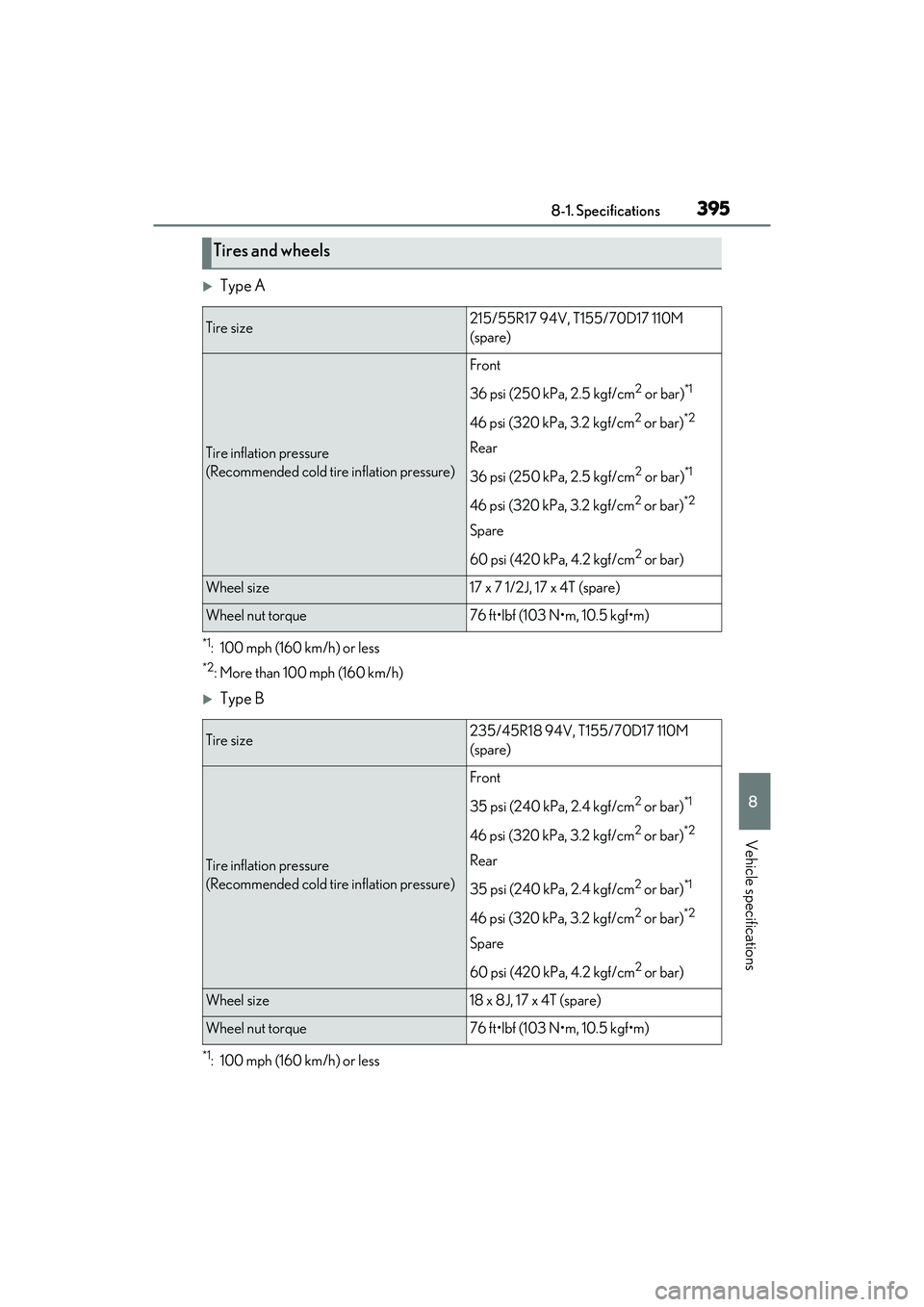
Type A
*1: 100 mph (160 km/h) or less
*2:More than 100 mph (160 km/h)
Type B
*1: 100 mph (160 km/h) or less
Tires and wheels
Tire size215/55R17 94V, T155/70D17 110M
(spare)
Tire inflation pressure
(Recommended cold tire inflation pressure)
Front
36 psi (250 kPa, 2.5 kgf/cm
2 or bar)*1
46 psi (320 kPa, 3.2 kgf/cm2 or bar)*2
Rear
36 psi (250 kPa, 2.5 kgf/cm
2 or bar)*1
46 psi (320 kPa, 3.2 kgf/cm2 or bar)*2
Spare
60 psi (420 kPa, 4.2 kgf/cm
2 or bar)
Wheel size17 x 7 1/2J, 17 x 4T (spare)
Wheel nut torque76 ft•lbf (103 N•m, 10.5 kgf•m)
Tire size235/45R18 94V, T155/70D17 110M
(spare)
Tire inflation pressure
(Recommended cold tire inflation pressure)
Front
35 psi (240 kPa, 2.4 kgf/cm
2 or bar)*1
46 psi (320 kPa, 3.2 kgf/cm2 or bar)*2
Rear
35 psi (240 kPa, 2.4 kgf/cm
2 or bar)*1
46 psi (320 kPa, 3.2 kgf/cm2 or bar)*2
Spare
60 psi (420 kPa, 4.2 kgf/cm
2 or bar)
Wheel size18 x 8J, 17 x 4T (spare)
Wheel nut torque76 ft•lbf (103 N•m, 10.5 kgf•m)
Page 401 of 468
3998-1. Specifications
8
Vehicle specifications
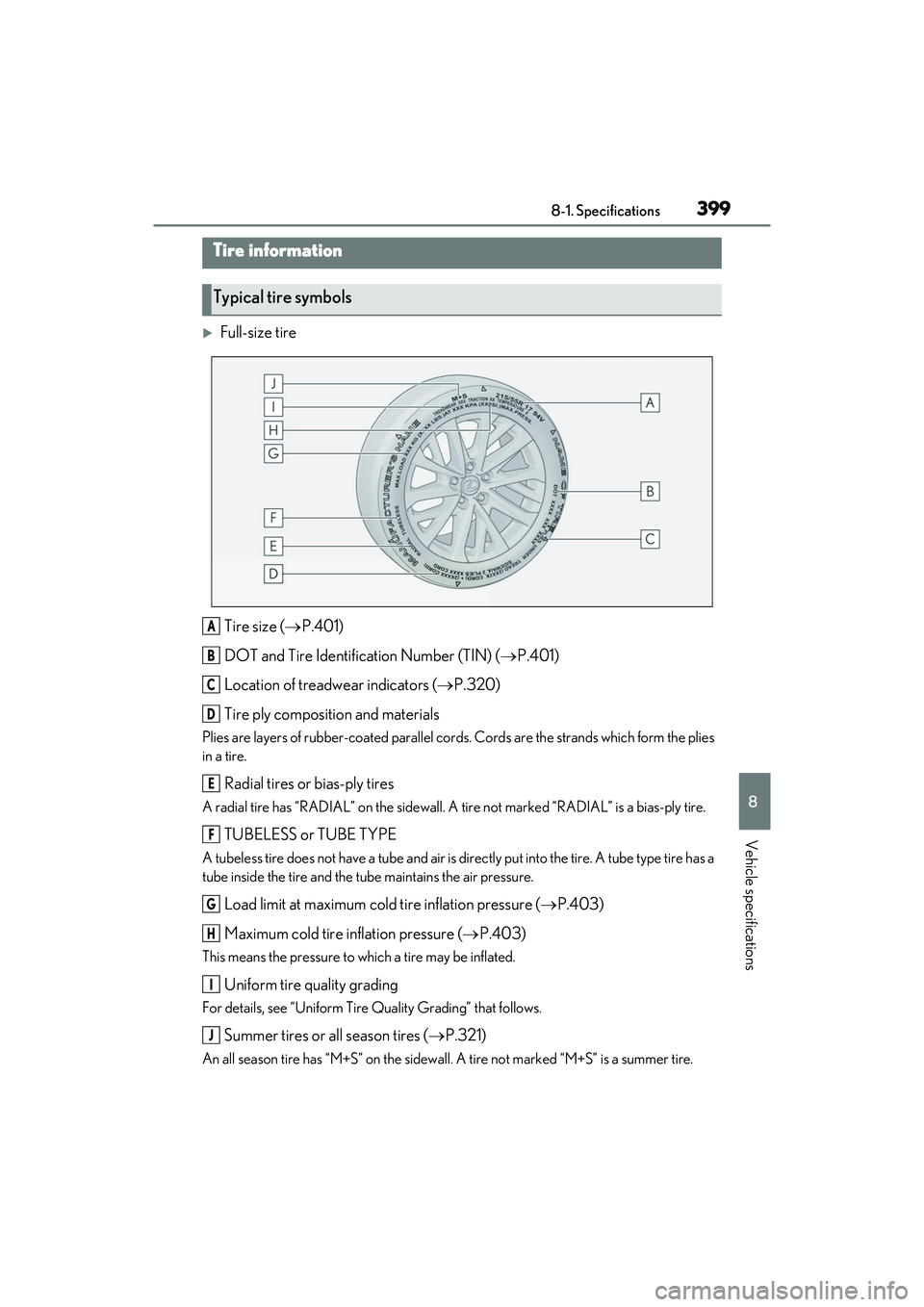
Full-size tireTire size ( P.401)
DOT and Tire Identification Number (TIN) ( P.401)
Location of treadwear indicators ( P.320)
Tire ply composition and materials
Plies are layers of rubber-coated parallel cord s. Cords are the strands which form the plies
in a tire.
Radial tires or bias-ply tires
A radial tire has “RADIAL” on the sidewall. A tire not marked “RADIAL” is a bias-ply tire.
TUBELESS or TUBE TYPE
A tubeless tire does not have a tube and air is directly put into the tire. A tube type tire has a
tube inside the tire and the tube maintains the air pressure.
Load limit at maximum cold tire inflation pressure ( P.403)
Maximum cold tire inflation pressure ( P.403)
This means the pressure to which a tire may be inflated.
Uniform tire quality grading
For details, see “Uniform Tire Quality Grading” that follows.
Summer tires or all season tires (P.321)
An all season tire has “M+S” on the sidewall. A tire not marked “M+S” is a summer tire.
Tire information
Typical tire symbols
A
B
C
D
E
F
G
H
I
J
Page 402 of 468
4008-1. Specifications
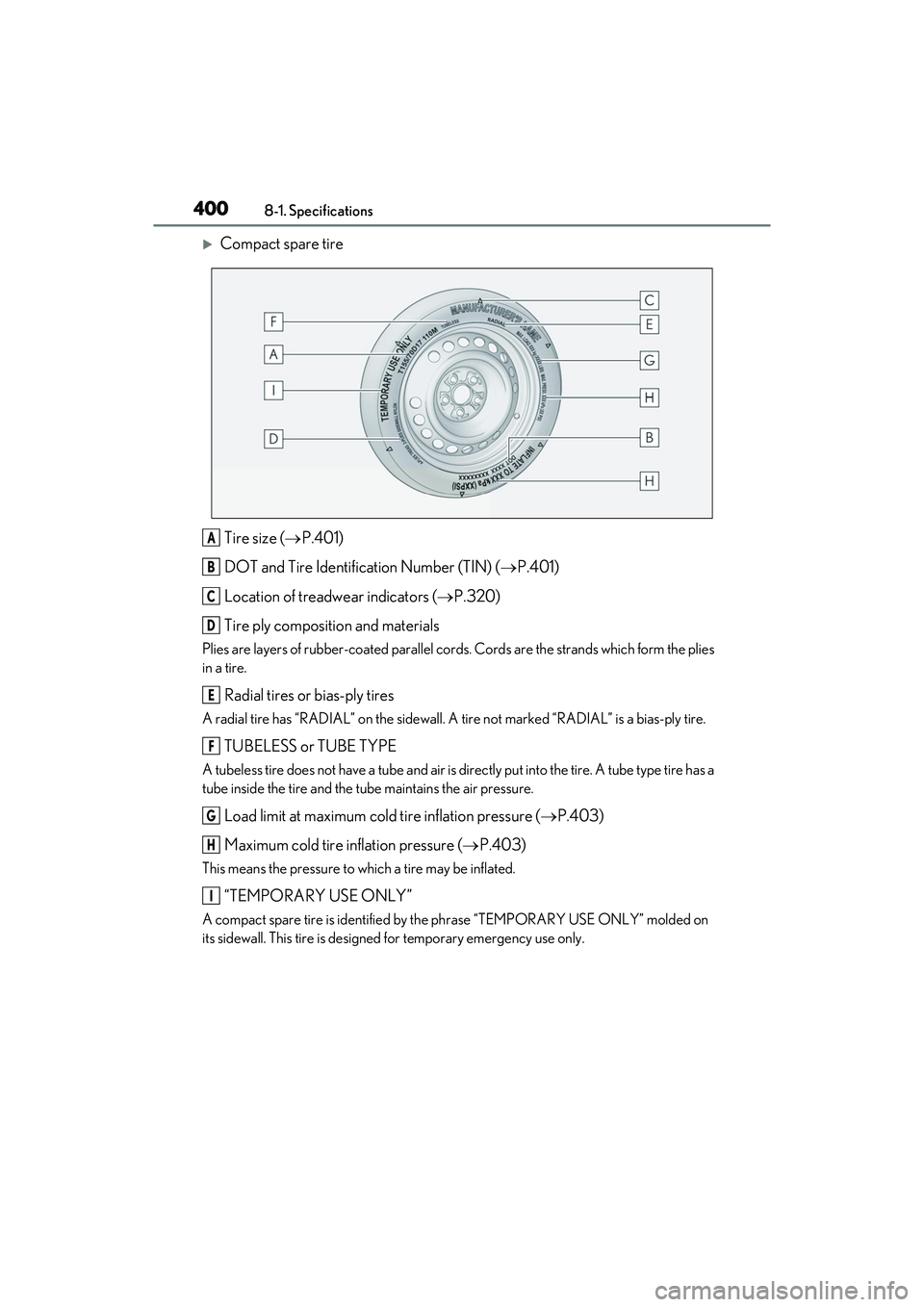
Compact spare tireTire size ( P.401)
DOT and Tire Identification Number (TIN) ( P.401)
Location of treadwear indicators ( P.320)
Tire ply composition and materials
Plies are layers of rubber-coated parallel cord s. Cords are the strands which form the plies
in a tire.
Radial tires or bias-ply tires
A radial tire has “RADIAL” on the sidewall. A tire not marked “RADIAL” is a bias-ply tire.
TUBELESS or TUBE TYPE
A tubeless tire does not have a tube and air is directly put into the tire. A tube type tire has a
tube inside the tire and the tube maintains the air pressure.
Load limit at maximum cold tire inflation pressure ( P.403)
Maximum cold tire inflation pressure ( P.403)
This means the pressure to which a tire may be inflated.
“TEMPORARY USE ONLY”
A compact spare tire is identified by the phrase “TEMPORARY USE ONLY” molded on
its sidewall. This tire is designed for temporary emergency use only.
A
B
C
D
E
F
G
H
I