2022 LEXUS ES350 inflation pressure
[x] Cancel search: inflation pressurePage 397 of 468
3958-1. Specifications
8
Vehicle specifications
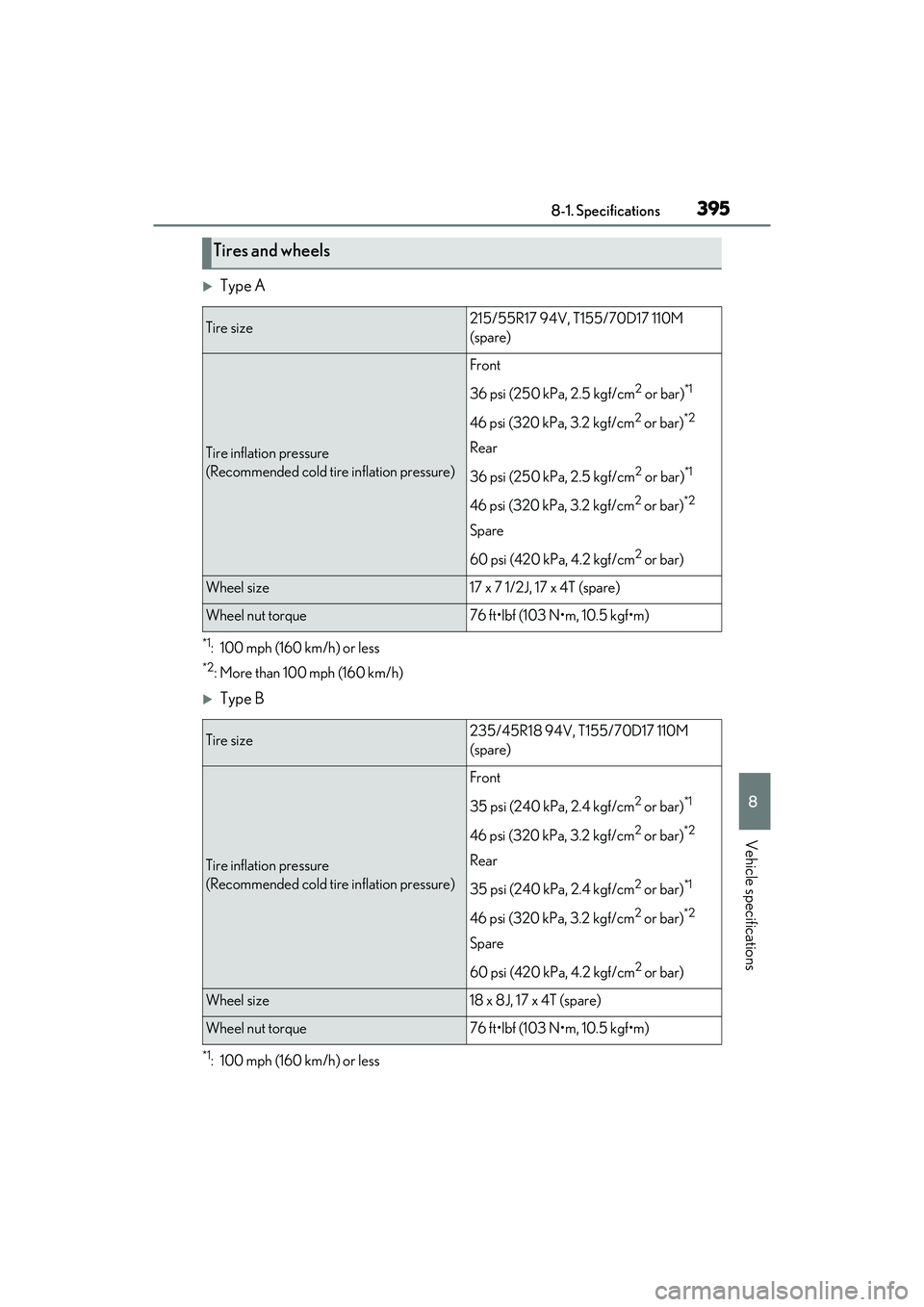
Type A
*1: 100 mph (160 km/h) or less
*2:More than 100 mph (160 km/h)
Type B
*1: 100 mph (160 km/h) or less
Tires and wheels
Tire size215/55R17 94V, T155/70D17 110M
(spare)
Tire inflation pressure
(Recommended cold tire inflation pressure)
Front
36 psi (250 kPa, 2.5 kgf/cm
2 or bar)*1
46 psi (320 kPa, 3.2 kgf/cm2 or bar)*2
Rear
36 psi (250 kPa, 2.5 kgf/cm
2 or bar)*1
46 psi (320 kPa, 3.2 kgf/cm2 or bar)*2
Spare
60 psi (420 kPa, 4.2 kgf/cm
2 or bar)
Wheel size17 x 7 1/2J, 17 x 4T (spare)
Wheel nut torque76 ft•lbf (103 N•m, 10.5 kgf•m)
Tire size235/45R18 94V, T155/70D17 110M
(spare)
Tire inflation pressure
(Recommended cold tire inflation pressure)
Front
35 psi (240 kPa, 2.4 kgf/cm
2 or bar)*1
46 psi (320 kPa, 3.2 kgf/cm2 or bar)*2
Rear
35 psi (240 kPa, 2.4 kgf/cm
2 or bar)*1
46 psi (320 kPa, 3.2 kgf/cm2 or bar)*2
Spare
60 psi (420 kPa, 4.2 kgf/cm
2 or bar)
Wheel size18 x 8J, 17 x 4T (spare)
Wheel nut torque76 ft•lbf (103 N•m, 10.5 kgf•m)
Page 398 of 468
3968-1. Specifications
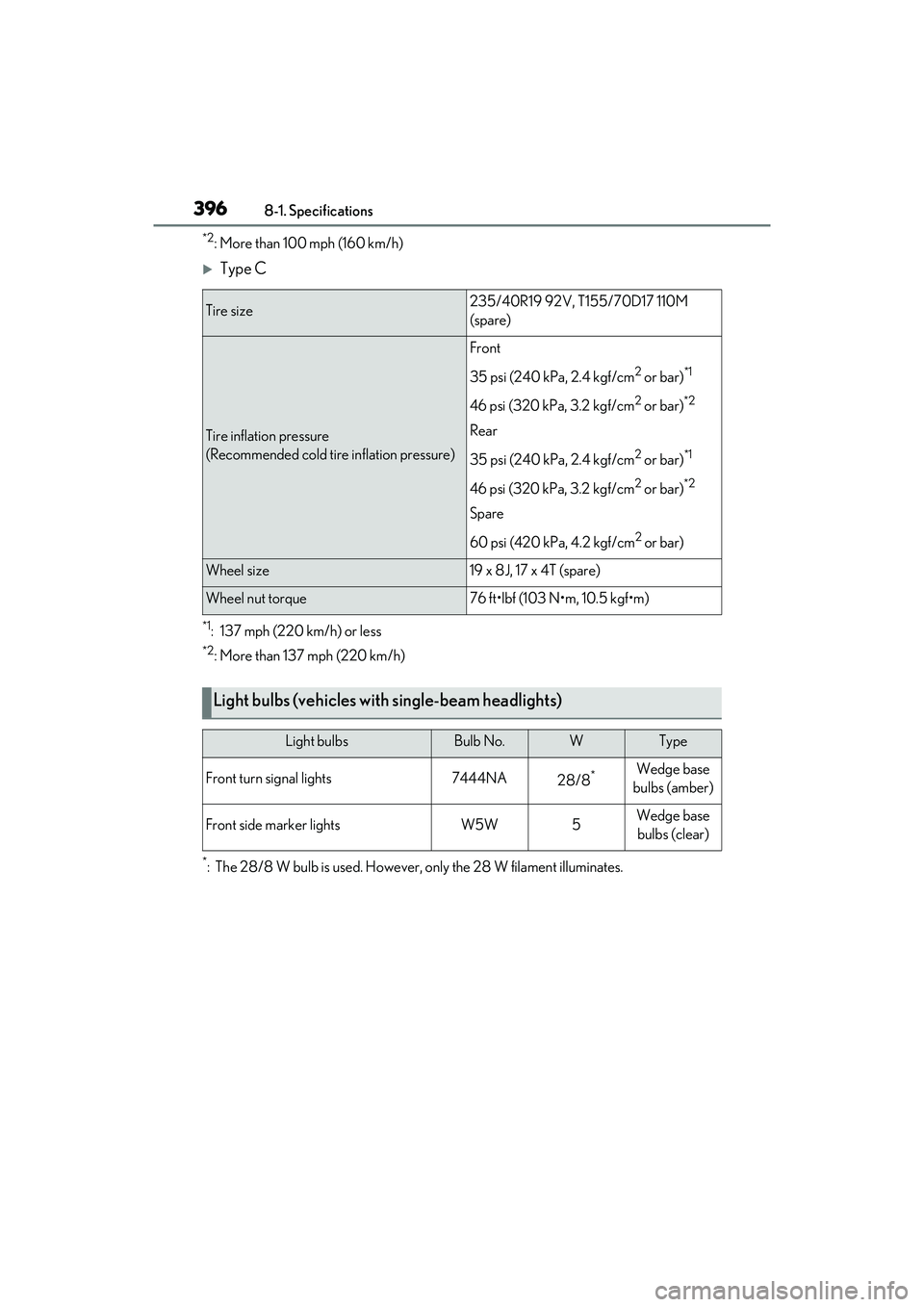
*2:More than 100 mph (160 km/h)
Type C
*1: 137 mph (220 km/h) or less
*2:More than 137 mph (220 km/h)
*: The 28/8 W bulb is used. However, only the 28 W filament illuminates.
Tire size235/40R19 92V, T155/70D17 110M
(spare)
Tire inflation pressure
(Recommended cold tire inflation pressure)
Front
35 psi (240 kPa, 2.4 kgf/cm
2 or bar)*1
46 psi (320 kPa, 3.2 kgf/cm2 or bar)*2
Rear
35 psi (240 kPa, 2.4 kgf/cm
2 or bar)*1
46 psi (320 kPa, 3.2 kgf/cm2 or bar)*2
Spare
60 psi (420 kPa, 4.2 kgf/cm
2 or bar)
Wheel size19 x 8J, 17 x 4T (spare)
Wheel nut torque76 ft•lbf (103 N•m, 10.5 kgf•m)
Light bulbs (vehicles with single-beam headlights)
Light bulbsBulb No.WType
Front turn signal lights7444NA28/8*Wedge base
bulbs (amber)
Front side marker lightsW5W5Wedge base bulbs (clear)
Page 401 of 468
3998-1. Specifications
8
Vehicle specifications
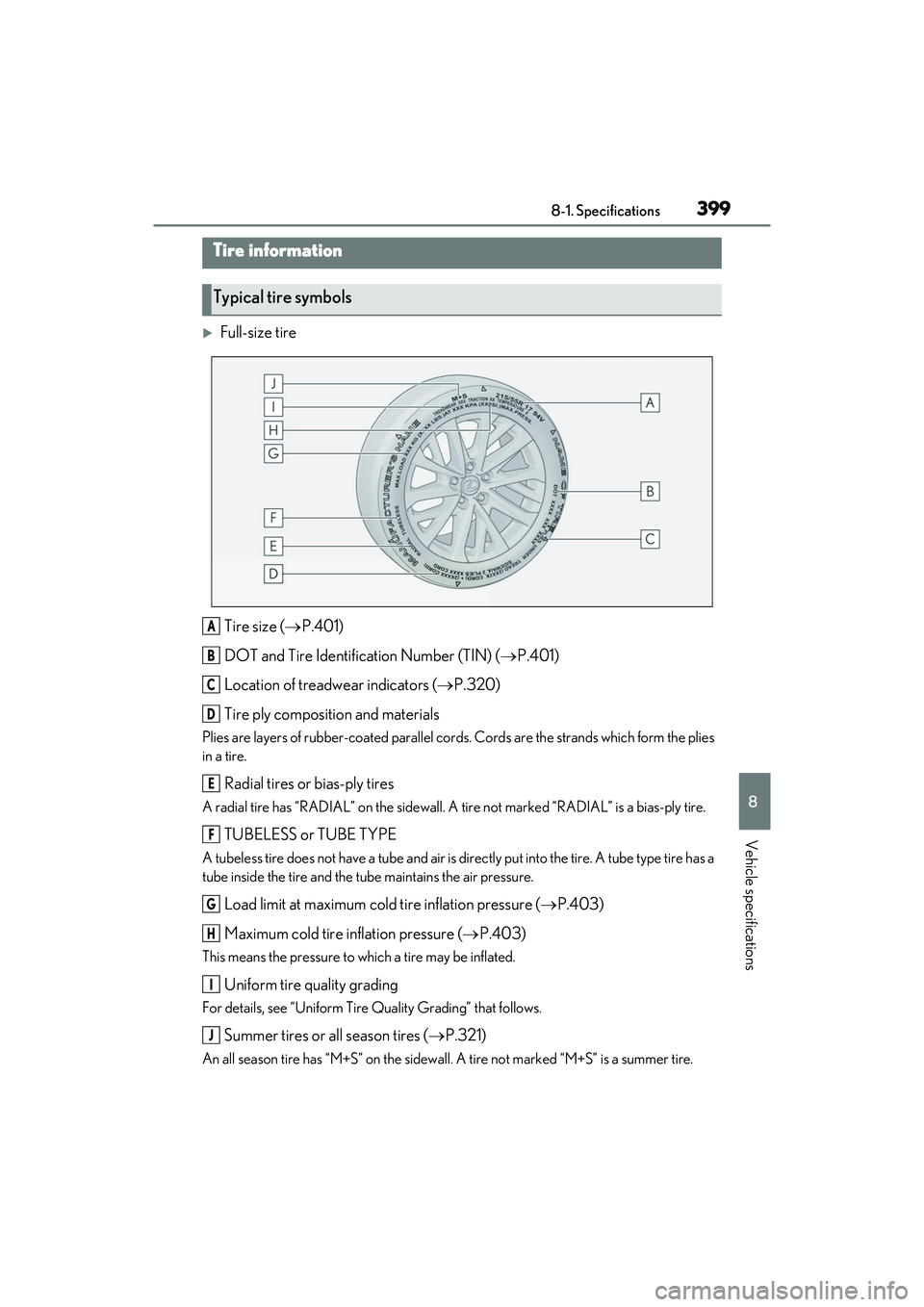
Full-size tireTire size ( P.401)
DOT and Tire Identification Number (TIN) ( P.401)
Location of treadwear indicators ( P.320)
Tire ply composition and materials
Plies are layers of rubber-coated parallel cord s. Cords are the strands which form the plies
in a tire.
Radial tires or bias-ply tires
A radial tire has “RADIAL” on the sidewall. A tire not marked “RADIAL” is a bias-ply tire.
TUBELESS or TUBE TYPE
A tubeless tire does not have a tube and air is directly put into the tire. A tube type tire has a
tube inside the tire and the tube maintains the air pressure.
Load limit at maximum cold tire inflation pressure ( P.403)
Maximum cold tire inflation pressure ( P.403)
This means the pressure to which a tire may be inflated.
Uniform tire quality grading
For details, see “Uniform Tire Quality Grading” that follows.
Summer tires or all season tires (P.321)
An all season tire has “M+S” on the sidewall. A tire not marked “M+S” is a summer tire.
Tire information
Typical tire symbols
A
B
C
D
E
F
G
H
I
J
Page 402 of 468
4008-1. Specifications
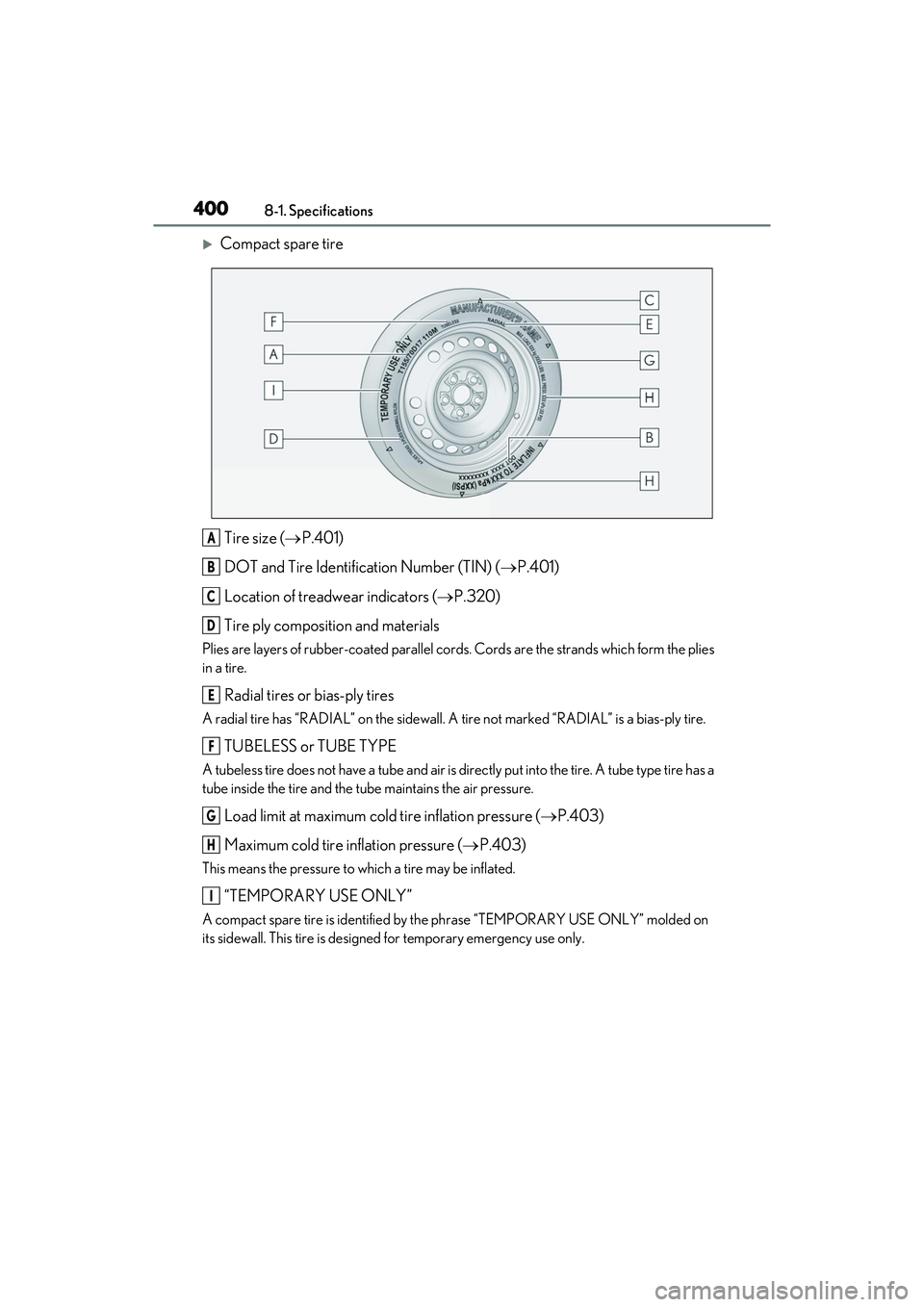
Compact spare tireTire size ( P.401)
DOT and Tire Identification Number (TIN) ( P.401)
Location of treadwear indicators ( P.320)
Tire ply composition and materials
Plies are layers of rubber-coated parallel cord s. Cords are the strands which form the plies
in a tire.
Radial tires or bias-ply tires
A radial tire has “RADIAL” on the sidewall. A tire not marked “RADIAL” is a bias-ply tire.
TUBELESS or TUBE TYPE
A tubeless tire does not have a tube and air is directly put into the tire. A tube type tire has a
tube inside the tire and the tube maintains the air pressure.
Load limit at maximum cold tire inflation pressure ( P.403)
Maximum cold tire inflation pressure ( P.403)
This means the pressure to which a tire may be inflated.
“TEMPORARY USE ONLY”
A compact spare tire is identified by the phrase “TEMPORARY USE ONLY” molded on
its sidewall. This tire is designed for temporary emergency use only.
A
B
C
D
E
F
G
H
I
Page 405 of 468
4038-1. Specifications
8
Vehicle specifications
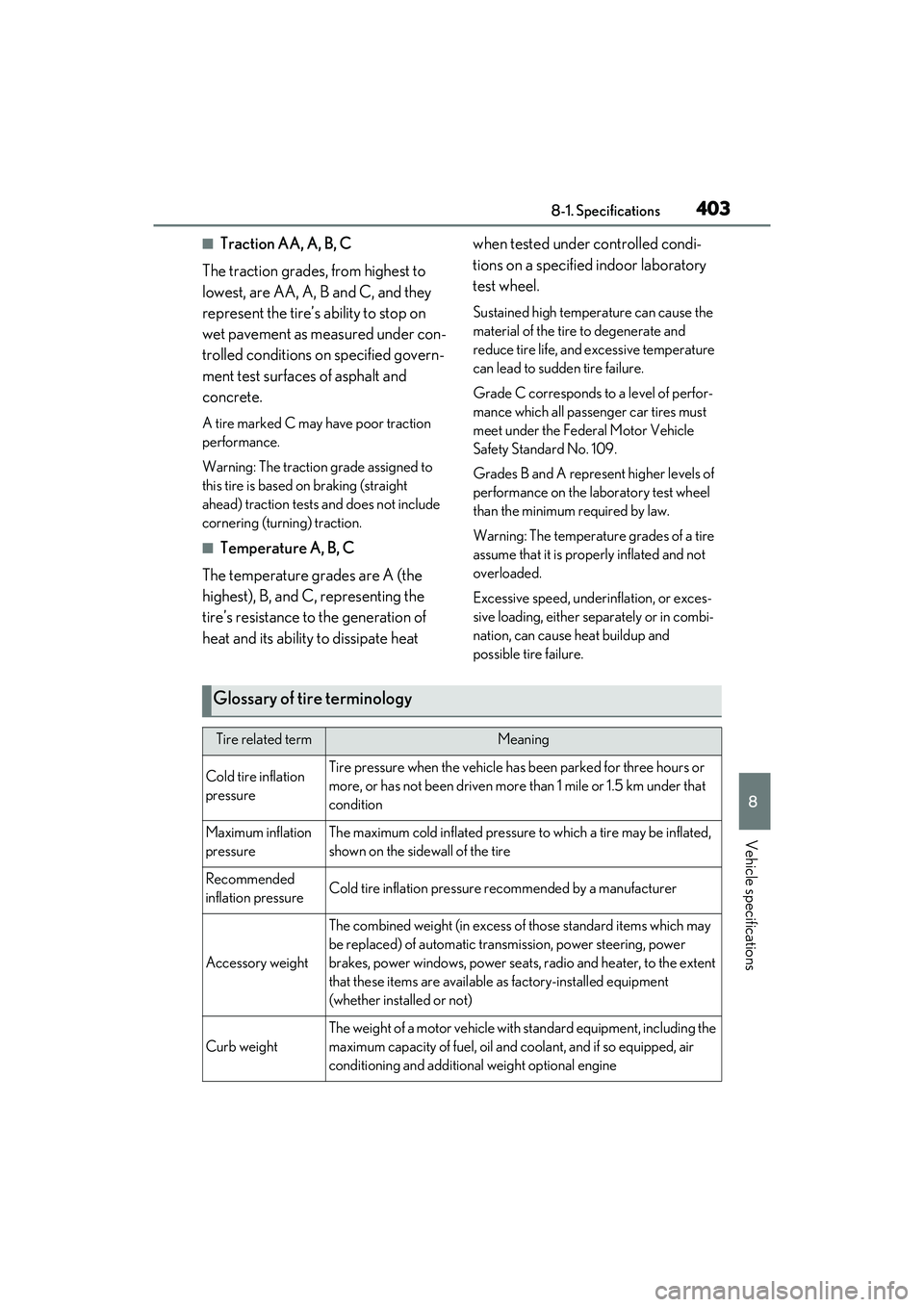
■Traction AA, A, B, C
The traction grades, from highest to
lowest, are AA, A, B and C, and they
represent the tire’s ability to stop on
wet pavement as measured under con-
trolled conditions on specified govern-
ment test surfaces of asphalt and
concrete.
A tire marked C may have poor traction
performance.
Warning: The traction grade assigned to
this tire is based on braking (straight
ahead) traction tests and does not include
cornering (turning) traction.
■Temperature A, B, C
The temperature grades are A (the
highest), B, and C, representing the
tire’s resistance to the generation of
heat and its ability to dissipate heat when tested under controlled condi-
tions on a specified indoor laboratory
test wheel.
Sustained high temperature can cause the
material of the tire to degenerate and
reduce tire life, and excessive temperature
can lead to sudden tire failure.
Grade C corresponds to a level of perfor-
mance which all passenger car tires must
meet under the Federal Motor Vehicle
Safety Standard No. 109.
Grades B and A represent higher levels of
performance on the laboratory test wheel
than the minimum required by law.
Warning: The temperature grades of a tire
assume that it is properly inflated and not
overloaded.
Excessive speed, underinflation, or exces-
sive loading, either separately or in combi-
nation, can cause heat buildup and
possible tire failure.
Glossary of tire terminology
Tire related termMeaning
Cold tire inflation
pressureTire pressure when the vehicle has been parked for three hours or
more, or has not been driven more
than 1 mile or 1.5 km under that
condition
Maximum inflation
pressureThe maximum cold inflated pressure to which a tire may be inflated,
shown on the sidewall of the tire
Recommended
inflation pressureCold tire inflation pressure recommended by a manufacturer
Accessory weight
The combined weight (in excess of those standard items which may
be replaced) of automatic transmission, power steering, power
brakes, power windows, power seats, radio and heater, to the extent
that these items are available as factory-installed equipment
(whether installed or not)
Curb weight
The weight of a motor vehicle with standard equipment, including the
maximum capacity of fuel, oil and coolant, and if so equipped, air
conditioning and additional weight optional engine
Page 407 of 468
4058-1. Specifications
8
Vehicle specifications
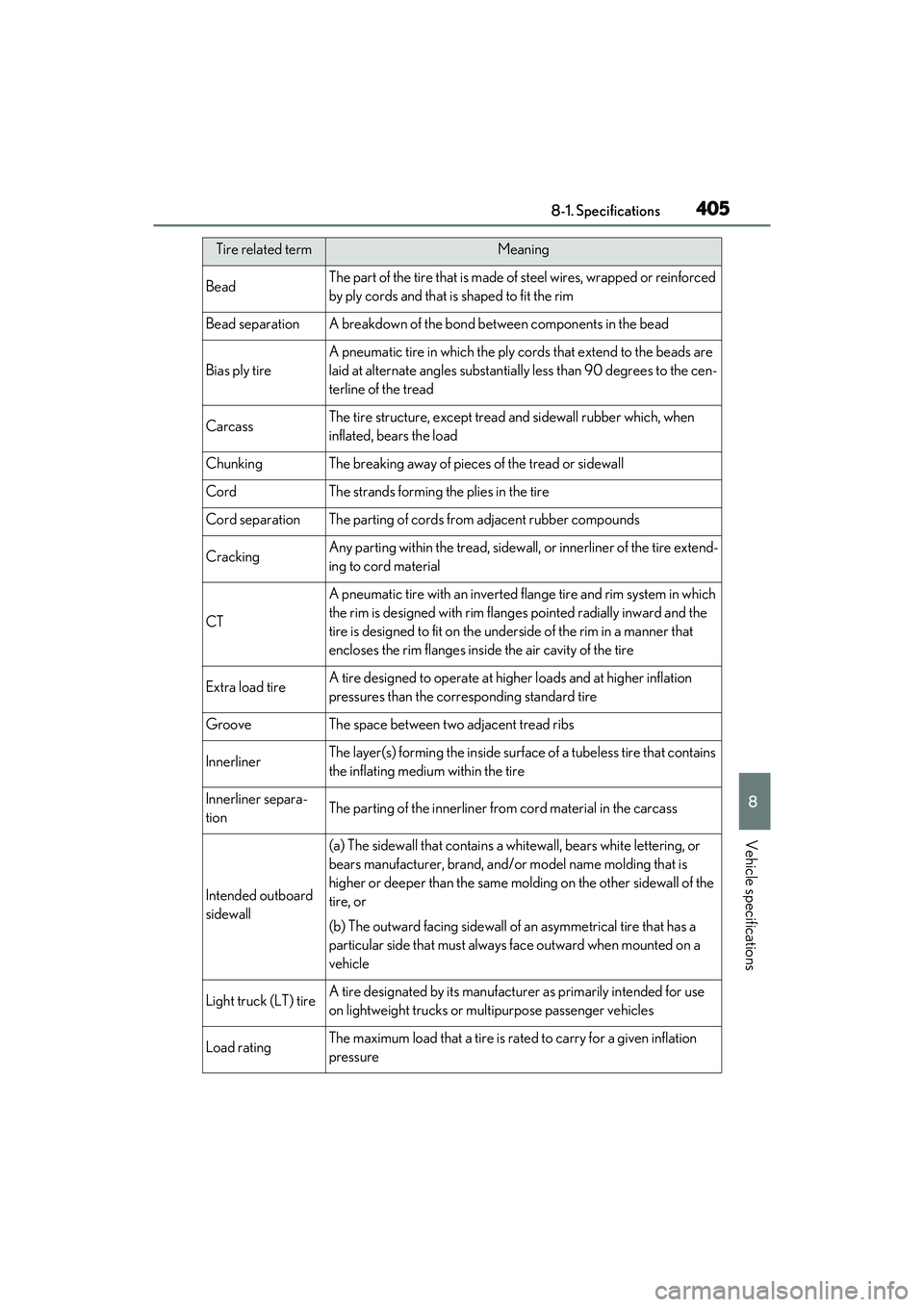
BeadThe part of the tire that is made of steel wires, wrapped or reinforced
by ply cords and that is shaped to fit the rim
Bead separationA breakdown of the bond between components in the bead
Bias ply tire
A pneumatic tire in which the ply cords that extend to the beads are
laid at alternate angles substantially less than 90 degrees to the cen-
terline of the tread
CarcassThe tire structure, except tread and sidewall rubber which, when
inflated, bears the load
ChunkingThe breaking away of pieces of the tread or sidewall
CordThe strands forming the plies in the tire
Cord separationThe parting of cords from adjacent rubber compounds
CrackingAny parting within the tread, sidewall, or innerliner of the tire extend-
ing to cord material
CT
A pneumatic tire with an inverted flange tire and rim system in which
the rim is designed with rim flange s pointed radially inward and the
tire is designed to fit on the underside of the rim in a manner that
encloses the rim flanges inside the air cavity of the tire
Extra load tireA tire designed to operate at higher loads and at higher inflation
pressures than the corresponding standard tire
GrooveThe space between two adjacent tread ribs
InnerlinerThe layer(s) forming the inside surface of a tubeless tire that contains
the inflating medium within the tire
Innerliner separa-
tionThe parting of the innerliner from cord material in the carcass
Intended outboard
sidewall
(a) The sidewall that contains a whit ewall, bears white lettering, or
bears manufacturer, brand, and/or model name molding that is
higher or deeper than the same molding on the other sidewall of the
tire, or
(b) The outward facing sidewall of an asymmetrical tire that has a
particular side that must always face outward when mounted on a
vehicle
Light truck (LT) tireA tire designated by its manufacturer as primarily intended for use
on lightweight trucks or multipurpose passenger vehicles
Load ratingThe maximum load that a tire is rated to carry for a given inflation
pressure
Tire related termMeaning
Page 408 of 468

4068-1. Specifications
Maximum load rat-
ingThe load rating for a tire at the maximum permissible inflation pres-
sure for that tire
Maximum permissi-
ble inflation pres-
sure
The maximum cold inflation pressure to which a tire may be inflated
Measuring rimThe rim on which a tire is fitted for physical dimension requirements
Open spliceAny parting at any junction of trea d, sidewall, or innerliner that
extends to cord material
Outer diameterThe overall diameter of an inflated new tire
Overall width
The linear distance between the exteriors of the sidewalls of an
inflated tire, including elevations due to labeling, decorations, or pro-
tective bands or ribs
Passenger car tire
A tire intended for use on passeng er cars, multipurpose passenger
vehicles, and trucks, that have a gross vehicle weight rating (GVWR)
of 10,000 lb. or less.
PlyA layer of rubber-coated parallel cords
Ply separationA parting of rubber compound between adjacent plies
Pneumatic tire
A mechanical device made of rubber, chemicals, fabric and steel or
other materials, that, when mounted on an automotive wheel, pro-
vides the traction and contains the gas or fluid that sustains the load
Radial ply tireA pneumatic tire in which the ply cords that extend to the beads are
laid at substantially 90 degrees to the centerline of the tread
Reinforced tireA tire designed to operate at higher loads and at higher inflation
pressures than the corresponding standard tire
Section width
The linear distance between the exteriors of the sidewalls of an
inflated tire, excluding elevations due to labeling, decoration, or pro-
tective bands
SidewallThat portion of a tire between the tread and bead
Sidewall separationThe parting of the rubber compound from the cord material in the
sidewall
Tire related termMeaning
Page 421 of 468
4198-3. Items to initialize
8
Vehicle specifications
8-3.Items to initialize
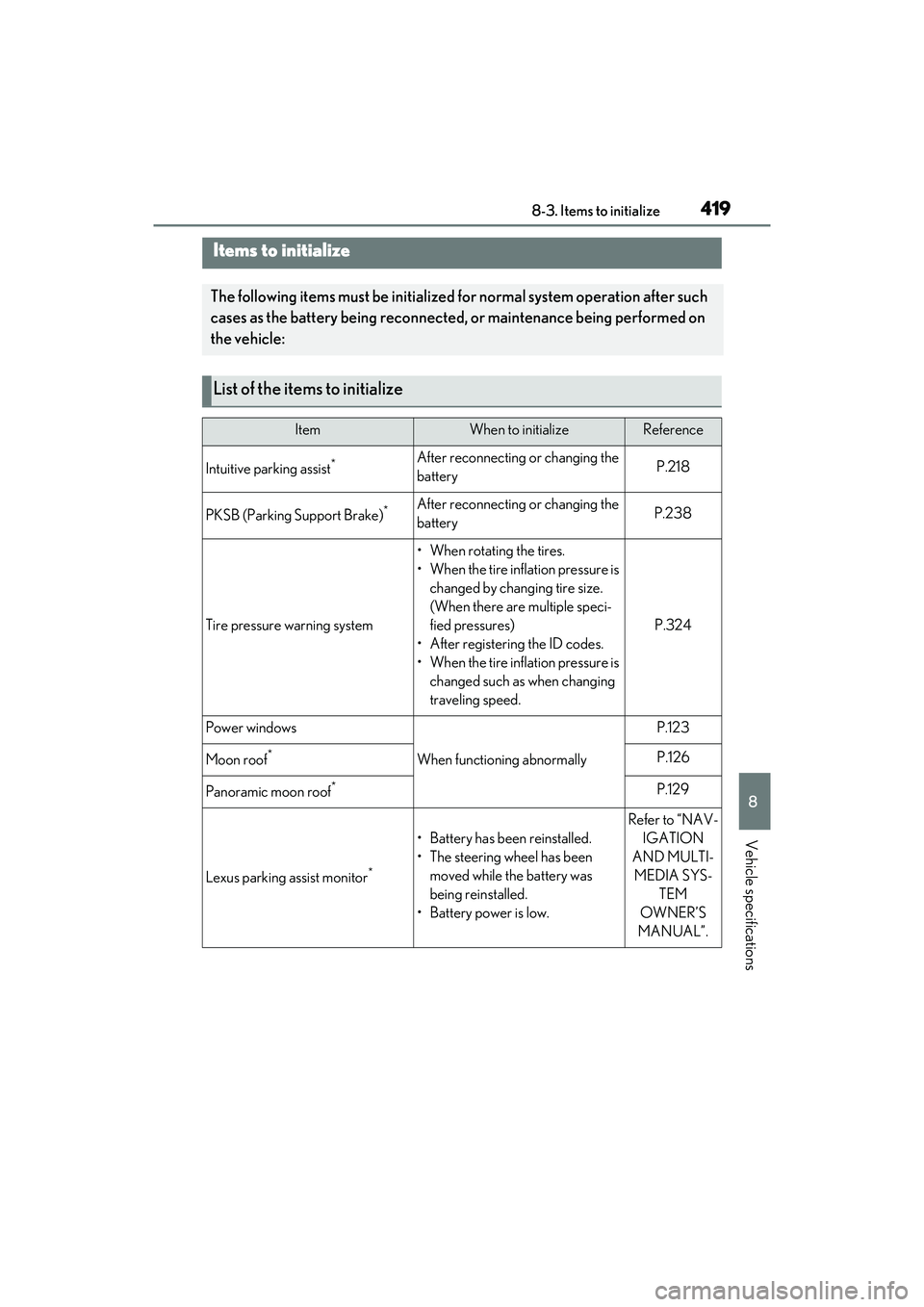
Items to initialize
The following items must be initialized for normal system operation after such
cases as the battery being reconnected, or maintenance being performed on
the vehicle:
List of the items to initialize
ItemWhen to initializeReference
Intuitive parking assist*After reconnecting or changing the
batteryP.218
PKSB (Parking Support Brake)*After reconnecting or changing the
batteryP.238
Tire pressure warning system
• When rotating the tires.
• When the tire inflation pressure is changed by changing tire size.
(When there are multiple speci-
fied pressures)
• After registering the ID codes.
• When the tire inflation pressure is changed such as when changing
traveling speed.
P.324
Power windows
When functioning abnormally
P.123
Moon roof*P.126
Panoramic moon roof*P.129
Lexus parking assist monitor*
• Battery has been reinstalled.
• The steering wheel has been moved while the battery was
being reinstalled.
• Battery power is low.
Refer to “NAV- IGATION
AND MULTI- MEDIA SYS- TEM
OWNER’S
MANUAL”.