2022 LEXUS ES350 towing
[x] Cancel search: towingPage 233 of 468
2314-5. Using the driving support systems
4
Driving
■Situations in which the system may not
operate properly
●Some pedestrians, such as the following,
may not be detected by the rear camera
detection function, preventing the func-
tion from operating properly:
• Pedestrians who are bending forward or squatting
• Pedestrians who are lying down
• Pedestrians who are running
• Pedestrians who suddenly enter the detection area
• People riding a bicycle, skateboard, or other light vehicle
• Pedestrians wearing oversized clothing such as a rain coat, long skirt, etc., making
their silhouette obscure
• Pedestrians whose body is partially hid- den by an object, such as a cart or
umbrella
• Pedestrians which are obscured by dark- ness, such as at night
●In some situations, such as the following,
pedestrians may not be detected by the
rear camera detection function, prevent-
ing the function from operating properly:
• When backing up in inclement weather (rain, snow, fog, etc.)
• When the rear camera is obscured (dirt, snow, ice, etc. are attached) or scratched
• When a very bright light, such as the sun,
or the headlights of another vehicle,
shines directly into the rear camera
• When backing up in a place where the
surrounding brightness changes sud-
denly, such as at the entrance or exit of a
garage or underground parking lot
• When backing up in a dim environment such as during dusk or in an underground
parking lot
• When the camera position and direction are deviated
• When a towing hook is attached
• When water droplets are flowing on the camera lens
• When the vehicle height is extremely
changed (nose up, nose down)
• When tire chains or an emergency tire
puncture repair kit are used
■Situations in which the system may
operate unexpectedly
●Even though there are no pedestrians in the detection area, some objects, such as
the following, may be detected, possibly
causing the rear camera detection func-
tion to operate.
• Three dimensional objects, such as a pole, traffic cone, fence, or parked vehi-
cle
• Moving objects, such as a car or motor- cycle
• Objects moving toward your vehicle when backing up, such as flags or pud-
dles (or airborne matter, such as smoke,
steam, rain, or snow)
• Cobblestone or gravel roads, tram rails, road repairs, white lines, pedestrian
crossings or fallen leaves on the road
• Metal covers (gratings), such as those used for drainage ditches
• Objects reflected in a puddle or on a wet road surface
•Shadows on the road
●In some situations, such as the following,
the rear camera detection function may
operate even though there are no pedes-
trians in the detection area.
• When backing up toward the roadside or
a bump on the road
• When backing up toward an incline/decline
• If the rear of the vehicle is raised or low- ered due to the carried load
• If a bumper protector, such as an addi-
tional trim strip, is installed to the rear
bumper
• If the orientation of the rear camera has
been changed due to a collision or other
impact, or removal and installation
• If a towing eyelet is installed to the rear of
the vehicle
• When water is flowing over the rear cam- era lens
• When the rear camera is obscured (dirt, snow, ice, etc. are attached) or scratched
• If there is a flashing light in the detection
area, such as the emergency flashers of
another vehicle
• When tire chains or an emergency tire puncture repair kit are used.
●Situations in which the rear camera
detection function may be difficult to
notice
• The buzzer may be difficult to hear if the surrounding area is noisy, the volume of
Page 235 of 468

2334-5. Using the driving support systems
4
Driving
■Parking Support Brake function
(rear pedestrians) (if equipped)
A rear camera sensor is used to detect
pedestrians in the detection area
behind the vehicle when backing up.
( P.244)
WARNING
■Cautions regarding the use of the
system
Do not overly rely on the system, as
doing so may lead to an accident.
Always drive while checking the safety of
the surroundings of the vehicle.
Depending on the vehicle and road con-
ditions, weather, etc., the system may not
operate.
The detection capabilities of sensors and
radars are limited. Always drive while
checking the safety of the surroundings
of the vehicle.
●The driver is solely responsible for safe
driving. Always drive carefully, taking
care to observe your surroundings.
The Parking Support Brake system is
designed to provide support to lessen
the severity of collisions. However, it
may not operate in some situations.
●The Parking Support Brake system is
not designed to stop the vehicle com-
pletely. Additionally, even if the system
has stopped the vehicle, it is necessary
to depress the brake pedal immedi-
ately as brake control will be canceled
after approximately 2 seconds.
●It is extremely dangerous to check the
system operations by intentionally
driving the vehicle in to the direction of
a wall, etc. Never attempt such actions.
■When to disable the Parking Support
Brake
In the following situations, disable the
Parking Support Brake as the system
may operate even though there is no
possibility of a collision.
●When inspecting the vehicle using a
chassis roller, chassis dynamo or free
roller.
●When loading the vehicle onto a boat,
truck or other transport vessel.
●If the suspension has been modified or
tires of a size other than specified are
installed.
●If the front of the vehicle is raised or
lowered due to the carried load.
●When equipment that may obstruct a
sensor is installed, such as a towing
eyelet, bumper protector (an addi-
tional trim strip, etc.), bicycle carrier,
or snow plow.
●When using automatic car washing
devices.
●If the vehicle cannot be driven in a sta-
ble manner, such as when the vehicle
has been in an accident or is malfunc-
tioning.
●When the vehicle is driven in a sporty
manner or off-road.
●When the tires are not properly
inflated.
●When the tires are very worn.
●When tire chains, a compact spare tire
or an emergency tire puncture repair
kit are used.
Page 349 of 468
3477-2. Steps to take in an emergency
7
When trouble arises
7-2.Steps to take in an emergency
The following may indicate a problem
with your transmission. Contact your
Lexus dealer or commercial towing
service before towing.
The engine is running but the vehi-
cle does not move.
The vehicle makes an abnormal
sound.
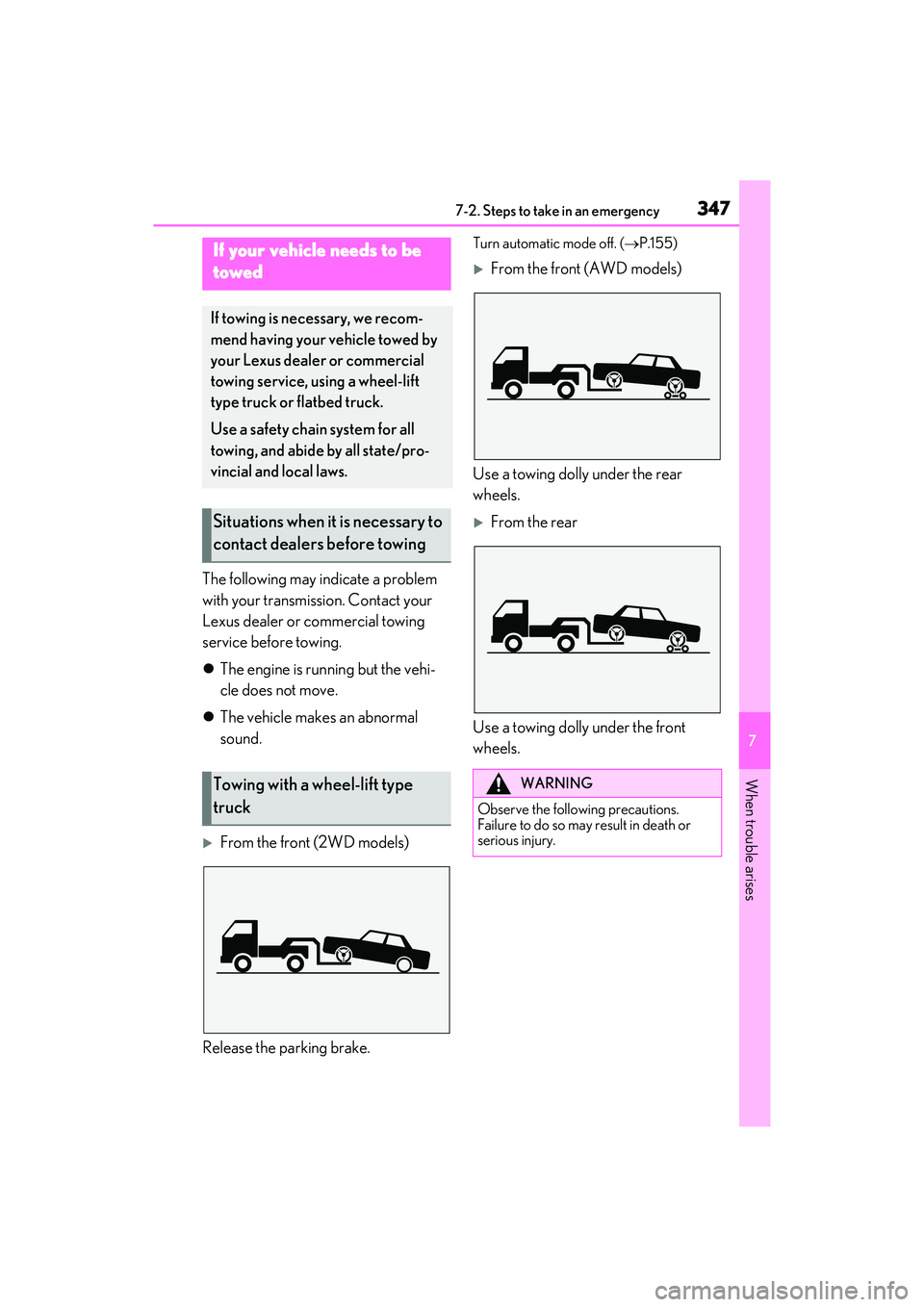
From the front (2WD models)
Release the parking brake.
Turn automatic mode off. ( P.155)
From the front (AWD models)
Use a towing dolly under the rear
wheels.
From the rear
Use a towing dolly under the front
wheels.
If your vehicl e needs to be
towed
If towing is necessary, we recom-
mend having your vehicle towed by
your Lexus dealer or commercial
towing service, using a wheel-lift
type truck or flatbed truck.
Use a safety chain system for all
towing, and abide by all state/pro-
vincial and local laws.
Situations when it is necessary to
contact dealers before towing
Towing with a wheel-lift type
truckWARNING
Observe the following precautions.
Failure to do so may result in death or
serious injury.
Page 350 of 468
3487-2. Steps to take in an emergency
When using a flat-bed truck to trans-
port the vehicle, use tire strapping
belts. Refer to the owner’s manual of
the flat-bed truck for the tire strapping
method.
In order to suppress vehicle movement
during transportation, set the parking
brake and turn the engine switch off.
WARNING
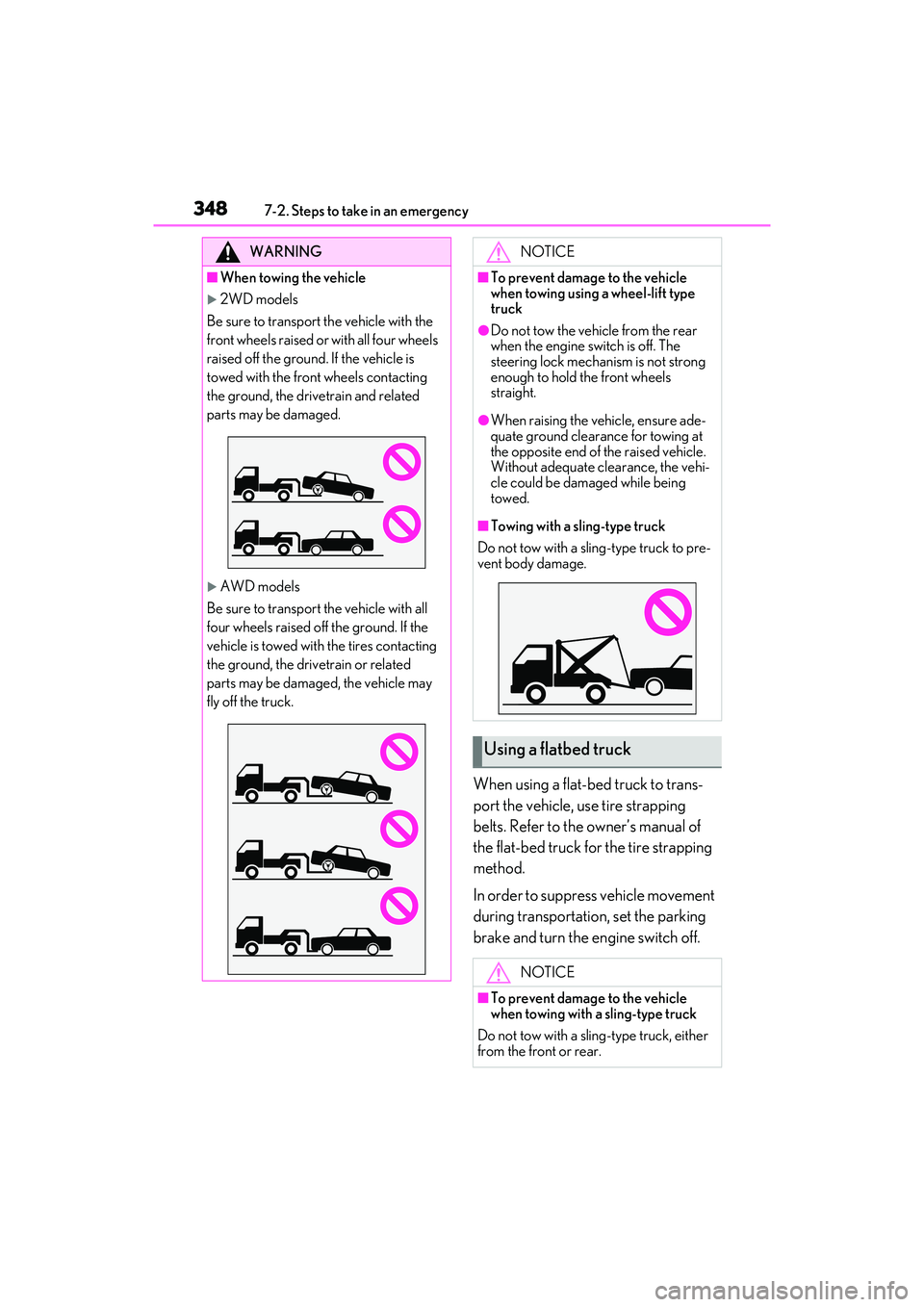
■When towing the vehicle
2WD models
Be sure to transport the vehicle with the
front wheels raised or with all four wheels
raised off the ground. If the vehicle is
towed with the front wheels contacting
the ground, the drivetrain and related
parts may be damaged.
AWD models
Be sure to transport the vehicle with all
four wheels raised off the ground. If the
vehicle is towed with the tires contacting
the ground, the drivetrain or related
parts may be damaged, the vehicle may
fly off the truck.
NOTICE
■To prevent damage to the vehicle
when towing using a wheel-lift type
truck
●Do not tow the vehicle from the rear
when the engine switch is off. The
steering lock mechan ism is not strong
enough to hold the front wheels
straight.
●When raising the vehicle, ensure ade-
quate ground clearance for towing at
the opposite end of the raised vehicle.
Without adequate clearance, the vehi-
cle could be damaged while being
towed.
■Towing with a sling-type truck
Do not tow with a sling-type truck to pre-
vent body damage.
Using a flatbed truck
NOTICE
■To prevent damage to the vehicle
when towing with a sling-type truck
Do not tow with a sling-type truck, either
from the front or rear.
Page 351 of 468
3497-2. Steps to take in an emergency
7
When trouble arises
Fluid leaks under the vehicle.
(Water dripping from the air condi-
tioning after use is normal.)
Flat-looking tires or uneven tire
wear
Engine coolant temperature gauge
continually points higher than nor-
mal.
Changes in exhaust sound
Excessive tire squeal when corner-
ing
Strange noises related to the sus-
pension system
Pinging or other noises related to
the engine
Engine missing, stumbling or run-
ning roughly
Appreciable loss of power
Vehicle pulls heavily to one side
when braking
NOTICE
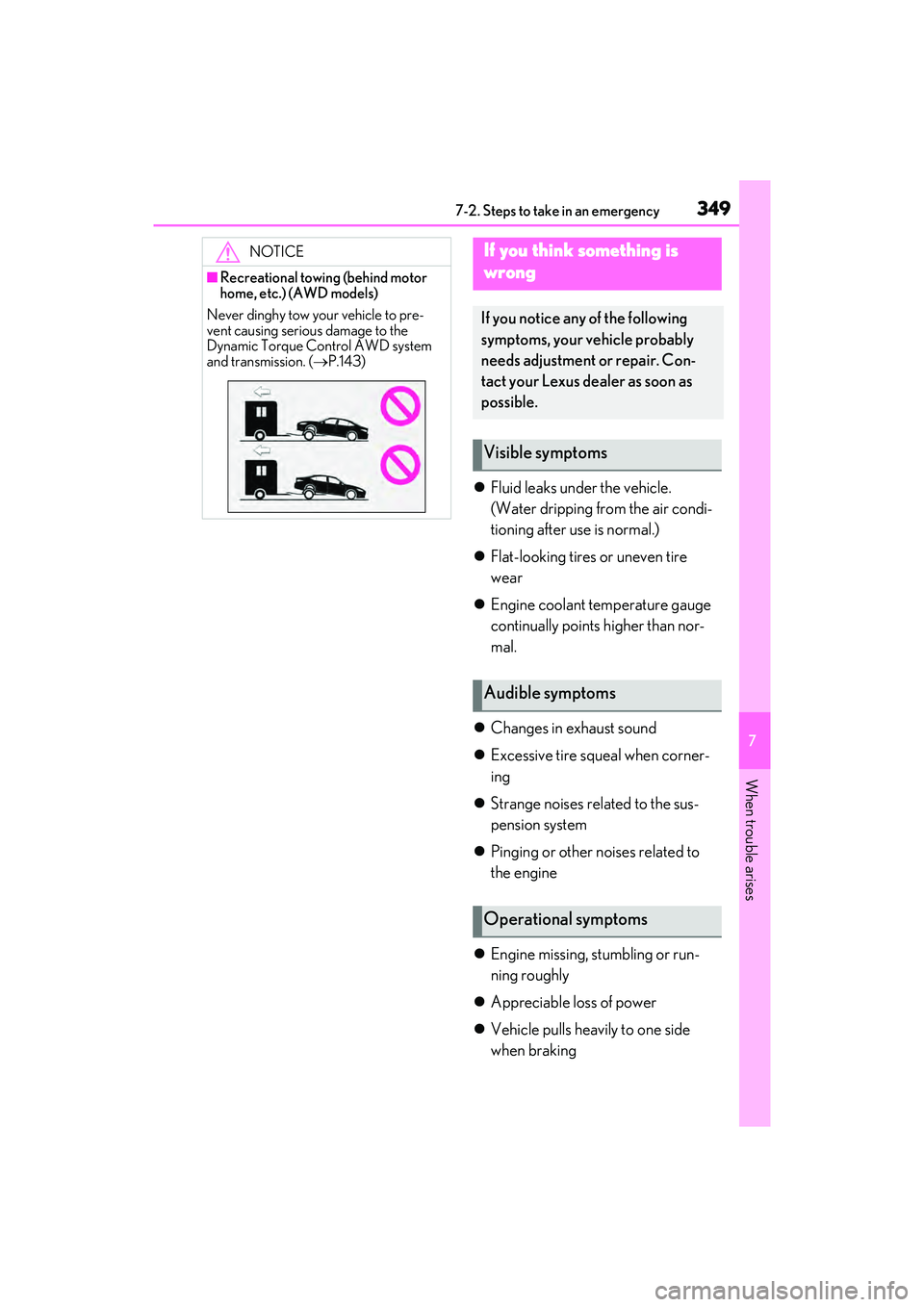
■Recreational towing (behind motor
home, etc.) (AWD models)
Never dinghy tow your vehicle to pre-
vent causing serious damage to the
Dynamic Torque Control AWD system
and transmission. ( P.143)
If you think something is
wrong
If you notice any of the following
symptoms, your vehicle probably
needs adjustment or repair. Con-
tact your Lexus dealer as soon as
possible.
Visible symptoms
Audible symptoms
Operational symptoms
Page 387 of 468

3857-2. Steps to take in an emergency
7
When trouble arises
1Stop the engine. Set the parking
brake and shift the shift lever to P.
2 Remove the mud, snow or sand
from around the front wheels.
3 Place wood, stones or some other
material under the front wheels to
help provide traction.
4 Restart the engine.
5 Shift the shift lever to D or R and
release the parking brake. Then,
while exercising caution, depress
the accelerator pedal.
■When it is difficult to free the vehicle
Press the switch to turn off TRAC.
If the vehicle becomes stuck
Carry out the following procedures
if the tires spin or the vehicle
becomes stuck in mud, dirt or snow:
Recovering procedure
WARNING
■When attempting to free a stuck vehi-
cle
If you choose to push the vehicle back
and forth to free it, make sure the sur-
rounding area is clear to avoid striking
other vehicles, objects or people. The
vehicle may also lunge forward or lunge
back suddenly as it becomes free. Use
extreme caution.
■When shifting the shift lever
Be careful not to shift the shift lever with
the accelerator pedal depressed.
This may lead to unexpected rapid accel-
eration of the vehicle that may cause an
accident resulting in death or serious
injury.
NOTICE
■To avoid damaging the transmission
and other components
●Avoid spinning the front wheels and
depressing the accelerator pedal
more than necessary.
●If the vehicle remains stuck even after
these procedures are performed, the
vehicle may require towing to be
freed.
Page 440 of 468

438Alphabetical index
C
Card key ............................................................ 92
Care ........................................................298, 301Aluminum wheels ......................................298
Exterior ...........................................................298
Interior .............................................................. 301
Seat belts......................................................... 301
Cargo capacity...............................................142
Cargo hooks ................................................. 279
Center Display ............................................. 258
Chains .............................................................. 252
Child-protectors............................................. 99
Child restraint system................................... 43 Fixed with a LATCH system ..................50
Fixed with a seat belt....................................47
Front passenger occupant classification system ..............................................................37
Points to remember .................................... 43
Riding with children ..................................... 43
Types of child restraint system installation method ........................................................... 44
Using an anchor bracket .......................... 53
Child safety ....................................................... 43 Airbag precautions...................................... 33
Battery precautions .........................318, 381
Child restraint system................................. 44
Heated steering wheel and seat heater precautions................................................ 269
How your child should wear the seat belt ............................................................................ 25
Moon roof precautions ............................ 127
Panoramic moon roof precautions... 130
Power window lock switch..................... 124
Power window precautions ................... 124
Rear door child-protectors ..................... 99
Seat belt extender precautions ............. 25
Seat belt precautions .................................. 43
Trunk precautions ...................................... 100
Cleaning ................................................298, 301 Aluminum wheels ......................................298
Exterior ...........................................................298 Interior .............................................................. 301
Radar sensor ....................................... 171, 209
Seat belts ......................................................... 301
Clock .................................................68, 71, 280
Coat hooks.....................................................288
Compass ......................................................... 294
Condenser .......................................................316
Console box ................................................... 277
Console box light .........................................277
Cooling system...............................................316 Engine overheating...................................382
Cornering lights ............................................ 160 Replacing light bulbs............................... 338
Cruise control Dynamic radar cruise control with full-speed range ............................................... 198
Cup holder ......................................................277
Current fuel consumption .......................... 78
Curtain shield airbags .................................. 28
Customizable features ..............................408
Custom mode .................................................213
D
Daytime running light system .................. 158
Defogger Outside rear view mirrors.....................263
Rear window ................................................263
Windshield ....................................................263
Dimension ......................................................388
Dinghy towing.................................................143
Display BSM (Blind Spot Monitor)................... 208
Dynamic radar cruise control with full-speed range ............................................... 198
Head-up display............................................83
Intuitive parking assist ................................216
LTA (Lane Tracing Assist) ....................... 191
Multi-information display .......................... 76
Parking Support Brake function (rear pedestrians)............................................... 244
RCD (Rear Camera Detection) ........ 229
RCTA............................................................... 223
Page 449 of 468

Alphabetical index447
Theft deterrent systemAlarm ..................................................................60
Engine immobilizer system ..................... 59
Tire inflation pressure ................................ 328 Maintenance data......................................395
Tire inflation pressure display function......................................................................... 322
Warning light ...............................................355
Tire information ............................................ 399 Glossary.........................................................403
Size..................................................................... 401
Tire identification number ...................... 401
Uniform Tire Quality Grading............ 402
Tire pressure warning system ................ 322 Function .......................................................... 322
Initializing ....................................................... 324
Installing tire pressure warning valves and transmitters ...................................... 323
Registering ID codes ............................... 326
Warning light ...............................................355
Tires ................................................................... 320 Chains ............................................................. 252
Checking .......................................................320
If you have a flat tire ..................................365
Inflation pressure........................................ 328
Information....................................................399
Replacing .......................................................365
Rotating tires ................................................ 322
Size....................................................................395
Snow tires ........................................................251
Spare tire........................................................365
Tire inflation pressure display function......................................................................... 322
Tire pressure warning system ............. 322
Warning light ...............................................355
Tools.................................................................. 366
Top tether strap ............................................... 53
Total load capacity ......................................388
Towing Dinghy towing ...............................................143
Emergency towing ................................... 347
Trailer towing................................................. 142 TRAC (Traction Control) ........................ 246
Traction Control (TRAC) ........................ 246
Trailer towing ..................................................142
Transmission
Automatic transmission ........................... 149
Driving Mode Select switch ...................213
Paddle shift switches .........................151, 152
S mode ............................................................. 152
Trip meters ................................................ 70, 74
Trunk .................................................................. 100 Hands Free Power Trunk Lid............... 103
Internal trunk release lever..................... 105
Power trunk lid .............................................100
Smart access system with push-button start ................................................................. 103
Trunk closer switch .................................... 104
Trunk easy closer........................................ 104
Trunk features .............................................. 279
Trunk grip ....................................................... 104
Trunk light ....................................................... 104
Trunk opener main switch...................... 106
Trunk opener switch ................................. 102
Trunk storage extension........................ 288
Wireless remote control ......................... 103
Trunk light ........................................................ 104
Turn signal lights ............................................153 Replacing light bulbs................... 338, 339
Turn signal lever .......................................... 153
Wattage ......................................................... 396
U
USB charging ports......................................281
V
Vanity lights....................................................280
Vanity mirrors ...............................................280
Vehicle data recordings ..................................7
Vehicle identification number ................388
Vehicle Stability Control (VSC) ........... 246
Ventilators (seat ventilators)................... 269
VSC (Vehicle Stability Control) ........... 246