2022 LEXUS ES350 airbag
[x] Cancel search: airbagPage 39 of 468
371-1. For safe use
1
For safety and security
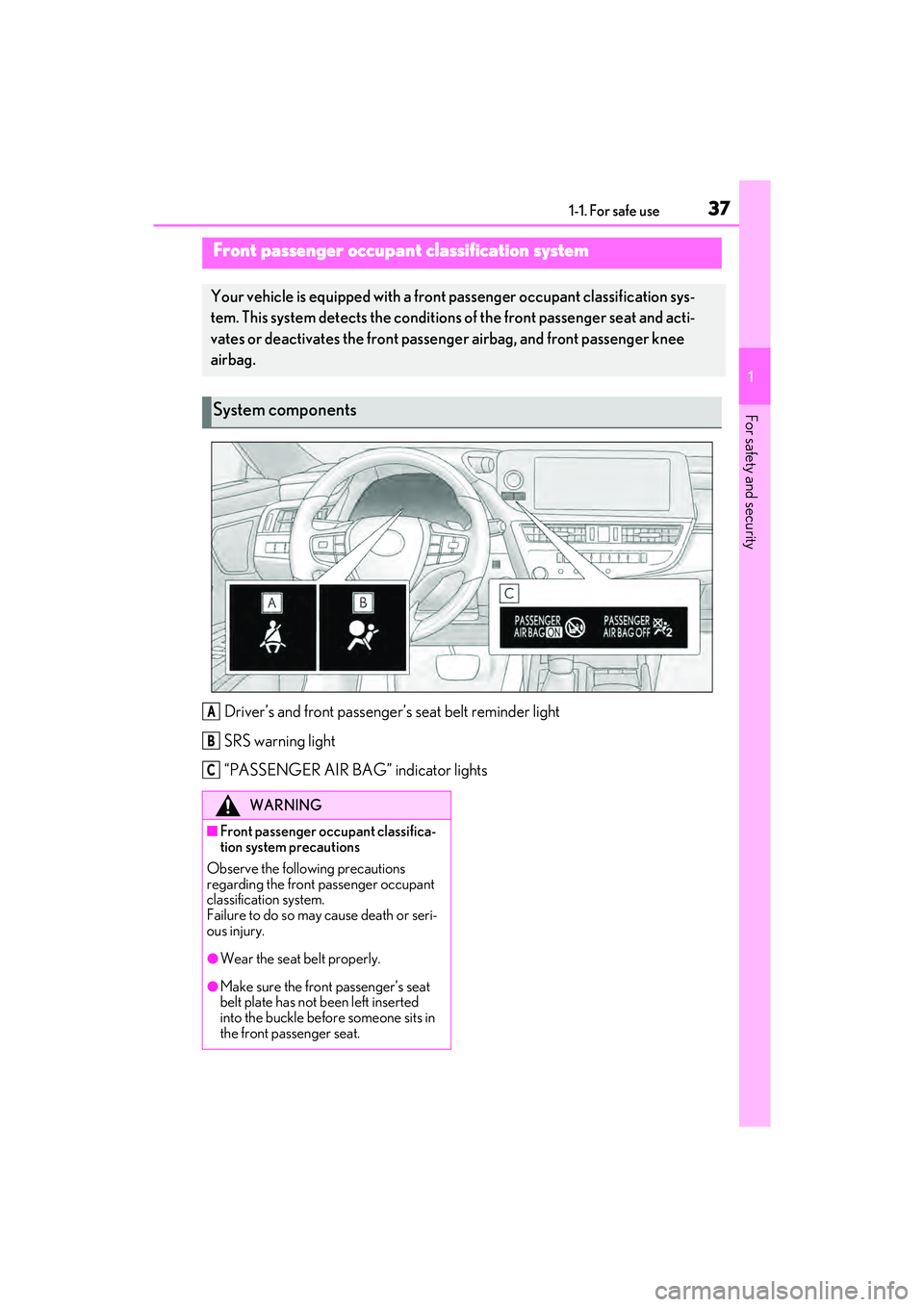
Driver’s and front passenger’s seat belt reminder light
SRS warning light
“PASSENGER AIR BAG” indicator lights
Front passenger occupant classification system
Your vehicle is equipped with a front passenger occupant classification sys-
tem. This system detects the conditions of the front passenger seat and acti-
vates or deactivates the front passenger airbag, and front passenger knee
airbag.
System components
A
B
C
WARNING
■Front passenger occupant classifica-
tion system precautions
Observe the following precautions
regarding the front passenger occupant
classification system.
Failure to do so may cause death or seri-
ous injury.
●Wear the seat belt properly.
●Make sure the front passenger’s seat
belt plate has not been left inserted
into the buckle befo re someone sits in
the front passenger seat.
Page 40 of 468
381-1. For safe use
WARNING
●Make sure the “PASSENGER AIR
BAG OFF” indicator light is not illumi-
nated when using the seat belt
extender for the front passenger seat.
If the “PASSENGER AIR BAG ON”
indicator light is illuminated, discon-
nect the extender tongue from the
seat belt buckle, and reconnect the
seat belt. Reconnect the seat belt
extender after making sure the “PAS-
SENGER AIR BAG OFF” indicator
light is illuminated. If you use the seat
belt extender while the “PASSENGER
AIR BAG OFF” indicator light is illu-
minated, the SRS airbags for the front
passenger will not activate, which
could cause death or serious injury in
the event of a collision.
●Do not apply a heavy load to the front
passenger seat or equipment (e.g.
seatback pocket).
●Do not put weight on the front passen-
ger seat by putting your hands or feet
on the front passenger seat seatback
from the rear passenger seat.
●Do not let a rear passenger lift the
front passenger seat with their feet or
press on the seatback with their legs.
●Do not put objects under the front pas-
senger seat.
●Do not recline the front passenger
seatback so far that it touches a rear
seat. This may cause the “PASSEN-
GER AIR BAG OFF” indicator light to
be illuminated, which indicates that the
SRS airbags for the front passenger
will not activate in the event of a severe
accident. If the seatback touches the
rear seat, return the seatback to a
position where it does not touch the
rear seat. Keep the front passenger
seatback as upright as possible when
the vehicle is moving. Reclining the
seatback excessively may lessen the
effectiveness of the seat belt system.
●If an adult sits in the front passenger
seat, the “PASSENGER AIR BAG
ON” indicator light is illuminated. If the
“PASSENGER AIR BAG OFF” indi-
cator is illuminated, ask the passenger
to sit up straight, well back in the seat,
feet on the floor, and with the seat belt
worn correctly. If the “PASSENGER
AIR BAG OFF” indicator still remains
illuminated, either ask the passenger
to move to the rear seat, or if that is not
possible, move the front passenger
seat fully rearward.
●When it is unavoidable to install a for-
ward-facing child restraint system on
the front passenger seat, install the
child restraint system on the front pas-
senger seat in the proper order.
( P.45)
●Do not modify or remove the front
seats.
●Do not kick the front passenger seat or
subject it to severe impact. Otherwise,
the SRS warning light may come on to
indicate a malfunction of the front pas-
senger occupant classification system.
In this case, contact your Lexus dealer
immediately.
●Child restraint systems installed on the
rear seat should not contact the front
seatbacks.
●Do not use a seat accessory, such as a
cushion and seat cover, that covers the
seat cushion surface.
●Do not modify or replace the uphol-
stery of the front seat.
●Do not place anything between the
console box and front passenger seat.
Otherwise, the system may not detect
the front passenger properly, leading
to improper operation of the airbags.
Page 41 of 468
391-1. For safe use
1
For safety and security
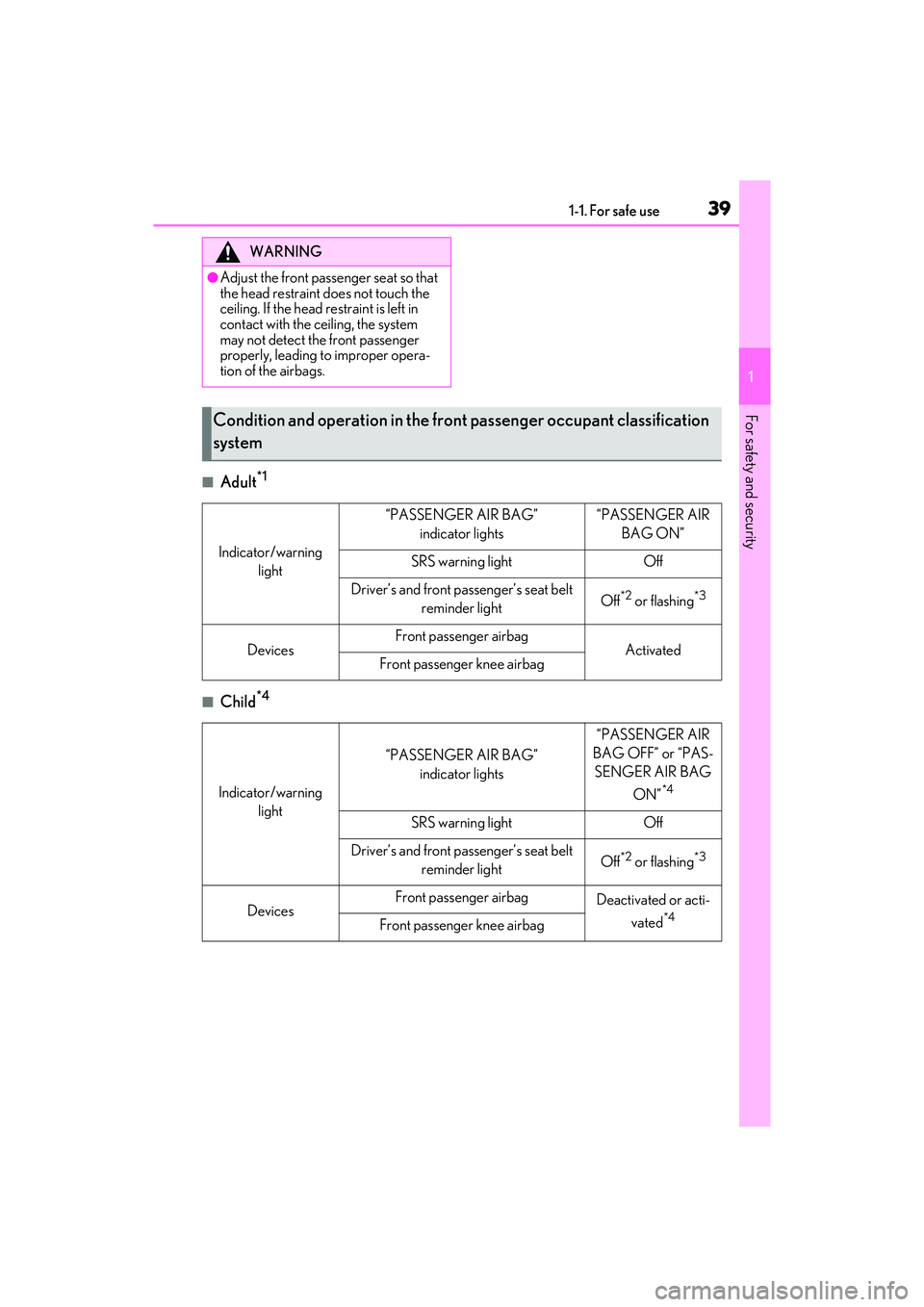
■Adult*1
■Child*4
WARNING
●Adjust the front passenger seat so that
the head restraint does not touch the
ceiling. If the head restraint is left in
contact with the ceiling, the system
may not detect the front passenger
properly, leading to improper opera-
tion of the airbags.
Condition and operation in the front passenger occupant classification
system
Indicator/warning light
“PASSENGER AIR BAG” indicator lights“PASSENGER AIR BAG ON”
SRS warning lightOff
Driver’s and front passenger’s seat belt reminder lightOff*2 or flashing*3
DevicesFront passenger airbagActivatedFront passenger knee airbag
Indicator/warning light
“PASSENGER AIR BAG” indicator lights
“PASSENGER AIR
BAG OFF” or “PAS- SENGER AIR BAG
ON”
*4
SRS warning lightOff
Driver’s and front passenger’s seat belt reminder lightOff*2 or flashing*3
DevicesFront passenger airbagDeactivated or acti-
vated
*4Front passenger knee airbag
Page 42 of 468
401-1. For safe use
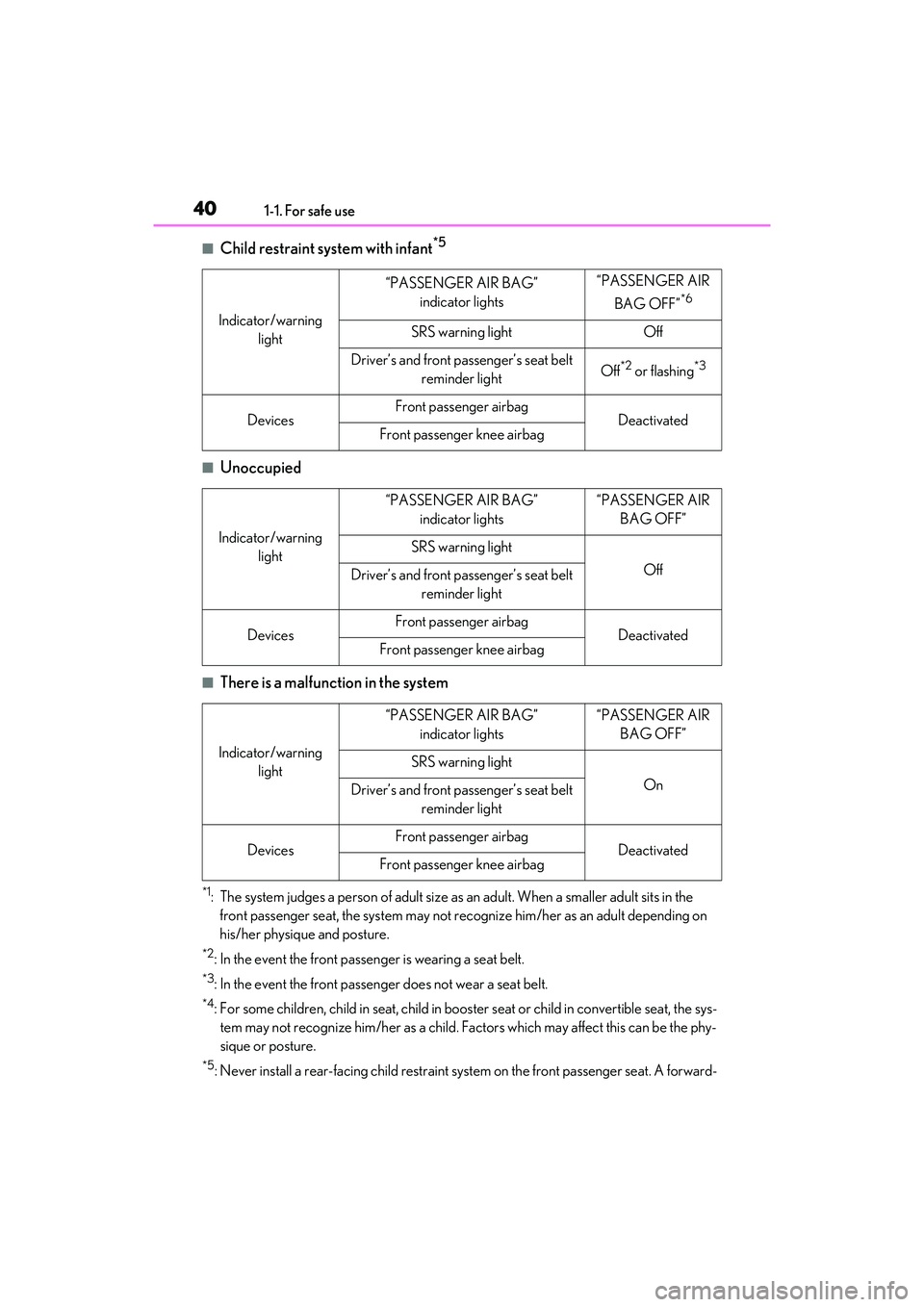
■Child restraint system with infant*5
■Unoccupied
■There is a malfunction in the system
*1: The system judges a person of adult size as an adult. When a smaller adult sits in the front passenger seat, the system may not recognize him/her as an adult depending on
his/her physique and posture.
*2: In the event the front passenger is wearing a seat belt.
*3: In the event the front passenger does not wear a seat belt.
*4: For some children, child in seat, child in boos ter seat or child in convertible seat, the sys-
tem may not recognize him/her as a child. Factors which may affect this can be the phy-
sique or posture.
*5: Never install a rear-facing child restraint sy stem on the front passenger seat. A forward-
Indicator/warning
light
“PASSENGER AIR BAG” indicator lights“PASSENGER AIR
BAG OFF”
*6
SRS warning lightOff
Driver’s and front passenger’s seat belt reminder lightOff*2 or flashing*3
DevicesFront passenger airbagDeactivatedFront passenger knee airbag
Indicator/warning light
“PASSENGER AIR BAG” indicator lights“PASSENGER AIR BAG OFF”
SRS warning light
OffDriver’s and front passenger’s seat belt reminder light
DevicesFront passenger airbagDeactivatedFront passenger knee airbag
Indicator/warning light
“PASSENGER AIR BAG” indicator lights“PASSENGER AIR BAG OFF”
SRS warning light
OnDriver’s and front passenger’s seat belt reminder light
DevicesFront passenger airbagDeactivatedFront passenger knee airbag
Page 48 of 468
461-2. Child safety
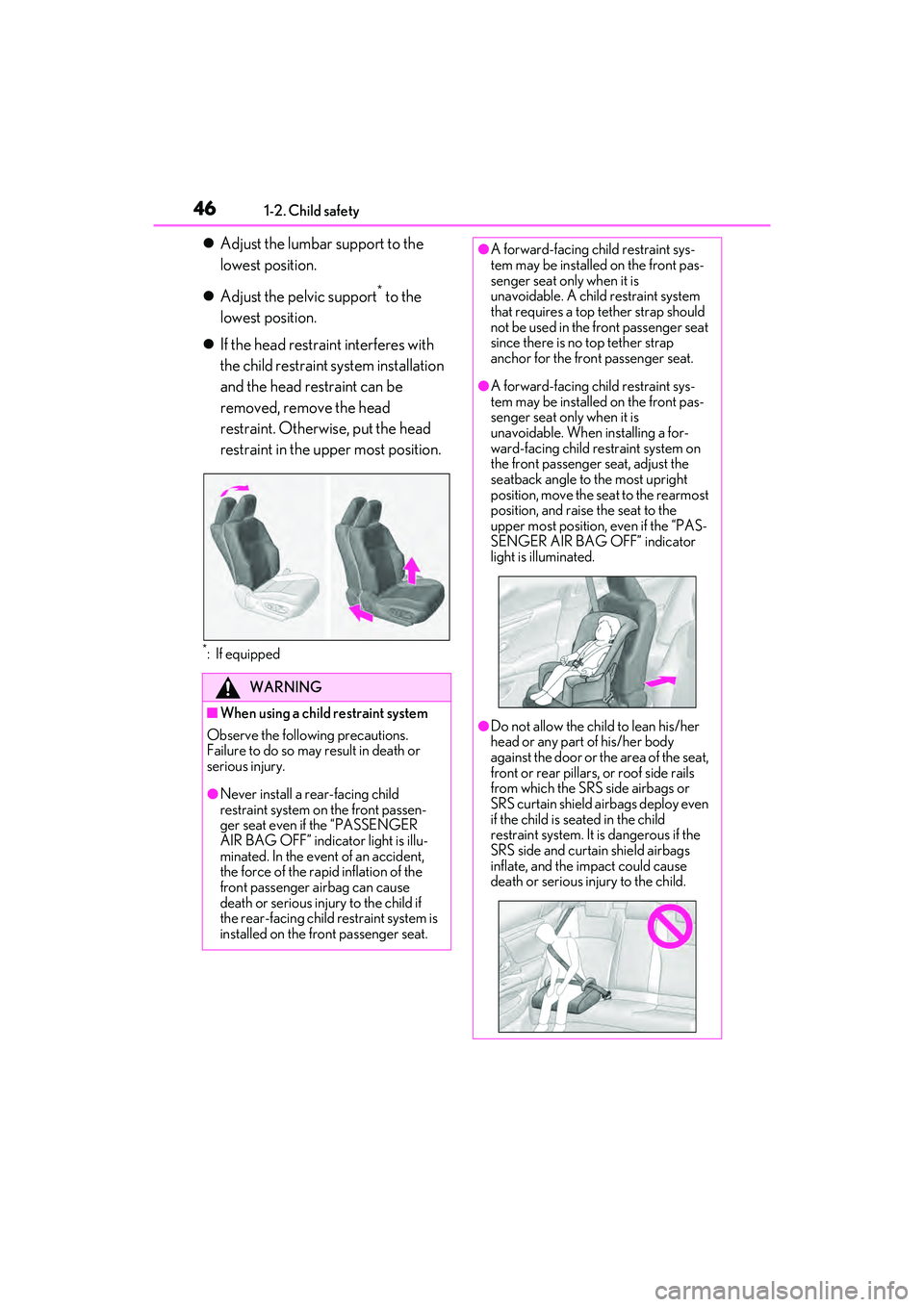
Adjust the lumbar support to the
lowest position.
Adjust the pelvic support
* to the
lowest position.
If the head restrain t interferes with
the child restraint system installation
and the head restraint can be
removed, remove the head
restraint. Otherwise, put the head
restraint in the upper most position.
*: If equipped
WARNING
■When using a child restraint system
Observe the following precautions.
Failure to do so may result in death or
serious injury.
●Never install a rear-facing child
restraint system on the front passen-
ger seat even if the “PASSENGER
AIR BAG OFF” indicator light is illu-
minated. In the event of an accident,
the force of the rapid inflation of the
front passenger airbag can cause
death or serious injury to the child if
the rear-facing child restraint system is
installed on the front passenger seat.
●A forward-facing child restraint sys-
tem may be installed on the front pas-
senger seat only when it is
unavoidable. A child restraint system
that requires a top tether strap should
not be used in the front passenger seat
since there is no top tether strap
anchor for the front passenger seat.
●A forward-facing child restraint sys-
tem may be installed on the front pas-
senger seat only when it is
unavoidable. When installing a for-
ward-facing child restraint system on
the front passenger seat, adjust the
seatback angle to the most upright
position, move the seat to the rearmost
position, and raise the seat to the
upper most position, even if the “PAS-
SENGER AIR BAG OFF” indicator
light is illuminated.
●Do not allow the child to lean his/her
head or any part of his/her body
against the door or the area of the seat,
front or rear pillars, or roof side rails
from which the SRS side airbags or
SRS curtain shield airbags deploy even
if the child is seated in the child
restraint system. It is dangerous if the
SRS side and curtain shield airbags
inflate, and the impact could cause
death or serious injury to the child.
Page 59 of 468
571-3. Lexus Enform
1
For safety and security
■Automatic Collision Notification
In case of either airbag deployment or
severe rear-end collision, the system is
designed to automatically call the
response center. The responding
agent receives the vehicle’s location
and attempts to speak with the vehicle
occupants to assess the level of emer-
gency. If the occupants are unable to
communicate, the agent automatically
treats the call as an emergency, con-
tacts the nearest emergency services
provider to describe the situation, and
requests that assistance be sent to the
location.
■Stolen Vehicle Location
If your vehicle is stolen, Safety Connect
can work with local authorities to assist
them in locating and recovering the
vehicle. After filing a police report, call
the Safety Connect response center at
1-800-25-LEXUS (1-800-255-
3987) in the United States, 1-877-
539-8777 in Puerto Rico or 1-800-
265-3987 in Canada, and follow the
prompts for Safety Connect to initiate
this service.
In addition to assisting law enforce-
ment with recovery of a stolen vehicle,
Safety-Connect-equipped vehicle
location data may, under certain cir-
cumstances, be shared with third par-
ties to locate your vehicle. Further
information is available at Lexus.com.
■Emergency Assistance Button
(“SOS”)
In the event of an emergency on the
road, push the “SOS” button to reach
the Safety Connect response center.
The answering agent will determine
your vehicle’s location, assess the
emergency, and dispatch the neces-
sary assistance required.
If you accidentally press the “SOS” button,
tell the response-center agent that you are
not experiencing an emergency.
■Enhanced Roadside Assistance
Enhanced Roadside Assistance adds
GPS data to the already included war-
ranty-based Lexus roadside service.
Subscribers can press the “SOS” but-
ton to reach a Safety Connect
response-center agent, who can help
with a wide range of needs, such as:
towing, flat tire, fuel delivery, etc. For a
description of the Roadside Assistance
services and their limitations, please
see the Safety Connect Terms and
Conditions, which are available at
Lexus.com.
Important! Read this information about
exposure to radio frequency signals
before using Safety Connect;
The Safety Connect system installed in
your vehicle is a low-power radio
transmitter and receiver. It receives
and also sends out radio frequency
(RF) signals.
Safety Connect services
Safety information for Safety
Connect
Page 248 of 468

2464-5. Using the driving support systems
■ABS (Anti-lock Brake System)
Helps to prevent wheel lock when the
brakes are applied suddenly, or if the
brakes are applied while driving on a
slippery road surface
■Brake assist
Generates an increased level of brak-
ing force after the brake pedal is
depressed when the system detects a
panic stop situation
■VSC (Vehicle Stability Control)
Helps the driver to control skidding
when swerving suddenly or turning on
slippery road surfaces.
■Enhanced VSC (Enhanced Vehi-
cle Stability Control)
Provides cooperative control of the
ABS, TRAC, VSC and EPS.
Helps to maintain directional stability
when swerving on slippery road sur-
faces by controlling steering perfor-
mance.
■Secondary Collision Brake
When the SRS airbag sensor detects a
collision and the system operates, the
brakes and brake lights are automati-
cally controlled to reduce the vehicle
speed and help reduce the possibility
of further damage due to a secondary
collision.
■TRAC (Traction Control)
Helps to maintain drive power and
prevent the drive wheels from spinning
when starting the vehicle or accelerat-
ing on slippery roads
■Active Cornering Assist (ACA)
Helps to prevent the vehicle from drift-
ing to the outer side by performing
inner wheel brake control when
attempting to accelerate while turning
■Hill-start assist control
Helps to reduce the backward move-
ment of the vehicle when starting on an
uphill
■Dynamic Torque Control AWD
system (AWD models)
Automatically switches from front-
wheel drive to all-wheel drive (AWD)
according to the driving conditions,
helping to ensure reliable handling and
stability. Examples of conditions where
the system will switch to AWD are
when cornering, going uphill, starting
off or accelerating, and when the road
surface is slippery due to snow, rain,
etc.
■EPS (Electric Power Steering)
Employs an electric motor to reduce
the amount of effort needed to turn the
Driving assist systems
To keep driving safety and perfor-
mance, the following systems oper-
ate automatically in response to
various driving situations. Be
aware, however, that these systems
are supplementary and should not
be relied upon too heavily when
operating the vehicle.
Summary of the driving assist
systems
Page 250 of 468

2484-5. Using the driving support systems
■Automatic system cancelation of hill-
start assist control
The hill-start assist control will turn off in any
of the following situations:
●The shift lever is shifted to P or N.
●The accelerator pedal is depressed.
●The parking brake is engaged.
●2 seconds at maximum elapsed after the
brake pedal is released.
■Sounds and vibrations caused by the
ABS, brake assist, VSC, TRAC and hill-
start assist control systems
●A sound may be heard from the engine
compartment when the brake pedal is
depressed repeatedly, when the engine is
started or just after the vehicle begins to
move. This sound does not indicate that a
malfunction has occurred in any of these
systems.
●Any of the following conditions may
occur when the above systems are oper-
ating. None of these indicates that a mal-
function has occurred.
• Vibrations may be felt through the vehi-
cle body and steering.
• A motor sound may be heard also after the vehicle comes to a stop.
• The brake pedal may pulsate slightly after the ABS is activated.
• The brake pedal may move down slightly
after the ABS is activated.
■Active Cornering Assist operation
sounds and vibrations
When the Active Cornering Assist is oper-
ated, operation sounds and vibrations may
be generated from the brake system, but
this is not a malfunction.
■EPS operation sound
When the steering wheel is operated, a
motor sound (whirring sound) may be
heard. This does not indicate a malfunction.
■Automatic reactivation of TRAC and
VSC systems
After turning the TRAC and VSC systems
off, the systems will be automatically re-
enabled in the following situations:
●When the engine switch is turned off
●If only the TRAC system is turned off, the
TRAC will turn on when vehicle speed
increases
If both the TRAC and VSC systems are
turned off, automatic re-enabling will not
occur when vehicle speed increases.
■Secondary Collision Brake operating
conditions
The system operates when the SRS airbag
sensor detects a collision while the vehicle
is in motion.
However, the system does not operate
when the components are damaged.
■Secondary Collision Brake automatic
cancellation
The system is automatically canceled in any
of the following situations.
●The vehicle speed drops to approxi-
mately 6 mph (10 km/h)
●A certain amount of time elapses during
operation
●The accelerator pedal is depressed a
large amount
■Operating conditions of Active Corner-
ing Assist
The system operates when the following
occurs.
●TRAC/VSC can operate
●The driver is attempting to accelerate
while turning
●The system detects that the vehicle is
drifting to the outer side
●The brake pedal is released
■Reduced effectiveness of the EPS sys-
tem
The effectiveness of the EPS system is
reduced to prevent the system from over-
heating when there is frequent steering
input over an extended period of time. The
steering wheel may feel heavy as a result.
Should this occur, refrain from excessive
steering input or stop the vehicle and turn
the engine off. The EPS system should
return to normal within 10 minutes.