Page 409 of 446
7-57
7
Maintenance
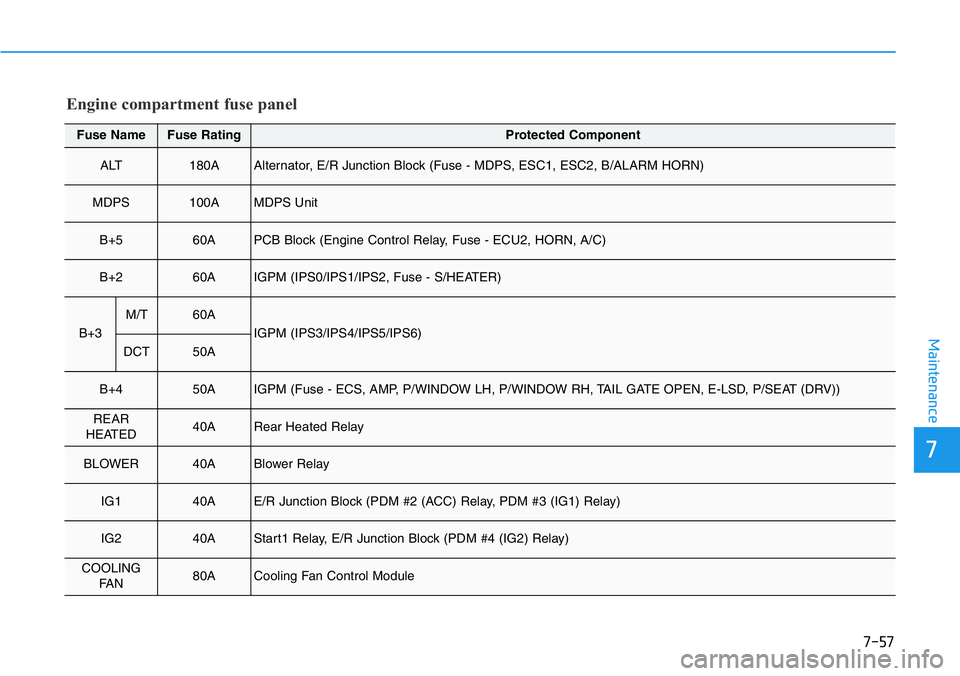
Engine compartment fuse panel
Fuse NameFuse RatingProtected Component
ALT180AAlternator, E/R Junction Block (Fuse - MDPS, ESC1, ESC2, B/ALARM HORN)
MDPS100AMDPS Unit
B+560APCB Block (Engine Control Relay, Fuse - ECU2, HORN, A/C)
B+260AIGPM (IPS0/IPS1/IPS2, Fuse - S/HEATER)
B+3
M/T60A
IGPM (IPS3/IPS4/IPS5/IPS6)
DCT50A
B+450AIGPM (Fuse - ECS, AMP, P/WINDOW LH, P/WINDOW RH, TAIL GATE OPEN, E-LSD, P/SEAT (DRV))
REAR
HEATED40ARear Heated Relay
BLOWER40ABlower Relay
IG140AE/R Junction Block (PDM #2 (ACC) Relay, PDM #3 (IG1) Relay)
IG240AStart1 Relay, E/R Junction Block (PDM #4 (IG2) Relay)
COOLING
FA N80ACooling Fan Control Module
Page 410 of 446
7-58
Maintenance
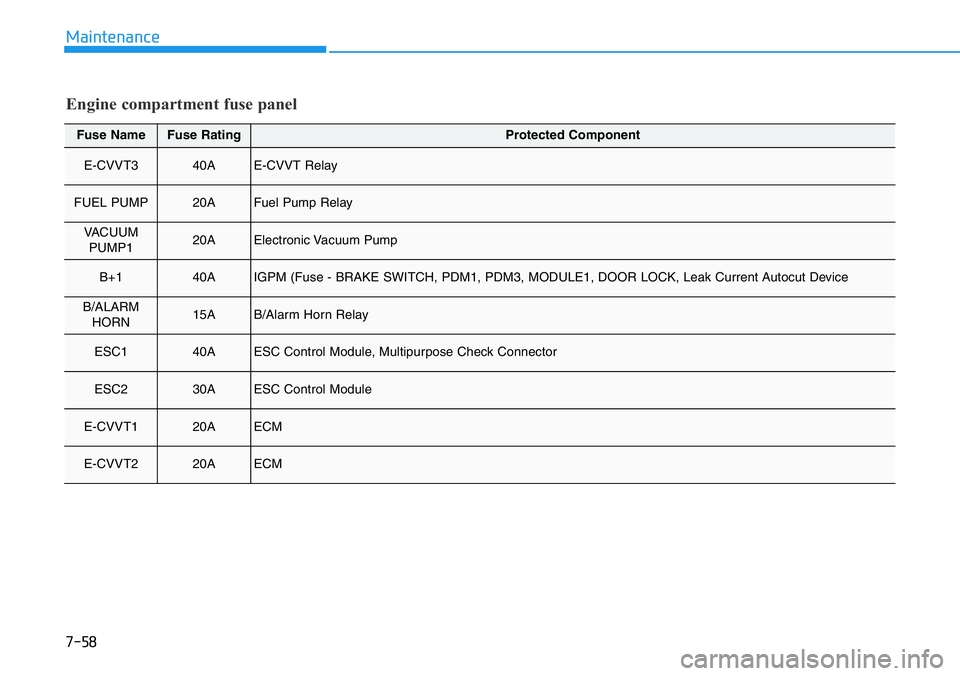
Engine compartment fuse panel
Fuse NameFuse RatingProtected Component
E-CVVT340AE-CVVT Relay
FUEL PUMP20AFuel Pump Relay
VACUUM
PUMP120AElectronic Vacuum Pump
B+140AIGPM (Fuse - BRAKE SWITCH, PDM1, PDM3, MODULE1, DOOR LOCK, Leak Current Autocut Device
B/ALARM
HORN15AB/Alarm Horn Relay
ESC140AESC Control Module, Multipurpose Check Connector
ESC230AESC Control Module
E-CVVT120AECM
E-CVVT220AECM
Page 411 of 446
7-59
7
Maintenance
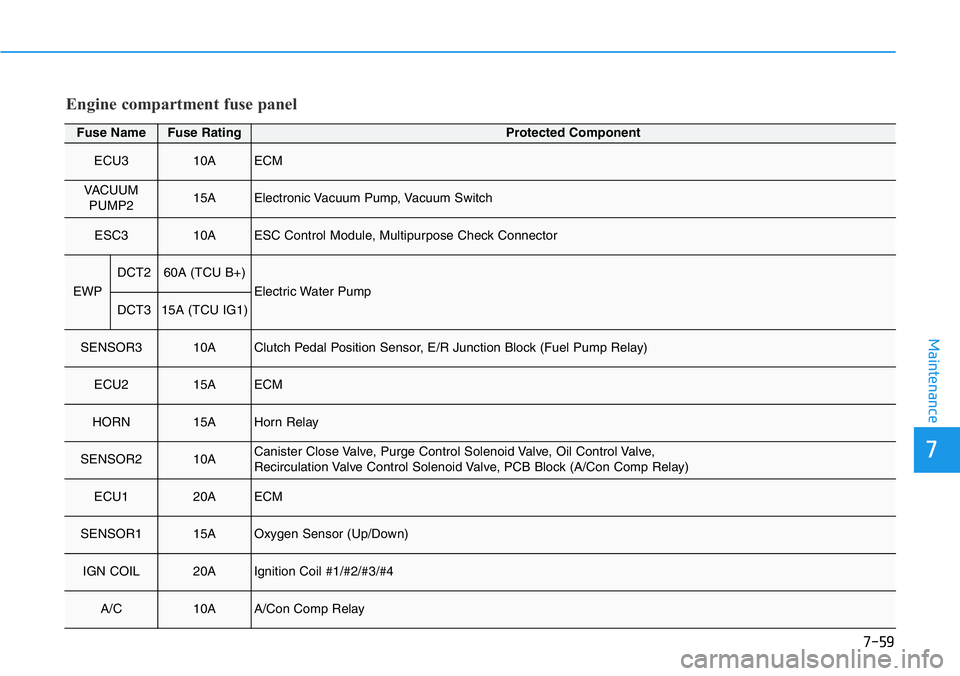
Fuse NameFuse RatingProtected Component
ECU310AECM
VACUUM
PUMP215AElectronic Vacuum Pump, Vacuum Switch
ESC310AESC Control Module, Multipurpose Check Connector
EWP
DCT260A (TCU B+)
Electric Water Pump
DCT315A (TCU IG1)
SENSOR310AClutch Pedal Position Sensor, E/R Junction Block (Fuel Pump Relay)
ECU215AECM
HORN15AHorn Relay
SENSOR210ACanister Close Valve, Purge Control Solenoid Valve, Oil Control Valve,
Recirculation Valve Control Solenoid Valve, PCB Block (A/Con Comp Relay)
ECU120AECM
SENSOR115AOxygen Sensor (Up/Down)
IGN COIL20AIgnition Coil #1/#2/#3/#4
A/C10AA/Con Comp Relay
Engine compartment fuse panel
Page 412 of 446
7-60
Maintenance
Engine compartment fuse panel
(Battery terminal cover)
(if equipped)
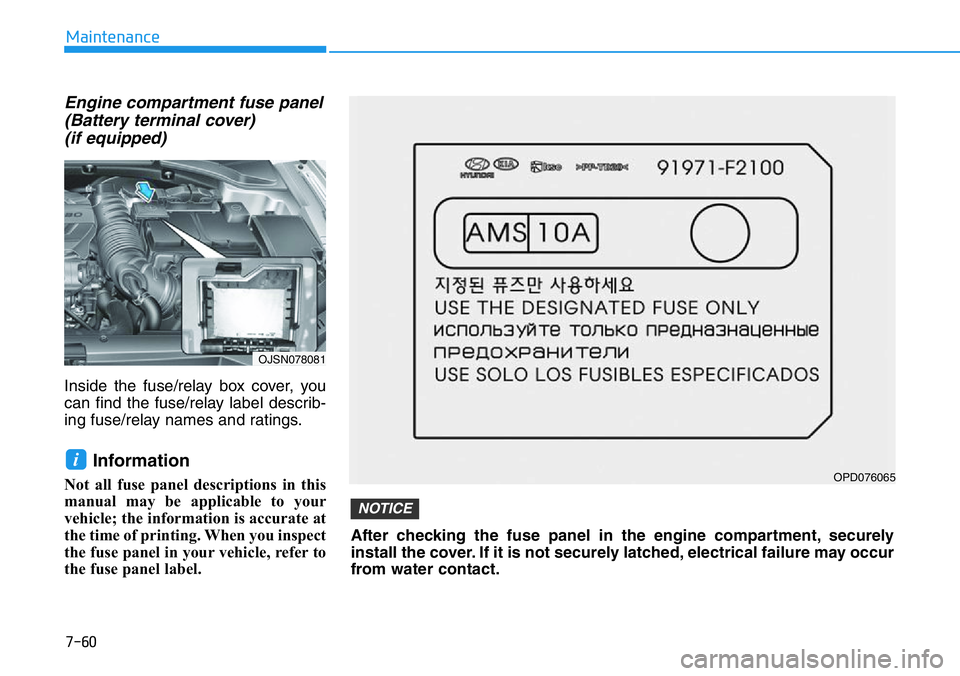
Inside the fuse/relay box cover, you
can find the fuse/relay label describ-
ing fuse/relay names and ratings.
Information
Not all fuse panel descriptions in this
manual may be applicable to your
vehicle; the information is accurate at
the time of printing. When you inspect
the fuse panel in your vehicle, refer to
the fuse panel label.
i
OJSN078081
OPD076065
After checking the fuse panel in the engine compartment, securely
install the cover. If it is not securely latched, electrical failure may occur
from water contact.
NOTICE
Page 419 of 446
7-67
7
Maintenance
Backup lamp
1. Turn off the engine.
2. Open the liftgate.
3. Remove the service cover using a
flat-blade screwdriver.
[A] : Backup lamp
4. Remove the socket from the
assembly by turning the socket
counterclockwise until the tabs on
the socket align with the slots on
the assembly.
5. Remove the bulb from the socket
by pressing it in and rotating it
counterclockwise until the tabs on
the bulb align with the slots in the
socket. Pull the bulb out of the
socket.6. Insert a new bulb by inserting it
into the socket and rotating it until
it locks into place.
7. Install the socket into the assem-
bly by aligning the tabs on the
socket with the slots in the assem-
bly. Push the socket into the
assembly and turn the socket
clockwise.
8. Reinstall the lamp assembly to the
body of the vehicle.
OJS078034OJSN078038L
Page 423 of 446

7-71
7
Maintenance
High-pressure washing
• When using high-pressure wash-
ers, make sure to maintain suffi-
cient distance from the vehicle.
Insufficient clearance or excessive
pressure can lead to component
damage or water penetration.
• Do not spray the camera, sensors
or its surrounding area directly with
a high pressure washer. Shock
applied from high pressure water
may cause the device to not oper-
ate normally.
• Do not bring the nozzle tip close to
boots (rubber or plastic covers)or
connectors as they may be dam-
aged if they come into contact with
high pressure water.
• Do not use any high-pressure noz-
zles, which induce either one-direct
water stream or water swirling.• Water washing in the engine
compartment including high
pressure water washing may
cause the failure of electrical cir-
cuits located in the engine com-
partment.
• Never allow water or other liq-
uids to come in contact with
electrical/electronic compo-
nents inside the vehicle as this
may damage them.Matte paint finish vehicle
(if equipped)
Automatic car wash which uses
rotating brushes should not be
used as this can damage the sur-
face of your vehicle. A steam
cleaner which washes the vehicle
surface at high temperature may
result the oil to adhere and leave
stains that is difficult to remove.
Use a soft cloth (e.g. microfiber
towel or sponge) when washing
your vehicle and dry with a
microfiber towel. When you hand
wash your vehicle, you should not
use a cleaner that finishes with
wax. If the vehicle surface is too
dirty (sand, dirt, dust, contami-
nant, etc.), clean the surface with
water before washing the car.
NOTICE
NOTICE
OBU078046N
Page 431 of 446
7-79
7
Maintenance
Canister
Fuel vapors generated inside the fuel
tank are absorbed and stored in the
onboard canister. When the engine is
running, the fuel vapors absorbed in
the canister are drawn into the surge
tank through the purge control sole-
noid valve.
Purge Control Solenoid Valve
(PCSV)
The purge control solenoid valve is
controlled by the Engine Control
Module (ECM); when the engine
coolant temperature is low during
idling, the PCSV closes so that evap-
orated fuel is not taken into the
engine. After the engine warms-up
during ordinary driving, the PCSV
opens to introduce evaporated fuel to
the engine.
3. Exhaust Emission Control
System
The Exhaust Emission Control
System is a highly effective system
which controls exhaust emissions
while maintaining good vehicle per-
formance.
When the engine starts or fails to
start, excessive attempts to restart
the engine may cause damage to the
emission system.
Engine exhaust (carbon monox-
ide) precautions
• Carbon monoxide can be present
with other exhaust fumes. If you
smell exhaust fumes of any kind in
your vehicle, drive with all the win-
dows fully open. Have your vehicle
checked and repaired immediately.
Engine exhaust gases contain
carbon monoxide (CO). Though
colorless and odorless, it is
dangerous and could be lethal if
inhaled. Follow the instructions
on this page to avoid CO poi-
soning.
WARNING
Page 432 of 446
7-80
Maintenance
• Do not operate the engine in con-
fined or closed areas (such as
garages) any more than what is
necessary to move the vehicle in or
out of the area.
• When the vehicle is stopped in an
open area for more than a short
time with the engine running,
adjust the ventilation system (as
needed) to draw outside air into the
vehicle.
• Never sit in a parked or stopped
vehicle for any extended time with
the engine running.
• When the engine stalls or fails to
start, excessive attempts to restart
the engine may cause damage to
the emission control system.
Operating precautions for cat-
alytic converters (if equipped)
The exhaust system and cat-
alytic converter are very hot
during and immediately after
the engine has been running. To
avoid SERIOUS INJURY or
DEATH:
•Do not park, idle, or drive the
vehicle over or near flamma-
ble objects, such as grass,
vegetation, paper, leaves, etc.
A hot exhaust system can
ignite flammable items under
your vehicle.
•Keep away from the exhaust
system and catalytic convert-
er or you may get burned.
Also, Do not remove the heat
sink around the exhaust sys-
tem, do not seal the bottom of
the vehicle, and do not coat
the vehicle for corrosion con-
trol. It may present a fire risk
under certain conditions.
WARNING CALIFORNIA PROPOSITION 65
WARNING
Engine exhaust and a wide vari-
ety of automobile components
and parts, including compo-
nents found in the interior fur-
nishings in a vehicle, contain or
emit chemicals known to the
State of California to cause can-
cer and birth defects and repro-
ductive harm. In addition, cer-
tain fluids contained in vehicles
and certain products of compo-
nent wear contain or emit chem-
icals known to the State of
California to cause cancer and
birth defects or other reproduc-
tive harm.
WARNING
![HYUNDAI VELOSTER 2022 Owners Manual 7-67
7
Maintenance
Backup lamp
1. Turn off the engine.
2. Open the liftgate.
3. Remove the service cover using a
flat-blade screwdriver.
[A] : Backup lamp
4. Remove the socket from the
assembly by tur](/manual-img/35/56213/w960_56213-418.png "HYUNDAI VELOSTER 2022 Owners Manual 7-67
7
Maintenance
Backup lamp
1. Turn off the engine.
2. Open the liftgate.
3. Remove the service cover using a
flat-blade screwdriver.
[A] : Backup lamp
4. Remove the socket from the
assembly by tur")