2022 HYUNDAI TUCSON Recommended
[x] Cancel search: RecommendedPage 543 of 638
08
8-17
WARNING
Wheels may have sharp edges. Handle
them carefully to avoid possible severe
injury. Before putting the wheel into
place, be sure that there is nothing on
the hub or wheel (such as mud, tar,
gravel, etc.) that interferes with the
wheel from fitting solidly against the
hub.
If there is, remove it. If there is not
good contact on the mounting surface
between the wheel and hub, the wheel
nuts could come loose and cause the
loss of a wheel. Loss of a wheel may
result in loss of control of the vehicle.
This may cause serious injury or death.
10. Install the spare tire onto the studs of
the hub.
11. Tighten the lug nuts with your fingers
onto the studs with the smaller end of
the lug nuts closest to the wheel.
12. Lower the vehicle to the ground
by turning the jack handle
counterclockwise.
OTL065007
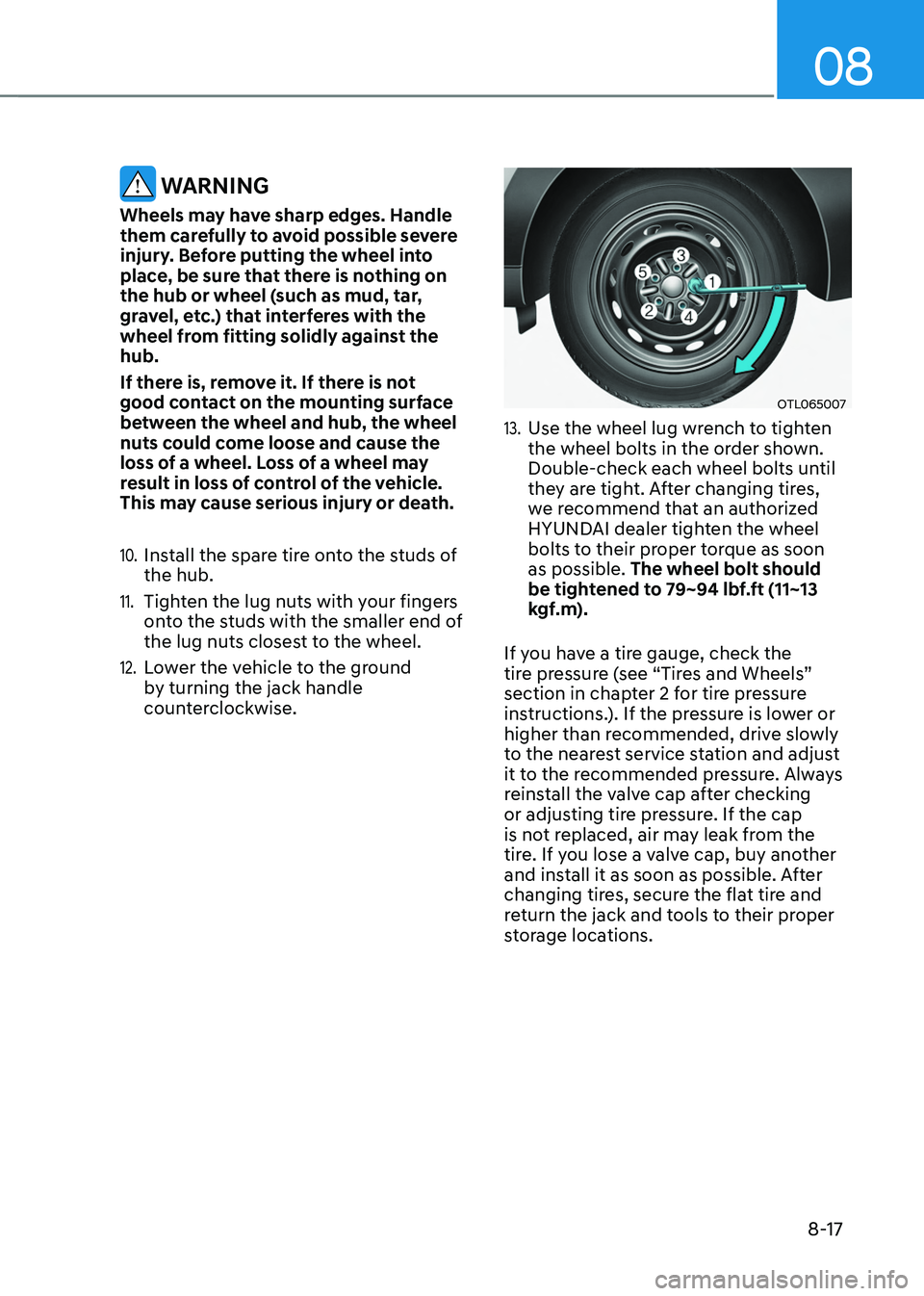
13. Use the wheel lug wrench to tighten
the wheel bolts in the order shown.
Double-check each wheel bolts until
they are tight. After changing tires,
we recommend that an authorized
HYUNDAI dealer tighten the wheel
bolts to their proper torque as soon
as possible. The wheel bolt should
be tightened to 79~94 lbf.ft (11~13
kgf.m).
If you have a tire gauge, check the
tire pressure (see “Tires and Wheels”
section in chapter 2 for tire pressure
instructions.). If the pressure is lower or
higher than recommended, drive slowly
to the nearest service station and adjust
it to the recommended pressure. Always
reinstall the valve cap after checking
or adjusting tire pressure. If the cap
is not replaced, air may leak from the
tire. If you lose a valve cap, buy another
and install it as soon as possible. After
changing tires, secure the flat tire and
return the jack and tools to their proper
storage locations.
Page 544 of 638
Emergency situations
8-18
NOTICE
Check the tire pressure as soon as
possible after installing a spare tire.
Adjust it to the recommended pressure.
CAUTION
Your vehicle has metric threads on the
studs and wheel bolts. Make certain
during tire changing that the same bolts
that were removed are reinstalled. If
you have to replace your wheel bolts
make sure they have metric threads to
avoid damaging the studs and ensure
the wheel is properly secured to the
hub. We recommend that you consult
an authorized HYUNDAI dealer for
assistance.
WARNING
Wheel studs
If the studs are damaged, they may lose
their ability to retain the wheel. This
could lead to the loss of the wheel and a
collision resulting in serious injuries.
If any of the equipment such as the jack,
wheel bolts, studs, or other equipment
is damaged or in poor condition, do not
attempt to change the tire and call for
assistance.
Use of compact spare tires
Compact spare tires are designed for
emergency use only. Drive carefully on
the compact spare tire and always follow
the safety precautions.
WARNING
To prevent compact spare tire failure
and loss of control possibly resulting in
an accident:
• Use the compact spare tire only in an
emergency.
• NEVER operate your vehicle over 50
mph (80 km/h).
• Do not exceed the vehicle’s
maximum load rating or the load
carrying capacity shown on the
sidewall of the compact spare tire.
• Do not use the compact spare tire
continuously. Repair or replace the
original tire as soon as possible to
avoid failure of the compact spare
tire.
Page 547 of 638
![HYUNDAI TUCSON 2022 Owners Manual 08
8-21
TOWING
Towing service
A
A
ONX4080013[A] : Dollies
If emergency towing is necessary,
we recommend having it done by
an authorized HYUNDAI dealer or a
commercial tow-truck service.
Proper lif](/manual-img/35/41173/w960_41173-546.png "HYUNDAI TUCSON 2022 Owners Manual 08
8-21
TOWING
Towing service
A
A
ONX4080013[A] : Dollies
If emergency towing is necessary,
we recommend having it done by
an authorized HYUNDAI dealer or a
commercial tow-truck service.
Proper lif")
08
8-21
TOWING
Towing service
A
A
ONX4080013[A] : Dollies
If emergency towing is necessary,
we recommend having it done by
an authorized HYUNDAI dealer or a
commercial tow-truck service.
Proper lifting and towing procedures
are necessary to prevent damage to
the vehicle. The use of wheel dollies or
flatbed is recommended.
For 2WD vehicles, it is acceptable to tow
the vehicle with the front wheels on the
ground (without dollies) and the rear
wheels off the ground.
If any of the loaded wheels or suspension
components are damaged or the vehicle
is being towed with the rear wheels on
the ground, use a towing dolly under the
rear wheels.
When being towed by a commercial tow
truck and wheel dollies are not used,
the rear of the vehicle should always be
lifted, not the front.
For AWD vehicles, it must be towed
with a wheel lift and dollies or flatbed
equipment with all the wheels off the
ground.
NOTICE
Do not lift the vehicle by the tow fitting
or body and chassis parts. Otherwise
the vehicle may be damaged.
CAUTION
• Do not tow the vehicle with the front
wheels on the ground as this may
cause damage to the vehicle.
ONX4080016
• Do not tow with sling-type
equipment. Use wheel lift or flatbed
equipment.
ONX4080015
Page 552 of 638

Tires and wheels ........................................................................\
.....................9-36Tire care ........................................................................\
..............................................9-36
Recommended cold tire inflation pressures ............................................................9-36
Check tire inflation pressure ........................................................................\
.............9-37
Tire rotation ........................................................................\
.......................................9-38
Wheel alignment and tire balance ........................................................................\
....9-39
Tire replacement ........................................................................\
................................9-39
Wheel replacement ........................................................................\
...........................9-40
Tire traction ........................................................................\
.......................................9-40
Tire maintenance ........................................................................\
..............................9-40
Tire sidewall labeling ........................................................................\
..........................9-41
Low aspect ratio tires ........................................................................\
........................9-44
Fuses ........................................................................\
........................................9-45Instrument panel fuse replacement ........................................................................\
9-46
Engine compartment panel fuse replacement ........................................................9-47
Fuse/relay panel description ........................................................................\
............9-48
Light bulbs ........................................................................\
...............................9-54Headlamp, position lamp, turn signal lamp, Daytime Running Light (DRL)
replacement ........................................................................\
.......................................9-55
Side repeater lamp replacement ........................................................................\
.....9-56
Rear combination lamp replacement ......................................................................9-56
High mounted stop lamp replacement ...................................................................9-60
License plate lamp replacement ........................................................................\
......9-60
Interior light replacement ........................................................................\
..................9-61
Appearance care ........................................................................\
.....................9-63Exterior care ........................................................................\
......................................9-63
Interior care ........................................................................\
.......................................9-68
Emission control system ........................................................................\
.......... 9-71Gasoline Particulate Filter (GPF) ........................................................................\
....... 9-73
California perchlorate notice ........................................................................\
..9 -74
9
Page 557 of 638
09
9 -7
Follow Normal Maintenance Schedule if the vehicle is usually operated where none of
the following conditions apply. If any of the following conditions apply, you must follow
the Maintenance Under Severe Usage Conditions.
• Repeated driving short distance of less than 5 miles (8 km) in normal temperature or
less than 10 miles (16 km) in freezing temperature
• Extensive engine idling or low speed driving for long distances
• Driving on rough, dusty, muddy, unpaved, graveled or salt-spread roads
• Driving in areas using salt or other corrosive materials or in very cold weather
• Driving in heavy dust conditions
• Driving in heavy traffic area
• Driving on uphill, downhill, or mountain road repeatedly
• Towing a trailer or using a camper, or driving with loads on the roof
• Driving as a patrol car, taxi, other commercial use of vehicle towing
• Frequently driving under high speed or rapid acceleration/deceleration
• Frequently driving in stop-and-go condition
• Engine oil usage which is not recommended (Mineral type, Semi-synthetic, Lower
grade spec, etc.)
If your vehicle is operated under the above conditions, you should inspect, replace
or refill more frequently than the following Normal Maintenance Schedule. After the
periods or distance shown in the chart, continue to follow the prescribed maintenance
intervals.
Information
• As it is normal for engine oil to be consumed during driving, the engine oil level should
be checked on regular basis.
• The engine oil change interval for normal operating conditions is based on the use of
the recommended engine specification. If the recommended engine oil specification
is not used, then replace the engine oil according to the maintenance schedule under
severe operating conditions.
SCHEDULED MAINTENANCE SERVICES
Page 558 of 638
Maintenance
9-8
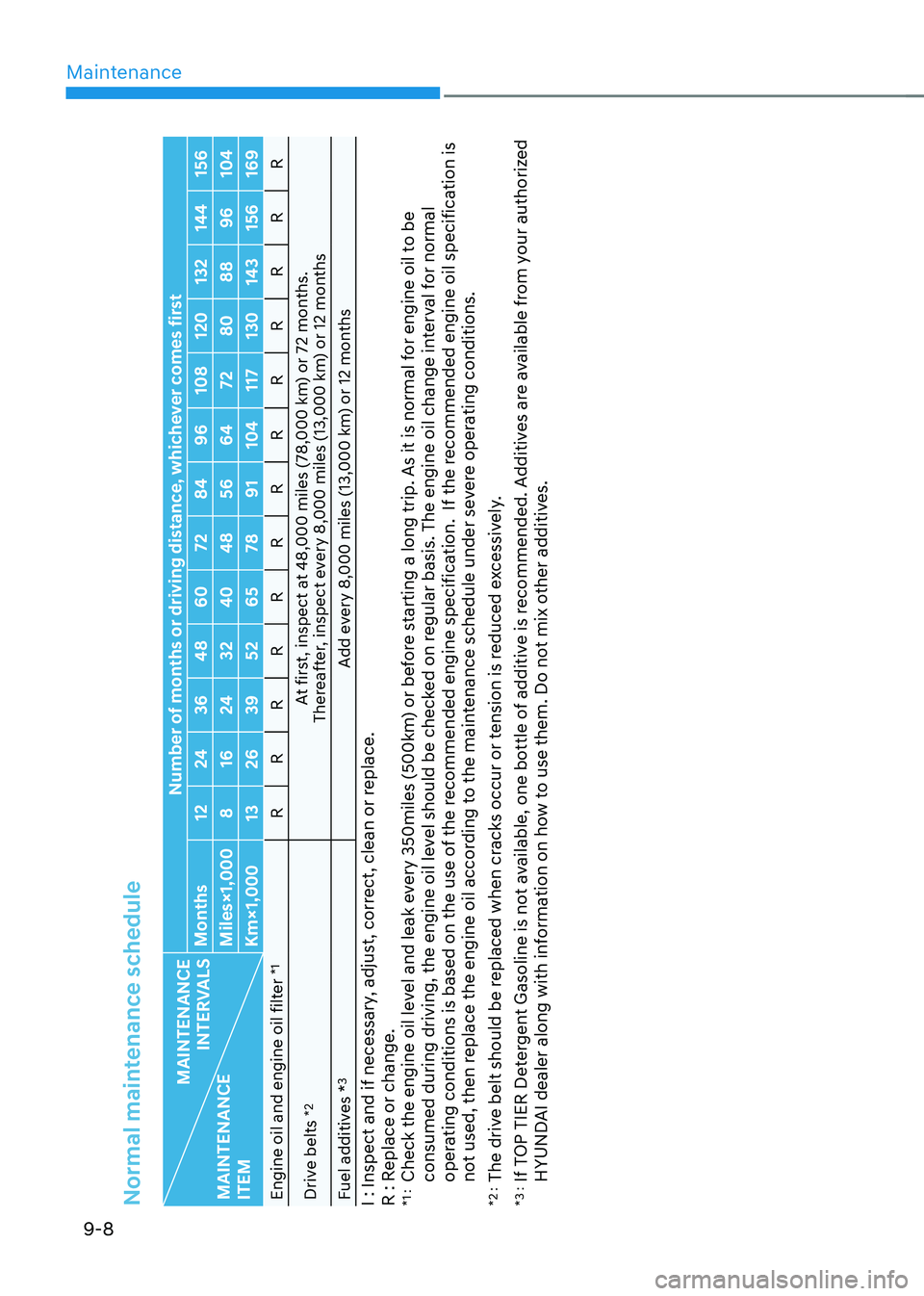
Normal maintenance schedule
MAINTENANCE
INTERVALS
MAINTENANCE
ITEM Number of months or driving distance, whichever comes first
Months 1224 3648 60 7284 96108 120132144 156
Miles×1,000 816 24 3240 48 5664 7280 8896104
Km×1,000 1326 39 5265 78 91104 117130 143156169
Engine oil and engine oil filter
*1
R RRRRRRR RRRRR
Drive belts
*2
At first, inspect at 48,000 miles (78,000 km) or 72 months.
Thereafter, inspect every 8,000 miles (13,000 km) or 12 months
Fuel additives *
3
Add every 8,000 miles (13,000 km) or 12 months
I : Inspect and if necessary, adjust, correct, clean or replace.
R : Replace or change.*1 : Check the engine oil level and leak every 350miles (500km) or before starting a long trip. As it is normal for engine oil to be consumed during driving, the engine oil level should be checked on regular basis. The engine oil change interval for normal
operating conditions is based on the use of the recommended engine specification. If the recommended engine oil specification is
not used, then replace the engine oil according to the maintenance schedule under severe operating conditions.
*2 : The drive belt should be replaced when cracks occur or tension is reduced excessively.
*3 : If TOP TIER Detergent Gasoline is not available, one bottle of additive is recommended. Additives are available from your authorized
HYUNDAI dealer along with information on how to use them. Do not mix other additives.
Page 559 of 638

09
9-9
Normal maintenance schedule
MAINTENANCE
INTERVALS
MAINTENANCE
ITEM Number of months or driving distance, whichever comes first
Months 1224 3648 60 7284 96108 120 132144 156
Miles×1,000 816 24 3240 48 5664 7280 8896104
Km×1,000 1326 39 5265 78 91104 117130 143156169
Air cleaner filter IIR IIR IIR IIR I
Spark plugs
*4
Replace every 96,000 miles (156,000 km)
Vapor hose, fuel filler cap and fuel tank IIIIII
Fuel tank air filter IIIIII
Fuel lines, hoses and connections IIIIII
I : Inspect and if necessary, adjust, correct, clean or replace.
R : Replace or change.*4 : For your convenience, it can be replaced prior to it’s interval when you do maintenance of other items.
Fuel filter :
The fuel filter is consider
ed to be maintenance free but periodic inspection is recommended for this maintenance schedule
depends on fuel quality. If there are some important matters like fuel flow restriction, surging, loss of power, hard starting
problem etc, replace the fuel filter immediately regardless of maintenance schedule. We recommend that you consult an
authorized HYUNDAI dealer for details.
Page 563 of 638
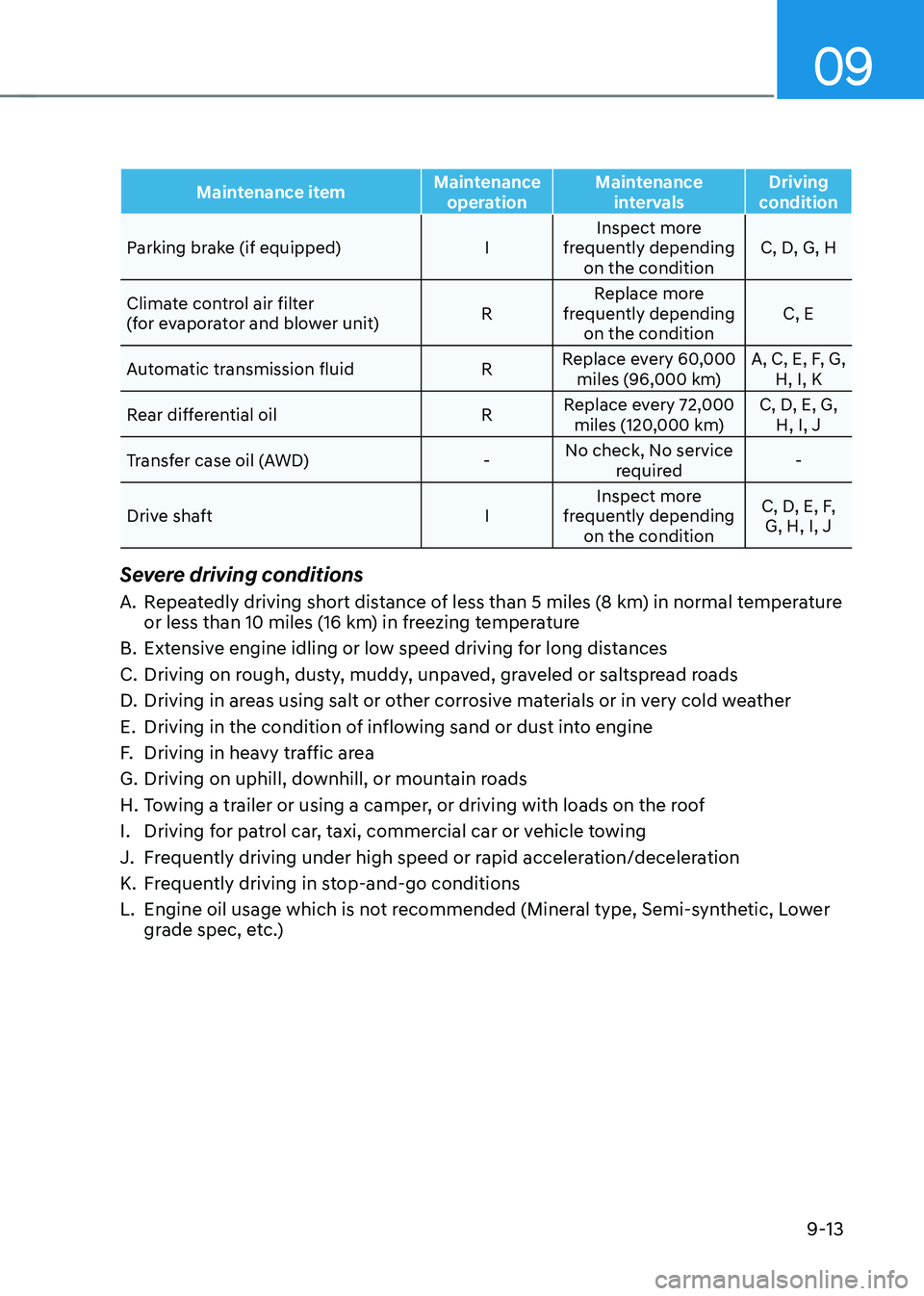
09
9-13
Maintenance itemMaintenance
operation Maintenance
intervals Driving
condition
Parking brake (if equipped) IInspect more
frequently depending on the condition C, D, G, H
Climate control air filter
(for evaporator and blower unit) RReplace more
frequently depending on the condition C, E
Automatic transmission fluid RReplace every 60,000
miles (96,000 km) A, C, E, F, G,
H, I, K
Rear differential oil RReplace every 72,000
miles (120,000 km) C, D, E, G,
H, I, J
Transfer case oil (AWD) -No check, No service
required -
Drive shaft IInspect more
frequently depending on the condition C, D, E, F,
G, H, I, J
Severe driving conditions
A. Repeatedly driving short distance of less than 5 miles (8 km) in normal temperature
or less than 10 miles (16 km) in freezing temperature
B. Extensive engine idling or low speed driving for long distances
C. Driving on rough, dusty, muddy, unpaved, graveled or saltspread roads
D. Driving in areas using salt or other corrosive materials or in very cold weather
E. Driving in the condition of inflowing sand or dust into engine
F. Driving in heavy traffic area
G. Driving on uphill, downhill, or mountain roads
H. Towing a trailer or using a camper, or driving with loads on the roof
I. Driving for patrol car, taxi, commercial car or vehicle towing
J. Frequently driving under high speed or rapid acceleration/deceleration
K. Frequently driving in stop-and-go conditions
L. Engine oil usage which is not recommended (Mineral type, Semi-synthetic, Lower
grade spec, etc.)