2022 HYUNDAI TUCSON HYBRID Recommended lubricants
[x] Cancel search: Recommended lubricantsPage 6 of 630
Foreword / Hybrid System Overview
1-2
FOREWORD
Congratulations, and thank you for choosing HYUNDAI. We are pleased to welcome
you to the growing number of discerning people who drive HYUNDAIs. We are very
proud of the advanced engineering and high-quality construction of each HYUNDAI
we build.
Your Owner’s Manual will introduce you to the features and operation of your new
HYUNDAI. To become familiar with your new HYUNDAI, so that you can fully enjoy it,
read this Owner’s Manual carefully before driving your new vehicle.
This manual contains important safety information and instructions intended to
familiarize you with your vehicle’s controls and safety features so you can safely
operate your vehicle.
This manual also contains information on maintenance designed to enhance safe
operation of the vehicle. It is recommended that all service and maintenance on your
car be performed by an authorized HYUNDAI dealer. An authorized HYUNDAI dealers
are prepared to provide high-quality service, maintenance and any other assistance
that may be required.
This Owner’s Manual should be considered a permanent part of your vehicle, and
should be kept in the vehicle so you can refer to it at any time. The manual should stay
with the vehicle if you sell it to provide the next owner with important operating, safety
and maintenance information.
HYUNDAI MOTOR AMERICA
CAUTION
Severe engine and transmission damage may result from the use of poor quality
fuels and lubricants that do not meet HYUNDAI specifications. You must always use
high quality fuels and lubricants that meet the specifications listed on Page 2-13 in
the Vehicle Specifications section of the Owner’s Manual.
Copyright 2021 HYUNDAI Motor America. All rights reserved. No part of this publication
may be reproduced, stored in any retrieval system or transmitted in any form or by any
means without the prior written permission of HYUNDAI Motor America.
Foreword / Hybrid System Overview
Page 30 of 630
2. Vehicle Information,
Consumer Information and
Reporting Safety Defects
Vehicle Information, Consumer Information and Reporting Safety Defects
Exterior overview (I) ........................................................................\
...................2-2
Exterior overview (II)
........................................................................\
..................2-3
Interior overview
........................................................................\
......................2-4
Instrument panel overview (I)
........................................................................\
.2-5
Instrument panel overview (II)
........................................................................\
2-6
Engine compartment
........................................................................\
.................2-7
Dimensions
........................................................................\
................................2-8
Engine
........................................................................\
........................................2-8
Bulb wattage
........................................................................\
.............................2-9
Tires and wheels
........................................................................\
......................2-10
Air conditioning system
........................................................................\
............2-11
Volume and weight
........................................................................\
...................2-11
Recommended lubricants and capacities
.....................................................2-12Recommended SAE viscosity number ......................................................................2-13
Vehicle identification number (VIN) ...............................................................2-14
Vehicle certification label
........................................................................\
........2-14
Tire specification and pressure label
..............................................................2-15
Engine number
........................................................................\
.........................2-15
Air conditioner compressor label
...................................................................2-15
Consumer Information
........................................................................\
............2-16
Reporting Safety Defects
........................................................................\
........2-17
2
Page 41 of 630
Vehicle Information, Consumer Information and Reporting Safety Defects
2-12
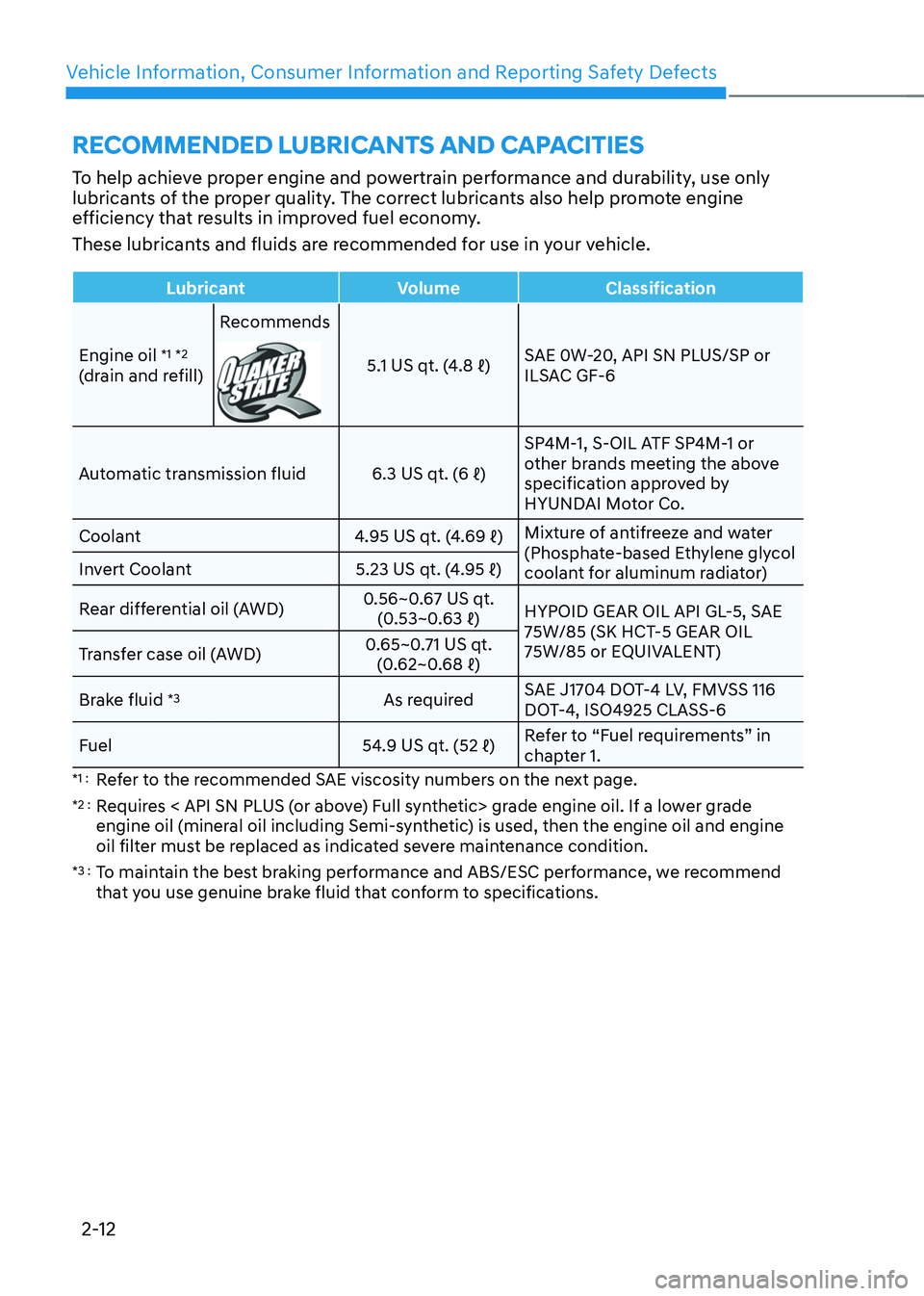
To help achieve proper engine and powertrain performance and durability, use only
lubricants of the proper quality. The correct lubricants also help promote engine
efficiency that results in improved fuel economy.
These lubricants and fluids are recommended for use in your vehicle.
LubricantVolumeClassification
Engine oil
*1 *2
(drain and refill) Recommends5.1 US qt. (4.8 ℓ)SAE 0W-20, API SN PLUS/SP or
ILSAC GF-6
Automatic transmission fluid6.3 US qt. (6 ℓ)
SP4M-1, S-OIL ATF SP4M-1 or
other brands meeting the above
specification approved by
HYUNDAI Motor Co.
Coolant
4.95 US qt. (4.69 ℓ)Mixture of antifreeze and water
(Phosphate-based Ethylene glycol
coolant for aluminum radiator)
Invert Coolant
5.23 US qt. (4.95 ℓ)
Rear differential oil (AWD) 0.56~0.67 US qt. (0.53~0.63 ℓ)HYPOID GEAR OIL API GL-5, SAE
75W/85 (SK HCT-5 GEAR OIL
75W/85 or EQUIVALENT)
Transfer case oil (AWD) 0.65~0.71 US qt.
(0.62~0.68 ℓ)
Brake fluid *3As required SAE J1704 DOT-4 LV, FMVSS 116
DOT-4, ISO4925 CLASS-6
Fuel
54.9 US qt. (52 ℓ)Refer to “Fuel requirements” in
chapter 1.
*1 : Refer to the recommended SAE viscosity numbers on the next page.
*2 : Requires < API SN PLUS (or above) Full synthetic> grade engine oil. If a lower grade
engine oil (mineral oil including Semi-synthetic) is used, then the engine oil and engine
oil filter must be replaced as indicated severe maintenance condition.
*3 : To maintain the best braking performance and ABS/ESC performance, we recommend
that you use genuine brake fluid that conform to specifications.
RECOMMENDED LUBRICANTS AND CAPACITIES
Page 562 of 630
09
9-15
Checking the engine oil level
Engine oil is used for lubricating,
cooling, and operating various hydraulic
components in the engine. Engine oil
consumption while driving is normal,
and it is necessary to check and refill the
engine oil regularly. Also, check and refill
the oil level within the recommended
maintenance schedule to prevent
deterioration of oil performance.
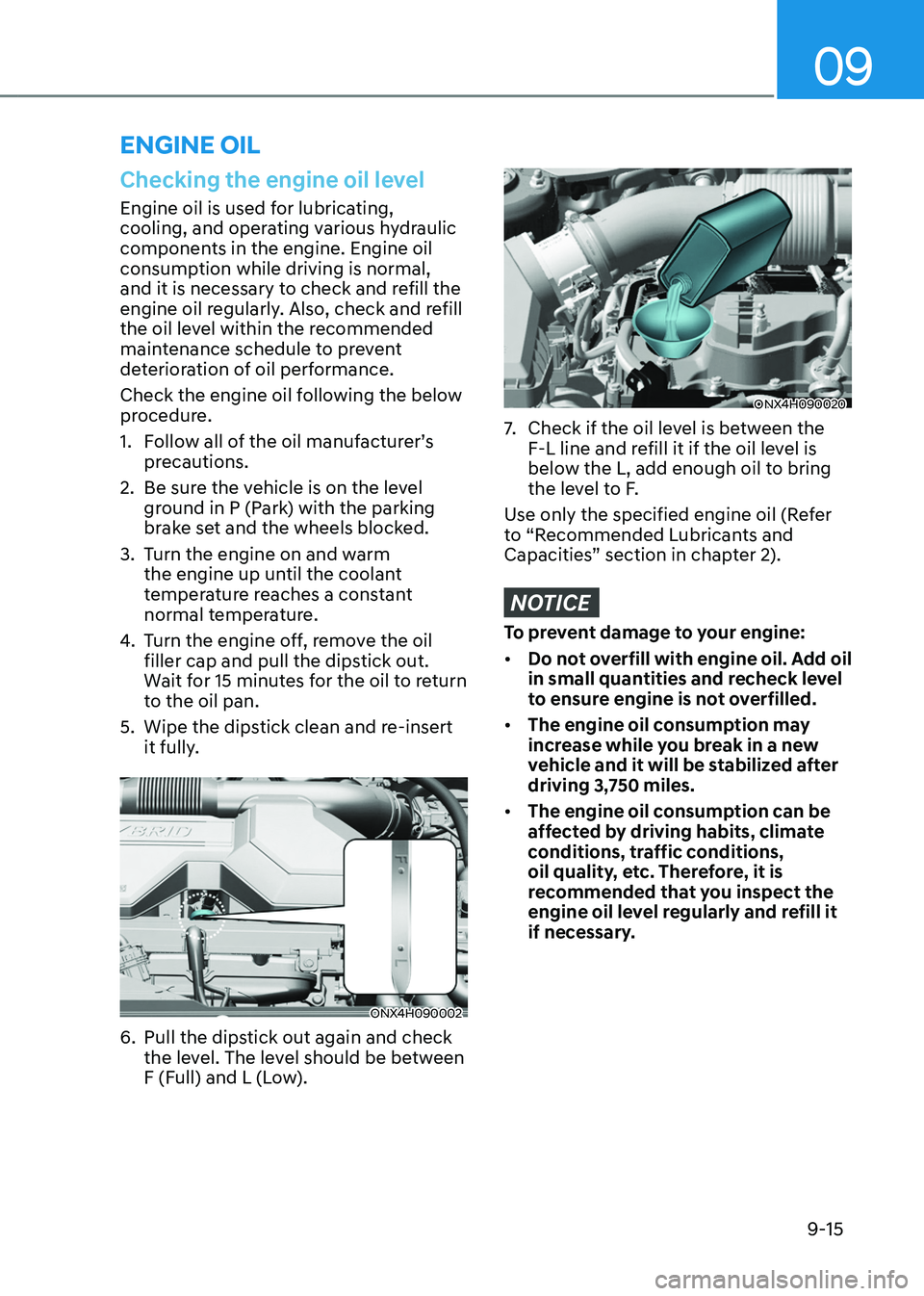
Check the engine oil following the below
procedure.
1.
Follo
w all of the oil manufacturer’s
precautions.
2.
Be sure the v
ehicle is on the level
ground in P (Park) with the parking
brake set and the wheels blocked.
3.
Turn the engine on and w
arm
the engine up until the coolant
temperature reaches a constant
normal temperature.
4.
Turn the engine o
ff, remove the oil
filler cap and pull the dipstick out.
Wait for 15 minutes for the oil to return
to the oil pan.
5.
Wipe the dipstick clean and r
e-insert
it fully.
ONX4H090002
6. Pull the dipstick out again and check
the le vel. The level should be between
F (Full) and L (Low).
ONX4H090020
7. Check if the oil lev el is between the
F-L line and refill it if the oil level is
below the L, add enough oil to bring
the level to F.
Use only the specified engine oil (Refer
to “Recommended Lubricants and
Capacities” section in chapter 2).
NOTICE
To prevent damage to your engine:
• Do not overfill with engine oil. Add oil
in small quantities and recheck level
to ensure engine is not overfilled.
• The engine oil consumption may
increase while you break in a new
vehicle and it will be stabilized after
driving 3,750 miles.
• The engine oil consumption can be
affected by driving habits, climate
conditions, traffic conditions,
oil quality, etc. Therefore, it is
recommended that you inspect the
engine oil level regularly and refill it
if necessary.
EnginE oil
Page 568 of 630
09
9-21
washEr fluid
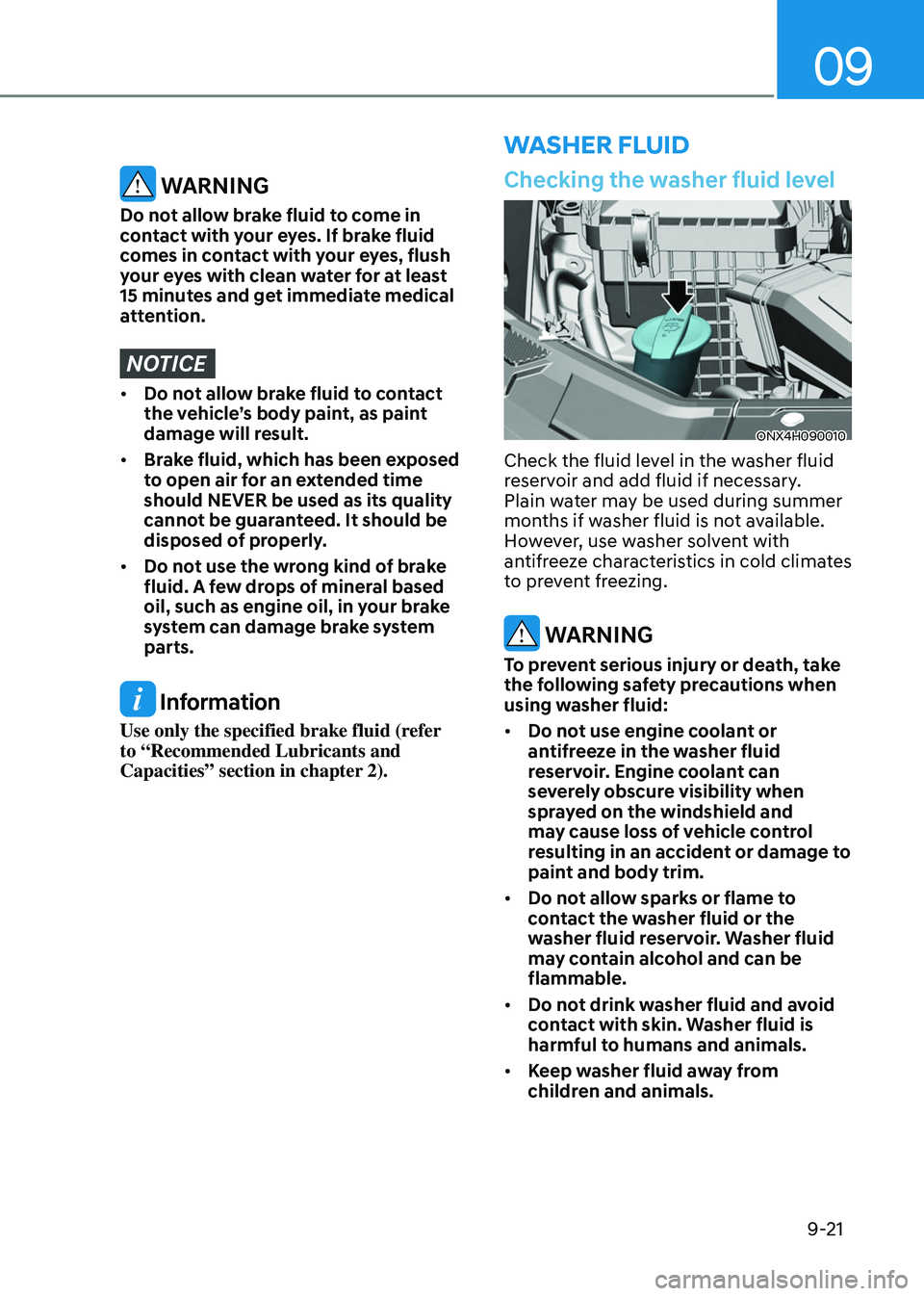
Checking the washer fluid level
ONX4H090010
Check the fluid level in the washer fluid
reservoir and add fluid if necessary.
Plain water may be used during summer
months if washer fluid is not available.
However, use washer solvent with
antifreeze characteristics in cold climates
to prevent freezing.
WARNING
To prevent serious injury or death, take
the following safety precautions when
using washer fluid:
• Do not use engine coolant or
antifreeze in the washer fluid
reservoir. Engine coolant can
severely obscure visibility when
sprayed on the windshield and
may cause loss of vehicle control
resulting in an accident or damage to
paint and body trim.
• Do not allow sparks or flame to
contact the washer fluid or the
washer fluid reservoir. Washer fluid
may contain alcohol and can be
flammable.
• Do not drink washer fluid and avoid
contact with skin. Washer fluid is
harmful to humans and animals.
• Keep washer fluid away from
children and animals.
WARNING
Do not allow brake fluid to come in
contact with your eyes. If brake fluid
comes in contact with your eyes, flush
your eyes with clean water for at least
15 minutes and get immediate medical
attention.
NOTICE
• Do not allow brake fluid to contact
the vehicle’s body paint, as paint
damage will result.
• Brake fluid, which has been exposed
to open air for an extended time
should NEVER be used as its quality
cannot be guaranteed. It should be
disposed of properly.
• Do not use the wrong kind of brake
fluid. A few drops of mineral based
oil, such as engine oil, in your brake
system can damage brake system
parts.
Information
Use only the specified brake fluid (refer
to “Recommended Lubricants and
Capacities” section in chapter 2).
Page 627 of 630
Index
I-10
N
Navigation-Based Smart Cruise Control (NSCC)
...............................................7-85
Limitations of the system ........................................................................\
.........7-88
System operation ........................................................................\
......................7-86
System settings ........................................................................\
.........................7-85
O
Owner maintenance
........................................................................\
.......................9-5
Owner maintenance schedule ........................................................................\
.....9-5
P
Panoramic sunroof
........................................................................\
.......................5-61
Closing the sunroof ........................................................................\
..................5-63
Resetting the sunroof ........................................................................\
................5-65
Sliding the sunroof ........................................................................\
...................5-62
Sunroof open warning ........................................................................\
..............5-66
Sunshade........................................................................\
................................... 5-62
Tilting the sunroof ........................................................................\
....................5-63
R
Rear corner radar
........................................................................\
.......................7-139
Rear Cross-Traffic Collision Warning (RCCW)
...............................................7-111
System malfunction and limitations ...............................................................7-115
System operation ........................................................................\
....................7-113
System settings ........................................................................\
.......................7-112
Rear Cross-Traffic Collision-Avoidance Assist (RCCA)
.................................7-119
System malfunction and limitations ...............................................................7-125
System operation ........................................................................\
....................7-121
System settings ........................................................................\
.......................7-120
Rear View Monitor (RVM)
........................................................................\
........7-102
System malfunction and limitations ...............................................................7-105
System operation ........................................................................\
....................7-103
System settings ........................................................................\
.......................7-102
Recommended lubricants and capacities
.............................................................2-12
Recommended SAE viscosity number .............................................................2-13
Reporting Safety Defects
........................................................................\
.............2-17