Maintenance
7
7-11
Maintenance Under Severe Usage Conditions (3.8 GDI)
The following items must be serviced more frequently on cars normally used under severe driving conditions. Refer
to the chart below for the appropriate maintenance intervals.
R : Replace or change.
I : Inspect and if necessary, adjust, correct, clean or replace.
MAINTENANCE ITEMMAINTENANCEOPERATIONMAINTENANCE INTERVALSDRIVING
CONDITION
Engine oil and filterREvery 5,000 miles (6,500 km) or 6 monthsA, B, C, D, E, F, G,H, I, J, K, L
Air cleaner filterRMore frequentlyC, E
Spark plugs RMore frequentlyA, B, F, H, I ,K
Automatic transaxle fluidREvery 60,000 miles (96,000 km) A, C, D, E,
F, G, H, J, I
Front brake disc/pads, calipersIMore frequentlyC, D, ,E, J, G, H, K
Rear brake disc/pads, calipersIMore frequentlyC, D, ,E, J, G, H, K
Parking brakeIMore frequentlyC, D, G, H
7-14
Maintenance
Air Cleaner Filter
A genuine HYUNDAI air cleaner filter
is recommended when the filter is
replaced.
Spark Plugs
Make sure to install new spark plugs
of the correct heat range.
When assembling parts, be sure to
wipe out foreign substances inside
and outside of the boot bottom of the
ignition coil and the insulator of the
spark plug with a soft cloth to prevent
contamination of the spark plug insu-
lator.
Cooling System
Check cooling system components,
such as radiator, coolant reservoir,
hoses and connections for leakage
and damage. Replace any damaged
parts.
Engine Coolant
The coolant should be changed at
the intervals specified in the mainte-
nance schedule.
Automatic Transmission Fluid
Automatic transmission fluid should
not be checked under normal usage
conditions. But in severe conditions,
the fluid should be changed at an
authorized HYUNDAI dealer in
accordance to the scheduled mainte-
nance at the beginning of this chap-
ter.
Information
Automatic transmission fluid color is
red when new.
As the vehicle is driven, the automatic
transmission fluid will begin to look
darker. This is a normal condition and
you should not judge the need to
replace the fluid based upon the
changed color.The use of a non-specified fluid
could result in transmission mal-
function and failure. Use only the
specified automatic transmission
fluid (refer to "Recommended
Lubricants and Capacities" in
chapter 8).
NOTICE
i
7-19
7
Maintenance
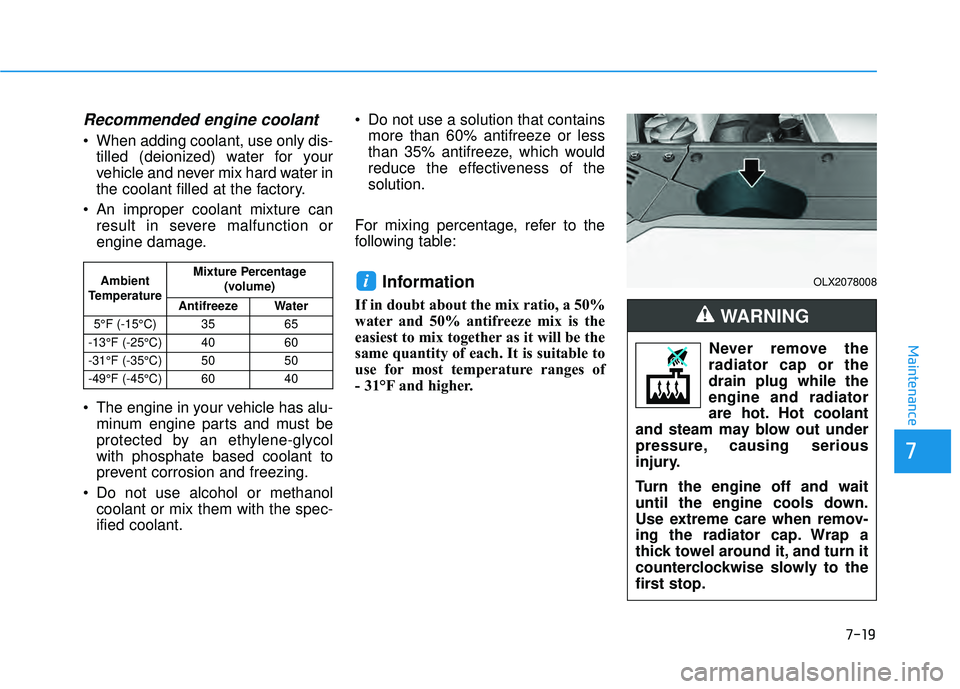
Recommended engine coolant
When adding coolant, use only dis-tilled (deionized) water for your
vehicle and never mix hard water in
the coolant filled at the factory.
An improper coolant mixture can result in severe malfunction or
engine damage.
The engine in your vehicle has alu- minum engine parts and must be
protected by an ethylene-glycol
with phosphate based coolant to
prevent corrosion and freezing.
Do not use alcohol or methanol coolant or mix them with the spec-
ified coolant. Do not use a solution that contains
more than 60% antifreeze or less
than 35% antifreeze, which would
reduce the effectiveness of the
solution.
For mixing percentage, refer to the
following table:
Information
If in doubt about the mix ratio, a 50%
water and 50% antifreeze mix is the
easiest to mix together as it will be the
same quantity of each. It is suitable to
use for most temperature ranges of
- 31°F and higher.
iAmbient
Temperature Mixture Percentage
(volume)
Antifreeze Water
5°F (-15°C) 35 65
-13°F (-25°C) 40 60
-31°F (-35°C) 50 50
-49°F (-45°C) 60 40
Never remove the
radiator cap or the
drain plug while the
engine and radiator
are hot. Hot coolant
and steam may blow out under
pressure, causing serious
injury.
Turn the engine off and wait
until the engine cools down.
Use extreme care when remov-
ing the radiator cap. Wrap a
thick towel around it, and turn it
counterclockwise slowly to the
first stop.
WARNING
OLX2078008
8-9
88
Specifications, Consumer information and Reporting safety defects
Recommended SAE viscosity
number
Always be sure to clean the area
around any filler plug, drain
plug, or dipstick before check-
ing or draining any lubricant.
This is especially important in
dusty or sandy areas and when
the vehicle is used on unpaved
roads. Cleaning the plug and
dipstick areas will prevent dirt
and grit from entering the
engine and other mechanisms
that could be damaged.
CAUTION
*1: For better fuel economy, it is recommended to use the engine oil of a viscositygrade SAE 5W-30. However, if the engine oil is not available in your country,
select the proper engine oil using the engine oil viscosity chart.
An engine oil displaying this American Petroleum Institute(API)
Certification Mark conforms to the International Lubricant
Specification Advisory Committee (ILSAC). It is recommended to
only use engine oils that uphold this API Certification Mark.
Engine oil viscosity (thickness) has an effect on fuel economy and cold
weather operating (engine start and engine oil flowability). Lower viscosity
engine oils can provide better fuel economy and cold weather performance,
however, higher viscosity engine oils are required for satisfactory lubrication
in hot weather.
Using oils of any viscosity other than those recommended could result in
engine damage.
When choosing an oil, consider the range of temperature your vehicle will be
operated in before the next oil change. Proceed to select the recommended
oil viscosity from the chart.
Temperature Range for SAE Viscosity Numbers
Temperature -30 -20 -10 0 10 20 30 40 50
-10 0 20 40 60 80 100 120
Engine Oil *1
°C
(°F)
5W-30