Page 22 of 579
02
2-9
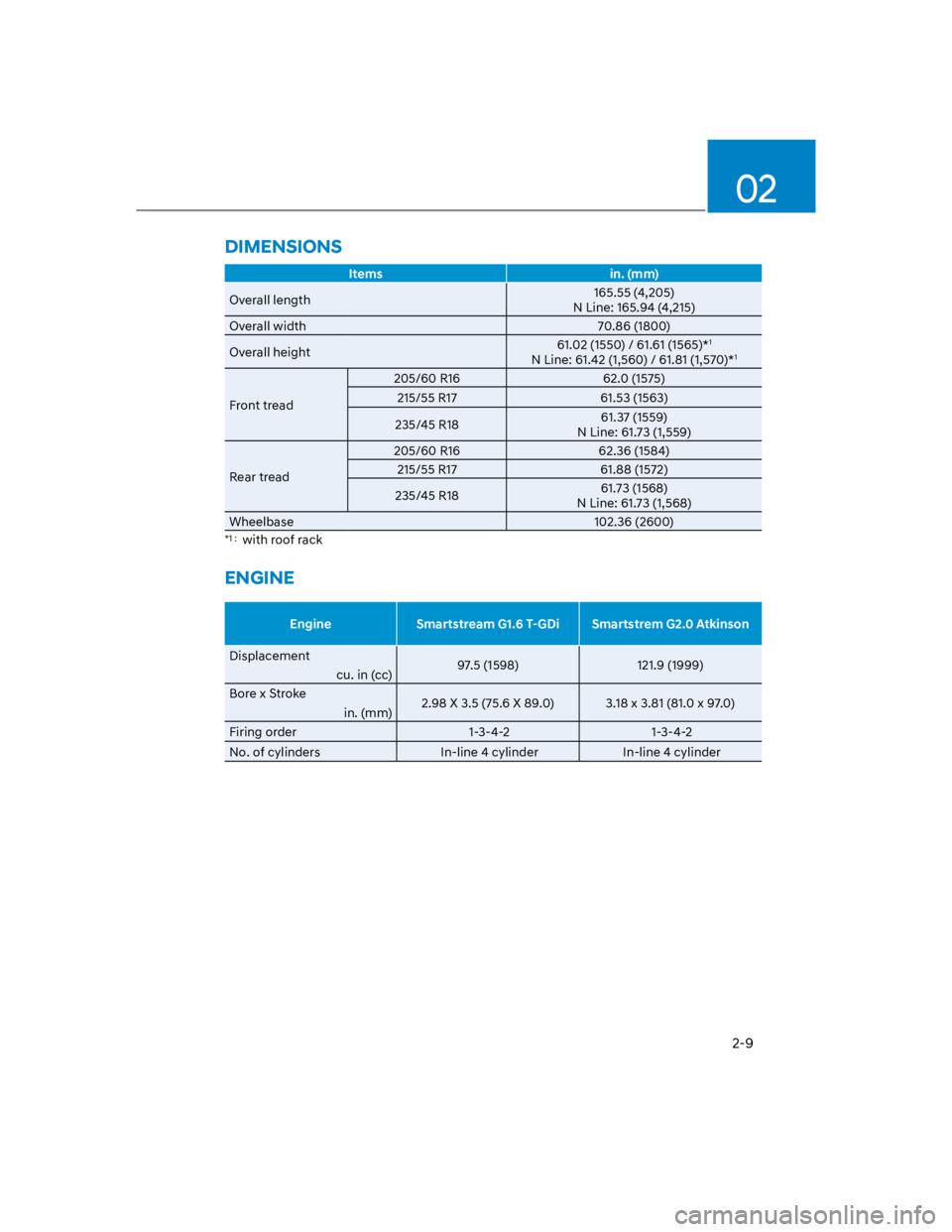
Items in. (mm)
Overall length165.55 (4,205)
N Line: 165.94 (4,215)
Overall width 70.86 (1800)
Overall height61.02 (1550) / 61.61 (1565)*1
N Line: 61.42 (1,560) / 61.81 (1,570)*1
Front tread
205/60 R16 62.0 (1575)
215/55 R17 61.53 (1563)
235/45 R1861.37 (1559)
N Line: 61.73 (1,559)
Rear tread
205/60 R16 62.36 (1584)
215/55 R17 61.88 (1572)
235/45 R1861.73 (1568)
N Line: 61.73 (1,568)
Wheelbase 102.36 (2600)
*1 : with roof rack
ENGINE
Engine Smartstream G1.6 T-GDi Smartstrem G2.0 Atkinson
Displacement
cu. in (cc)97.5 (1598) 121.9 (1999)
Bore x Stroke
in. (mm)2.98 X 3.5 (75.6 X 89.0) 3.18 x 3.81 (81.0 x 97.0)
Firing order 1-3-4-2 1-3-4-2
No. of cylinders In-line 4 cylinder In-line 4 cylinder
DIMENSIONS
Page 34 of 579
3-3
03
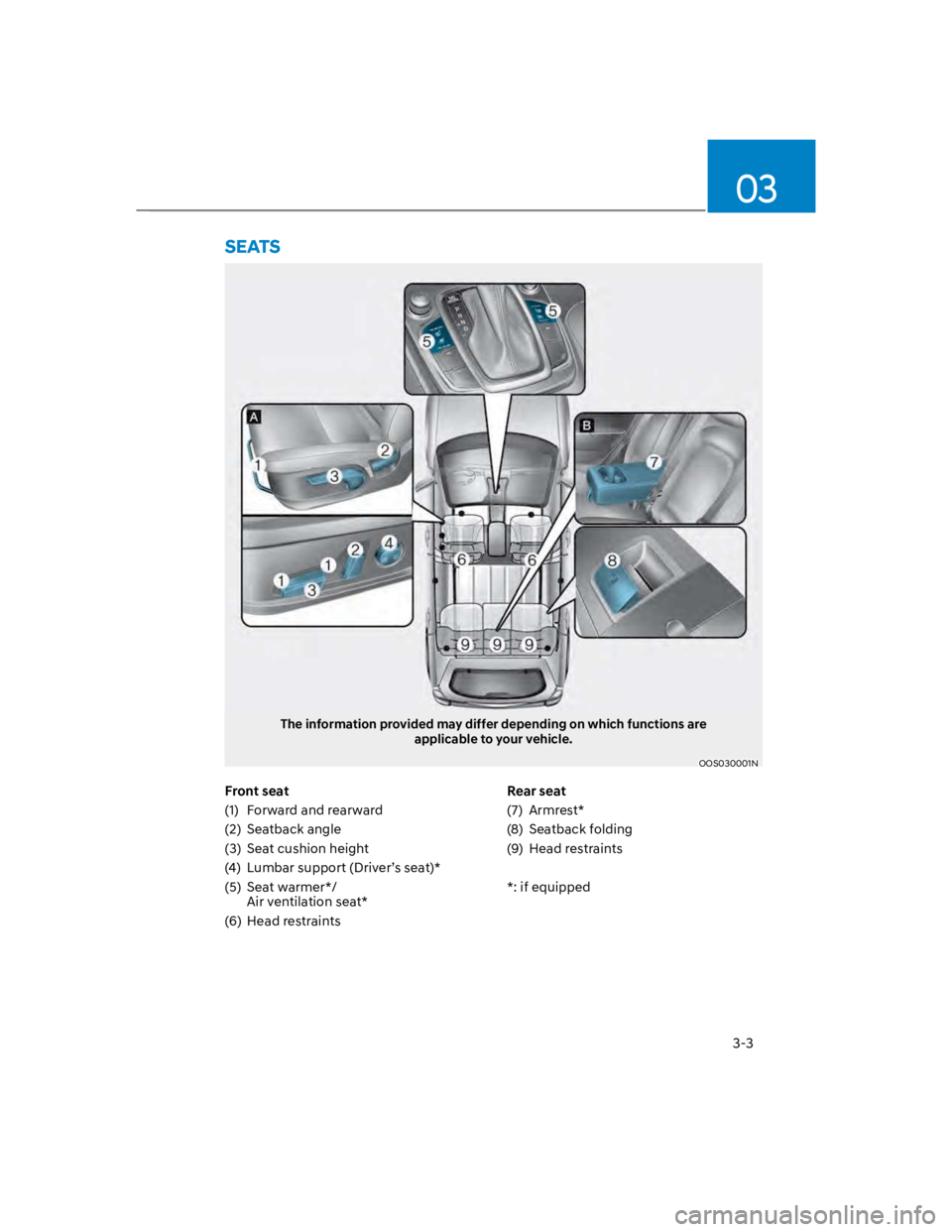
Front seat
(1) Forward and rearward
(2) Seatback angle
(3) Seat cushion height
(4) Lumbar support (Driver’s seat)*
(5) Seat warmer*/
Air ventilation seat*
(6) Head restraints
Rear seat
(7) Armrest*
(8) Seatback folding
(9) Head restraints
*: if equipped
SEATS
The information provided may differ depending on which functions are
applicable to your vehicle.
OOS030001N
Page 38 of 579
03
3-7
Seat belts must be snug against your
hips and chest to work properly. When
the seatback is reclined, the shoulder
belt cannot do its job because it will not
be snug against your chest. Instead,
it will be in front of you. During an
accident, you could be thrown into the
seat belt, causing neck or other injuries.
The more the seatback is reclined,
the greater chance the passenger’s
hips will slide under the lap belt or the
passenger’s neck will strike the shoulder
belt.
OOS037004
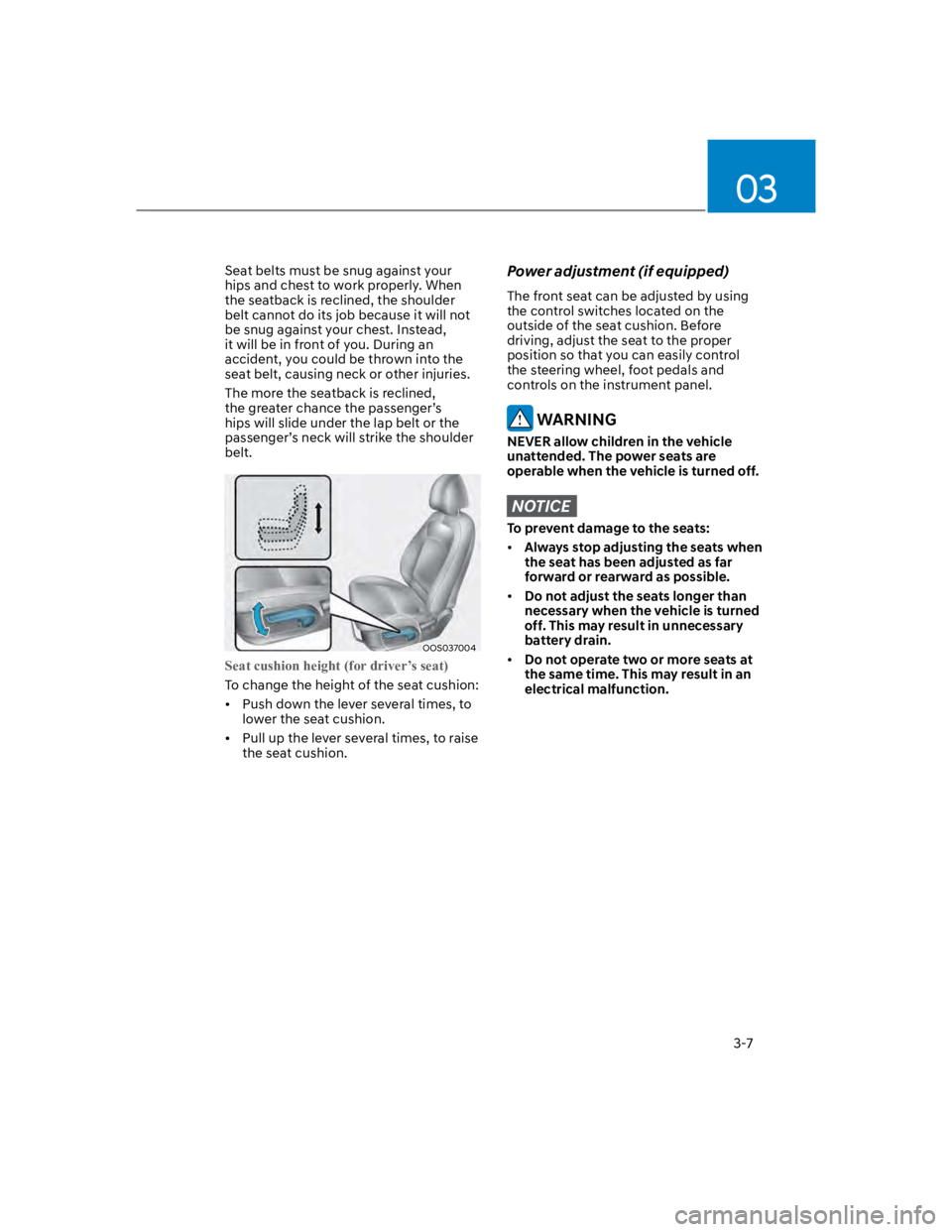
Seat cushion height (for driver’s seat)
To change the height of the seat cushion:
Push down the lever several times, to
lower the seat cushion.
Pull up the lever several times, to raise
the seat cushion.
Power adjustment (if equipped)
The front seat can be adjusted by using
the control switches located on the
outside of the seat cushion. Before
driving, adjust the seat to the proper
position so that you can easily control
the steering wheel, foot pedals and
controls on the instrument panel.
WARNING
NEVER allow children in the vehicle
unattended. The power seats are
operable when the vehicle is turned off.
NOTICE
To prevent damage to the seats:
Always stop adjusting the seats when
the seat has been adjusted as far
forward or rearward as possible.
Do not adjust the seats longer than
necessary when the vehicle is turned
off. This may result in unnecessary
battery drain.
Do not operate two or more seats at
the same time. This may result in an
electrical malfunction.
Page 40 of 579
03
3-9
Seat belts must be snug against your
hips and chest to work properly. When
the seatback is reclined, the shoulder
belt cannot do its job because it will not
be snug against your chest. Instead,
it will be in front of you. During an
accident, you could be thrown into the
seat belt, causing neck or other injuries.
The more the seatback is reclined,
the greater chance the passenger’s
hips will slide under the lap belt or the
passenger’s neck will strike the shoulder
belt.
OOSEV038001
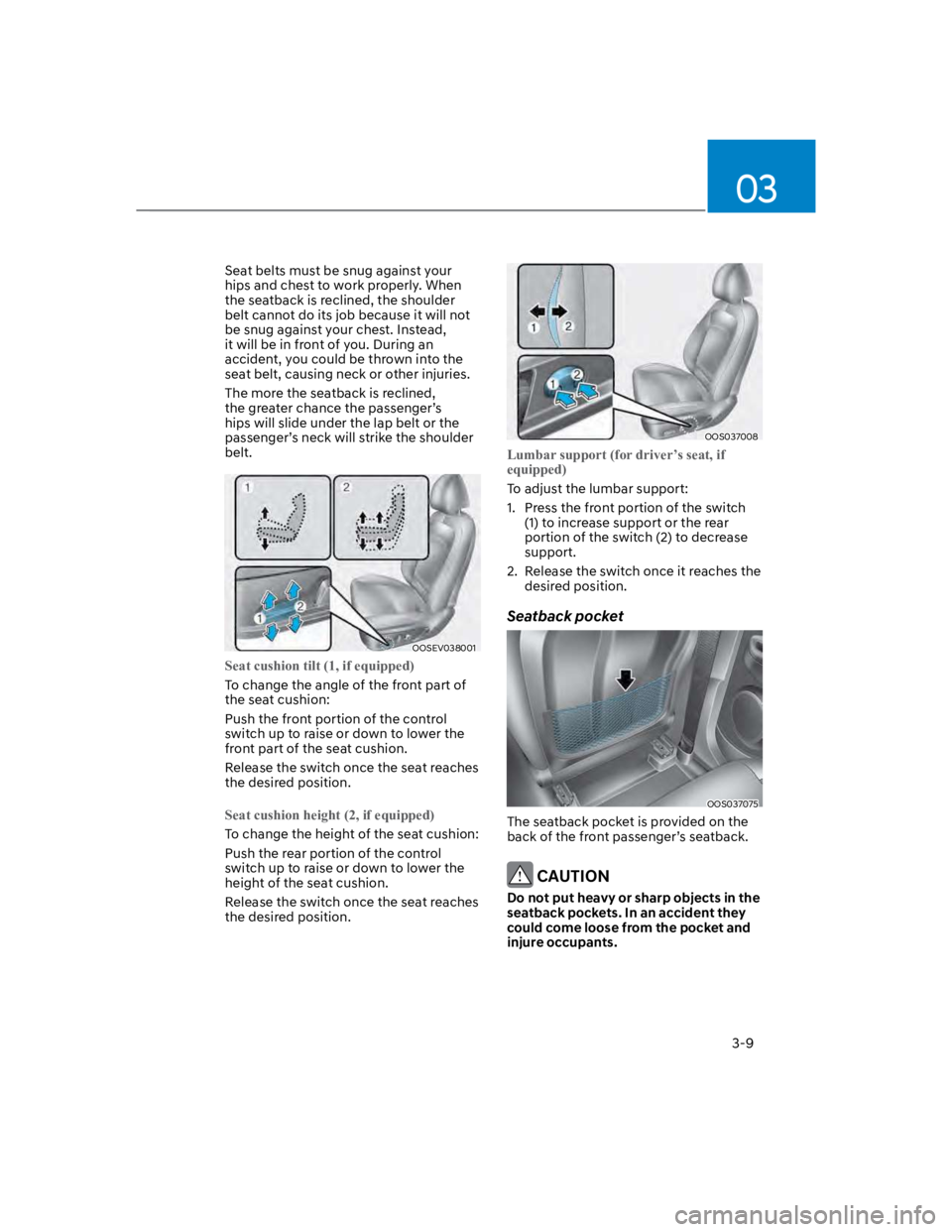
Seat cushion tilt (1, if equipped)
To change the angle of the front part of
the seat cushion:
Push the front portion of the control
switch up to raise or down to lower the
front part of the seat cushion.
Release the switch once the seat reaches
the desired position.
Seat cushion height (2, if equipped)
To change the height of the seat cushion:
Push the rear portion of the control
switch up to raise or down to lower the
height of the seat cushion.
Release the switch once the seat reaches
the desired position.
OOS037008
Lumbar support (for driver’s seat, if
equipped)
To adjust the lumbar support:
1. Press the front portion of the switch
(1) to increase support or the rear
portion of the switch (2) to decrease
support.
2. Release the switch once it reaches the
desired position.
Seatback pocket
OOS037075
The seatback pocket is provided on the
back of the front passenger’s seatback.
CAUTION
Do not put heavy or sharp objects in the
seatback pockets. In an accident they
could come loose from the pocket and
injure occupants.
Page 44 of 579
03
3-13
Head Restraints
The vehicle’s front and rear (second row
and/or third row) seats have adjustable
head restraints. The head restraints
provide comfort for passengers, but
more importantly they are designed to
help protect passengers from whiplash
and other neck and spinal injuries during
an accident, especially in a rear impact
collision.
WARNING
To help reduce the risk of serious
injury or death in an accident, take the
following precautions when adjusting
your head restraints:
Always properly adjust the head
restraints for all passengers BEFORE
starting the vehicle.
NEVER let anyone ride in a seat
with the head restraints removed or
reversed.
OLF034072N
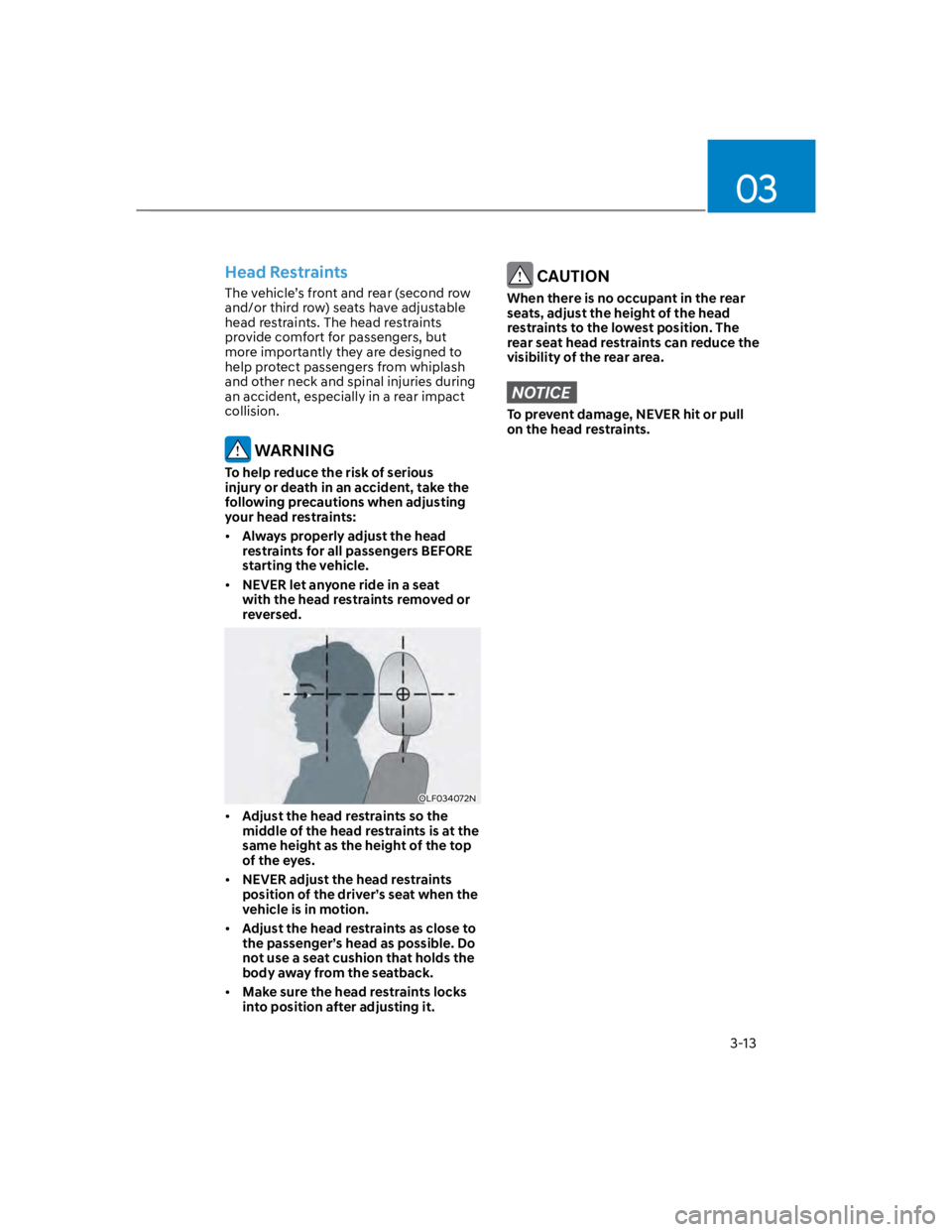
Adjust the head restraints so the
middle of the head restraints is at the
same height as the height of the top
of the eyes.
NEVER adjust the head restraints
position of the driver’s seat when the
vehicle is in motion.
Adjust the head restraints as close to
the passenger’s head as possible. Do
not use a seat cushion that holds the
body away from the seatback.
Make sure the head restraints locks
into position after adjusting it.
CAUTION
When there is no occupant in the rear
seats, adjust the height of the head
restraints to the lowest position. The
rear seat head restraints can reduce the
visibility of the rear area.
NOTICE
To prevent damage, NEVER hit or pull
on the head restraints.
Page 45 of 579
Seats & Safety System
3-14
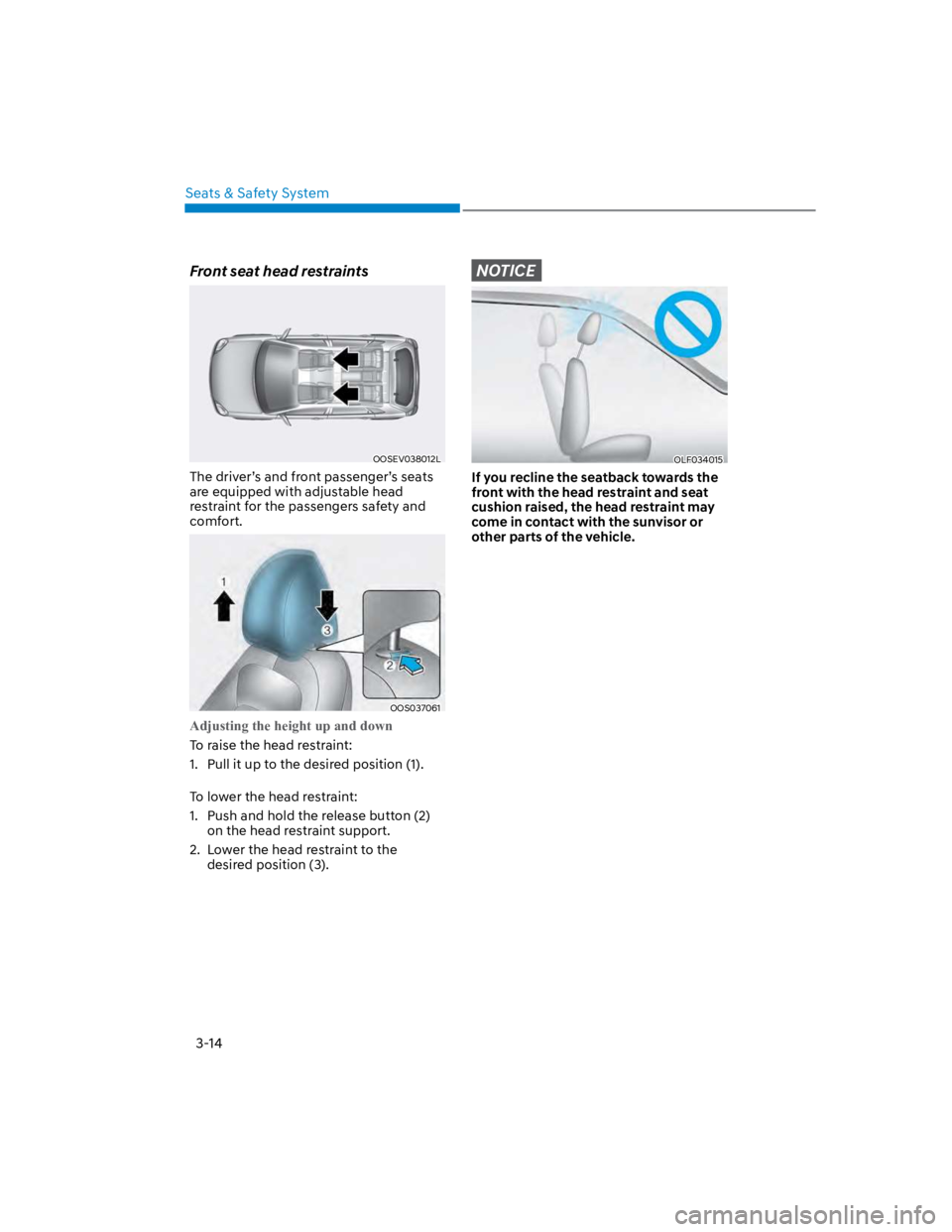
Front seat head restraints
OOSEV038012L
The driver’s and front passenger’s seats
are equipped with adjustable head
restraint for the passengers safety and
comfort.
OOS037061
Adjusting the height up and down
To raise the head restraint:
1. Pull it up to the desired position (1).
To lower the head restraint:
1. Push and hold the release button (2)
on the head restraint support.
2. Lower the head restraint to the
desired position (3).
NOTICE
OLF034015
If you recline the seatback towards the
front with the head restraint and seat
cushion raised, the head restraint may
come in contact with the sunvisor or
other parts of the vehicle.
Page 46 of 579
03
3-15
Type A
OOS037011
Type B
OOS037012
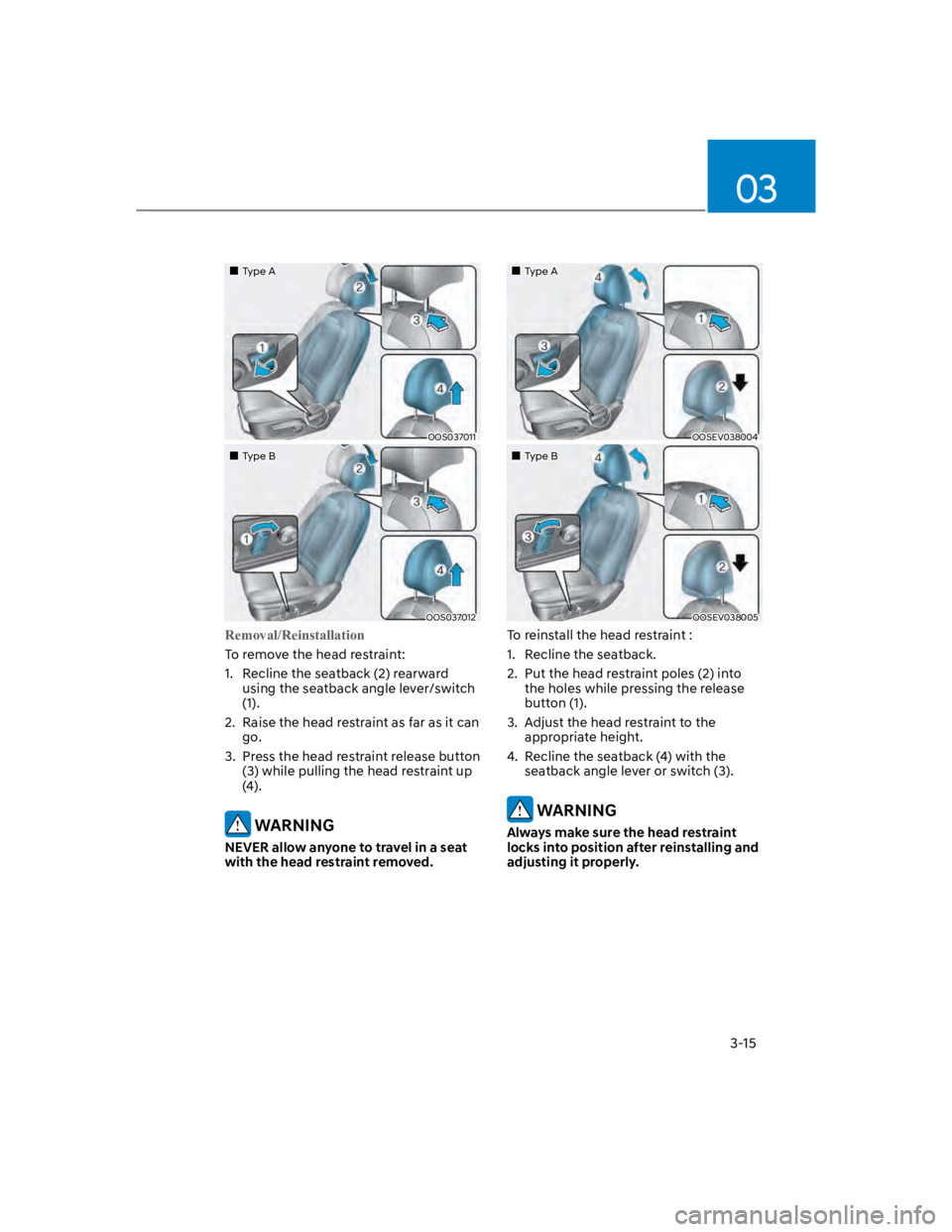
Removal/Reinstallation
To remove the head restraint:
1. Recline the seatback (2) rearward
using the seatback angle lever/switch
(1).
2. Raise the head restraint as far as it can
go.
3. Press the head restraint release button
(3) while pulling the head restraint up
(4).
WARNING
NEVER allow anyone to travel in a seat
with the head restraint removed.
Type A
OOSEV038004
Type B
OOSEV038005
To reinstall the head restraint :
1. Recline the seatback.
2. Put the head restraint poles (2) into
the holes while pressing the release
button (1).
3. Adjust the head restraint to the
appropriate height.
4. Recline the seatback (4) with the
seatback angle lever or switch (3).
WARNING
Always make sure the head restraint
locks into position after reinstalling and
adjusting it properly.
Page 47 of 579
Seats & Safety System
3-16
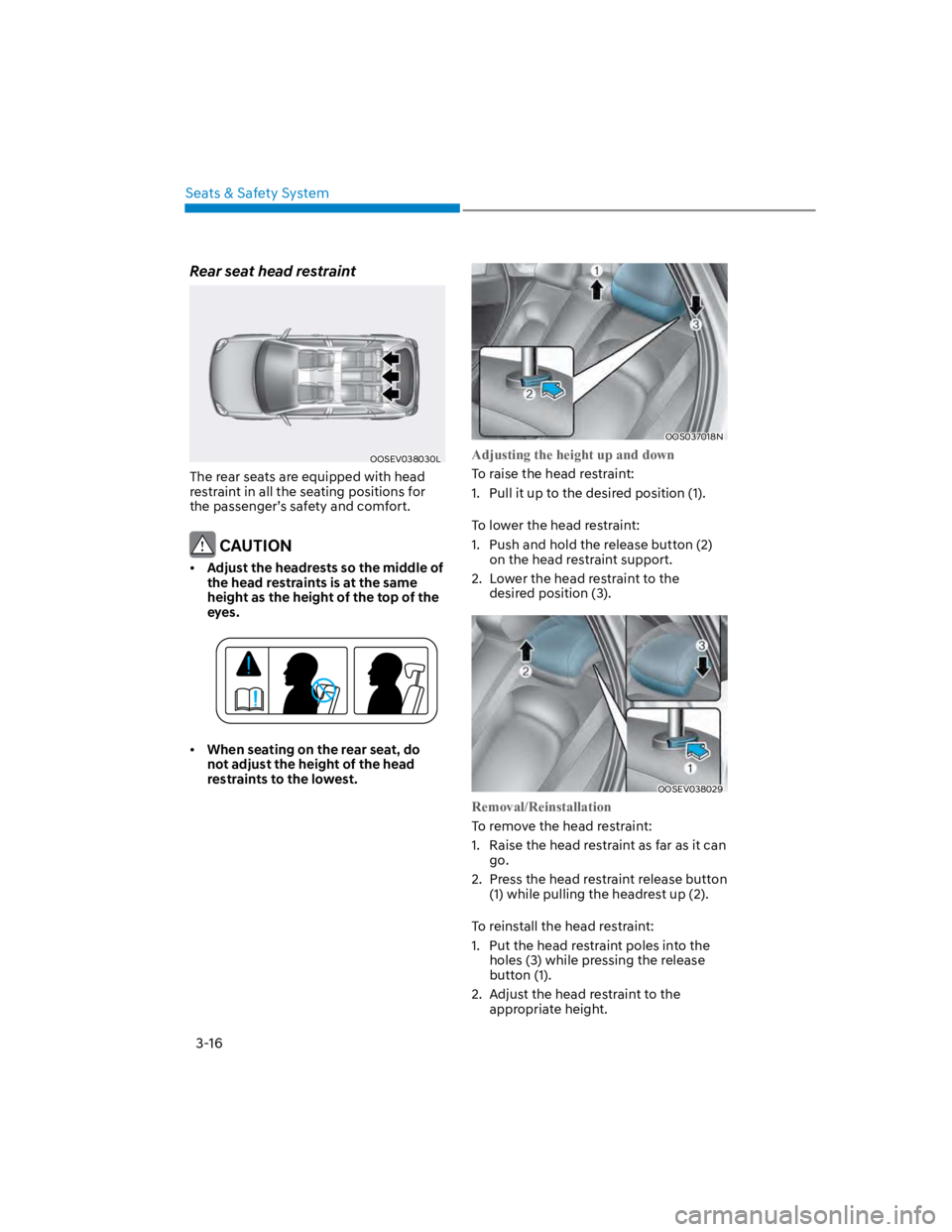
Rear seat head restraint
OOSEV038030L
The rear seats are equipped with head
restraint in all the seating positions for
the passenger’s safety and comfort.
CAUTION
Adjust the headrests so the middle of
the head restraints is at the same
height as the height of the top of the
eyes.
When seating on the rear seat, do
not adjust the height of the head
restraints to the lowest.
OOS037018N
Adjusting the height up and down
To raise the head restraint:
1. Pull it up to the desired position (1).
To lower the head restraint:
1. Push and hold the release button (2)
on the head restraint support.
2. Lower the head restraint to the
desired position (3).
OOSEV038029
Removal/Reinstallation
To remove the head restraint:
1. Raise the head restraint as far as it can
go.
2. Press the head restraint release button
(1) while pulling the headrest up (2).
To reinstall the head restraint:
1. Put the head restraint poles into the
holes (3) while pressing the release
button (1).
2. Adjust the head restraint to the
appropriate height.