2022 HYUNDAI KONA AIR VENT
[x] Cancel search: AIR VENTPage 557 of 579
09
9-71
Bright-metal maintenance
To remove road tar and insects, use
a tar remover, not a scraper or other
sharp object.
To protect the surfaces of bright metal
parts from corrosion, apply a coating
of wax or chrome preservative and rub
to a high luster.
During winter weather or in coastal
areas, cover the bright metal parts
with a heavier coating of wax or
preservative. If necessary, coat the
parts with non-corrosive petroleum
jelly or other protective compound.
Underbody maintenance
Corrosive materials used for ice and
snow removal and dust control may
collect on the underbody. If these
materials are not removed, accelerated
rusting can occur on underbody parts
such as the fuel lines, frame, floor pan
and exhaust system, even though they
have been treated with rust protection.
Thoroughly flush the vehicle underbody
and wheel openings with lukewarm or
cold water once a month, after off-road
driving and at the end of each winter. Pay
special attention to these areas because
it is difficult to see all the mud and dirt.
It will do more harm than good to wet
down the road grime without removing
it. The lower edges of doors, rocker
panels, and frame members have drain
holes that should not be allowed to clog
with dirt; trapped water in these areas
can cause rusting.
WARNING
After washing the vehicle, test the
brakes while driving slowly to see if
they have been affected by water. If
braking performance is impaired, dry
the brakes by applying them lightly
while maintaining a slow forward
speed.
Aluminum wheel maintenance
The aluminum wheels are coated with a
clear protective finish.
Do not use abrasive cleaner, polishing
compound, solvent, or wire brushes
on aluminum wheels.
Clean the wheel when it has cooled.
Use only a mild soap or neutral
detergent, and rinse thoroughly with
water. Also, clean the wheels after
driving on salted roads.
Do not wash the wheels with high-
speed car wash brushes.
Do not use any cleaners containing
acid or alkaline detergents.
Page 558 of 579
Maintenance
9-72
Corrosion protection
By using the most advanced design
and construction practices to combat
corrosion, HYUNDAI produces vehicles
of the highest quality. However, this is
only part of the job. To achieve the long-
term corrosion resistance your vehicle
can deliver, the owner’s cooperation and
assistance is also required.
The most common causes of corrosion
on your vehicle are:
Road salt, dirt and moisture that is
allowed to accumulate underneath
the vehicle.
Removal of paint or protective
coatings by stones, gravel, abrasion
or minor scrapes and dents which
leave unprotected metal exposed to
corrosion.
If you live in an area where your vehicle is
regularly exposed to corrosive materials,
corrosion protection is particularly
important. Some of the common causes
of accelerated corrosion are road salts,
dust control chemicals, ocean air and
industrial pollution.
Moisture creates the conditions in
which corrosion is most likely to occur.
For example, corrosion is accelerated
by high humidity, particularly when
temperatures are just above freezing. In
such conditions, the corrosive material is
kept in contact with the vehicle surfaces
by moisture that is slow to evaporate.
Mud is particularly corrosive because
it is slow to dry and holds moisture in
contact with the vehicle. Although the
mud appears to be dry, it can still retain
moisture and promote corrosion.
High temperatures can also accelerate
corrosion of parts that are not properly
ventilated so the moisture can be
dispersed. For all these reasons, it is
particularly important to keep your
vehicle clean and free of mud or
accumulations of other materials. This
applies not only to the visible surfaces
but particularly to the underside of the
vehicle.
Page 563 of 579
09
9-77
The emission control system of your
vehicle is covered by a written limited
warranty. Please see the warranty
information contained in the Service
Passport in your vehicle.
Your vehicle is equipped with an
emission control system to meet all
applicable emission regulations. There
are three emission control systems, as
follows.
(1) Crankcase emission control system
(2) Evaporative emission control system
(3) Exhaust emission control system
In order to ensure the proper function
of the emission control systems, it
is recommended that you have your
vehicle inspected and maintained
by an authorized HYUNDAI dealer in
accordance with the maintenance
schedule in this manual.
NOTICE
For the Inspection and Maintenance
Test (with Electronic Stability Control
(ESC) system)
To prevent the vehicle from misfiring
during dynamometer testing, turn
the Electronic Stability Control
(ESC) system off by pressing the ESC
switch (ESC OFF light illuminated).
After dynamometer testing is
completed, turn the ESC system back
on by pressing the ESC switch again.
1. Crankcase emission control
system
The positive crankcase ventilation system
is employed to prevent air pollution
caused by blow-by gases being emitted
from the crankcase. This system supplies
fresh filtered air to the crankcase through
the air intake hose. Inside the crankcase,
the fresh air mixes with blow-by gases,
which then pass through the PCV valve
into the induction system.
2. Evaporative emission control
system
The Evaporative Emission Control System
is designed to prevent fuel vapors from
escaping into the atmosphere.
Canister
Fuel vapors generated inside the fuel
tank are absorbed and stored in the
onboard canister. When the engine is
running, the fuel vapors absorbed in the
canister are drawn into the surge tank
through the purge control solenoid valve.
Purge Control Solenoid Valve (PCSV)
The purge control solenoid valve
is controlled by the Engine Control
Module (ECM); when the engine coolant
temperature is low during idling, the
PCSV closes so that evaporated fuel
is not taken into the engine. After the
engine warms-up during ordinary
driving, the PCSV opens to introduce
evaporated fuel to the engine.
EMISSION CONTROL SYSTEM
Page 564 of 579
Maintenance
9-78
3. Exhaust emission control
system
The Exhaust Emission Control System is
a highly effective system which controls
exhaust emissions while maintaining
good vehicle performance.
When the engine starts or fails to start,
excessive attempts to restart the engine
may cause damage to the emission
system.
Engine exhaust (carbon monoxide)
precautions
Carbon monoxide can be present
with other exhaust fumes. If you smell
exhaust fumes of any kind in your
vehicle, drive with all the windows
fully open. Have your vehicle checked
and repaired immediately.
WARNING
Engine exhaust gases contain carbon
monoxide (CO). Though colorless and
odorless, it is dangerous and could be
lethal if inhaled. Follow the instructions
on this page to avoid CO poisoning.
WARNING
CALIFORNIA PROPOSITION 65
WARNING
Engine exhaust and a wide variety of
automobile components and parts,
including components found in the
interior furnishings in a vehicle, contain
or emit chemicals known to the State
of California to cause cancer and
birth defects and reproductive harm.
In addition, certain fluids contained
in vehicles and certain products of
component wear contain or emit
chemicals known to the State of
California to cause cancer and birth
defects or other reproductive harm.
Do not operate the engine in confined
or closed areas (such as garages) any
more than what is necessary to move
the vehicle in or out of the area.
When the vehicle is stopped in an
open area for more than a short time
with the engine running, adjust the
ventilation system (as needed) to draw
outside air into the vehicle.
Never sit in a parked or stopped
vehicle for any extended time with the
engine running.
When the engine stalls or fails to
start, excessive attempts to restart
the engine may cause damage to the
emission control system.
Operating precautions for catalytic
converters (if equipped)
WARNING
The exhaust system and catalytic
converter are very hot during and
immediately after the engine has been
running. To avoid SERIOUS INJURY or
DEATH:
Do not park, idle, or drive the vehicle
over or near flammable objects, such
as grass, vegetation, paper, leaves,
etc. A hot exhaust system can ignite
flammable items under your vehicle.
Keep away from the exhaust system
and catalytic converter or you may
get burned.
Also, do not remove the heat sink
around the exhaust system, do not
seal the bottom of the vehicle, and
do not coat the vehicle for corrosion
control. It may present a fire risk
under certain conditions.
Page 565 of 579
09
9-79
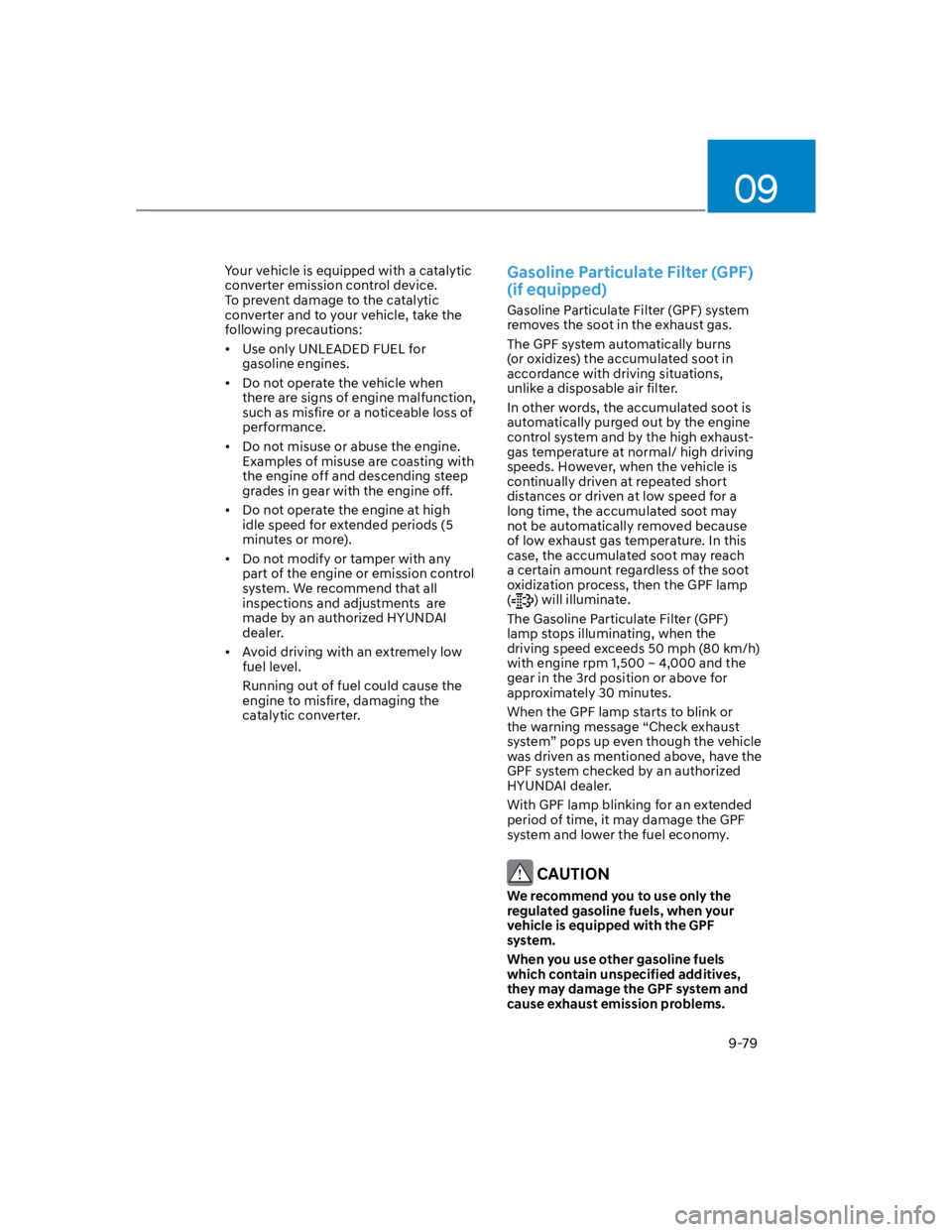
Your vehicle is equipped with a catalytic
converter emission control device.
To prevent damage to the catalytic
converter and to your vehicle, take the
following precautions:
Use only UNLEADED FUEL for
gasoline engines.
Do not operate the vehicle when
there are signs of engine malfunction,
such as misfire or a noticeable loss of
performance.
Do not misuse or abuse the engine.
Examples of misuse are coasting with
the engine off and descending steep
grades in gear with the engine off.
Do not operate the engine at high
idle speed for extended periods (5
minutes or more).
Do not modify or tamper with any
part of the engine or emission control
system. We recommend that all
inspections and adjustments are
made by an authorized HYUNDAI
dealer.
Avoid driving with an extremely low
fuel level.
Running out of fuel could cause the
engine to misfire, damaging the
catalytic converter.
Gasoline Particulate Filter (GPF)
(if equipped)
Gasoline Particulate Filter (GPF) system
removes the soot in the exhaust gas.
The GPF system automatically burns
(or oxidizes) the accumulated soot in
accordance with driving situations,
unlike a disposable air filter.
In other words, the accumulated soot is
automatically purged out by the engine
control system and by the high exhaust-
gas temperature at normal/ high driving
speeds. However, when the vehicle is
continually driven at repeated short
distances or driven at low speed for a
long time, the accumulated soot may
not be automatically removed because
of low exhaust gas temperature. In this
case, the accumulated soot may reach
a certain amount regardless of the soot
oxidization process, then the GPF lamp
() will illuminate.
The Gasoline Particulate Filter (GPF)
lamp stops illuminating, when the
driving speed exceeds 50 mph (80 km/h)
with engine rpm 1,500 ~ 4,000 and the
gear in the 3rd position or above for
approximately 30 minutes.
When the GPF lamp starts to blink or
the warning message “Check exhaust
system” pops up even though the vehicle
was driven as mentioned above, have the
GPF system checked by an authorized
HYUNDAI dealer.
With GPF lamp blinking for an extended
period of time, it may damage the GPF
system and lower the fuel economy.
CAUTION
We recommend you to use only the
regulated gasoline fuels, when your
vehicle is equipped with the GPF
system.
When you use other gasoline fuels
which contain unspecified additives,
they may damage the GPF system and
cause exhaust emission problems.
Page 569 of 579

I
I-3
Brake fluid ........................................................................................................... 9-21
Checking the brake fluid level ......................................................................... 9-21
Braking system .................................................................................................... 6-26
Anti-lock Brake System (ABS) ........................................................................ 6-36
Auto Hold ......................................................................................................... 6-33
Disc brakes wear indicator ............................................................................... 6-26
Downhill Brake Control (DBC) ...................................................................... 6-42
Electronic Parking Brake (EPB) ..................................................................... 6-28
Electronic Stability Control (ESC)................................................................... 6-38
Good braking practices..................................................................................... 6-45
Hill-Start Assist Control (HAC) ...................................................................... 6-41
Parking Brake ................................................................................................... 6-27
Power-assist brakes .......................................................................................... 6-26
Vehicle Stability Management (VSM) ............................................................ 6-40
Bulb wattage ........................................................................................................ 2-10
C
California perchlorate notice ............................................................................... 9-80
Child Restraint System (CRS) ............................................................................. 3-30
Children Always in the Rear ............................................................................ 3-30
Installing a Child Restraint System (CRS)....................................................... 3-33
Selecting a Child Restraint System (CRS) ....................................................... 3-31
Climate control additional features.................................................................... 5-103
Automatic Ventilation..................................................................................... 5-103
Inside air circulation while operating the washer fluid ................................. 5-103
Sunroof Inside Air Recirculation.................................................................... 5-103
Climate control air filter ...................................................................................... 9-24
Filter Inspection................................................................................................ 9-24
Consumer information ......................................................................................... 2-17
Cruise Control (CC) ............................................................................................ 7-60
Function operation ........................................................................................... 7-60
Page 577 of 579
I
I-11
Seats ....................................................................................................................... 3-3
Front seats .......................................................................................................... 3-5
Head Restraints ................................................................................................ 3-13
Rear Seats ......................................................................................................... 3-10
Safety precautions .............................................................................................. 3-4
Seat Warmers and Air Ventilation Seats ........................................................... 3-17
Smart Cruise Control (SCC) .............................................................................. 7-64
Smart Cruise Control settings ......................................................................... 7-65
Smart Cruise Control display and control ........................................................ 7-69
Smart Cruise Control malfunction and limitations .......................................... 7-74
Smart Cruise Control operation........................................................................ 7-68
Special driving conditions ................................................................................... 6-63
Driving at night ................................................................................................ 6-64
Driving in flooded areas ................................................................................... 6-65
Driving in the rain ............................................................................................ 6-64
Hazardous driving conditions........................................................................... 6-63
Highway driving............................................................................................... 6-65
Reducing the risk of a rollover ......................................................................... 6-65
Rocking the vehicle .......................................................................................... 6-63
Smooth cornering ............................................................................................. 6-64
Steering wheel ..................................................................................................... 5-36
Electric Power Steering (EPS) ......................................................................... 5-36
Heated steering wheel ...................................................................................... 5-38
Horn.................................................................................................................. 5-38
Tilt / Telescopic steering .................................................................................. 5-37
Storage compartment ......................................................................................... 5-104
Center console storage ................................................................................... 5-104
Glove box ....................................................................................................... 5-104
Luggage tray................................................................................................... 5-106
Multi Box ....................................................................................................... 5-105
Sunglass Holder.............................................................................................. 5-105
Sunroof ................................................................................................................ 5-57
Resetting the sunroof........................................................................................ 5-60
Slide open/close................................................................................................ 5-58
Sunroof Open Warning..................................................................................... 5-60
Sunshade........................................................................................................... 5-57
Tilt open/close .................................................................................................. 5-58