2022 HYUNDAI KONA EV start stop button
[x] Cancel search: start stop buttonPage 286 of 548
Driving your vehicle
6-6
Starting the vehicle
WARNING
• Always wear appropriate shoes when
operating your vehicle. Unsuitable
shoes, such as high heels, ski boots,
sandals, flip-flops, etc., may interfere
with your ability to use the brake,
accelerator and clutch pedals.
• Do not start the vehicle with the
accelerator pedal depressed. The
vehicle can move which can lead to
an accident.
Information
• The vehicle will start by pressing the
START/STOP button, only when the smart key is in the vehicle.
• Even if the smart key is in the vehicle,
and when it is far away from the driver, the vehicle may not start.
• When the START/STOP button is in
the ACC or ON position, any door is
open, the system checks for the smart
key. When the smart key is not in the vehicle, the "
" indicator will blink
and the warning "Key not in vehicle"
will come on. When all doors are
closed, the chime will also sound for about 5 seconds. Keep the smart key in
the vehicle when in the ACC position or
if the vehicle is in the ready (
) mode.
1. Always carry the smart key with you.
2. Make sure the parking brake is applied.
3. Make sure the gear is in P (Park).
4. Depress the brake pedal.
5. Press the START/STOP button. If the vehicle starts, the "
" indicator will
come on.
Information
• Always start the vehicle with your foot
on the brake pedal. Do not depress the
accelerator while starting the vehicle.
• If ambient temperature is low, the "
" indicator may remain illuminated
longer than the normal amount of time.
NOTICE
To prevent damage to the vehicle: • If the "
" indicator turns off while
you are in motion, do not attempt to
shift to the P (Park) position.
If traffic and road conditions permit,
you may shift to the N (Neutral)
position while the vehicle is still
moving and press the START/STOP
button in an attempt to restart the
vehicle.
• Do not push or tow your vehicle to
start the vehicle.
Page 287 of 548
06
6 -7
NOTICE
To prevent damage to the vehicle:
Do not press the START/STOP button for
more than 10 seconds except when the
stop lamp fuse is blown.
When the stop lamp fuse is blown, you
can’t start the vehicle normally. Replace
the fuse with a new one. If you are not
able to replace the fuse, you can start
the vehicle by pressing and holding
the START/STOP button for 10 seconds
with the START/STOP button in the ACC position.
For your safety always depress the
brake before starting the vehicle.
OOSEV060020L
Information
If the smart key battery is weak or the
smart key does not work correctly, you
can start the vehicle by pressing the
START/STOP button with the smart key
in the direction of the picture above.
Turning off the vehicle
1. Depress the brake pedal fully.
2. Shift to P (Park).
3. Apply the parking brake.
4. Press the START/STOP button to turn
the vehicle off.
5. Make sure the "
" indicator light on
the instrument cluster is turned off.
CAUTION
If the "
" indicator light on the
instrument cluster is still on, the vehicle
is not turned off and can move when
the gear is in any position except P
(Park).
Page 288 of 548
Driving your vehicle
6-8
REDuCTION GEAR
Reduction gear operation
WARNING
To reduce the risk of serious injury or
death: • ALWAYS check the surrounding
areas near your vehicle for people,
especially children, before shifting a
vehicle into D (Drive) or R (Reverse).
• Before leaving the driver's seat,
always make sure the gear is in
the P (Park) position, then set the
parking brake, and place the START/
STOP button in the OFF position.
Unexpected and sudden vehicle
movement can occur if these
precautions are not followed.
OOSEV058004L
Select gear positions by pressing the
shift button.
For your safety, always depress the brake
pedal while shifting to another gear.
WARNING
The reduction gear button or interior
parts might get hot when a vehicle is
parked outside during hot weather.
Always be careful when the vehicle is
hot. Gear position
OCN7040013
The indicator in the instrument cluster
displays the gear position when the
START/STOP button is in the ON position.
P (Park)
Always come to a complete stop before
shifting into P (Park).
To shift the gear from R (Reverse), N
(Neutral) or D (Drive) to P (Park), press
the [P] button.
If you turn off the vehicle in D (Drive) or
R (Reverse), the gear automatically shifts
to P (Park).
With the vehicle on, the gear
automatically shifts to P (Park) if you
open the driver's door when the gear is in
N (Neutral), R (Reverse) or D (Drive) and
the following conditions are met:
- The brake/accelerator pedal is not depressed
- Seat belt is unfastened
- The vehicle speed is below 0.6 km/h
When the vehicle is over a certain speed,
the gear does not shift to P (Park) when
the P button is pressed.
Page 289 of 548
06
6-9
WARNING
Shifting into P (Park) while the vehicle is
in motion may cause you to lose control
of the vehicle.
After the vehicle has stopped, always
make sure the gear is in P (Park), apply
the parking brake, and turn the vehicle
off.
Do not use the P (Park) position in place
of the parking brake.
R (Reverse)
Use this position to drive the vehicle
backward.
To shift to R (Reverse), press the [R]
button while depressing the brake pedal.
N (Neutral)
The wheels and gear are not engaged.
To shift to N (Neutral), press the [N]
button while depressing the brake pedal.
Always depress the brake pedal when
you are shifting from N (Neutral) to
another gear.
In N (Neutral), if the driver attempts to
turn off the vehicle, the gear remains in
N (Neutral) and the START/STOP button
will be in the ACC position.
To turn off the vehicle from the ACC
position, press the POWER button to the
ON position, press the [P] button, and
press the START/STOP button to the OFF position.
When the driver’s door is opened within
3 minutes with the START/STOP button
in the ACC position and the gear in N
(Neutral), the vehicle is automatically
turned OFF and shifted to the P (Park) position.
D (Drive)
This is the normal driving position.
To shift to D (Drive), press the [D] button
while depressing the brake pedal. Shift-lock system
For your safety, your vehicle has a shift-
lock system which prevents shifting the
gear from P (Park) or N (Neutral) into R
(Reverse) or D (Drive) unless the brake
pedal is depressed.
To shift from P (Park) or N (Neutral) into
R (Reverse) or D (Drive), from R (Reverse)
into D (Drive) or from D (Drive) into R
(Reverse) :
1. Depress and hold the brake pedal.
2. Start the vehicle or place the START/
STOP button in the ON position.
3. Press the R (Reverse) or D (Drive) button.
Information
For your safety, you cannot shift the gear while the charging cable is connected.
When the battery (12 V) is discharged
You cannot shift the gear when the
battery is discharged.
Jump start your vehicle (refer to "Jump
Starting" in chapter 8) or we recommend
that you contact an authorized HYUNDAI
dealer.
Parking
Always come to a complete stop and
continue to depress the brake pedal.
Shift to the P (Park) position, apply the
parking brake, and place the START/
STOP button in the OFF position. Take
the Key with you when exiting the
vehicle.
Page 303 of 548
06
6-23
Electronic Parking Brake (EPB)
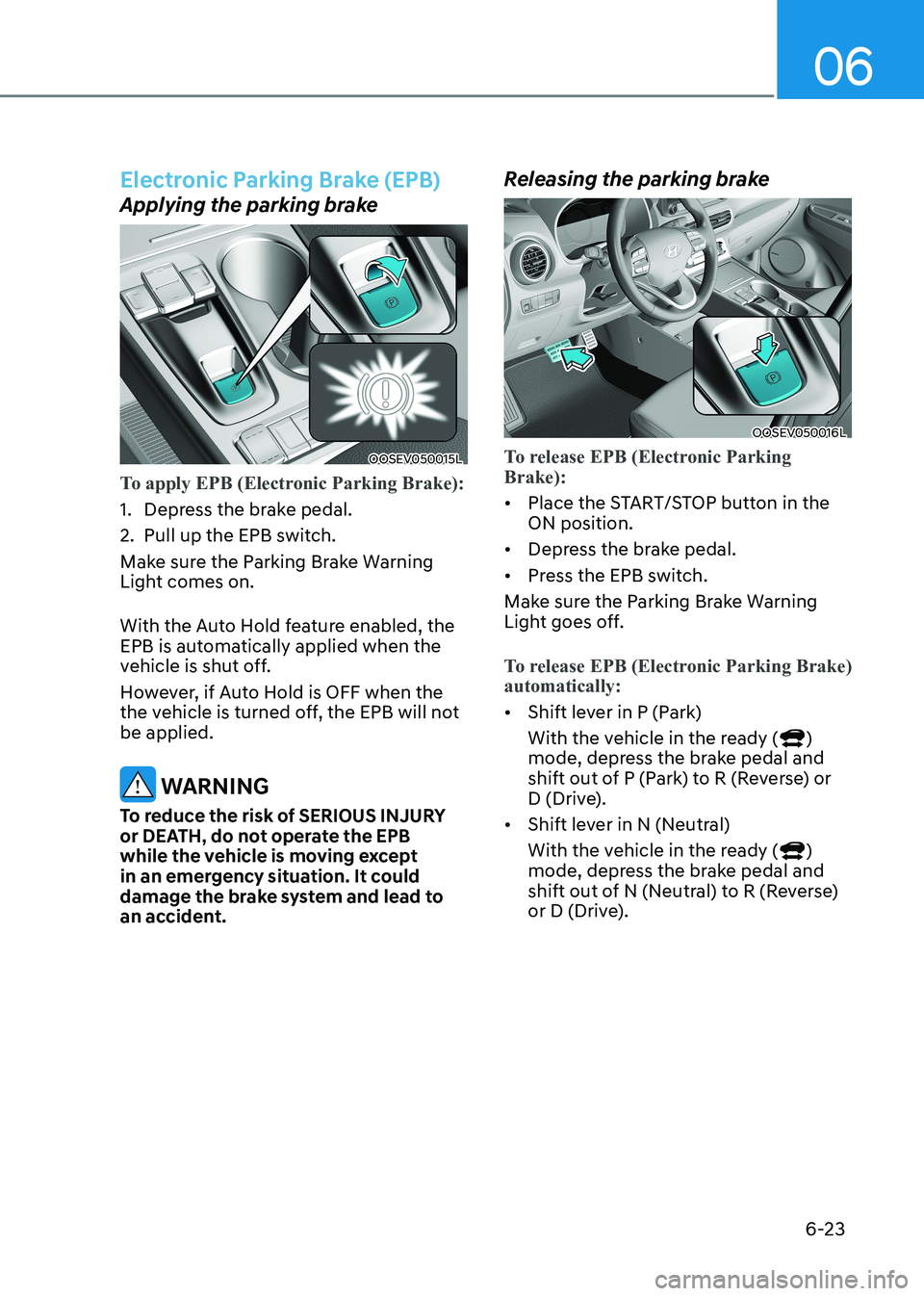
Applying the parking brake
OOSEV050015L
To apply EPB (Electronic Parking Brake):
1. Depress the brake pedal.
2. Pull up the EPB switch.
Make sure the Parking Brake Warning
Light comes on.
With the Auto Hold feature enabled, the
EPB is automatically applied when the
vehicle is shut off.
However, if Auto Hold is OFF when the
the vehicle is turned off, the EPB will not be applied.
WARNING
To reduce the risk of SERIOUS INJURY
or DEATH, do not operate the EPB
while the vehicle is moving except
in an emergency situation. It could
damage the brake system and lead to
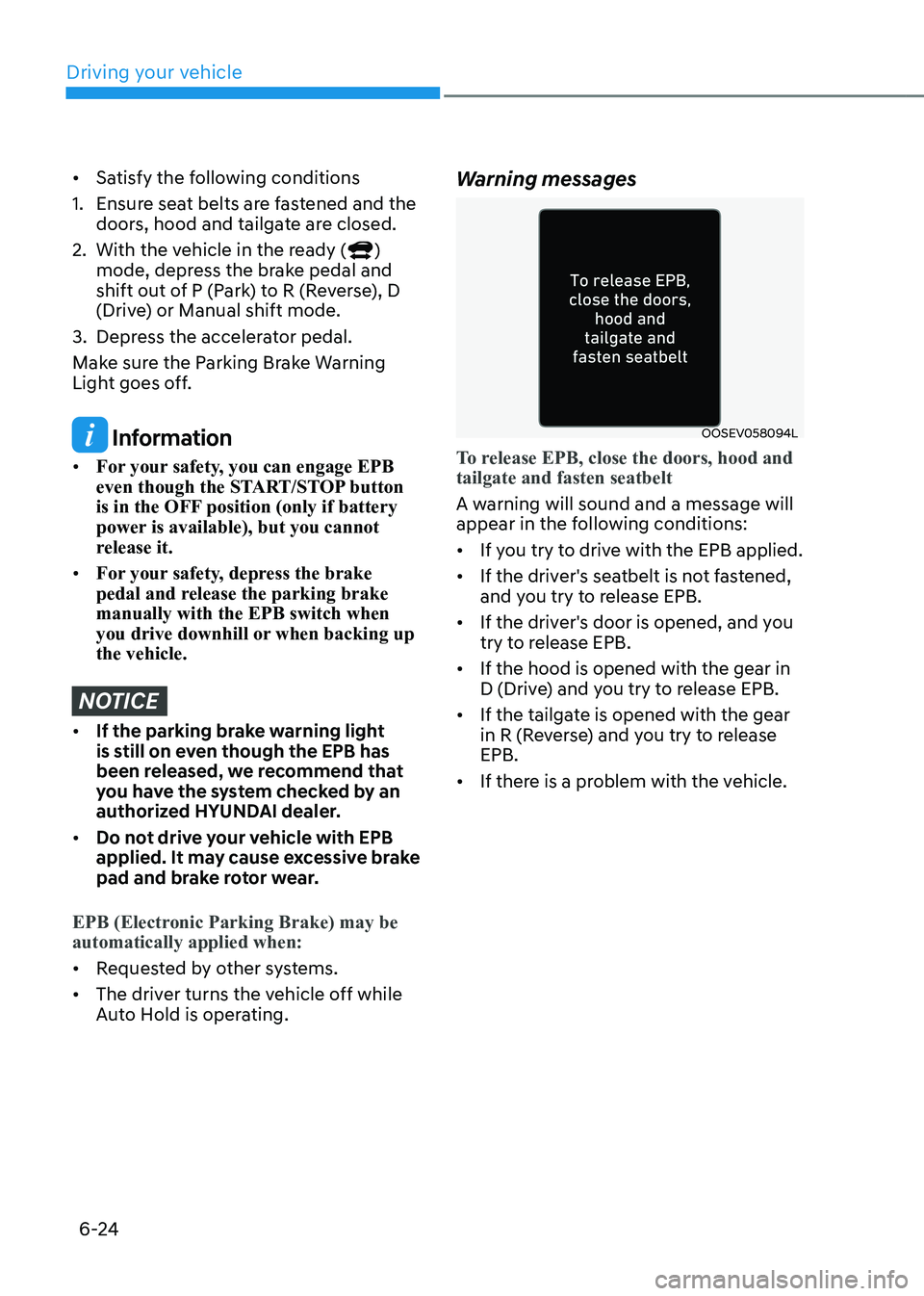
an accident. Releasing the parking brake
OOSEV050016L
To release EPB (Electronic Parking Brake):
•
Place the START/STOP button in the ON position.
• Depress the brake pedal.
• Press the EPB switch.
Make sure the Parking Brake Warning
Light goes off.
To release EPB (Electronic Parking Brake) automatically:
• Shift lever in P (Park)
With the vehicle in the ready (
)
mode, depress the brake pedal and
shift out of P (Park) to R (Reverse) or
D (Drive).
• Shift lever in N (Neutral)
With the vehicle in the ready (
)
mode, depress the brake pedal and
shift out of N (Neutral) to R (Reverse)
or D (Drive).
Page 304 of 548
Driving your vehicle
6-24
• Satisfy the following conditions
1. Ensure seat belts are fastened and the doors, hood and tailgate are closed.
2. With the vehicle in the ready (
)
mode, depress the brake pedal and
shift out of P (Park) to R (Reverse), D
(Drive) or Manual shift mode.
3. Depress the accelerator pedal.
Make sure the Parking Brake Warning
Light goes off.
Information
• For your safety, you can engage EPB
even though the START/STOP button
is in the OFF position (only if battery
power is available), but you cannot
release it.
• For your safety, depress the brake
pedal and release the parking brake manually with the EPB switch when
you drive downhill or when backing up the vehicle.
NOTICE
• If the parking brake warning light
is still on even though the EPB has
been released, we recommend that
you have the system checked by an
authorized HYUNDAI dealer.
• Do not drive your vehicle with EPB
applied. It may cause excessive brake
pad and brake rotor wear.
EPB (Electronic Parking Brake) may be automatically applied when:
• Requested by other systems.
• The driver turns the vehicle off while
Auto Hold is operating. Warning messages
OOSEV058094L
To release EPB, close the doors, hood and tailgate and fasten seatbelt
A warning will sound and a message will
appear in the following conditions: •
If you try to drive with the EPB applied.
• If the driver's seatbelt is not fastened,
and you try to release EPB.
• If the driver's door is opened, and you
try to release EPB.
• If the hood is opened with the gear in
D (Drive) and you try to release EPB.
• If the tailgate is opened with the gear
in R (Reverse) and you try to release EPB.
• If there is a problem with the vehicle.
Page 306 of 548
6-26
Driving your vehicle
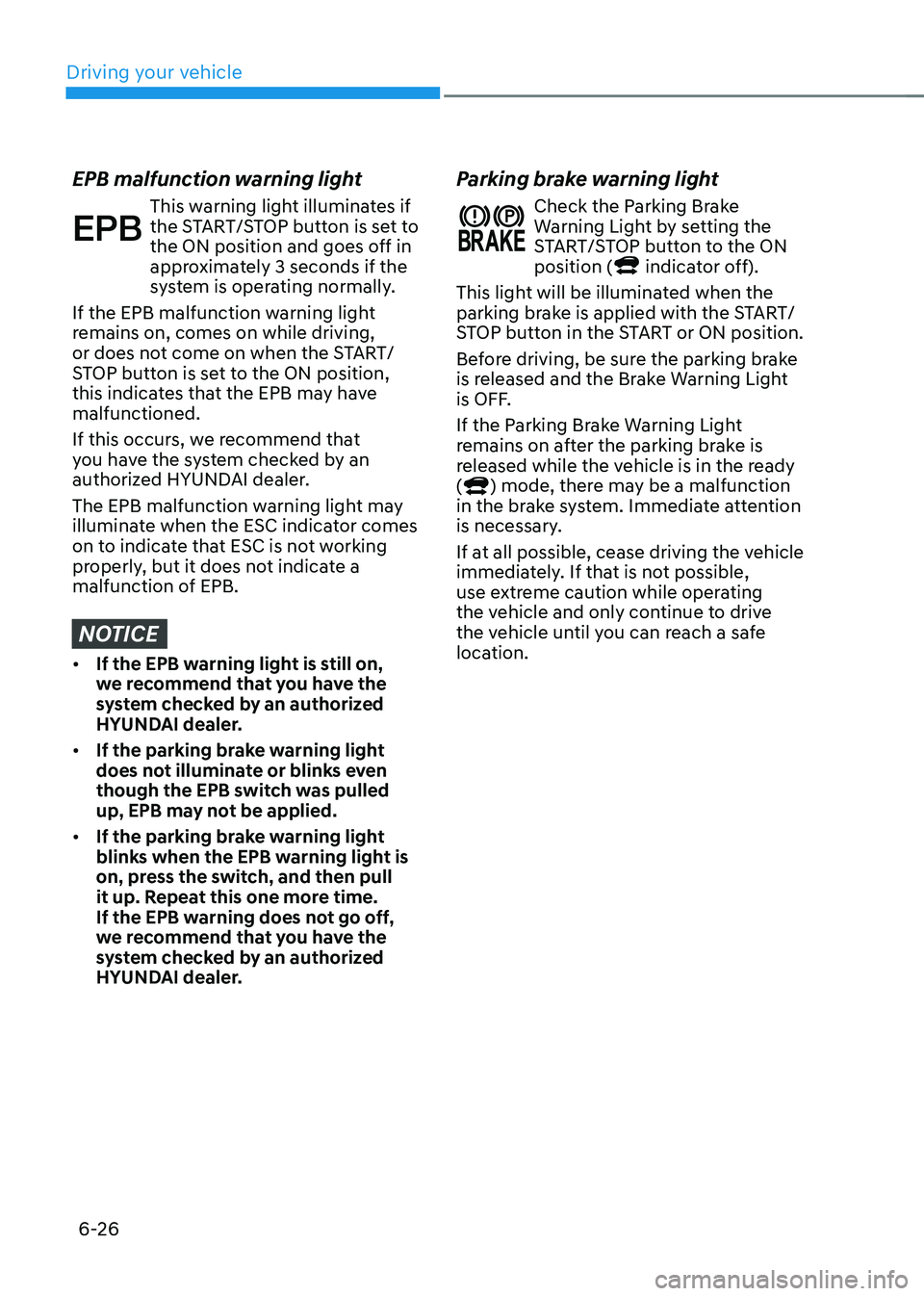
EPB malfunction warning light
This warning light illuminates if
the START/STOP button is set to
the ON position and goes off in
approximately 3 seconds if the
system is operating normally.
If the EPB malfunction warning light
remains on, comes on while driving,
or does not come on when the START/
STOP button is set to the ON position,
this indicates that the EPB may have malfunctioned.
If this occurs, we recommend that
you have the system checked by an
authorized HYUNDAI dealer.
The EPB malfunction warning light may
illuminate when the ESC indicator comes
on to indicate that ESC is not working
properly, but it does not indicate a
malfunction of EPB.
NOTICE
• If the EPB warning light is still on,
we recommend that you have the
system checked by an authorized
HYUNDAI dealer.
• If the parking brake warning light
does not illuminate or blinks even
though the EPB switch was pulled
up, EPB may not be applied.
• If the parking brake warning light
blinks when the EPB warning light is
on, press the switch, and then pull
it up. Repeat this one more time.
If the EPB warning does not go off,
we recommend that you have the
system checked by an authorized
HYUNDAI dealer. Parking brake warning light
Check the Parking Brake
Warning Light by setting the
START/STOP button to the ON position (
indicator off).
This light will be illuminated when the
parking brake is applied with the START/
STOP button in the START or ON position.
Before driving, be sure the parking brake
is released and the Brake Warning Light
is OFF.
If the Parking Brake Warning Light
remains on after the parking brake is
released while the vehicle is in the ready (
) mode, there may be a malfunction
in the brake system. Immediate attention
is necessary.
If at all possible, cease driving the vehicle
immediately. If that is not possible,
use extreme caution while operating
the vehicle and only continue to drive
the vehicle until you can reach a safe
location.
Page 311 of 548
6-31
06
Anti-lock Brake System (ABS)
WARNING
Anti-Lock Braking System (ABS) or
Electronic Stability Control (ESC) will
not prevent accidents due to improper
or dangerous driving maneuvers. Even
though vehicle control is improved
during emergency braking, always
maintain a safe distance between
you and objects ahead of you. Vehicle
speeds should always be reduced
during extreme road conditions. The
braking distance for vehicles equipped
with ABS or ESC may be longer than
for those without these systems in the
following road conditions.
Drive your vehicle at reduced speeds
during the following conditions: • Rough, gravel or snow-covered
roads.
• On roads where the road surface is
pitted or has different surface height.
• Tire chains are installed on your
vehicle. Drive your vehicle at
reduced speeds during the above
conditions.
The safety features of ABS or ESC
equipped vehicle should not be tested
by high speed driving or cornering. This
could endanger the safety of yourself or
others.
ABS is an electronic braking system that
helps to prevent a braking skid. ABS
allows the driver to steer and brake at the same time. Using ABS
To obtain the maximum benefit from
your ABS in an emergency situation,
do not attempt to modulate your brake
pressure and do not try to pump your
brakes. Depress your brake pedal as hard as possible.
When you apply your brakes under
conditions which may lock the wheels,
you may hear sounds from the brakes,
or feel a corresponding sensation in the
brake pedal. This is normal and it means
your ABS is active.
ABS does not reduce the time or distance
it takes to stop the vehicle.
Always maintain a safe distance from the
vehicle in front of you.
ABS will not prevent a skid that results
from sudden changes in direction, such
as trying to take a corner too fast or
making a sudden lane change. Always
drive at a safe speed depending on the
road and weather conditions.
ABS cannot prevent a loss of stability.
Always steer moderately when braking
hard. Severe or sharp steering wheel
movement can still cause your vehicle to
veer into oncoming traffic or off the road.
On loose or uneven road surfaces,
operation of the anti-lock brake system
may result in a longer stopping distance
than for vehicles equipped with a
conventional brake system.
The ABS warning light (
) will stay on
for several seconds after the START/
STOP button is placed in the ON position.
During that time, the ABS will go through
self-diagnosis and the light will go off
if everything is normal. If the light stays
on, you may have a problem with your
ABS. We recommend that you contact an
authorized HYUNDAI dealer as soon as possible.