2022 DODGE DURANGO air
[x] Cancel search: airPage 256 of 332

254IN CASE OF EMERGENCY
(Continued)
REAR WHEEL DRIVE MODELS
FCA US LLC recommends towing your vehicle with
all four wheels OFF the ground using a flatbed.
If flatbed equipment is not available, and the
transmission is operable, the vehicle may be towed
(with rear wheels off the ground) under the
following conditions:
The transmission must be in NEUTRAL (N).
For instructions on shifting the transmission to
NEUTRAL (N) when the engine is off
Ú page 250.
The towing speed must not exceed 30 mph
(48 km/h).
The towing distance must not exceed 30 miles
(48 km).
If the transmission is not operable, or the vehicle
must be towed faster than 30 mph (48 km/h) or
farther than 30 miles (48 km), tow with the rear
wheels OFF the ground. Acceptable methods are to tow the vehicle on a flatbed, or with the front
wheels raised and the rear wheels on a towing
dolly, or (when using a suitable steering wheel
stabilizer to hold the front wheels in the straight
position) with the rear wheels raised and the front
wheels
ON the ground.
ALL WHEEL DRIVE MODELS
FCA US LLC recommends towing with all wheels
OFF the ground. Acceptable methods are to tow
the vehicle on a flatbed or with one end of the
vehicle raised and the opposite end on a towing
dolly.
If flatbed equipment is not available, and the
transfer case is operable, vehicles with a
two-speed transfer case may be towed (in the
forward direction, with ALL wheels on the ground),
IF the transfer case is in NEUTRAL (N) and the
transmission is in PARK Úpage 149.
Vehicles equipped with a single-speed transfer
case have no NEUTRAL (N) position, and therefore
must be towed will all four wheels OFF the ground.ENHANCED ACCIDENT RESPONSE SYSTEM
(EARS)
This vehicle is equipped with an Enhanced
Accident Response System.
This feature is a communication network that
takes effect in the event of an impact Úpage 214.
EVENT DATA RECORDER (EDR)
This vehicle is equipped with an event data
recorder (EDR). The main purpose of an EDR is to
record data that will assist in understanding how a
vehicle’s systems performed under certain crash
or near crash-like situations, such as an air bag
deployment or hitting a road obstacle Úpage 215.CAUTION!
Towing faster than 30 mph (48 km/h) or
farther than 30 miles (48 km) with rear
wheels on the ground can cause severe trans -
mission damage. Damage from improper
towing is not covered under the New Vehicle
Limited Warranty.
CAUTION!
Front or rear wheel lifts must not be used
(if the remaining wheels are on the ground).
Internal damage to the transmission or
transfer case will occur if a front or rear wheel
lift is used when towing.
Towing this vehicle in violation of the above
requirements can cause severe transmission
and/or transfer case damage. Damage from
improper towing is not covered under the New
Vehicle Limited Warranty.
CAUTION!
22_WD_OM_EN_USC_t.book Page 254
Page 258 of 332

256SERVICING AND MAINTENANCE
MAINTENANCE PLAN
Refer to the Maintenance Plans for required maintenance.
At Every Oil Change Interval As Indicated By Oil Change Indicator System:
Change oil and filter.
Rotate the tires at the first sign of irregular wear, even if it occurs before the oil indicator system turns on.
Inspect battery and clean and tighten terminals as required.
Inspect the CV/Universal joints.
Inspect brake pads, shoes, rotors, drums, hoses and parking brake.
Inspect engine cooling system protection and hoses.
Inspect exhaust system.
Inspect engine air cleaner filter if using in dusty or off-road conditions. Replace engine air cleaner filter, if necessary.
22_WD_OM_EN_USC_t.book Page 256
Page 259 of 332
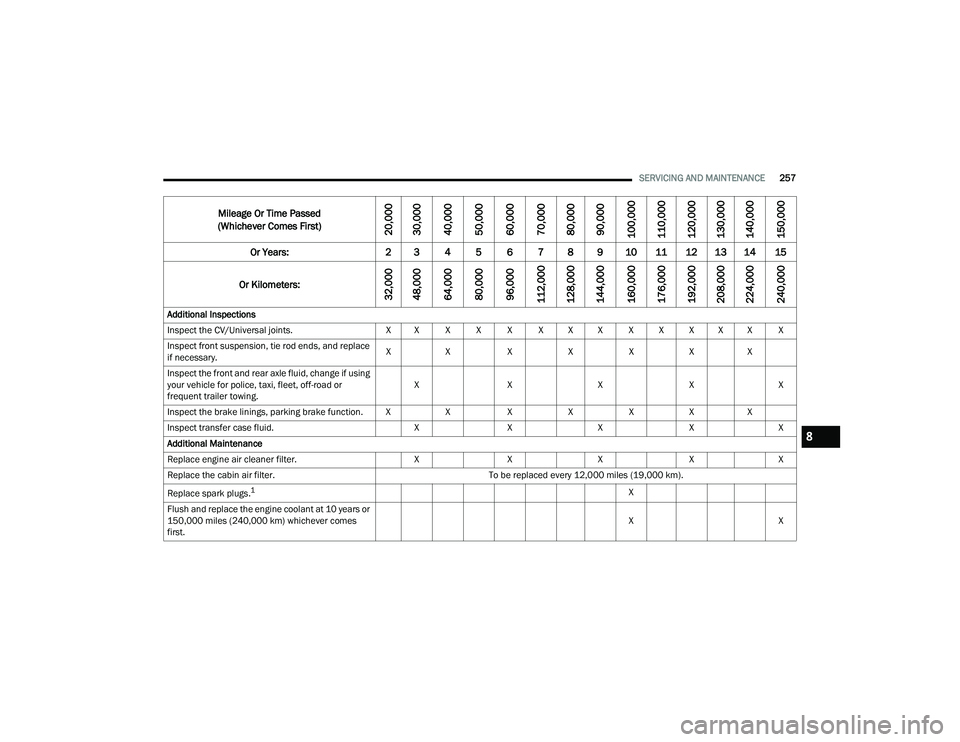
SERVICING AND MAINTENANCE257
Mileage Or Time Passed
(Whichever Comes First)
20,000
30,000
40,000
50,000
60,000
70,000
80,000
90,000
100,000
110,000
120,000
130,000
140,000
150,000
Or Years: 2 3 4 5 6 7 8 9 10 11 12 13 14 15
Or Kilometers:
32,000
48,000
64,000
80,000
96,000
112,000
128,000
144,000
160,000
176,000
192,000
208,000
224,000
240,000
Additional Inspections
Inspect the CV/Universal joints. X X X X X X X X X X X X X X
Inspect front suspension, tie rod ends, and replace
if necessary. X
X XXXXX
Inspect the front and rear axle fluid, change if using
your vehicle for police, taxi, fleet, off-road or
frequent trailer towing. X
XX XX
Inspect the brake linings, parking brake function. X XXXXXX
Inspect transfer case fluid. XXX XX
Additional Maintenance
Replace engine air cleaner filter. XXX XX
Replace the cabin air filter. To be replaced every 12,000 miles (19,000 km).
Replace spark plugs.
1X
Flush and replace the engine coolant at 10 years or
150,000 miles (240,000 km) whichever comes
first. X
X
8
22_WD_OM_EN_USC_t.book Page 257
Page 261 of 332

SERVICING AND MAINTENANCE259
ENGINE COMPARTMENT
3.6L ENGINE
1 — Remote Jump Start Negative Terminal 6 — Brake Fluid Reservoir Cap
2 — Remote Jump Start Positive Terminal 7 — Engine Coolant Pressure Cap
3 — Power Distribution Center (Fuses) 8 — Washer Fluid Reservoir Cap
4 — Engine Oil Dipstick 9 — Engine Air Cleaner Filter
5 — Engine Oil Fill
8
22_WD_OM_EN_USC_t.book Page 259
Page 262 of 332

260SERVICING AND MAINTENANCE
5.7L ENGINE
1 — Remote Jump Start Negative Terminal 6 — Engine Coolant Reservoir Cap
2 — Remote Jump Start Positive Terminal 7 — Engine Coolant Pressure Cap
3 — Power Distribution Center (Fuses) 8 — Engine Oil Dipstick
4 — Engine Oil Fill 9 — Washer Fluid Reservoir Cap
5 — Brake Fluid Reservoir Cap 10 — Engine Air Cleaner Filter
22_WD_OM_EN_USC_t.book Page 260
Page 265 of 332

SERVICING AND MAINTENANCE263
Light (MIL) comes on, see the nearest authorized
dealer.
American Petroleum Institute (API)
Approved Engine Oil
These symbols mean that the oil has been certified
by the API. The manufacturer only recommends
API trademark oils. The API Starburst trademark certifies
0W-20, 0W-30 and 5W-30 engine oils.
The API Donut trademark certifies 0W-40
and 5W-40 engine oil.
Synthetic Engine Oils
Your engine was designed for synthetic engine oils,
only use synthetic API approved engine oils.
Synthetic engine oils which do not have both the
correct API trademark and the correct SAE viscosity
grade numbers should not be used.
Materials Added To Engine Oil
The manufacturer strongly recommends against
the addition of any additives (other than leak
detection dyes) to the engine oil. Engine oil is an
engineered product and its performance may be
impaired by supplemental additives.
Disposing Of Used Engine Oil And Oil
Filters
Care should be taken in disposing of used engine
oil and oil filters from your vehicle. Used oil and oil
filters, indiscriminately discarded, can present a
problem to the environment. Contact an
authorized dealer, service station or governmental
agency for advice on how and where used oil and
oil filters can be safely discarded in your area.
ENGINE OIL FILTER
The engine oil filter should be replaced with a new
filter at every engine oil change.
Engine Oil Filter Selection
A full-flow type disposable oil filter should be used
for replacement. The quality of replacement filters
varies considerably. Only high quality Mopar®
certified filters should be used.
ENGINE AIR CLEANER FILTER
For the proper maintenance intervals Úpage 256.
Engine Air Cleaner Filter Selection
The quality of replacement filters varies
considerably. Only high quality Mopar® certified
filters should be used.
CAUTION!
Do not use chemical flushes in your engine oil as
the chemicals can damage your engine. Such
damage is not covered by the New Vehicle
Limited Warranty.
WARNING!
The air induction system (air cleaner, hoses,
etc.) can provide a measure of protection in the
case of engine backfire. Do not remove the air
induction system (air cleaner, hoses, etc.) unless
such removal is necessary for repair or
maintenance. Make sure that no one is near the
engine compartment before starting the vehicle
with the air induction system (air cleaner, hoses,
etc.) removed. Failure to do so can result in
serious personal injury.
8
22_WD_OM_EN_USC_t.book Page 263
Page 266 of 332

264SERVICING AND MAINTENANCE
Engine Air Cleaner Filter Inspection and
Replacement
Inspect engine air cleaner filter for dirt and/or
debris. If you find evidence of either dirt or debris,
change the engine air cleaner filter.
Engine Air Cleaner Filter Removal
1. Release the spring clips from the engine air
cleaner filter cover.
Engine Air Cleaner Filter Cover
2. Lift the engine air cleaner filter cover to access the engine air cleaner filter.
3. Remove the engine air cleaner filter from the housing assembly.
Engine Air Cleaner Filter Assembly
Engine Air Cleaner Filter Installation
NOTE:Inspect and clean the housing if significant dirt or
debris is present before replacing the engine air
cleaner filter.
1. Install the engine air cleaner filter into the housing assembly with the engine air cleaner
filter inspection surface facing downward.
2. Install the engine air cleaner filter cover onto the housing assembly locating tabs.
3. Latch the spring clips and lock the engine air cleaner filter cover to the housing assembly.
AIR CONDITIONER MAINTENANCE
For best possible performance, your air conditioner
should be checked and serviced by an authorized
dealer at the start of each warm season. This
service should include cleaning of the condenser
fins and a performance test. Drive belt tension
should also be checked at this time.
1 — Engine Air Cleaner Filter Cover
2 — Spring Clips
1 — Engine Air Cleaner Filter Cover
2 — Engine Air Cleaner Filter
WARNING!
Use only refrigerants and compressor lubri -
cants approved by the manufacturer for your
air conditioning system. Some unapproved
refrigerants are flammable and can explode,
injuring you. Other unapproved refrigerants or
lubricants can cause the system to fail,
requiring costly repairs. Refer to Warranty
Information Book, for further warranty infor -
mation.
The air conditioning system contains refrig -
erant under high pressure. To avoid risk of
personal injury or damage to the system,
adding refrigerant or any repair requiring lines
to be disconnected should be done by an
experienced technician.
22_WD_OM_EN_USC_t.book Page 264
Page 267 of 332

SERVICING AND MAINTENANCE265
Refrigerant Recovery And Recycling
R-134a — If Equipped
R-134a Air Conditioning Refrigerant is a Hydrofluo -
rocarbon (HFC) that is an ozone-friendly
substance. The manufacturer recommends that
air conditioning service be performed by an
authorized dealer or other service facilities using
recovery and recycling equipment.
NOTE:Use only the manufacturer approved A/C system
PAG compressor oil and refrigerants.
Refrigerant Recovery And Recycling
R-1234yf — If Equipped
R-1234yf Air Conditioning Refrigerant is a Hydroflu -
oroolefin (HFO) that is endorsed by the
Environmental Protection Agency and is an
ozone-friendly substance with a low
global-warming potential. The manufacturer
recommends that air conditioning service be
performed by an authorized dealer using recovery
and recycling equipment.
NOTE:Use only the manufacturer approved A/C system
PAG compressor oil, and refrigerants.
Cabin Air Filter
For the proper maintenance intervals Úpage 256. The cabin air filter is located in the fresh air inlet
behind the glove compartment. Perform the
following procedure to replace the filter:
1. Open the glove compartment and remove all
contents.
Glove Compartment
2. There are glove compartment travel stops on both sides of the glove compartment door.
Partially close the glove compartment door
and push inward to release the glove
compartment travel stop on one side and
repeat this procedure for the opposite side.
CAUTION!
Do not use chemical flushes in your air
conditioning system as the chemicals can
damage your air conditioning components. Such
damage is not covered by the New Vehicle
Limited Warranty.
WARNING!
Do not remove the cabin air filter while the
vehicle is running, or while the ignition is in the
ACC or ON/RUN mode. With the cabin air filter
removed and the blower operating, the blower
can contact hands and may propel dirt and
debris into your eyes, resulting in personal injury.1 — Glove Compartment Travel Stops
2 — Glove Compartment Tension Tether
3 — Glove Compartment Door
8
22_WD_OM_EN_USC_t.book Page 265