2022 CITROEN C4 PICASSO Engine light
[x] Cancel search: Engine lightPage 143 of 316

141
Going into engine START mode
This indicator lamp goes off and the
engine restarts automatically.
-
W
ith a manual gearbox , when you fully
depress the clutch pedal.
-
W
ith an automatic gearbox :
•
g
ear selector in position D or M , when
you release the brake pedal,
•
o
r gear selector in position N and brake
pedal released, when you place the gear
selector in position D or M ,
•
o
r when you engage reverse gear.
Special cases: START mode
activated automatically
START mode is activated automatically if:
- y ou open the driver's door,
-
y
ou unfasten the driver's seat belt,
-
t
he speed of the vehicle exceeds 16 mph
(25
km/h) with a manual gearbox (2 mph
(3
km/h) with PureTech 110, 130, THP 165,
180
and BlueHDi 100, 130 versions), 2 mph
(3
km/h) with an automatic gearbox,
-
t
he electric parking brake is being applied,
-
c
ertain specific conditions (battery charge,
engine temperature, braking assistance,
air conditioning setting, etc.) where the
engine is needed for control of the system
or vehicle.
Deactivation/Manual
reactivation
- certain special conditions (battery charge, engine temperature, braking assistance,
exterior temperature, etc.) where the engine
is needed for control of the
system.
In this case, this indicator lamp
flashes for a
few seconds then goes
of f.
This operation is perfectly normal.
In this case, this indicator lamp
flashes for a
few seconds, then goes
of f.
This operation is perfectly normal.
In certain circumstances, such as to
maintain the temperature in the passenger
compartment, it may be necessary to
deactivate the Stop & Start system. The system can be deactivated at any time,
once the ignition is switched on.
If the engine is in STOP mode, it then restarts.
The Stop & Start system is reactivated
automatically every time the ignition is switched
on.
The Stop & Start is deactivated in the Driving
menu of the touch screen.
Select "Stop & Start" to deactivate the system.
It is indicated by this warning lamp
coming on.
Select "Stop & Start" again to reactivate the
function. It is indicated by this indicator lamp
coming on.
Use of the adaptive cruise control
deactivates the Stop & Start function.
Operating fault
If the system fails, this warning lamp
flashes for a few seconds before
lighting up continuously, associated
with a
message.
6
Driving
Page 168 of 316
166
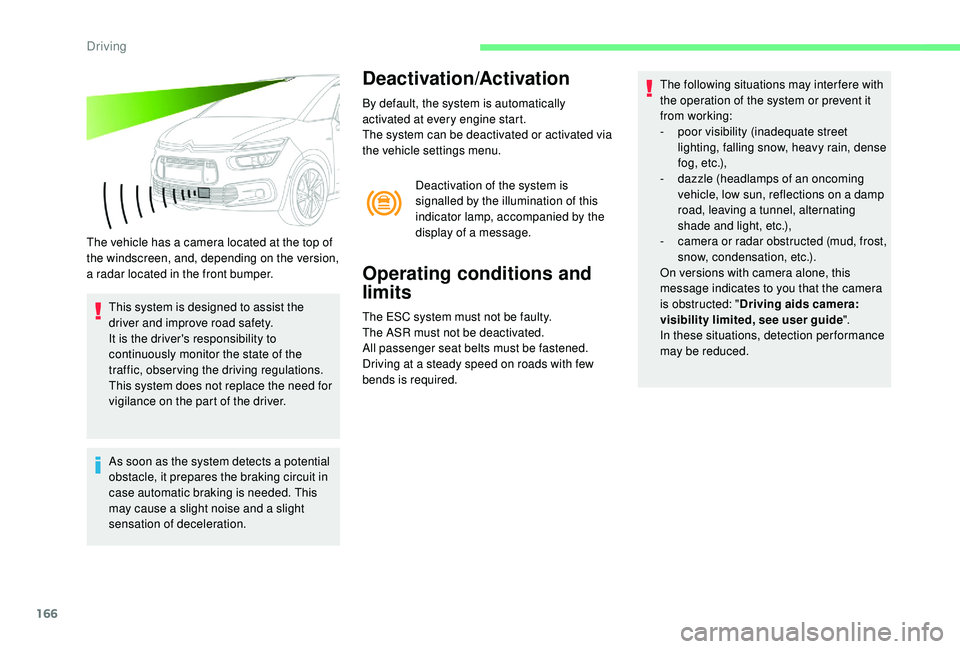
The vehicle has a camera located at the top of
t he windscreen, and, depending on the version,
a radar located in the front bumper.
This system is designed to assist the
driver and improve road safety.
It is the driver's responsibility to
continuously monitor the state of the
traffic, observing the driving regulations.
This system does not replace the need for
vigilance on the part of the driver.
As soon as the system detects a
potential
obstacle, it prepares the braking circuit in
case automatic braking is needed. This
may cause a
slight noise and a slight
sensation of deceleration.
Deactivation/Activation
By default, the system is automatically
activated at every engine start.
The system can be deactivated or activated via
the vehicle settings menu.
Deactivation of the system is
signalled by the illumination of this
indicator lamp, accompanied by the
display of a
message.
Operating conditions and
limits
The ESC system must not be faulty.
The ASR must not be deactivated.
All passenger seat belts must be fastened.
Driving at a steady speed on roads with few
bends is required. The following situations may interfere with
the operation of the system or prevent it
from working:
-
p
oor visibility (inadequate street
lighting, falling snow, heavy rain, dense
f o g , e t c .),
-
d
azzle (headlamps of an oncoming
vehicle, low sun, reflections on a damp
road, leaving a tunnel, alternating
shade and light, etc.),
-
c
amera or radar obstructed (mud, frost,
snow, condensation, etc.).
On versions with camera alone, this
message indicates to you that the camera
is obstructed: " Driving aids camera:
visibility limited, see user guide ".
In these situations, detection performance
may be reduced.
Driving
Page 192 of 316

190
Fuel
Fuel tank capacity: approximately 57 litres
(petrol) or 55 litres (Diesel).
Low fuel level
When the low fuel level is reached,
this warning lamp in the instrument
panel comes on, accompanied by
an audible warning, a message and
the last bar of the fuel gauge lights
up orange.
When it first comes on there remains
approximately 6
litres of fuel in the tank.
Until sufficient fuel has been added, this
warning lamp appears every time the ignition
is switched on, accompanied by an audible
warning and a
message. This audible warning
and this message are repeated with increasing
frequency as the fuel level drops towards " 0".
Refuel as soon as possible to avoid running
out.
Refilling
A self-adhesive label on the inner face of the
filler flap reminds you of the type of fuel to use,
depending on your engine.
Additions of fuel must be of at least 5
litres, in
order to be registered by the fuel gauge. To refuel in complete safety:
F
Y
ou must switch off the engine.
F
W
ith the vehicle unlocked, press the rear
edge of the flap to open it (the filler cap is
a part of it).
F T ake care to select the pump that delivers
the correct type of fuel for your vehicle.
F
I
nsert the nozzle so as to push in the metal
non-return flap.
F
M
ake sure that the nozzle is pushed in as
far as possible before starting to refuel (risk
of blowback). If you are filling your tank to the top, do not
continue after the 3
rd cut- off of the nozzle;
this could cause malfunctions.
Your vehicle is fitted with a
catalytic converter,
a device which helps to reduce the level of
harmful emissions in the exhaust gases.
For petrol engines, you must use unleaded
fuel.
The filler neck is narrower, allowing only
unleaded petrol nozzles to be introduced.
If you have put in the wrong fuel for
your vehicle, you must have the fuel
tank drained and filled with the correct
fuel before star ting the engine.
Fuel cut- of f
Your vehicle is fitted with a safety system that
c uts off the supply of fuel in the event of an
impact.
Opening the filler flap may create a
noise
caused by an inrush of air. This is entirely
normal and results from the sealing of the fuel
system. F
H
old it in this position throughout the filling
operation.
F
P
ush the filler flap to close it.
With Stop & Start, never refuel with the
engine in STOP mode; you must switch
off the ignition with the "START/STOP"
button.
Practical information
Page 199 of 316

197
Maximum load, distributed over the roof
bars, for a loading height not exceeding
40
cm: 80 kg.
As this value may be changed, please
verify the maximum load quoted in the
user guide supplied with the roof bars.
If the height exceeds 40
cm, adapt the
speed of the vehicle to the profile of the
road to avoid damaging the roof bars and
the fixings on the vehicle.
Be sure to refer to national legislation in
order to comply with the regulations for
transporting objects which are longer than
the vehicle.
When carrying long objects, it is
recommended that the motorised tailgate
function is deactivated.
Very cold climate screen(s)
(Depending on the country where the product
is sold.)
Removable screen(s) which prevent snow
accumulating at the radiator cooling fan.
Depending on the version, you have one or two
screens. Before fitting or removing a
screen,
ensure that the engine is off and the
cooling fan has stopped.
Fitting Removing
F Use a
screwdriver as a lever to release each
of the fixings of each screen in turn.
It is essential to remove the very cold
climate screen (or screens):
-
w
hen the exterior temperature exceeds
10°C,
-
w
hen towing,
-
a
t speeds above 75 mph (120 km/h).
Vision 360
system
The pre-cut section must be removed
before fitting the screen on the front
bumper, in order to be able to release the
camera.
When the very cold climate screen is
present, the camera image is slightly
altered.
F
O
ffer up the corresponding very cold
climate screen to the lower or upper section
of the front bumper.
F
P
ress around its edge to engage the fixing
clips of each screen one by one.
7
Practical information
Page 206 of 316

204
Only use products recommended by
CITROËN or products of equivalent quality
and specification.
In order to optimise the operation of
components as important as those in the
braking system, CITROËN selects and
offers very specific products.
After washing the vehicle, dampness, or
in wintry conditions, ice can form on the
brake discs and pads: braking efficiency
may be reduced. Make light brake
applications to dry and defrost the brakes.
AdBlue® (BlueHDi engines)
To respect the environment and ensure
compliance with the Euro 6 standard, without
adversely affecting the per formance or fuel
consumption of Diesel engines, CITROËN
has taken the decision to equip its vehicles
with a
system that associates SCR (Selective
Catalytic Reduction) with a
Diesel particle filter
(DPF) for the treatment of exhaust gases.
SCR system
Using a fluid called AdBlue® that contains
urea, a catalytic converter turns up to 85%
of nitrogen oxides (NOx) into nitrogen and
water, which are harmless to health and the
environment.
The AdBlue
® is contained in
a
special tank holding about
17
litres.
Its capacity allows a
driving range of around
12,500
miles (20,000
km). An alert system is
triggered automatically once the reser ve level
is reached: you can then drive for a
further
1,500
miles (2,400
km) before the tank is
e m pt y. Once the AdBlue
® tank is empty, a system
required by regulations prevents starting
of the engine.
If the SCR system is defective, the level of
emissions from your vehicle will no longer
meet the Euro 6
standard: your vehicle
becomes polluting.
In the event of a
confirmed fault with the
SCR system, you must go to a
CITROËN
dealer or a
qualified workshop as soon
as possible: after a
running distance of
685
miles (1,100
km), a system will be
triggered automatically to prevent engine
starting.
In either case, a range indicator gives you
the distance you can travel before the
vehicle is immobilised.
For more information on the Warning and
indicator lamps and associated alerts,
refer to the corresponding section.
Freezing of the AdBlue
®
AdBlue® freezes at temperatures below
around -11°C.
The SCR system includes a
heater for the
AdBlue
® tank, allowing you to continue
driving in very cold conditions.
Practical information
Page 233 of 316

231
12 V battery
General points
Lead-acid starter batteries
Batteries contain harmful substances
such as sulphuric acid and lead.
They must be disposed of in
accordance with regulations and must
not, in any circumstances, be discarded
with household waste.
Take used remote control batteries and
vehicle batteries to a
special collection
point.
Protect your eyes and face before
handling the battery.
All operations on the battery must be
carried out in a
well ventilated area and
away from naked flames and sources of
sparks, so as to avoid the risk of explosion
or fire.
Wash your hands afterwards.
Access to the battery
The battery (-) terminal is not accessible.
A remote earth point is located on the upper
part of the bonnet (next to the battery).
Starting using another
battery
When your vehicle's battery is discharged, the
engine can be started using a backup battery
(external or from another vehicle) and jump
leads or a
battery booster.
Never try to start the engine by connecting
a
battery charger.
Never use a
24 V or higher battery
b o o s t e r.
Check beforehand that the backup
battery has a
nominal voltage of 12 V and
a
capacity at least equal to that of the
discharged battery.
The two vehicles must not be in contact
with each other.
Switch off the electrical consumers on
both vehicles (audio system, wipers,
lighting, etc.).
Ensure that the jump lead cables do not
pass close to moving parts of the engine
(cooling fan, belts, etc.).
Do not disconnect the (+) terminal while
the engine is running.
The battery is located under the bonnet.
For access to the (+) terminal:
F
r
elease the bonnet using the interior lever,
then the exterior safety catch,
F
r
aise the bonnet and secure it with its stay,
F
l
ift the plastic cover for access to the (+)
terminal.
8
In the event of a breakdown
Page 235 of 316

233
Disconnecting the battery
In order to maintain an adequate state
of charge for starting the engine, it is
recommended that the battery be disconnected
if the vehicle is taken out of ser vice for a long
period.
Quick-release terminal clamp
F Switch off the ignition.
F S witch off all electrical consumers (audio
system, lighting, wipers, etc.).
F
S
witch off charger B before connecting the
cables to the battery, so as to avoid any
dangerous sparks.
F
E
nsure that the charger cables are in good
condition.
F
R
aise the plastic cover, if your vehicle has
one, on the (+) terminal.
F
C
onnect charger B cables as follows:
-
t
he (+) red cable to the (+) terminal of
battery A ,
-
t
he (-) black cable to earth point C on the
vehicle. Never try to charge a
frozen battery – risk
of explosion!
If the battery has frozen, have it checked
by a
CITROËN dealer or by a qualified
workshop who will check that the internal
components have not been damaged and
that the container has not cracked, which
would mean a
risk of toxic and corrosive
acid leaking.
F
A
t the end of the charging operation, switch
off charger B before disconnecting the
cables from battery A .
If this label is present, it is essential to
use only a 12 V charger to avoid causing
irreversible damage to the electrical
components related to the Stop & Start
system. Before disconnecting the battery:
F
c
lose all openings (doors, boot, windows,
roof),
F
s
witch off all electrical consumers (audio
system, wipers, lighting, etc.).
F
s
witch off the ignition and wait for four
minutes.
At the battery, detach the (+) terminal only.
Disconnecting the (+) terminal
F
Ra
ise the lever A fully to release the clamp B .
F
R
emove the clamp B by lifting it off.
8
In the event of a breakdown
Page 239 of 316

237
Engine technical data and
towed loads
Engines
The engine characteristics are given in the
vehicle's registration document, as well as in
sales brochures.The maximum power corresponds to the
value type-approved on a
test bed, under
conditions defined in European legislation
(Directive 1999/99/EC).
For more information, contact a
CITROËN
dealer or a
qualified workshop.
Weights and towed loads
The weights and towed loads relating to your
vehicle are given in the registration document,
as well as in sales brochures.
These values are also given on the
manufacturer's plate or label.
For more information, contact a CITROËN
dealer or a
qualified workshop. The GTW (Gross Train Weight) and towed load
values indicated are valid up to a
maximum
altitude of 1,000 metres. The towed load value
must be reduced by 10% for each additional
1,000 metres of altitude.
The maximum authorised nose weight
corresponds to the weight permitted on the
towball.
When exterior temperatures are high,
the vehicle per formance may be limited
in order to protect the engine. When the
exterior temperature is higher than 37°C,
limit the towed weight.
Towing using a lightly loaded vehicle can
adversely affect roadholding.
Braking distances are increased when
towing a trailer.
When using a vehicle to tow, never
exceed a speed of approximately 60 mph
(100
km/h) (obser ve the local legislation
in force).
If the exterior temperature is high, it is
recommended that the engine is allowed
to idle for 1
to 2 minutes after the vehicle
comes to a
stop, to facilitate its cooling.
9
Technical data