2022 CHRYSLER PACIFICA Index
[x] Cancel search: IndexPage 3 of 384

TABLE OF CONTENTS
1
2
3
4
5
6
7
8
9
10
11
1 INTRODUCTION .............................................................................................................................. 9
2 GETTING TO KNOW YOUR VEHICLE ................................................................................. 14
3 GETTING TO KNOW YOUR INSTRUMENT PANEL ....................................................... 110
4 STARTING AND OPERATING ................................................................................................ 131 5 MULTIMEDIA ............................................................................................................................... 187
6 SAFETY ........................................................................................................................................ 223 7 IN CASE OF EMERGENCY .................................................................................................... 282
8 SERVICING AND MAINTENANCE ......................................................................................309
9 TECHNICAL SPECIFICATIONS ............................................................................................360
10 CUSTOMER ASSISTANCE ..................................................................................................... 367 11 INDEX .............................................................................................................................................. 371
22_RUP_OM_EN_USC_t.book Page 1
Page 107 of 384

GETTING TO KNOW YOUR VEHICLE105
3. Twist the release knob counterclockwise and pull the bin towards you.
Debris Bin Release Knob
4. Remove the filter and dump the debris in a trash can. Lightly tap the filter on the collection
bin to remove loose debris from the filter. If the
filter is clogged from extended use, have the
filter replaced by an authorized dealer.
5. Reverse the procedure to reinstall.
NOTE:The debris bin must be fully installed and locked
for the vacuum to function properly. Hose Access Port
The hose access port is located behind the access
panel behind the third row seat on the driver’s
side.
To Remove Vacuum Hose For Cleaning
1. Open the access panel.
Vacuum System Access Panel
2. Open the small access panel on the upper right side, and unclip the hose from the hose
access port by pushing the yellow vacuum
hose release lever with right thumb and lifting
the hose with index finger.
Vacuum Hose Release Lever
3. Return to vacuum nozzle storage location located behind the sliding door.
4. Grab the vacuum nozzle and gently pull the hose out through vacuum nozzle storage
location.
5. Shake the hose to remove any objects stuck in the hose. Take care not to perforate the hose
while attempting to dislodge any objects.
6. Reverse the procedure to reinstall and clip the hose into place.
2
22_RUP_OM_EN_USC_t.book Page 105
Page 342 of 384
340SERVICING AND MAINTENANCE
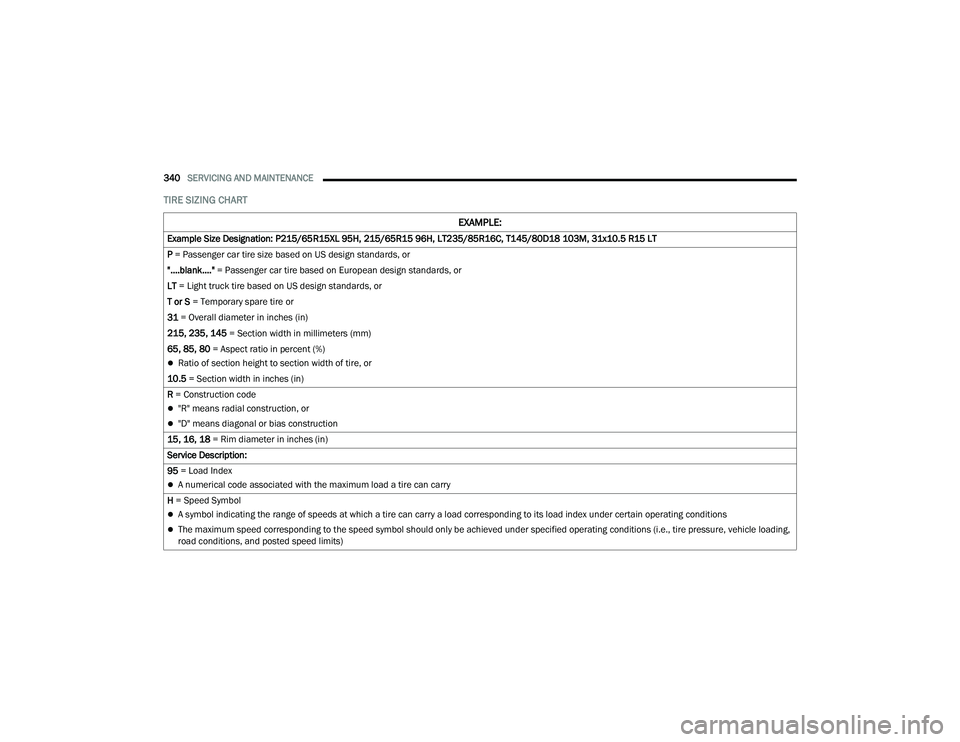
TIRE SIZING CHART
EXAMPLE:
Example Size Designation: P215/65R15XL 95H, 215/65R15 96H, LT235/85R16C, T145/80D18 103M, 31x10.5 R15 LT
P = Passenger car tire size based on US design standards, or
"....blank...." = Passenger car tire based on European design standards, or
LT = Light truck tire based on US design standards, or
T or S = Temporary spare tire or
31 = Overall diameter in inches (in)
215, 235, 145 = Section width in millimeters (mm)
65, 85, 80 = Aspect ratio in percent (%)
Ratio of section height to section width of tire, or
10.5 = Section width in inches (in)
R = Construction code
"R" means radial construction, or
"D" means diagonal or bias construction
15, 16, 18 = Rim diameter in inches (in)
Service Description:
95 = Load Index
A numerical code associated with the maximum load a tire can carry
H = Speed Symbol
A symbol indicating the range of speeds at which a tire can carry a load corresponding to its load index under certain operating conditions
The maximum speed corresponding to the speed symbol should only be achieved under specified operating conditions (i.e., tire pressure, vehicle loading,
road conditions, and posted speed limits)
22_RUP_OM_EN_USC_t.book Page 340
Page 350 of 384

348SERVICING AND MAINTENANCE
Consult an authorized tire dealer for tire repairs
and additional information.
Damaged Run Flat tires, or Run Flat tires that have
experienced a loss of pressure should be replaced
immediately with another Run Flat tire of identical
size and service description (Load Index and
Speed Symbol). Replace the tire pressure sensor
as well as it is not designed to be reused.
Run Flat Tires — If Equipped
Run Flat tires allow you the capability to drive
50 miles (80 km) at 50 mph (80 km/h) after a
rapid loss of inflation pressure. This rapid loss of
inflation is referred to as the Run Flat mode. A Run
Flat mode occurs when the tire inflation pressure is
of/or below 14 psi (96 kPa). Once a Run Flat tire
reaches the Run Flat mode it has limited driving
capabilities and needs to be replaced immediately.
A Run Flat tire is not repairable. When a Run Flat
tire is changed after driving with an underinflated
tire condition, please replace the TPMS sensor as
it is not designed to be reused when driven under
Run Flat mode 14 psi (96 kPa) condition.
NOTE:TPMS sensor must be replaced after driving the
vehicle on a flat tire condition. It is not recommended driving a vehicle loaded at
full capacity or to tow a trailer while a tire is in the
Run Flat mode Ú
page 236.
Tire Spinning
When stuck in mud, sand, snow, or ice conditions,
do not spin your vehicle's wheels above 30 mph
(48 km/h) or for longer than 30 seconds
continuously without stopping.
Tread Wear Indicators
Tread wear indicators are in the original equipment
tires to help you in determining when your tires
should be replaced.
Tire Tread
These indicators are molded into the bottom of the
tread grooves. They will appear as bands when the
tread depth becomes a 1/16 of an inch (1.6 mm).
When the tread is worn to the tread wear
indicators, the tire should be replaced
Ú page 349.
WARNING!
Fast spinning tires can be dangerous. Forces
generated by excessive wheel speeds may
cause tire damage or failure. A tire could
explode and injure someone. Do not spin your
vehicle's wheels faster than 30 mph (48 km/h)
for more than 30 seconds continuously when
you are stuck, and do not let anyone near a
spinning wheel, no matter what the speed.1 — Worn Tire
2 — New Tire
22_RUP_OM_EN_USC_t.book Page 348
Page 351 of 384
SERVICING AND MAINTENANCE349
Life Of Tire
The service life of a tire is dependent upon varying
factors including, but not limited to:
Driving style.
Tire pressure - Improper cold tire inflation pres -
sures can cause uneven wear patterns to
develop across the tire tread. These abnormal
wear patterns will reduce tread life, resulting in
the need for earlier tire replacement.
Distance driven.
Performance tires, tires with a speed rating of V
or higher, and Summer tires typically have a
reduced tread life. Rotation of these tires per
the vehicle scheduled maintenance is highly
recommended.
NOTE:Wheel valve stem must be replaced as well when
installing new tires due to wear and tear in existing
tires. Keep dismounted tires in a cool, dry place with as
little exposure to light as possible. Protect tires
from contact with oil, grease, and gasoline.
Replacement Tires
The tires on your new vehicle provide a balance of
many characteristics. They should be inspected
regularly for wear and correct cold tire inflation
pressures. The manufacturer strongly
recommends that you use tires equivalent to the
originals in size, quality and performance when
replacement is needed Ú
page 348. The Load
Index and Speed Symbol for your tire will be found
on the original equipment tire sidewall.
See the Tire Sizing Chart example found in the Tire
Safety Information section of this manual for more
information relating to the Load Index and Speed
Symbol of a tire Ú page 340.
It is recommended to replace the two front tires or
two rear tires as a pair. Replacing just one tire can
seriously affect your vehicle’s handling. If you ever
replace a wheel, make sure that the wheel’s
specifications match those of the original wheels.
It is recommended you contact an authorized tire
dealer or original equipment dealer with any
questions you may have on tire specifications or
capability. Failure to use equivalent replacement
tires may adversely affect the safety, handling, and
ride of your vehicle.
WARNING!
Tires and the spare tire should be replaced after
six years, regardless of the remaining tread.
Failure to follow this warning can result in
sudden tire failure. You could lose control and
have a collision resulting in serious injury or
death.
WARNING!
Do not use a tire, wheel size, load rating, or
speed rating other than that specified for your
vehicle. Some combinations of unapproved
tires and wheels may change suspension
dimensions and performance characteristics,
resulting in changes to steering, handling, and
braking of your vehicle. This can cause unpre -
dictable handling and stress to steering and
suspension components. You could lose
control and have a collision resulting in
serious injury or death. Use only the tire and
wheel sizes with load ratings approved for
your vehicle.
Never use a tire with a smaller load index or
capacity, other than what was originally
equipped on your vehicle. Using a tire with a
smaller load index could result in tire over -
loading and failure. You could lose control and
have a collision.
Failure to equip your vehicle with tires having
adequate speed capability can result in
sudden tire failure and loss of vehicle control.
8
22_RUP_OM_EN_USC_t.book Page 349
Page 373 of 384

371
INDEX
A
About Your Brakes......................................... 360Adaptive Cruise Control (ACC)
(Cruise Control).................................... 146, 147Adding Engine Coolant (Antifreeze)............... 325Additives, Fuel............................................... 363AdjustDown........................................................... 47Forward....................................................... 47Rearward..................................................... 47Up................................................................ 47Air Bag........................................................... 251Air Bag Operation...................................... 252Air Bag Warning Light...................... 250, 252Driver Knee Air Bag................................... 257Enhanced Accident Response......... 260, 308Event Data Recorder (EDR)....................... 308Front Air Bag............................................. 252If Deployment Occurs................................ 259Knee Impact Bolsters................................ 256Maintaining Your Air Bag System.............. 261Maintenance............................................. 261
Redundant Air Bag Warning Light............. 251Side Air Bags............................................ 257Transporting Pets..................................... 279Air Bag Light................................ 121, 250, 279Air Cleaner, Engine
(Engine Air Cleaner Filter)............................. 316Air Conditioner Maintenance........................ 317Air Conditioner Refrigerant.................. 317, 318Air Conditioner System................................. 317Air Conditioning Filter..............................83, 318Air Conditioning, Operating Tips....................... 83Air Filter........................................................ 316Air PressureTires......................................................... 347AlarmArm The System.......................................... 22Disarm The System..................................... 22Security Alarm.......................................... 124All Wheel DriveTowing...................................................... 308All Wheel Drive (AWD)................................... 143Alterations/ModificationsVehicle......................................................... 10
Amazon FireTV..................................... 213, 218Amazon FireTV Built-In.................................. 213Antifreeze (Engine Coolant).................. 325, 364Disposal.................................................... 326Anti-Lock Brake System (ABS)....................... 223Anti-Lock Warning Light................................ 124Assist, Hill Start............................................. 227Audio Jack........................................................87Audio Systems (Radio).................................. 187Auto Up Power Windows..................................93Automatic Dimming Mirror...............................57Automatic Headlights.......................................67Automatic Temperature Control (ATC)..............82Automatic Transaxle..................................... 139Automatic Transmission................................ 140Adding Fluid..................................... 328, 366Fluid And Filter Change............................. 328Fluid Change............................................. 328Fluid Level Check...................................... 328Fluid Type........................................ 328, 366Special Additives...................................... 328
11
22_RUP_OM_EN_USC_t.book Page 371