2022 CADILLAC XT4 heating
[x] Cancel search: heatingPage 296 of 419
Cadillac XT4 Owner Manual (GMNA-Localizing-U.S./Canada/Mexico-
15440907) - 2022 - CRC - 12/17/21
VEHICLE CARE 295
4. Inspect or replace the engine aircleaner/filter.
5. Reverse Steps 1–3 to reinstall the filter cover housing.
6. If equipped, reset the engine air filter life system after replacing the
engine air filter. See Engine Air
Filter Life System 0293.
{Warning
Operating the engine with the air
cleaner/filter off can cause you or
others to be burned. Use caution
when working on the engine. Do
not start the engine or drive the
vehicle with the air cleaner/filter
off, as flames may be present if the
engine backfires.
Caution
If the air cleaner/filter is off, dirt
can easily get into the engine,
which could damage it. Always have
the air cleaner/filter in place when
driving.
Cooling System
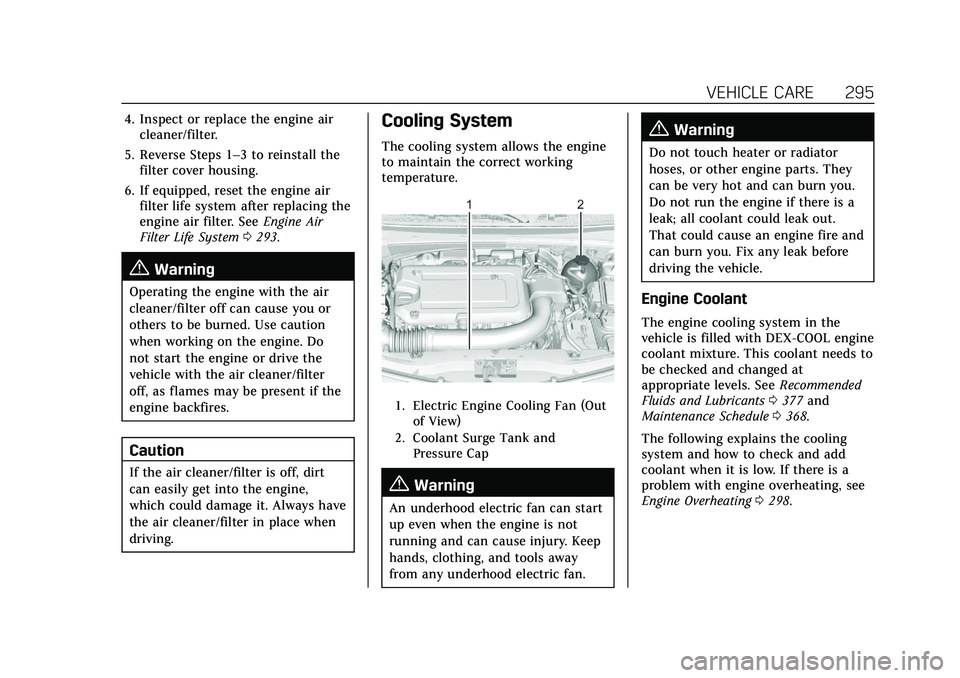
The cooling system allows the engine
to maintain the correct working
temperature.
1. Electric Engine Cooling Fan (Out
of View)
2. Coolant Surge Tank and Pressure Cap
{Warning
An underhood electric fan can start
up even when the engine is not
running and can cause injury. Keep
hands, clothing, and tools away
from any underhood electric fan.
{Warning
Do not touch heater or radiator
hoses, or other engine parts. They
can be very hot and can burn you.
Do not run the engine if there is a
leak; all coolant could leak out.
That could cause an engine fire and
can burn you. Fix any leak before
driving the vehicle.
Engine Coolant
The engine cooling system in the
vehicle is filled with DEX-COOL engine
coolant mixture. This coolant needs to
be checked and changed at
appropriate levels. See Recommended
Fluids and Lubricants 0377 and
Maintenance Schedule 0368.
The following explains the cooling
system and how to check and add
coolant when it is low. If there is a
problem with engine overheating, see
Engine Overheating 0298.
Page 297 of 419

Cadillac XT4 Owner Manual (GMNA-Localizing-U.S./Canada/Mexico-
15440907) - 2022 - CRC - 12/17/21
296 VEHICLE CARE
What to Use
{Warning
Do not touch heater or radiator
hoses, or other engine parts. They
can be very hot and can burn you.
Do not run the engine if there is a
leak; all coolant could leak out.
That could cause an engine fire and
can burn you. Fix any leak before
driving the vehicle.
Use a 50/50 mixture of clean,
drinkable water and DEX-COOL
coolant. This mixture:
.Gives freezing protection down to
−37 °C (−34 °F), outside temperature.
.Gives boiling protection up to
129 °C (265 °F), engine temperature.
.Protects against rust and corrosion.
.Will not damage aluminum parts.
.Helps keep the proper engine
temperature.
Caution
Do not use anything other than a
mix of DEX-COOL coolant that
meets GM Standard GMW3420 and
clean, drinkable water. Anything
else can cause damage to the
engine cooling system and the
vehicle, which would not be covered
by the vehicle warranty.
Never dispose of engine coolant by
putting it in the trash, pouring it on
the ground, or pouring into sewers,
streams, or bodies of water. Have the
coolant changed by an authorized
service center, familiar with legal
requirements regarding used coolant
disposal. This will help protect the
environment and your health.
Checking Coolant
The vehicle must be on a level surface
when checking the coolant level.
Check to see if coolant is visible in the
coolant surge tank. If the coolant
inside the coolant surge tank is
boiling, do not do anything else until
it cools down. If coolant is visible but
the coolant level mark is not at or
above the indicated mark, add a 50/
50 mixture of clean, drinkable water
and DEX-COOL coolant. Be sure the
cooling system is cool before this is
done. See Engine Overheating 0298.
The coolant surge tank is in the
engine compartment on the driver
side of the vehicle. See Engine
Compartment Overview 0289.
Page 299 of 419

Cadillac XT4 Owner Manual (GMNA-Localizing-U.S./Canada/Mexico-
15440907) - 2022 - CRC - 12/17/21
298 VEHICLE CARE
Automatic Coolant Service Fill
Instructions
This feature assists in filling and
removing air from the cooling system
after service of components or when
coolant is added after being too low.
To activate the fill and air removal
process:1. With a cold system, add coolant to the indicated mark on the
surge tank.
2. Replace the cap on the surge tank.
3. Connect the vehicle to a battery charger.
4. Turn the ignition to Service Mode. See Ignition Positions 0218.
5. Turn off the air conditioning.
6. Set the parking brake.
7. At the same time, press the accelerator and the brake for
automatic transmission vehicles for
two seconds, then release.
At the end of the cycle, check the
coolant level in the surge tank and
add coolant if it is low. Turn off the vehicle, allow the Electronic Control
Module (ECM) to go to sleep, about
2 minutes, and repeat Steps 3-7.
Listen for pump activation and
movement of the control valves while
watching the level of the coolant in
the surge tank. If the tank empties,
turn the ignition off, carefully remove
the surge tank cap, refill to the
indicated mark, and repeat Steps 3-6.
The fill and air removal process will
run for approximately 10 minutes.
Engine Overheating
The vehicle has several indicators to
warn of the engine overheating.
There is an engine coolant
temperature gauge on the instrument
cluster. See
Engine Coolant Temperature
Gauge 0104. The vehicle may also
display a message on the Driver
Information Center (DIC).
If the decision is made not to lift the
hood when this warning appears, get
service help right away. See Roadside
Service 0388. If the decision is made to lift the
hood, make sure the vehicle is parked
on a level surface. Then check to see if
the engine cooling fan is running.
If the engine is overheating, the fan
should be running. If it is not, do not
continue to run the engine. Have the
vehicle serviced.
Caution
Do not run the engine if there is a
leak in the engine cooling system.
This can cause a loss of all coolant
and can damage the system and
vehicle. Have any leaks fixed
right away.
If Steam Is Coming from the
Engine Compartment
{Warning
Steam and scalding liquids from a
hot cooling system are under
pressure. Turning the pressure cap,
even a little, can cause them to
come out at high speed and you
could be burned. Never turn the cap
when the cooling system, including
(Continued)
Page 312 of 419

Cadillac XT4 Owner Manual (GMNA-Localizing-U.S./Canada/Mexico-
15440907) - 2022 - CRC - 12/17/21
VEHICLE CARE 311
FusesUsage
15 PEPS –Passive Entry
Passive Start Module
16 FRT/WPR –Front
Wiper
17 PASS/PWR/SEAT –
Passenger Power Seat
–
18 LGM MTR –Power
Liftgate
19 DRVR/PWR/SEAT –
Driver Power Seat/
Memory Seat Module/
Driver Seat Massage
Control
21 S/ROOF –Power
Sunroof
–
22 –
23 TIM 2 –Not Used
26 TCM IGN –
Transmission Control
Module/Ignition Fuses
Usage
27 IP BODY IGN –Inside
Rear View Mirror –
Shifter Interface
Board Module Run/
Crank –Central
Gateway Module Run/
Crank –Heating
Ventilation and Air
Conditioning Control
Module Run/Crank
ignition 3
28 RR/WPR –Rear
Wiper
29 TRAILER IGN –
Not Used
30 MIL SS/TIM IGN –
Fuel Tank Zone
Module Run/Crank –
Direct Current to
Direct Current
Transformer Run/
Crank –Electronic
Brake Control Module
Run/Crank –
Instrument Panel
Cluster Run/Crank Fuses
Usage
32 RDCM 1 –Rear Drive
Control Module 1
–
33 FRT HTD ST 2/Spare –Front Heated Seat
Power 2/Spare
–
34 HANDSFREE/WDO SW–Liftgate
Module/Front
Window Switches
35 DEFC 2/NOT USED –
/Not Used
36 FUEL MODULE –Fuel
Tank Zone Module
39 MASGE –Driver Seat
Massage/Passenger
Seat Massage
–
40 STR/COL/LCK –Spare
41 –
Page 313 of 419

Cadillac XT4 Owner Manual (GMNA-Localizing-U.S./Canada/Mexico-
15440907) - 2022 - CRC - 12/17/21
312 VEHICLE CARE
FusesUsage
43 HTD/STR/WHL –
Heated Steering
Wheel/Spare
–
44 FRT HTD 1 & VENT ST–Front Heated
Seat Power Feed 1/
Front Vented Seats/
Rear Heated Seats/
Spare
–
46 ECM IGN –Engine
Control Module
Ignition
48 RDCM 2 –Rear Drive
Control Module 2/
Spare
–
49 HVAC BLOWR MTR –
Heating Ventilation
and Air Conditioning
Control Blower Motor
50 Spare
51 Spare Fuses
Usage
54 Spare
55 Spare
56 STRTR MTR –Starter
Motor
57 –
58 –
59 HDLP HI BEAM LT/ RT–High Beam
Headlamps
60 TIM 1 –Not Used
61 Spare
62 Spare
63 Spare
65 A/C CLUTCH –Air
Conditioning Clutch
67 Spare
68 Spare
69 –
70 TRLR PRK LAMP –
Trailer Park Lamp
– Fuses
Usage
72 STRTR PINION –
Starter Pinion
75 ECM MAIN –Engine
Control Module Main
76 PT OFF ENG –
Powertrain Off Engine
– Engine Control
Module Power Train
Ignition 1
78 Horn
79 WASH PMP –Front
and Rear
Washer Pump
81 TCM/ECM/COOL PUMP–Engine
Control Module
Battery/Spare
82 NOx SNSR –
Not Used
83 IGN COIL –Ignition
Coils
Page 318 of 419

Cadillac XT4 Owner Manual (GMNA-Localizing-U.S./Canada/Mexico-
15440907) - 2022 - CRC - 12/17/21
VEHICLE CARE 317
FusesUsage
F26 –
F27 –
F28 –
F29 BCM 8 –Body Control
Module 8 –Internal
Driver/Fuel Door
Unlock Relay Control
Signal, Internal
Non-Driver Door Lock
Relay Control Signal,
Internal All Door
Unlock Relay Control
Signal
F30 OVERHD CNSL –
Overhead Console
F31 STR/WHL/CNTRL –
Steering Wheel
Controls
F32 –
F33 HVAC –Heating
Ventilation and Air
Conditioning Control
Module
F34 CGM –Central Gateway
Module Fuses
Usage
F35 HEATED SW –Heated
Seat Switch/Hazard
Switch
–
F36 Wireless Charger Module/USB
Charge Port
F37 APO FRT –Not Used
F38 OnStar
F39 Displays –Shifter
Interface Board/Center
Stack/Head Up Display/
Instrument Panel
Cluster/HVAC Display
F40 OBS DET –Long Range
Radar Sensor/
Ultrasonic Park Assist
Module/Camera
Module/External Object
Calculating Module/
Side Blind Zone Alert
Modules/Front Camera
Module Fuses
Usage
F41 BCM 1 SS –Body
Control Module 1
(Stop/Start) –LED
Indicator Lighting
Control, Accessory LED
Control, Run-Start LED
Control, Ambient
Lighting LED Control 2,
Liftgate Latch Motor
Control Signal, Rear
Wiper Control Signal,
High Beam Lamp
Control (Direct Drive),
Rear Fog LED Lamp
Control Signal,
Windshield Washer
Pump Motor Control
Signal, Run/Crank
Relay Control Signal,
ECM/TCM ACC
Wakeup Control Signal,
Left Rear Turn Control
Signal, Rear Wiper
Wash Pump Control
Signal, Brake Pedal
Apply Signal
F42 RDO –Radio
Page 319 of 419

Cadillac XT4 Owner Manual (GMNA-Localizing-U.S./Canada/Mexico-
15440907) - 2022 - CRC - 12/17/21
318 VEHICLE CARE
FusesUsage
F43 APO CNSL –Console
Auxiliary Power Outlet
(Circuit Breaker)
–
F44 APO CNSL –Front
Console Auxiliary
Power Outlet
–
Relay Usage
K1 –
K2 RAP/ACCY
–Retained
Accessory Power
K3 Content Theft
–
Not Used
K4 –
K5 –Wheels and Tires
Tires
Every new GM vehicle has
high-quality tires made by a
leading tire manufacturer. See the
warranty manual for information
regarding the tire warranty and
where to get service. For
additional information refer to the
tire manufacturer.
{Warning
.Poorly maintained and
improperly used tires are
dangerous.
.Overloading the tires can
cause overheating as a result
of too much flexing. There
could be a blowout and a
serious crash. See Vehicle
Load Limits 0214.
.Underinflated tires pose the
same danger as overloaded
tires. The resulting crash
(Continued)
Warning (Continued)
could cause serious injury.
Check all tires frequently to
maintain the recommended
pressure. Tire pressure should
be checked when the tires
are cold.
.Overinflated tires are more
likely to be cut, punctured,
or broken by a sudden
impact —such as when
hitting a pothole. Keep tires
at the recommended pressure.
.Worn or old tires can cause a
crash. If the tread is badly
worn, replace them.
.Replace any tires that have
been damaged by impacts
with potholes, curbs, etc.
.Improperly repaired tires can
cause a crash. Only your
dealer or an authorized tire
(Continued)
Page 326 of 419

Cadillac XT4 Owner Manual (GMNA-Localizing-U.S./Canada/Mexico-
15440907) - 2022 - CRC - 12/17/21
VEHICLE CARE 325
treadwear. Ratings are determined
by tire manufacturers using
government testing procedures.
The ratings are molded into the
sidewall of the tire. SeeUniform
Tire Quality Grading 0335.
Vehicle Capacity Weight
:The
number of designated seating
positions multiplied by
68 kg (150 lb) plus the rated cargo
load. See Vehicle Load Limits 0214.
Vehicle Maximum Load on the
Tire
:Load on an individual tire
due to curb weight, accessory
weight, occupant weight, and
cargo weight.
Vehicle Placard
:A label
permanently attached to a vehicle
showing the vehicle capacity
weight and the original equipment
tire size and recommended
inflation pressure. See “Tire and
Loading Information Label” under
Vehicle Load Limits 0214.
Tire Pressure
Tires need the correct amount of
air pressure to operate effectively.
{Warning
Neither tire underinflation nor
overinflation is good.
Underinflated tires, or tires that
do not have enough air, can
result in:
.Tire overloading and
overheating, which could lead
to a blowout.
.Premature or irregular wear.
.Poor handling.
.Reduced fuel economy.
Overinflated tires, or tires that
have too much air, can result in:
.Unusual wear.
.Poor handling.
.Rough ride.
.Needless damage from road
hazards. The Tire and Loading Information
label on the vehicle indicates the
original equipment tires and the
correct cold tire inflation
pressures. The recommended
pressure is the minimum air
pressure needed to support the
vehicle's maximum load carrying
capacity. See
Vehicle Load Limits
0 214.
How the vehicle is loaded affects
vehicle handling and ride comfort.
Never load the vehicle with more
weight than it was designed to
carry.
When to Check
Check the pressure of the tires
once a month or more. Do not
forget the compact spare, if the
vehicle has one. The compact
spare cold tire pressure should be
at 420 kPa (60 psi). See Compact
Spare Tire 0350.