2022 CADILLAC CT5 oil pressure
[x] Cancel search: oil pressurePage 239 of 466

Cadillac CT5 Owner Manual (GMNA-Localizing-U.S./Canada-15268585) -
2022 - CRC - 10/11/21
238 DRIVING AND OPERATING
{Warning
Rear end spoilers may break under
pressure, resulting in property
damage or injury. Do not push the
vehicle by the spoiler or use the
spoiler as a handle.
Ignition Positions
The vehicle has an electronic keyless
ignition with pushbutton start.
The Remote Key must be in the
vehicle for the system to operate.
If the pushbutton start is not working,
the vehicle may be near a strong radio
antenna signal causing interference tothe Keyless Access system. See
Remote
Keyless Entry (RKE) System Operation
0 7.
To shift out of P (Park), the vehicle
must be on and the brake pedal must
be applied.
Stopping the Engine/OFF (No
Indicator Lights) : When the vehicle
is stopped, press ENGINE START/
STOP once to turn the engine off.
If the vehicle is in P (Park), the
ignition will turn off, and Retained
Accessory Power (RAP) will remain
active. See Retained Accessory Power
(RAP) 0243.
If the vehicle has an automatic
transmission, and is not in P (Park),
the ignition will return to ACC/
ACCESSORY and display a message in
the Driver Information Center (DIC).
When the vehicle is shifted into
P (Park), the ignition system will
turn OFF.
If the vehicle has a manual
transmission and is stationary, the
ignition will turn off, and Retained Accessory Power (RAP) will remain
active. See
Retained Accessory Power
(RAP) 0243.
The vehicle may have an electric
steering column lock. The lock is
activated when the vehicle is switched
to OFF and the driver door is opened.
A sound may be heard as the lock
actuates or releases. The steering
column lock may not release with the
wheels turned off center. If this
happens, the vehicle may not start.
Move the steering wheel from left to
right while attempting to start the
vehicle. If this does not work, the
vehicle needs service.
Do not turn the engine off when the
vehicle is moving. This will cause a
loss of power assist in the brake and
steering systems and disable the
airbags.
If the vehicle must be shut off in an
emergency: 1. Brake using a firm and steady pressure. Do not pump the brakes
repeatedly. This may deplete power
assist, requiring increased brake
pedal force.
Page 328 of 466

Cadillac CT5 Owner Manual (GMNA-Localizing-U.S./Canada-15268585) -
2022 - CRC - 10/11/21
VEHICLE CARE 327
Vehicle Care
General Information
General Information . . . . . . . . . . . . . 328
California Perchlorate MaterialsRequirements . . . . . . . . . . . . . . . . . . . 328
Accessories and Modifications . . . . . . . . . . . . . . . . . . . 328
Vehicle Checks
Doing Your OwnService Work . . . . . . . . . . . . . . . . . . . . 329
Hood . . . . . . . . . . . . . . . . . . . . . . . . . . . . . . 329
Engine Compartment Overview . . . . . . . . . . . . . . . . . . . . . . . . . 331
Engine Oil . . . . . . . . . . . . . . . . . . . . . . . . . 336
Engine Oil Life System . . . . . . . . . . . 338
Automatic Transmission Fluid . . . . . . . . . . . . . . . . . . . . . . . . . . . . . 339
Manual Transmission Fluid . . . . . 339
Hydraulic Clutch . . . . . . . . . . . . . . . . . 340
Engine Air Filter Life System . . . . 340
Engine Air Cleaner/Filter . . . . . . . . . 341
Cooling System . . . . . . . . . . . . . . . . . . . 343
Engine Overheating . . . . . . . . . . . . . . 347
Washer Fluid . . . . . . . . . . . . . . . . . . . . . 348
Brakes . . . . . . . . . . . . . . . . . . . . . . . . . . . . . 349
Brake Pad Life System (If Equipped) . . . . . . . . . . . . . . . . . . . . . . . 351
Brake Fluid . . . . . . . . . . . . . . . . . . . . . . . 352 Battery - North America . . . . . . . . . 353
All-Wheel Drive . . . . . . . . . . . . . . . . . . 354
Park Brake and P (Park)
Mechanism Check . . . . . . . . . . . . . . 354
Wiper Blade Replacement . . . . . . . 355
Windshield Replacement . . . . . . . . 355
Gas Strut(s) . . . . . . . . . . . . . . . . . . . . . . . 356
Headlamp Aiming
Front Headlamp Aiming . . . . . . . . . 357
Bulb Replacement
LED Lighting . . . . . . . . . . . . . . . . . . . . . 357
Electrical System
Electrical System Overload . . . . . . 357
Fuses and Circuit Breakers . . . . . . 359
Engine Compartment Fuse
Block . . . . . . . . . . . . . . . . . . . . . . . . . . . . 360
Instrument Panel Fuse Block . . . . 362
Rear Compartment Fuse Block . . . . . . . . . . . . . . . . . . . . . . . . . . . . 365
Wheels and Tires
Tires . . . . . . . . . . . . . . . . . . . . . . . . . . . . . . . 367
All-Season Tires . . . . . . . . . . . . . . . . . . 367
Winter Tires . . . . . . . . . . . . . . . . . . . . . . 368
Run-Flat Tires . . . . . . . . . . . . . . . . . . . . 368
Self-Sealing Tires . . . . . . . . . . . . . . . . . 369
Low-Profile Tires . . . . . . . . . . . . . . . . . 369
Summer Tires . . . . . . . . . . . . . . . . . . . . 369
Tire Sidewall Labeling . . . . . . . . . . . 370 Tire Designations . . . . . . . . . . . . . . . . . 371
Tire Terminology and
Definitions . . . . . . . . . . . . . . . . . . . . . . 372
Tire Pressure . . . . . . . . . . . . . . . . . . . . . . 374
Tire Pressure for High-Speed Operation . . . . . . . . . . . . . . . . . . . . . . . . 375
Tire Pressure Monitor System . . . 376
Tire Pressure Monitor Operation . . . . . . . . . . . . . . . . . . . . . . . . 377
Tire Inspection . . . . . . . . . . . . . . . . . . . 380
Tire Rotation . . . . . . . . . . . . . . . . . . . . . 380
When It Is Time for New Tires . . . . . . . . . . . . . . . . . . . . . . . . . . . . . 382
Buying New Tires . . . . . . . . . . . . . . . . 382
Different Size Tires and Wheels . . . . . . . . . . . . . . . . . . . . . . . . . . 384
Uniform Tire Quality Grading . . . 384
Wheel Alignment and Tire Balance . . . . . . . . . . . . . . . . . . . . . . . . . . 385
Wheel Replacement . . . . . . . . . . . . . . 386
Tire Chains . . . . . . . . . . . . . . . . . . . . . . . 386
If a Tire Goes Flat . . . . . . . . . . . . . . . . 387
Tire Sealant and Compressor Kit . . . . . . . . . . . . . . . . . 388
Storing the Tire Sealant and Compressor Kit . . . . . . . . . . . . . . . . . 394
Jump Starting
Jump Starting - NorthAmerica . . . . . . . . . . . . . . . . . . . . . . . . . 394
Page 333 of 466

Cadillac CT5 Owner Manual (GMNA-Localizing-U.S./Canada-15268585) -
2022 - CRC - 10/11/21
332 VEHICLE CARE
1. Windshield Washer Fluid Reservoir.See Washer Fluid 0348.
2. Engine Coolant Surge Tank and Pressure Cap. See Cooling System
0 343.
3. Engine Air Cleaner/Filter 0341.
4. Engine Cooling Fan (Out of View). See Cooling System 0343.
5. Engine Oil Fill Cap. See Engine Oil
0 336.
6. Engine Oil Dipstick. See Engine Oil
0 336.
7. Remote Positive (+) Battery Terminal. See Jump Starting - North
America 0394.
8. Brake Fluid Reservoir. See Brake
Fluid 0352.
9. Remote Negative (-) Battery Terminal. See Jump Starting - North
America 0394.
10. Engine Compartment Fuse Block
0360.
Page 335 of 466
Cadillac CT5 Owner Manual (GMNA-Localizing-U.S./Canada-15268585) -
2022 - CRC - 10/11/21
334 VEHICLE CARE
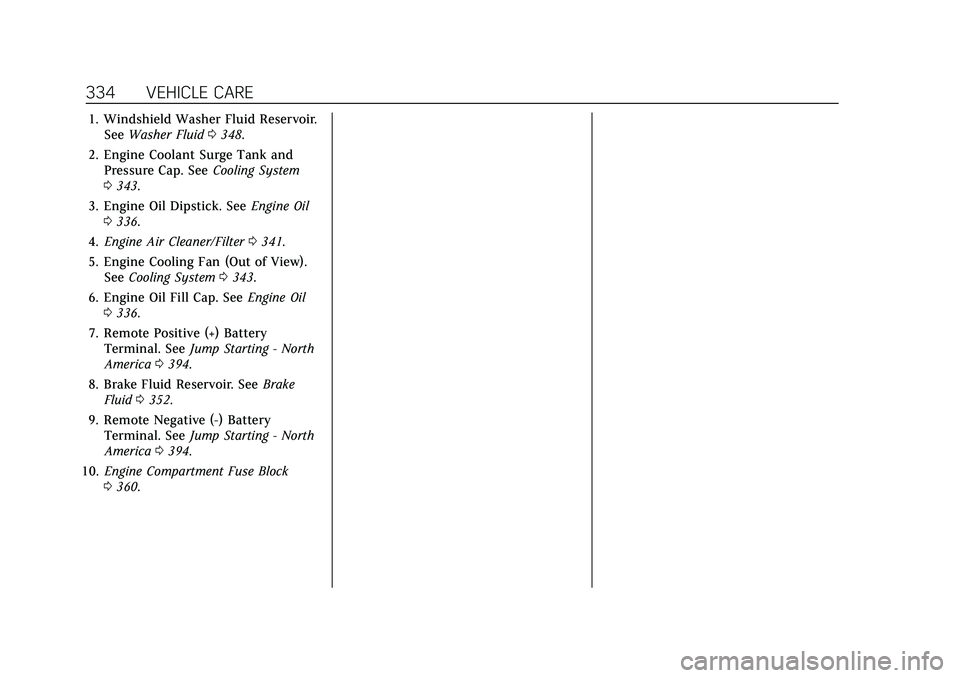
1. Windshield Washer Fluid Reservoir.See Washer Fluid 0348.
2. Engine Coolant Surge Tank and Pressure Cap. See Cooling System
0 343.
3. Engine Oil Dipstick. See Engine Oil
0 336.
4. Engine Air Cleaner/Filter 0341.
5. Engine Cooling Fan (Out of View). See Cooling System 0343.
6. Engine Oil Fill Cap. See Engine Oil
0 336.
7. Remote Positive (+) Battery Terminal. See Jump Starting - North
America 0394.
8. Brake Fluid Reservoir. See Brake
Fluid 0352.
9. Remote Negative (-) Battery Terminal. See Jump Starting - North
America 0394.
10. Engine Compartment Fuse Block
0360.
Page 336 of 466

Cadillac CT5 Owner Manual (GMNA-Localizing-U.S./Canada-15268585) -
2022 - CRC - 10/11/21
VEHICLE CARE 335
6.2L V8 Engine
1. Windshield Washer Fluid Reservoir. See Washer Fluid 0348.
2. Engine Coolant Surge Tank and Pressure Cap. See Cooling System
0 343.
3. Engine Air Cleaner/Filter 0341. 4. Engine Oil Dipstick. See
Engine Oil
0 336.
5. Engine Cooling Fan (Out of View). See Cooling System 0343.
6. Engine Oil Fill Cap. See Engine Oil
0 336. 7. Remote Positive (+) Battery
Terminal. See Jump Starting - North
America 0394.
8. Brake/Clutch Fluid Reservoir. See Brake Fluid 0352.
Page 346 of 466

Cadillac CT5 Owner Manual (GMNA-Localizing-U.S./Canada-15268585) -
2022 - CRC - 10/11/21
VEHICLE CARE 345
Check to see if coolant is visible in the
coolant surge tank. If the coolant
inside the coolant surge tank is
boiling, do not do anything else until
it cools down.
If coolant is visible but the coolant
level is not at or above the indicated
mark, add a 50/50 mixture of clean
drinkable water and DEX-COOL
coolant.
Be sure the cooling system is cool
before this is done.
If no coolant is visible in the coolant
surge tank, add coolant as follows:
How to Add Coolant to the
Coolant Surge Tank
{Warning
Spilling coolant on hot engine parts
can burn you. Coolant contains
ethylene glycol and it will burn if
the engine parts are hot enough.
{Warning
Plain water, or other liquids such as
alcohol, can boil before the proper
coolant mixture will. With plain
water or the wrong mixture, the
engine could get too hot but there
would not be an overheat warning.
The engine could catch fire and you
or others could be burned.
{Warning
Steam and scalding liquids from a
hot cooling system are under
pressure. Turning the pressure cap,
even a little, can cause them to
come out at high speed and you(Continued)
Warning (Continued)
could be burned. Never turn the cap
when the cooling system, including
the pressure cap, is hot. Wait for
the cooling system and pressure
cap to cool.
Caution
Failure to follow the specific
coolant fill procedure could cause
the engine to overheat and could
cause system damage. If coolant is
not visible in the surge tank,
contact your dealer.
If no problem is found, check to see if
coolant is visible in the coolant surge
tank. If coolant is visible but the
coolant level is not at or above the
indicated mark, add a 50/50 mixture
of clean, drinkable water and
DEX-COOL coolant at the coolant
surge tank, but be sure the cooling
system, including the coolant surge
tank pressure cap, is cool before you
do it.
Page 373 of 466

Cadillac CT5 Owner Manual (GMNA-Localizing-U.S./Canada-15268585) -
2022 - CRC - 10/11/21
372 VEHICLE CARE
to carry. The speed rating is the
maximum speed a tire is certified
to carry a load.
Tire Terminology and
Definitions
Air Pressure:The amount of air
inside the tire pressing outward
on each square inch of the tire.
Air pressure is expressed in kPa
(kilopascal) or psi (pounds per
square inch).
Accessory Weight
:The combined
weight of optional accessories.
Some examples of optional
accessories are automatic
transmission, power windows,
power seats, and air conditioning.
Aspect Ratio
:The relationship of
a tire's height to its width.
Belt
:A rubber coated layer of
cords between the plies and the
tread. Cords may be made from
steel or other reinforcing
materials. Bead
:The tire bead contains steel
wires wrapped by steel cords that
hold the tire onto the rim.
Bias Ply Tire
:A pneumatic tire in
which the plies are laid at
alternate angles less than
90 degrees to the centerline of the
tread.
Cold Tire Pressure
:The amount
of air pressure in a tire, measured
in kPa (kilopascal) or psi (pounds
per square inch) before a tire has
built up heat from driving. See
Tire Pressure 0374.
Curb Weight
:The weight of a
motor vehicle with standard and
optional equipment including the
maximum capacity of fuel, oil, and
coolant, but without passengers
and cargo.
DOT Markings
:A code molded
into the sidewall of a tire
signifying that the tire is in
compliance with the U.S.
Department of Transportation
(DOT) Motor Vehicle Safety Standards. The DOT code includes
the Tire Identification Number
(TIN), an alphanumeric designator
which can also identify the tire
manufacturer, production plant,
brand, and date of production.
GVWR
:Gross Vehicle Weight
Rating. See Vehicle Load Limits
0 233.
GAWR FRT
:Gross Axle Weight
Rating for the front axle. See
Vehicle Load Limits 0233.
GAWR RR
:Gross Axle Weight
Rating for the rear axle. See
Vehicle Load Limits 0233.
Intended Outboard Sidewall
:
The side of an asymmetrical tire
that must always face outward
when mounted on a vehicle.
Kilopascal (kPa)
:The metric unit
for air pressure.
Light Truck (LT-Metric) Tire
:A
tire used on light duty trucks and
some multipurpose passenger
vehicles.
Page 401 of 466

Cadillac CT5 Owner Manual (GMNA-Localizing-U.S./Canada-15268585) -
2022 - CRC - 10/11/21
400 VEHICLE CARE
Hand Wash
Rinse the vehicle well, before and after
washing, to remove all cleaning agents
completely. If they are allowed to dry
on the surface, they could stain.
Dry the finish with a soft, clean
chamois or an all-cotton towel to
avoid surface scratches and water
spotting.
Cleaning Underhood Components
Caution
Do not power wash any component
under the hood that has this
e
symbol.
This could cause damage to the
vehicle that would not be covered
by the vehicle warranty.
Avoid using solvents or abrasive
cleaners that may harm underhood
components. GM recommends using
only water to clean underhood
components.
If using a pressure washer, ensure the
following criteria is met:
.Water pressure must be kept below
14 000 KPa (2,000 PSI).
.Water temperature must be below
80 °C (180 °F).
.A spray nozzle with a 40 degree
wide angle spray pattern or wider
must be used, and must be kept at
least 30 cm (1 ft) away from all
surfaces.
Finish Care
Application of aftermarket clearcoat
sealant/wax materials is not
recommended. If painted surfaces are
damaged, see your dealer to have the
damage assessed and repaired.
Materials such as calcium chloride
and other salts, ice melting agents,
road oil and tar, tree sap, bird
droppings, chemicals from industrial
chimneys, etc., can damage the vehicle
finish if they remain on painted
surfaces. Wash the vehicle as soon as
possible. If necessary, use
non-abrasive cleaners that are marked
safe for painted surfaces to remove
foreign matter. Occasional hand waxing or mild
polishing should be done to remove
residue from the paint finish. See your
dealer for approved cleaning products.
Caution
Do not apply waxes or polishes to
uncoated plastic, vinyl, rubber,
decals, simulated wood, or matte
paint as damage can occur.
Caution
Machine compounding or
aggressive polishing on a basecoat/
clearcoat paint finish may damage
it. Use only non-abrasive waxes and
polishes that are made for a
basecoat/clearcoat paint finish on
the vehicle.
To keep the paint finish looking new,
keep the vehicle garaged or covered
whenever possible.