2022 BUICK ENCORE GX FLUID
[x] Cancel search: FLUIDPage 256 of 376

Buick Encore GX Owner Manual (GMNA-Localizing-U.S./Canada/Mexico-
15481080) - 2022 - CRC - 6/1/21
Vehicle Care 255
Vehicle Care
General Information
General Information . . . . . . . . . . . . . . . . . . . 256
California Perchlorate MaterialsRequirements . . . . . . . . . . . . . . . . . . . . . . . . 256
Accessories and Modifications . . . . . . . . . 256
Vehicle Checks
Doing Your Own Service Work . . . . . . . . . 257
Hood . . . . . . . . . . . . . . . . . . . . . . . . . . . . . . . . . . 257
Engine Compartment Overview . . . . . . . . 259
Engine Oil . . . . . . . . . . . . . . . . . . . . . . . . . . . . . 262
Engine Oil Life System . . . . . . . . . . . . . . . . 264
Automatic Transmission Fluid . . . . . . . . . 265
Engine Air Filter Life System . . . . . . . . . . 265
Engine Air Cleaner/Filter . . . . . . . . . . . . . . 265
Cooling System . . . . . . . . . . . . . . . . . . . . . . . . 267
Engine Overheating . . . . . . . . . . . . . . . . . . . 270
Washer Fluid . . . . . . . . . . . . . . . . . . . . . . . . . . . 271
Brakes . . . . . . . . . . . . . . . . . . . . . . . . . . . . . . . . . 272
Brake Pad Life System . . . . . . . . . . . . . . . . . 273
Brake Fluid . . . . . . . . . . . . . . . . . . . . . . . . . . . . 273
Battery - North America . . . . . . . . . . . . . . . 274
All-Wheel Drive . . . . . . . . . . . . . . . . . . . . . . . . 276
Automatic Transmission Shift Lock Control Function Check . . . . . . . . . . . . . . 276
Park Brake and P (Park) Mechanism Check . . . . . . . . . . . . . . . . . . . . . . . . . . . . . . . . 276
Wiper Blade Replacement . . . . . . . . . . . . . 277 Windshield Replacement . . . . . . . . . . . . . . 278
Gas Strut(s) . . . . . . . . . . . . . . . . . . . . . . . . . . . 278
Headlamp Aiming
Front Headlamp Aiming . . . . . . . . . . . . . . . 279
Bulb Replacement
Bulb Replacement . . . . . . . . . . . . . . . . . . . . . 279
Halogen Bulbs . . . . . . . . . . . . . . . . . . . . . . . . . 279
LED Lighting . . . . . . . . . . . . . . . . . . . . . . . . . . . 279
Headlamps and Sidemarker Lamps . . . . 279
Front Turn Signal and Fog Lamps . . . . . . 281
Taillamps, Turn Signal, Sidemarker,
Stoplamps, and Back-Up Lamps (Base
Level) . . . . . . . . . . . . . . . . . . . . . . . . . . . . . . . . 282
Taillamps, Turn Signal, Sidemarker, Stoplamps, and Back-Up Lamps
(Uplevel) . . . . . . . . . . . . . . . . . . . . . . . . . . . . 284
Electrical System
Electrical System Overload . . . . . . . . . . . . 285
Fuses and Circuit Breakers . . . . . . . . . . . . . 286
Engine Compartment Fuse Block . . . . . . 287
Instrument Panel Fuse Block . . . . . . . . . . 289
Rear Compartment Fuse Block . . . . . . . . . 291
Wheels and Tires
Tires . . . . . . . . . . . . . . . . . . . . . . . . . . . . . . . . . . 292
All-Season Tires . . . . . . . . . . . . . . . . . . . . . . . 292
Winter Tires . . . . . . . . . . . . . . . . . . . . . . . . . . . 293
Tire Sidewall Labeling . . . . . . . . . . . . . . . . . 293
Tire Designations . . . . . . . . . . . . . . . . . . . . . . 295 Tire Terminology and Definitions . . . . . . 295
Tire Pressure . . . . . . . . . . . . . . . . . . . . . . . . . . 297
Tire Pressure Monitor System . . . . . . . . . 298
Tire Pressure Monitor Operation . . . . . . 299
Tire Inspection . . . . . . . . . . . . . . . . . . . . . . . . 302
Tire Rotation . . . . . . . . . . . . . . . . . . . . . . . . . . 303
When It Is Time for New Tires . . . . . . . . 304
Buying New Tires . . . . . . . . . . . . . . . . . . . . . 304
Different Size Tires and Wheels . . . . . . . 305
Uniform Tire Quality Grading . . . . . . . . . 306
Wheel Alignment and Tire Balance . . . . 307
Wheel Replacement . . . . . . . . . . . . . . . . . . . 307
Tire Chains . . . . . . . . . . . . . . . . . . . . . . . . . . . . 308
If a Tire Goes Flat . . . . . . . . . . . . . . . . . . . . . 308
Tire Changing . . . . . . . . . . . . . . . . . . . . . . . . . 309
Compact Spare Tire . . . . . . . . . . . . . . . . . . . . 313
Jump Starting
Jump Starting - North America . . . . . . . . 314
Towing the Vehicle
Towing the Vehicle . . . . . . . . . . . . . . . . . . . . 316
Recreational Vehicle Towing . . . . . . . . . . . 317
Appearance Care
Exterior Care . . . . . . . . . . . . . . . . . . . . . . . . . . 320
Interior Care . . . . . . . . . . . . . . . . . . . . . . . . . . . 323
Floor Mats . . . . . . . . . . . . . . . . . . . . . . . . . . . . 326
Page 258 of 376
Buick Encore GX Owner Manual (GMNA-Localizing-U.S./Canada/Mexico-
15481080) - 2022 - CRC - 6/1/21
Vehicle Care 257
Vehicle Checks
Doing Your Own Service Work
{Warning
It can be dangerous to work on your
vehicle if you do not have the proper
knowledge, service manual, tools,
or parts. Always follow owner’s manual
procedures and consult the service
manual for your vehicle before doing any
service work.
If doing some of your own service work, use
the proper service manual. It tells you much
more about how to service the vehicle than
this manual can. To order the proper service
manual, see Publication Ordering
Information 0352.
This vehicle has an airbag system. Before
attempting to do your own service work,
see Servicing the Airbag-Equipped Vehicle
0 60. If equipped with remote vehicle start, open
the hood before performing any service
work to prevent remote starting the vehicle
accidentally. See
Remote Vehicle Start 013.
Keep a record with all parts receipts and list
the mileage and the date of any service
work performed. See Maintenance Records
0 340.
Caution
Even small amounts of contamination can
cause damage to vehicle systems. Do not
allow contaminants to contact the fluids,
reservoir caps, or dipsticks.
Hood
{Warning
For vehicles with auto engine stop/start,
turn the vehicle off before opening the
hood. If the vehicle is on, the engine will
start when the hood is opened. You or
others could be injured.
{Warning
Components under the hood can get hot
from running the engine. To help avoid
the risk of burning unprotected skin,
never touch these components until they
have cooled, and always use a glove or
towel to avoid direct skin contact.
Clear any snow from the hood before
opening.
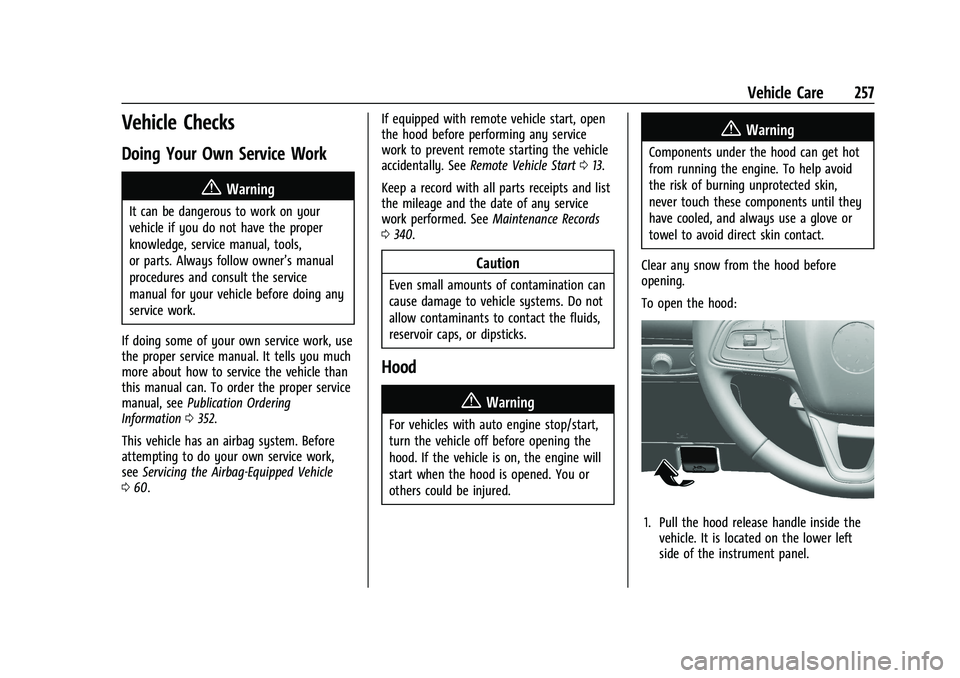
To open the hood:
1. Pull the hood release handle inside the vehicle. It is located on the lower left
side of the instrument panel.
Page 261 of 376

Buick Encore GX Owner Manual (GMNA-Localizing-U.S./Canada/Mexico-
15481080) - 2022 - CRC - 6/1/21
260 Vehicle Care
1. Windshield Washer Fluid Reservoir. SeeWasher Fluid 0271.
2. Engine Coolant Surge Tank and Pressure Cap. See Cooling System 0267.
3. Engine Oil Dipstick. See Engine Oil0262.
4. Engine Cooling Fan (Out of View). See Cooling System 0267.
5. Engine Oil Fill Cap. See Engine Oil0262.
6. Engine Air Cleaner/Filter 0265.
7. Brake Fluid Reservoir. See Brakes0272.
8. Positive (+) Battery Terminal. See Jump
Starting - North America 0314.
9. Battery - North America 0274.
10. Engine Compartment Fuse Block 0287.
11. Remote Negative (-) Battery Terminal. SeeJump Starting - North America 0314
Page 263 of 376

Buick Encore GX Owner Manual (GMNA-Localizing-U.S./Canada/Mexico-
15481080) - 2022 - CRC - 6/1/21
262 Vehicle Care
1. Windshield Washer Fluid Reservoir. SeeWasher Fluid 0271.
2. Engine Coolant Surge Tank and Pressure Cap. See Cooling System 0267.
3. Engine Oil Fill Cap. See Engine Oil0262.
4. Engine Oil Dipstick. See Engine Oil0262.
5. Engine Cooling Fan (Out of View). See Cooling System 0267.
6. Engine Air Cleaner/Filter 0265.
7. Brake Fluid Reservoir. See Brakes0272.
8. Positive (+) Battery Terminal. See Jump
Starting - North America 0314.
9. Battery - North America 0274.
10. Engine Compartment Fuse Block 0287.
11. Remote Negative (-) Battery Terminal. SeeJump Starting - North America 0314
Engine Oil
To ensure proper engine performance and
long life, careful attention must be paid to
engine oil. Following these simple, but
important steps will help protect your
investment:
.Use engine oil approved to the proper
specification and of the proper viscosity
grade. See “Selecting the Right Engine
Oil” in this section.
.Check the engine oil level regularly and
maintain the proper oil level. See
“Checking Engine Oil” and“When to Add
Engine Oil” in this section.
.Change the engine oil at the appropriate
time. SeeEngine Oil Life System 0264.
.Always dispose of engine oil properly. See
“What to Do with Used Oil” in this
section.
Checking Engine Oil
Check the engine oil level regularly, every
650 km (400 mi), especially prior to a long
trip. The engine oil dipstick handle is a loop.
See Engine Compartment Overview 0259 for
the location.
{Warning
The engine oil dipstick handle may be
hot; it could burn you. Use a towel or
glove to touch the dipstick handle.
If a low oil Driver Information Center (DIC)
message displays, check the oil level.
Follow these guidelines:
.To get an accurate reading, park the
vehicle on level ground. Check the engine
oil level after the engine has been off for
at least two hours. Checking the engine oil level on steep grades or too soon after
engine shutoff can result in incorrect
readings. Accuracy improves when
checking a cold engine prior to starting.
Remove the dipstick and check the level.
.If unable to wait two hours, the engine
must be off for at least 15 minutes if the
engine is warm, or at least 30 minutes if
the engine is not warm. Pull out the
dipstick, wipe it with a clean paper towel
or cloth, then push it back in all the way.
Remove it again, keeping the tip down,
and check the level.
When to Add Engine Oil
LIH 1.2L (Version 1) and L3T 1.3L L3 Engines
Page 264 of 376

Buick Encore GX Owner Manual (GMNA-Localizing-U.S./Canada/Mexico-
15481080) - 2022 - CRC - 6/1/21
Vehicle Care 263
LIH 1.2L (Version 2) L3 Engine
If the oil is below the cross-hatched area at
the tip of the dipstick and the engine has
been off for at least 15 minutes, add 1 L
(1 qt) of the recommended oil and then
recheck the level. See “Selecting the Right
Engine Oil” later in this section for an
explanation of what kind of oil to use. For
engine oil crankcase capacity, see Capacities
and Specifications 0342.
Caution
Do not add too much oil. Oil levels above
or below the acceptable operating range
shown on the dipstick are harmful to the
engine. If you find that you have an oil
level above the operating range, i.e., the
engine has so much oil that the oil level
gets above the MAX mark, the engine
could be damaged. You should drain out
(Continued)
Caution (Continued)
the excess oil or limit driving of the
vehicle and seek a service professional to
remove the excess amount of oil.
See Engine Compartment Overview 0259 for
the location of the engine oil fill cap.
Add enough oil to put the level somewhere
in the proper operating range between the
MIN and MAX marks. Push the dipstick all
the way back in when through.
Selecting the Right Engine Oil
Selecting the right engine oil depends on
both the proper oil specification and
viscosity grade. See Recommended Fluids
and Lubricants 0337.
Specification
Use full synthetic engine oils that meet the
dexos1 specification.
Engine oils that have been approved by GM
as meeting the dexos1 specification are
marked with the dexos1 approved logo. See
www.gmdexos.com.
Caution
Failure to use the recommended engine
oil or equivalent can result in engine
damage not covered by the vehicle
warranty.
Viscosity Grade
Use SAE 0W-20 viscosity grade engine oil for
1.3L L3 engine.
Use SAE 5W-30 viscosity grade engine oil for
1.2L L3 engine. Cold Temperature Operation:
In an area of extreme cold, where the
temperature falls below −29 °C (−20 °F), an
SAE 0W-30 oil may be used for the 1.2L L3
engine. An oil of this viscosity grade will
provide easier cold starting for the engine at
extremely low temperatures.
When selecting an oil of the appropriate
viscosity grade, it is recommended to select
an oil of the correct specification. See
“Specification” earlier in this section.
Page 266 of 376

Buick Encore GX Owner Manual (GMNA-Localizing-U.S./Canada/Mexico-
15481080) - 2022 - CRC - 6/1/21
Vehicle Care 265
Automatic Transmission Fluid
How to Check Automatic Transmission
Fluid
It is not necessary to check the transmission
fluid level. A transmission fluid leak is the
only reason for fluid loss. If a leak occurs,
take the vehicle to your dealer and have it
repaired as soon as possible.
There is a special procedure for checking and
changing the transmission fluid. Because this
procedure is difficult, you should have this
done at your dealer.
Change the fluid at the intervals listed in
Maintenance Schedule0329, and be sure to
use the fluid listed in Recommended Fluids
and Lubricants 0337.
Engine Air Filter Life System
If equipped, this feature provides the engine
air filter’s remaining life and best timing for
a change. The timing to change an engine
air filter depends on driving and
environmental conditions.
When to Change the Engine Air Filter
When the Driver Information Center (DIC)
displays a message to replace the engine air
filter at the next oil change, follow this
timing.
When the DIC displays a message to replace
the engine air filter soon, replace the engine
air filter at the earliest convenience.
The system must be reset after the engine
air filter is changed.
If the DIC displays a message to check the
engine air filter system, see your dealer.
How to Reset the Engine Air Filter Life
System
To reset:
1. Place the vehicle in P (Park).
2. Select Engine Air Filter Life on the DIC menu. See Driver Information Center
(DIC) (Base Level) 0107 or
Driver Information Center (DIC) (Uplevel)
0 109.
3. Press
lor the thumbwheel to move to
the Reset/Disable display area. Select
Reset then press
lor press the
thumbwheel. Then press Yes to confirm
the reset. 4. 100% AIR FILTER LIFE will be displayed
when the Engine Air Filter Life System is
successfully reset.
Engine Air Cleaner/Filter
The engine air cleaner/filter is in the engine
compartment on the passenger side of the
vehicle. See Engine Compartment Overview
0 259.
When to Inspect the Engine Air Cleaner/
Filter
If the vehicle is not equipped with the
engine air filter life system, see
Maintenance Schedule 0329 for intervals on
inspecting and replacing the engine air
cleaner/filter.
How to Inspect the Engine Air Cleaner/
Filter
Do not start the engine or have the engine
running with the engine air cleaner/filter
housing open. Before removing the engine
air cleaner/filter, make sure that the engine
air cleaner/filter housing and nearby
components are free of dirt and debris. Do
not clean the engine air cleaner/filter with
water or compressed air.
Page 272 of 376

Buick Encore GX Owner Manual (GMNA-Localizing-U.S./Canada/Mexico-
15481080) - 2022 - CRC - 6/1/21
Vehicle Care 271
If the decision is made to lift the hood,
make sure the vehicle is parked on a level
surface.
Then check to see if the engine cooling fan
is running. If the engine is overheating, the
fan should be running. If it is not, do not
continue to run the engine. Have the vehicle
serviced.
Caution
Do not run the engine if there is a leak
in the engine cooling system. This can
cause a loss of all coolant and can
damage the system and vehicle. Have
any leaks fixed right away.
If Steam Is Coming from the Engine
Compartment
{Warning
Steam and scalding liquids from a hot
cooling system are under pressure.
Turning the pressure cap, even a little,
can cause them to come out at high
speed and you could be burned. Never
turn the cap when the cooling system,(Continued)
Warning (Continued)
including the pressure cap, is hot. Wait
for the cooling system and pressure cap
to cool.
If No Steam Is Coming from the Engine
Compartment
If an engine overheat warning is displayed
but no steam can be seen or heard, the
problem may not be too serious. Sometimes
the engine can get a little too hot when the
vehicle:
.Climbs a long hill on a hot day
.Stops after high-speed driving
If the overheat warning is displayed with no
sign of steam: 1. Turn the air conditioning off.
2. Turn the heater on to the highest temperature and to the highest fan
speed. Open the windows as necessary.
3. When it is safe to do so, pull off the road, shift to P (Park) or N (Neutral), and
let the engine idle.
If the engine coolant temperature gauge is
no longer in the overheat zone, the vehicle
can be driven. Continue to drive the vehicle slowly for about 10 minutes. Keep a safe
vehicle distance from the vehicle in front.
If the warning does not come back on,
continue to drive normally and have the
cooling system checked for proper fill and
function.
If the warning continues, pull over, stop, and
park the vehicle right away.
If there is no sign of steam, idle the engine
for three minutes while parked. If the
warning is still displayed, turn off the
engine until it cools down.
Washer Fluid
What to Use
When the vehicle needs windshield washer
fluid, be sure to read the manufacturer's
instructions before use. If operating the
vehicle in an area where the temperature
may fall below freezing, use a fluid that has
sufficient protection against freezing.
Page 273 of 376

Buick Encore GX Owner Manual (GMNA-Localizing-U.S./Canada/Mexico-
15481080) - 2022 - CRC - 6/1/21
272 Vehicle Care
Adding Washer Fluid
Open the cap with the washer symbol on it.
Add washer fluid until the tank is full. See
Engine Compartment Overview0259 for
reservoir location.
Caution
.Do not use washer fluid that contains
any type of water repellent coating.
This can cause the wiper blades to
chatter or skip, and may also clog the
washer nozzle.
.Do not use engine coolant (antifreeze)
in the windshield washer. It can
damage the windshield washer system
and paint.
.Do not mix water with ready-to-use
washer fluid. Water can cause the
solution to freeze and damage the
washer fluid tank and other parts of
the washer system.
(Continued)
Caution (Continued)
.When using concentrated washer fluid,
follow the manufacturer instructions
for adding water.
.Fill the washer fluid tank only
three-quarters full when it is very cold.
This allows for fluid expansion if
freezing occurs, which could damage
the tank if it is completely full.
Brakes
Disc brake linings have built-in wear
indicators that make a high-pitched warning
sound when the brake linings are worn and
new linings are needed. The sound can come
and go or can be heard all the time when
the vehicle is moving, except when applying
the brake pedal firmly.
{Warning
The brake wear warning sound means
that soon the brakes will not work well.
That could lead to a crash. When the
brake wear warning sound is heard, have
the vehicle serviced.
Caution
Continuing to drive with worn-out brake
linings could result in costly brake
repairs.
Some driving conditions or climates can
cause a brake squeal when the brakes are
first applied, clearing up following several
applications. This does not mean something
is wrong with the brakes.
Properly torqued wheel nuts are necessary
to help prevent brake pulsation. When tires
are rotated, inspect brake linings for wear
and evenly tighten wheel nuts in the proper
sequence to torque specifications. See
Capacities and Specifications 0342.
Brake pads should be replaced as complete
axle sets.
Brake Pedal Travel
See your dealer if the brake pedal does not
return to normal height, or if there is a
rapid increase in pedal travel. This could be
a sign that brake service may be required.