2022 BUICK ENCLAVE spare tire
[x] Cancel search: spare tirePage 87 of 382

Buick Enclave Owner Manual (GMNA-Localizing-U.S./Canada/Mexico-
15253195) - 2022 - CRC - 11/3/21
86 Storage
The cargo management system is used to
organize storage in the cargo area. There are
two convenience hooks that can support up
to 5 kg (11 lb.).
After storing items in the cargo
management system, make sure to properly
latch the load floor.
Caution
The cargo bin can be damaged if the load
floor is improperly removed or installed.
Use care when removing and installing
the load floor.
Removal Procedure
To access the spare tire, the cargo
management system must be removed.
1. Remove the load floor. Open the loadfloor approximately 60% and pull
upward and outward to release the two
hooks from the rod affixed to the cargo
management system.2. Remove the four wing nuts.
3. Lift up on the handles on both sides toremove the cargo management system
to access the spare tire.
Page 88 of 382

Buick Enclave Owner Manual (GMNA-Localizing-U.S./Canada/Mexico-
15253195) - 2022 - CRC - 11/3/21
Storage 87
4. The load floor and storage bin can beplaced on the lowered third row seats
while accessing the spare tire.
Installation Procedure
1. Install the cargo management system inthe vehicle.
2. Install the four wing nuts.
3. Angle the load floor approximately 60%,align the two hooks on the load floor
above the rod, push and swing the load
floor closed.
4. Make sure to properly latch theload door.
{Warning
An improperly latched cargo cover,
or cargo cover left in the open position,
could separate during a crash or sudden
maneuver potentially impacting vehicle
occupants. Someone could be injured. Be
sure to return the cover to the closed
position and latch before driving.
Page 203 of 382

Buick Enclave Owner Manual (GMNA-Localizing-U.S./Canada/Mexico-
15253195) - 2022 - CRC - 11/4/21
202 Driving and Operating
{Warning
When driving off-road, bouncing and
quick changes in direction can easily
throw you out of position. This could
cause you to lose control and crash. You
and your passengers should always wear
seat belts.
Before Driving Off-Road
.Have all necessary maintenance and
service work completed.
.Fuel the vehicle, fill fluid levels, and check
inflation pressure in all tires, including the
spare, if equipped.
.Read all the information about
all-wheel-drive vehicles in this manual.
.Make sure all underbody shields,
if equipped, are properly attached.
.Know the local laws that apply to off-road
driving.
To gain more ground clearance if needed, it
may be necessary to remove the front fascia
lower air dam. However, driving without the
air dam reduces fuel economy.
Caution
Operating the vehicle for extended
periods without the front fascia lower air
dam installed can cause improper airflow
to the engine. Reattach the front fascia
air dam after off-road driving.
Loading the Vehicle for Off-Road Driving
{Warning
.Unsecured cargo on the load floor can
be tossed about when driving over
rough terrain. You or your passengers
can be struck by flying objects. Secure
the cargo properly.
.Keep cargo in the cargo area as far
forward and as low as possible. The
heaviest things should be on the floor,
forward of the rear axle.
.Heavy loads on the roof raise the
vehicle's center of gravity, making it
more likely to roll over. You can be
seriously or fatally injured if the
vehicle rolls over. Put heavy loads
inside the cargo area, not on the roof.
For more information about loading the
vehicle, see Vehicle Load Limits 0208.
Environmental Concerns
.Always use established trails, roads, and
areas that have been set aside for public
off-road recreational driving and obey all
posted regulations.
.Do not damage shrubs, flowers, trees,
or grasses or disturb wildlife.
.Do not park over things that burn. See
Parking over Things That Burn 0217.
Driving on Hills
Driving safely on hills requires good
judgment and an understanding of what the
vehicle can and cannot do.
{Warning
Many hills are simply too steep for any
vehicle. Driving up hills can cause the
vehicle to stall. Driving down hills can
cause loss of control. Driving across hills
can cause a rollover. You could be injured
or killed. Do not drive on steep hills.
Before driving on a hill, assess the
steepness, traction, and obstructions. If the
terrain ahead cannot be seen, get out of the
vehicle and walk the hill before driving
further.
Page 223 of 382
Buick Enclave Owner Manual (GMNA-Localizing-U.S./Canada/Mexico-
15253195) - 2022 - CRC - 11/4/21
222 Driving and Operating
be completed. Slow the vehicle, then tap the
left steering wheel control to the desired
lower gear range.
Cruise control can be used while in ERS.
Drive Systems
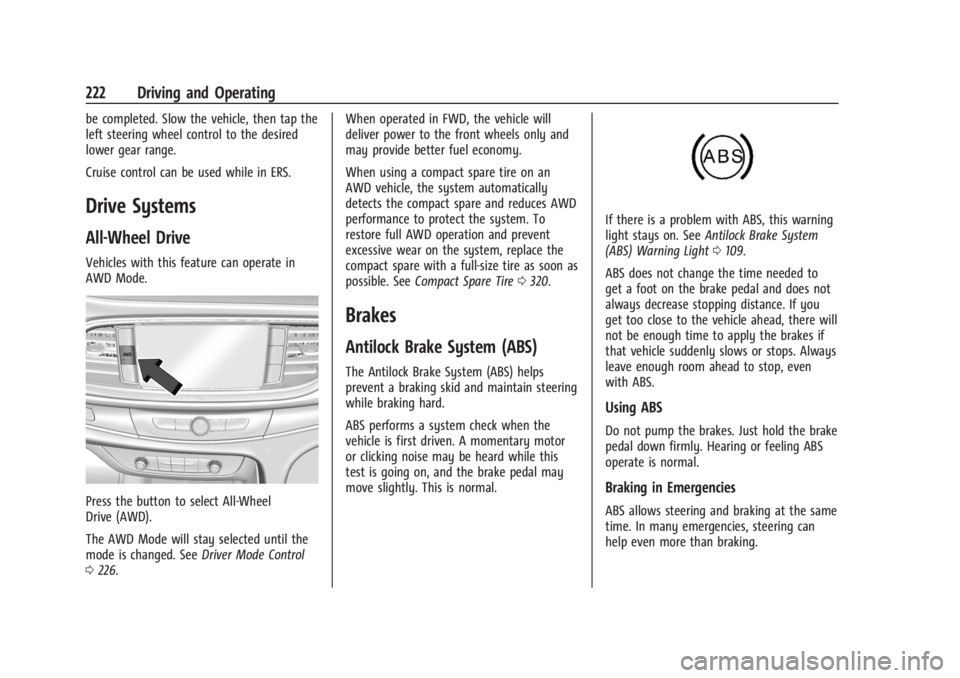
All-Wheel Drive
Vehicles with this feature can operate in
AWD Mode.
Press the button to select All-Wheel
Drive (AWD).
The AWD Mode will stay selected until the
mode is changed. SeeDriver Mode Control
0 226. When operated in FWD, the vehicle will
deliver power to the front wheels only and
may provide better fuel economy.
When using a compact spare tire on an
AWD vehicle, the system automatically
detects the compact spare and reduces AWD
performance to protect the system. To
restore full AWD operation and prevent
excessive wear on the system, replace the
compact spare with a full-size tire as soon as
possible. See
Compact Spare Tire 0320.
Brakes
Antilock Brake System (ABS)
The Antilock Brake System (ABS) helps
prevent a braking skid and maintain steering
while braking hard.
ABS performs a system check when the
vehicle is first driven. A momentary motor
or clicking noise may be heard while this
test is going on, and the brake pedal may
move slightly. This is normal.
If there is a problem with ABS, this warning
light stays on. See Antilock Brake System
(ABS) Warning Light 0109.
ABS does not change the time needed to
get a foot on the brake pedal and does not
always decrease stopping distance. If you
get too close to the vehicle ahead, there will
not be enough time to apply the brakes if
that vehicle suddenly slows or stops. Always
leave enough room ahead to stop, even
with ABS.
Using ABS
Do not pump the brakes. Just hold the brake
pedal down firmly. Hearing or feeling ABS
operate is normal.
Braking in Emergencies
ABS allows steering and braking at the same
time. In many emergencies, steering can
help even more than braking.
Page 265 of 382

Buick Enclave Owner Manual (GMNA-Localizing-U.S./Canada/Mexico-
15253195) - 2022 - CRC - 11/4/21
264 Driving and Operating
To reinstall hitch cover:1. Hold cover at a 45 degree angle to the vehicle and push the upper tabs into the
slots in the bumper.
2. Push the bottom of the cover forward until the lower tabs line up with the
lower slots.
3. Snap the hitch cover into place by pushing the upper corners forward.
4. Reinstall the two fasteners on the lower tabs.
Consider using mechanical sway controls
with any trailer. Ask a trailering professional
about sway controls or refer to the trailer
manufacturer's recommendations and
instructions.
Weight-Distributing Hitch Adjustment
A weight-distributing hitch may be useful
with some trailers.
1. Front of Vehicle
2. Body to Ground Distance
When using a weight-distributing hitch,
measure the front fender height above the
front axle distance (2) before and after
connecting the trailer. Adjust the spring bars
until the front fender height distance (2) is
approximately half way between the first
and second measurements.
Tires
.Do not tow a trailer while using a
compact spare tire on the vehicle.
.Tires must be properly inflated to support
loads while towing a trailer. See Tires
0 296 for instructions on proper tire
inflation.
Safety Chains
Always attach chains between the vehicle
and the trailer, and attach the chains to the
holes on the trailer hitch platform.
Instructions about safety chains may be
provided by the hitch manufacturer or by
the trailer manufacturer.
Cross the safety chains under the tongue of
the trailer to help prevent the tongue from
contacting the road if it becomes separated
from the hitch. Always leave just enough
slack so the combination can turn. Never
allow safety chains to drag on the ground.
Trailer Brakes
Loaded trailers over 450 kg (1,000 lb) must
be equipped with brake systems and with
brakes for each axle. Trailer braking
equipment conforming to Canadian
Standards Association (CSA) requirement
CAN3-D313, or its equivalent, is
recommended.
State or local regulations may require
trailers to have their own braking system if
the loaded weight of the trailer exceeds
certain minimums that can vary from state
to state.
Page 269 of 382

Buick Enclave Owner Manual (GMNA-Localizing-U.S./Canada/Mexico-
15253195) - 2022 - CRC - 11/3/21
268 Vehicle Care
Vehicle Care
General Information
General Information . . . . . . . . . . . . . . . . . . . 269
California Perchlorate MaterialsRequirements . . . . . . . . . . . . . . . . . . . . . . . 269
Accessories and Modifications . . . . . . . . . 269
Vehicle Checks
Doing Your Own Service Work . . . . . . . . 269
Hood . . . . . . . . . . . . . . . . . . . . . . . . . . . . . . . . . . 270
Engine Compartment Overview . . . . . . . . 271
Engine Oil . . . . . . . . . . . . . . . . . . . . . . . . . . . . . 272
Engine Oil Life System . . . . . . . . . . . . . . . . 274
Automatic Transmission Fluid . . . . . . . . . 274
Engine Air Filter Life System . . . . . . . . . . . 275
Engine Air Cleaner/Filter . . . . . . . . . . . . . . . 275
Cooling System . . . . . . . . . . . . . . . . . . . . . . . . 276
Engine Overheating . . . . . . . . . . . . . . . . . . . 279
Washer Fluid . . . . . . . . . . . . . . . . . . . . . . . . . . 280
Brakes . . . . . . . . . . . . . . . . . . . . . . . . . . . . . . . . 280
Brake Fluid . . . . . . . . . . . . . . . . . . . . . . . . . . . . 281
Battery - North America . . . . . . . . . . . . . . . 282
All-Wheel Drive . . . . . . . . . . . . . . . . . . . . . . . . 283
Park Brake and P (Park) Mechanism Check . . . . . . . . . . . . . . . . . . . . . . . . . . . . . . . . 283
Wiper Blade Replacement . . . . . . . . . . . . . 283
Windshield Replacement . . . . . . . . . . . . . . 284
Gas Strut(s) . . . . . . . . . . . . . . . . . . . . . . . . . . . 285
Headlamp Aiming
Front Headlamp Aiming . . . . . . . . . . . . . . . 286
Bulb Replacement
Bulb Replacement . . . . . . . . . . . . . . . . . . . . . 286
LED Lighting . . . . . . . . . . . . . . . . . . . . . . . . . . . 286
License Plate Lamp . . . . . . . . . . . . . . . . . . . . 286
Electrical System
High Voltage Devices and Wiring . . . . . . 287
Electrical System Overload . . . . . . . . . . . . 287
Fuses and Circuit Breakers . . . . . . . . . . . . . 289
Engine Compartment Fuse Block . . . . . . 289
Instrument Panel Fuse Block . . . . . . . . . . 292
Rear Compartment Fuse Block . . . . . . . . . 294
Wheels and Tires
Tires . . . . . . . . . . . . . . . . . . . . . . . . . . . . . . . . . . 296
All-Season Tires . . . . . . . . . . . . . . . . . . . . . . . 296
Winter Tires . . . . . . . . . . . . . . . . . . . . . . . . . . . 297
Tire Sidewall Labeling . . . . . . . . . . . . . . . . . 297
Tire Designations . . . . . . . . . . . . . . . . . . . . . . 299
Tire Terminology and Definitions . . . . . 299
Tire Pressure . . . . . . . . . . . . . . . . . . . . . . . . . . 302
Tire Pressure for High-Speed Operation . . . . . . . . . . . . . . . . . . . . . . . . . . . 303
Tire Pressure Monitor System . . . . . . . . . 304
Tire Pressure Monitor Operation . . . . . . 305
Tire Inspection . . . . . . . . . . . . . . . . . . . . . . . . 308
Tire Rotation . . . . . . . . . . . . . . . . . . . . . . . . . . 308
When It Is Time for New Tires . . . . . . . . 309 Buying New Tires . . . . . . . . . . . . . . . . . . . . . . 310
Different Size Tires and Wheels . . . . . . . . 311
Uniform Tire Quality Grading . . . . . . . . . . 311
Wheel Alignment and Tire Balance . . . . 312
Wheel Replacement . . . . . . . . . . . . . . . . . . . . 313
Tire Chains . . . . . . . . . . . . . . . . . . . . . . . . . . . . . 313
If a Tire Goes Flat . . . . . . . . . . . . . . . . . . . . . 314
Tire Changing . . . . . . . . . . . . . . . . . . . . . . . . . . 315
Compact Spare Tire . . . . . . . . . . . . . . . . . . . 320
Jump Starting
Jump Starting - North America . . . . . . . . . 321
Towing the Vehicle
Towing the Vehicle . . . . . . . . . . . . . . . . . . . . 323
Recreational Vehicle Towing . . . . . . . . . . . 324
Appearance Care
Exterior Care . . . . . . . . . . . . . . . . . . . . . . . . . . 326
Interior Care . . . . . . . . . . . . . . . . . . . . . . . . . . . 330
Floor Mats . . . . . . . . . . . . . . . . . . . . . . . . . . . . . 333
Page 298 of 382

Buick Enclave Owner Manual (GMNA-Localizing-U.S./Canada/Mexico-
15253195) - 2022 - CRC - 11/3/21
Vehicle Care 297
and weather conditions. Original equipment
tires designed to GM's specific tire
performance criteria have a TPC specification
code molded onto the sidewall. Original
equipment all-season tires can be identified
by the last two characters of this TPC code,
which will be“MS.”
Consider installing winter tires on the
vehicle if frequent driving on snow or
ice-covered roads is expected. All-season tires
provide adequate performance for most
winter driving conditions, but they may not
offer the same level of traction or
performance as winter tires on snow or
ice-covered roads. See Winter Tires0297.
Winter Tires
This vehicle was not originally equipped
with winter tires. Winter tires are designed
for increased traction on snow and
ice-covered roads. Consider installing winter
tires on the vehicle if frequent driving on ice
or snow covered roads is expected. See your
dealer for details regarding winter tire
availability and proper tire selection. Also,
see Buying New Tires 0310. With winter tires, there may be decreased
dry road traction, increased road noise, and
shorter tread life. After changing to winter
tires, be alert for changes in vehicle
handling and braking.
If using winter tires:
.Use tires of the same brand and tread
type on all four wheel positions.
.Use only radial ply tires of the same size,
load range, and speed rating as the
original equipment tires.
Winter tires with the same speed rating as
the original equipment tires may not be
available for H, V, W, Y, and ZR speed rated
tires. If winter tires with a lower speed
rating are chosen, never exceed the tire's
maximum speed capability.
Tire Sidewall Labeling
Useful information about a tire is
molded into its sidewall. The examples
show a typical passenger vehicle tire
and a compact spare tire sidewall.
Passenger (P-Metric) Tire Example
(1) Tire Size:The tire size is a
combination of letters and numbers
used to define a particular tire's width,
height, aspect ratio, construction type,
and service description. See the “Tire
Size” illustration in this section.
(2) TPC Spec (Tire Performance Criteria
Specification)
:Original equipment tires
designed to GM's specific tire
performance criteria have a TPC
specification code molded onto the
sidewall. GM's TPC specifications meet
or exceed all federal safety guidelines.
Page 299 of 382

Buick Enclave Owner Manual (GMNA-Localizing-U.S./Canada/Mexico-
15253195) - 2022 - CRC - 11/3/21
298 Vehicle Care
(3) DOT (Department of
Transportation)
:The Department of
Transportation (DOT) code indicates that
the tire is in compliance with the U.S.
Department of Transportation Motor
Vehicle Safety Standards.
DOT Tire Date of Manufacture
:The last
four digits of the TIN indicate the tire
manufactured date. The first two digits
represent the week and the last two
digits, the year. For example, the third
week of the year 2020 would have a
4-digit DOT date of 0320. Week 01 is
the first full week (Sunday through
Saturday) of each year.
(4) Tire Identification Number (TIN)
:
The letters and numbers following the
DOT (Department of Transportation)
code are the Tire Identification Number
(TIN). The TIN shows the manufacturer
and plant code, tire size, and date the
tire was manufactured. The TIN is
molded onto both sides of the tire,
although only one side may have the
date of manufacture. (5) Tire Ply Material
:The type of cord
and number of plies in the sidewall and
under the tread.
(6) Uniform Tire Quality Grading
(UTQG)
:Tire manufacturers are
required to grade tires based on three
performance factors: tread wear,
traction, and temperature resistance.
For more information see Uniform Tire
Quality Grading 0311.
(7) Maximum Cold Inflation Load
Limit
:Maximum load that can be
carried and the maximum pressure
needed to support that load.
Compact Spare Tire Example
(1) Tire Ply Material:The type of cord
and number of plies in the sidewall and
under the tread.
(2) Temporary Use Only
:The compact
spare tire or temporary use tire should
not be driven at speeds over 80 km/h
(50 mph). The compact spare tire is for
emergency use when a regular road tire
has lost air and gone flat. If the vehicle
has a compact spare tire, see Compact
Spare Tire 0320 and
If a Tire Goes Flat 0314.
(3) Tire Identification Number (TIN)
:
The letters and numbers following the
DOT (Department of Transportation)
code are the Tire Identification Number
(TIN). The TIN shows the manufacturer
and plant code, tire size, and date the
tire was manufactured. The TIN is
molded onto both sides of the tire,
although only one side may have the
date of manufacture.
(4) Maximum Cold Inflation Load
Limit
:Maximum load that can be
carried and the maximum pressure
needed to support that load.