2022 BUICK ENCLAVE transmission
[x] Cancel search: transmissionPage 222 of 382

Buick Enclave Owner Manual (GMNA-Localizing-U.S./Canada/Mexico-
15253195) - 2022 - CRC - 11/4/21
Driving and Operating 221
If the vehicle is shifted into D (Drive) while
the speed is too high, the transmission will
get ready to engage D (Drive). Reduce the
vehicle speed, then the transmission will
engage D (Drive).
To shift into D (Drive):1. Bring the vehicle to a complete stop.
2. Pull the D (Drive) switch on the center console.
To shift out of D (Drive): 1. Bring the vehicle to a complete stop.
2. Shift to the desired gear.
Downshifting the transmission in slippery
road conditions could result in skidding. See
“Skidding” underLoss of Control 0201.
Caution
Spinning the tires or holding the vehicle
in one place on a hill using only the
accelerator pedal may damage the
transmission. The repair will not be
covered by the vehicle warranty. If the
vehicle is stuck, do not spin the tires.
When stopping on a hill, use the brakes
to hold the vehicle in place.
Manual Mode
Electronic Range Select (ERS)
Caution
If the vehicle is driven at a high rpm
without upshifting while using Electronic
Range Select (ERS), the vehicle could be
damaged. Always upshift when necessary
while using ERS.
Electronic Range Select (ERS), or Manual
Mode, allows for the selection of the range
of gear positions. Use this mode when
driving downhill or towing a trailer to limit
the top gear and vehicle speed. The shift
position indicator within the Driver Information Center (DIC) will display a
number next to the L indicating the highest
available gear.
To enter Electronic Range Select or
Manual Mode:
1. With the vehicle in D (Drive), press the L (Low) button.
2. Tap the left steering wheel control to reduce the highest gear available, or the
right control to increase the highest gear
available.
To exit Electronic Range Select, pull the
D (Drive) switch on the center console.
When shifting to L (Low), the transmission
will shift to a preset lower gear range. For
this preset range, the highest gear available
will be displayed next to the L in the DIC.
See Driver Information Center (DIC). All gears
below that number are available to use. For
example, when 4 (Fourth) is shown next to
the L, 1 (First) through 4 (Fourth) gears are
shifted automatically. To shift to 5 (Fifth)
gear, tap the right steering wheel control or
shift into D (Drive).
L (Low) will prevent shifting to a lower gear
range if the engine speed is too high. If the
vehicle speed is not reduced within the time
allowed, the lower gear range shift will not
Page 228 of 382

Buick Enclave Owner Manual (GMNA-Localizing-U.S./Canada/Mexico-
15253195) - 2022 - CRC - 11/4/21
Driving and Operating 227
AWD Mode Switch
To activate each mode, press the MODE
switch on the instrument panel.
Modes
Tour Mode
Use for normal city and highway driving to
provide a smooth ride. This setting provides
balance between comfort and handling.
There is no persistent indicator in the
instrument cluster for this mode.
Sport Mode
Use where road conditions or personal
preference demand a more controlled
response. Sport Mode improves vehicle
handling and acceleration on dry pavement. When active, Sport Mode modifies AWD
torque, steering, Electronic Stability Control
(ESC), Traction Control System (TCS), and
suspension tuning, if equipped.
AWD Mode
AWD provides torque to all four wheels.
Pressing the AWD Mode switch will select
AWD Mode. The AWD light will flash briefly
while the system is engaging and stay on to
indicate AWD is active. AWD Mode can be
turned on and off independently of other
modes. Select AWD Mode to improve
traction and control on slippery road
surfaces, such as gravel, sand, wet
pavement, snow, and ice. For more
information on AWD, see
All-Wheel Drive
0 222.
Tow/Haul Mode
This mode will automatically activate AWD,
if available. The transmission holds lower
gears longer before shifting to provide more
torque necessary when towing heavy loads.
This will also increase fuel consumption.
Tow/Haul Mode also modifies, steering, ESC,
TCS, and suspension tuning, if equipped. Use
this mode to assist in maintaining desired vehicle speeds when driving on downhill
grades by using the engine and transmission
to slow the vehicle.
This helps prevent the brakes from
overheating. For more information, see
Towing the Vehicle
0323.
Cruise Control
With cruise control the vehicle can maintain
a speed of about 40 km/h (25 mph) or more
without keeping your foot on the
accelerator. Cruise control does not work at
speeds below 40 km/h (25 mph).
{Warning
Cruise control can be dangerous where
you cannot drive safely at a steady
speed. Do not use cruise control on
winding roads or in heavy traffic.
Cruise control can be dangerous on
slippery roads. On such roads, fast
changes in tire traction can cause
excessive wheel slip, and you could lose
control. Do not use cruise control on
slippery roads.
Page 230 of 382

Buick Enclave Owner Manual (GMNA-Localizing-U.S./Canada/Mexico-
15253195) - 2022 - CRC - 11/4/21
Driving and Operating 229
Resuming a Set Speed
If the cruise control is set at a desired speed
and then the brakes are applied or
*is
pressed, the cruise control is disengaged
without erasing the set speed from memory.
Once the vehicle reaches about 40 km/h
(25 mph) or more, press RES+ up briefly. The
vehicle returns to the previously set speed.
Increasing Speed While Using Cruise Control
Do one of the following:
.Press and hold RES+ up until the vehicle
accelerates to the desired speed, then
release it.
.To increase vehicle speed in small
increments, press RES+ up briefly. For
each press, the vehicle goes about 1 km/h
(1 mph) faster.
Reducing Speed While Using Cruise Control
Do one of the following:
.Press and hold SET− down until the
desired lower speed is reached, then
release it.
.To slow down in small increments, press
SET− down briefly. For each press, the
vehicle goes about 1 km/h (1 mph) slower. Passing Another Vehicle While Using Cruise
Control
Use the accelerator pedal to increase the
vehicle speed. When you take your foot off
the pedal, the vehicle will slow down to the
previously set cruise speed. While pressing
the accelerator pedal or shortly following
the release to override cruise control, briefly
pressing SET−
will result in cruise set to the
current vehicle speed.
Using Cruise Control on Hills
How well the cruise control will work on
hills depends upon the vehicle speed, load,
and the steepness of the hills. When going
up steep hills, you might have to step on
the accelerator pedal to maintain your
speed. When going downhill, you might
have to brake or shift to a lower gear to
keep your speed down. If the brake pedal is
applied, cruise control will disengage.
Ending Cruise Control
There are four ways to end cruise control:
.Step lightly on the brake pedal.
.Press*.
.Shift the transmission to N (Neutral).
.To turn off cruise control, press5. Erasing Speed Memory
The cruise control set speed is erased from
memory if
5is pressed or the ignition is
turned off.
Adaptive Cruise Control
(Advanced)
If equipped with Adaptive Cruise Control
(ACC), it allows for selecting the cruise
control set speed and following gap. Read
this entire section before using this system.
ACC uses a radar sensor to detect other
vehicles. See Radio Frequency Statement
0 359.
The following gap is the following time (or
distance) between your vehicle and a vehicle
detected directly ahead in your path,
moving in the same direction. If no vehicle
is detected in your path, ACC works like
regular cruise control.
If a vehicle is detected in your path, ACC can
speed up the vehicle or apply limited,
moderate braking to maintain the selected
following gap. To disengage ACC, apply the
brake. If the Traction Control System (TCS)
or StabiliTrak/Electronic Stability Control
(ESC) system activates while ACC is engaged,
Page 258 of 382

Buick Enclave Owner Manual (GMNA-Localizing-U.S./Canada/Mexico-
15253195) - 2022 - CRC - 11/4/21
Driving and Operating 257
Warning (Continued)
trailer only if all the steps in this section
have been followed. Ask your dealer for
advice and information about towing a
trailer with the vehicle.
Driving with a Trailer
Trailering is different than just driving the
vehicle by itself. Trailering means changes in
handling, acceleration, braking, durability,
and fuel economy. Successful, safe trailering
takes correct equipment, and it has to be
used properly.
The following information has many
time-tested, important trailering tips and
safety rules. Many of these are important
for your safety and that of your passengers.
Read this section carefully before pulling a
trailer.When towing a trailer:
.Become familiar with and follow all state
and local laws that apply to trailer
towing. These requirements vary from
state to state.
.State laws may require the use of
extended side view mirrors. Even if not
required, you should install extended side
view mirrors if your visibility is limited or
restricted while towing.
.Do not tow a trailer during the first
800 km (500 mi) of vehicle use to
prevent damage to the engine, axle,
or other parts.
.It is recommended to perform the first oil
change before heavy towing.
.During the first 800 km (500 mi) of
trailer towing, do not drive over 80 km/h
(50 mph) and do not make starts at full
throttle.
.Vehicles can tow in D (Drive). Tow/Haul
Mode is recommended for heavier trailers.
See
Driver Mode Control 0226. If the
transmission downshifts too often, a
lower gear may be selected using Manual
Mode See Manual Mode 0221. If equipped, the following driver assistance
features should be turned off when towing
a trailer:
.Adaptive Cruise Control (ACC)
.Super Cruise Control
.Lane Keep Assist (LKA)
.Park Assist
.Automatic Parking Assist (APA)
.Reverse Automatic Braking (RAB)
If equipped, the following driver assistance
features should be turned to alert or off
when towing a trailer:
.Automatic Emergency Braking (AEB)
.Intelligent Brake Assist (IBA)
.Front Pedestrian Braking (FPB)
If equipped with Lane Change Alert (LCA),
the LCA detection zones that extend back
from the side of the vehicle do not move
further back when a trailer is towed. Use
caution while changing lanes when towing a
trailer.
If equipped with Rear Cross Traffic Alert
(RCTA), use caution while backing up when
towing a trailer, as the RCTA detection zones
that extend out from the back of the vehicle
do not move further back when a trailer is
towed.
Page 260 of 382
Buick Enclave Owner Manual (GMNA-Localizing-U.S./Canada/Mexico-
15253195) - 2022 - CRC - 11/4/21
Driving and Operating 259
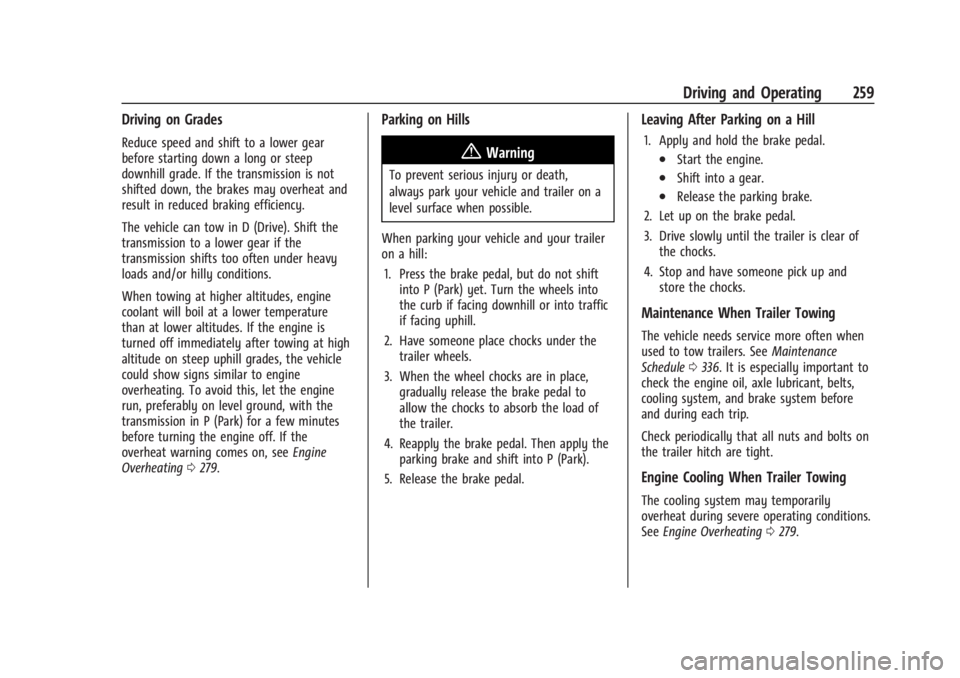
Driving on Grades
Reduce speed and shift to a lower gear
before starting down a long or steep
downhill grade. If the transmission is not
shifted down, the brakes may overheat and
result in reduced braking efficiency.
The vehicle can tow in D (Drive). Shift the
transmission to a lower gear if the
transmission shifts too often under heavy
loads and/or hilly conditions.
When towing at higher altitudes, engine
coolant will boil at a lower temperature
than at lower altitudes. If the engine is
turned off immediately after towing at high
altitude on steep uphill grades, the vehicle
could show signs similar to engine
overheating. To avoid this, let the engine
run, preferably on level ground, with the
transmission in P (Park) for a few minutes
before turning the engine off. If the
overheat warning comes on, seeEngine
Overheating 0279.
Parking on Hills
{Warning
To prevent serious injury or death,
always park your vehicle and trailer on a
level surface when possible.
When parking your vehicle and your trailer
on a hill: 1. Press the brake pedal, but do not shift into P (Park) yet. Turn the wheels into
the curb if facing downhill or into traffic
if facing uphill.
2. Have someone place chocks under the trailer wheels.
3. When the wheel chocks are in place, gradually release the brake pedal to
allow the chocks to absorb the load of
the trailer.
4. Reapply the brake pedal. Then apply the parking brake and shift into P (Park).
5. Release the brake pedal.
Leaving After Parking on a Hill
1. Apply and hold the brake pedal.
.Start the engine.
.Shift into a gear.
.Release the parking brake.
2. Let up on the brake pedal.
3. Drive slowly until the trailer is clear of the chocks.
4. Stop and have someone pick up and store the chocks.
Maintenance When Trailer Towing
The vehicle needs service more often when
used to tow trailers. See Maintenance
Schedule 0336. It is especially important to
check the engine oil, axle lubricant, belts,
cooling system, and brake system before
and during each trip.
Check periodically that all nuts and bolts on
the trailer hitch are tight.
Engine Cooling When Trailer Towing
The cooling system may temporarily
overheat during severe operating conditions.
See Engine Overheating 0279.
Page 267 of 382

Buick Enclave Owner Manual (GMNA-Localizing-U.S./Canada/Mexico-
15253195) - 2022 - CRC - 11/4/21
266 Driving and Operating
Trailer Lamps
Always check all trailer lamps are working at
the beginning of each trip, and periodically
on longer trips.
Turn Signals When Towing a Trailer
When properly connected, the trailer turn
signals will illuminate to indicate the vehicle
is turning, changing lanes, or stopping.
When towing a trailer, the arrows on the
instrument cluster will illuminate even if the
trailer is not properly connected or the bulbs
are burned out.
Tow/Haul Mode
For instructions on how to enter Tow/Haul
mode, seeDriver Mode Control 0226.
Tow/Haul assists when pulling a heavy
trailer or a large or heavy load.
Tow/Haul Mode is designed to be most
effective when the vehicle and trailer
combined weight is at least 75% of the
vehicle's Gross Combined Weight Rating
(GCWR). See “Weight of the Trailer” under
Trailer Towing 0260.
Tow/Haul Mode is most useful when pulling
a heavy trailer or a large or heavy load:
.through rolling terrain
.in stop-and-go traffic
.in busy parking lots
Operating the vehicle in Tow/Haul Mode
when lightly loaded or not towing will not
cause damage; however, it is not
recommended and may result in unpleasant
engine and transmission driving
characteristics and reduced fuel economy.
Trailer Sway Control (TSC)
Vehicles with StabiliTrak/Electronic Stability
Control (ESC) have a Trailer Sway Control
(TSC) feature. Trailer sway is unintended
side-to-side motion of a trailer while towing.
If the vehicle is towing a trailer and the TSC
detects that sway is increasing, the vehicle
brakes are selectively applied at each wheel,
to help reduce excessive trailer sway.
If equipped with the Integrated Trailer Brake
Control (ITBC) system, and the trailer has an
electric brake system, StabiliTrak/ESC may
also apply the trailer brakes.
If TSC is enabled, the Traction Control
System (TCS)/StabiliTrak/ESC warning light
will flash on the instrument cluster. Reduce
vehicle speed by gradually removing your
foot from the accelerator. If trailer sway
continues, StabiliTrak/ESC can reduce engine
torque to help slow the vehicle. TSC will not
function if StabiliTrak/ESC is turned off. See
Traction Control/Electronic Stability Control
0 224.
{Warning
Trailer sway can result in a crash and in
serious injury or death, even if the
vehicle is equipped with TSC.
If the trailer begins to sway, reduce
vehicle speed by gradually removing your
foot from the accelerator. Then pull over
to check the trailer and vehicle to help
correct possible causes, including an
improperly or overloaded trailer,
unrestrained cargo, improper trailer hitch
configuration, or improperly inflated or
incorrect vehicle or trailer tires. See
Towing Equipment 0263 for trailer
ratings and hitch setup recommendations.
Page 269 of 382

Buick Enclave Owner Manual (GMNA-Localizing-U.S./Canada/Mexico-
15253195) - 2022 - CRC - 11/3/21
268 Vehicle Care
Vehicle Care
General Information
General Information . . . . . . . . . . . . . . . . . . . 269
California Perchlorate MaterialsRequirements . . . . . . . . . . . . . . . . . . . . . . . 269
Accessories and Modifications . . . . . . . . . 269
Vehicle Checks
Doing Your Own Service Work . . . . . . . . 269
Hood . . . . . . . . . . . . . . . . . . . . . . . . . . . . . . . . . . 270
Engine Compartment Overview . . . . . . . . 271
Engine Oil . . . . . . . . . . . . . . . . . . . . . . . . . . . . . 272
Engine Oil Life System . . . . . . . . . . . . . . . . 274
Automatic Transmission Fluid . . . . . . . . . 274
Engine Air Filter Life System . . . . . . . . . . . 275
Engine Air Cleaner/Filter . . . . . . . . . . . . . . . 275
Cooling System . . . . . . . . . . . . . . . . . . . . . . . . 276
Engine Overheating . . . . . . . . . . . . . . . . . . . 279
Washer Fluid . . . . . . . . . . . . . . . . . . . . . . . . . . 280
Brakes . . . . . . . . . . . . . . . . . . . . . . . . . . . . . . . . 280
Brake Fluid . . . . . . . . . . . . . . . . . . . . . . . . . . . . 281
Battery - North America . . . . . . . . . . . . . . . 282
All-Wheel Drive . . . . . . . . . . . . . . . . . . . . . . . . 283
Park Brake and P (Park) Mechanism Check . . . . . . . . . . . . . . . . . . . . . . . . . . . . . . . . 283
Wiper Blade Replacement . . . . . . . . . . . . . 283
Windshield Replacement . . . . . . . . . . . . . . 284
Gas Strut(s) . . . . . . . . . . . . . . . . . . . . . . . . . . . 285
Headlamp Aiming
Front Headlamp Aiming . . . . . . . . . . . . . . . 286
Bulb Replacement
Bulb Replacement . . . . . . . . . . . . . . . . . . . . . 286
LED Lighting . . . . . . . . . . . . . . . . . . . . . . . . . . . 286
License Plate Lamp . . . . . . . . . . . . . . . . . . . . 286
Electrical System
High Voltage Devices and Wiring . . . . . . 287
Electrical System Overload . . . . . . . . . . . . 287
Fuses and Circuit Breakers . . . . . . . . . . . . . 289
Engine Compartment Fuse Block . . . . . . 289
Instrument Panel Fuse Block . . . . . . . . . . 292
Rear Compartment Fuse Block . . . . . . . . . 294
Wheels and Tires
Tires . . . . . . . . . . . . . . . . . . . . . . . . . . . . . . . . . . 296
All-Season Tires . . . . . . . . . . . . . . . . . . . . . . . 296
Winter Tires . . . . . . . . . . . . . . . . . . . . . . . . . . . 297
Tire Sidewall Labeling . . . . . . . . . . . . . . . . . 297
Tire Designations . . . . . . . . . . . . . . . . . . . . . . 299
Tire Terminology and Definitions . . . . . 299
Tire Pressure . . . . . . . . . . . . . . . . . . . . . . . . . . 302
Tire Pressure for High-Speed Operation . . . . . . . . . . . . . . . . . . . . . . . . . . . 303
Tire Pressure Monitor System . . . . . . . . . 304
Tire Pressure Monitor Operation . . . . . . 305
Tire Inspection . . . . . . . . . . . . . . . . . . . . . . . . 308
Tire Rotation . . . . . . . . . . . . . . . . . . . . . . . . . . 308
When It Is Time for New Tires . . . . . . . . 309 Buying New Tires . . . . . . . . . . . . . . . . . . . . . . 310
Different Size Tires and Wheels . . . . . . . . 311
Uniform Tire Quality Grading . . . . . . . . . . 311
Wheel Alignment and Tire Balance . . . . 312
Wheel Replacement . . . . . . . . . . . . . . . . . . . . 313
Tire Chains . . . . . . . . . . . . . . . . . . . . . . . . . . . . . 313
If a Tire Goes Flat . . . . . . . . . . . . . . . . . . . . . 314
Tire Changing . . . . . . . . . . . . . . . . . . . . . . . . . . 315
Compact Spare Tire . . . . . . . . . . . . . . . . . . . 320
Jump Starting
Jump Starting - North America . . . . . . . . . 321
Towing the Vehicle
Towing the Vehicle . . . . . . . . . . . . . . . . . . . . 323
Recreational Vehicle Towing . . . . . . . . . . . 324
Appearance Care
Exterior Care . . . . . . . . . . . . . . . . . . . . . . . . . . 326
Interior Care . . . . . . . . . . . . . . . . . . . . . . . . . . . 330
Floor Mats . . . . . . . . . . . . . . . . . . . . . . . . . . . . . 333
Page 275 of 382

Buick Enclave Owner Manual (GMNA-Localizing-U.S./Canada/Mexico-
15253195) - 2022 - CRC - 11/3/21
274 Vehicle Care
good hand cleaner. Wash or properly
dispose of clothing or rags containing used
engine oil. See the manufacturer's warnings
about the use and disposal of oil products.
Used oil can be a threat to the environment.
If you change your own oil, be sure to drain
all the oil from the filter before disposal.
Never dispose of oil by putting it in the
trash or pouring it on the ground, into
sewers, or into streams or bodies of water.
Recycle it by taking it to a place that
collects used oil.
Engine Oil Life System
When to Change Engine Oil
This vehicle has a computer system that
indicates when to change the engine oil and
filter. This is based on a combination of
factors which include engine revolutions,
engine temperature, and miles driven. Based
on driving conditions, the mileage at which
an oil change is indicated can vary
considerably. For the oil life system to work
properly, the system must be reset every
time the oil is changed.
When the system has calculated that oil life
has been diminished, it indicates that an oil
change is necessary. A CHANGE ENGINE OILSOON message comes on. Change the oil as
soon as possible within the next 1 000 km
(600 mi). It is possible that, if driving under
the best conditions, the oil life system
might indicate that an oil change is not
necessary for up to a year. The engine oil
and filter must be changed at least once a
year and, at this time, the system must be
reset. Your dealer has trained service people
who will perform this work and reset the
system. It is also important to check the oil
regularly over the course of an oil drain
interval and keep it at the proper level.
If the system is ever reset accidentally, the
oil must be changed at 5 000 km (3,000 mi)
since the last oil change. Remember to reset
the oil life system whenever the oil is
changed.
How to Reset the Engine Oil Life System
Reset the system whenever the engine oil is
changed so that the system can calculate
the next engine oil change. To reset the
system:
1. Display the REMAINING OIL LIFE on the DIC. See Driver Information Center (DIC)
(Base Level) 0114 or
Driver Information Center (DIC) (Uplevel)
0 116. 2. Press and hold
Von the DIC while the
Oil Life display is active. The oil life will
change to 100%.
If the CHANGE ENGINE OIL SOON message
comes back on when the vehicle is started,
the engine oil life system has not been
reset. Repeat the procedure.
Automatic Transmission Fluid
It is not necessary to check the transmission
fluid level. A transmission fluid leak is the
only reason for fluid loss. If a leak occurs,
take the vehicle to the dealer and have it
repaired as soon as possible.
Change the fluid at the intervals listed in
Maintenance Schedule 0336, and be sure to
use the transmission fluid listed in
Recommended Fluids and Lubricants 0344.
Caution
Use of the incorrect automatic
transmission fluid may damage the
vehicle, and the damage may not be
covered by the vehicle warranty. Always
use the correct automatic transmission
fluid. See Recommended Fluids and
Lubricants 0344.