Page 70 of 124
Operation and important rid ing points
7-4
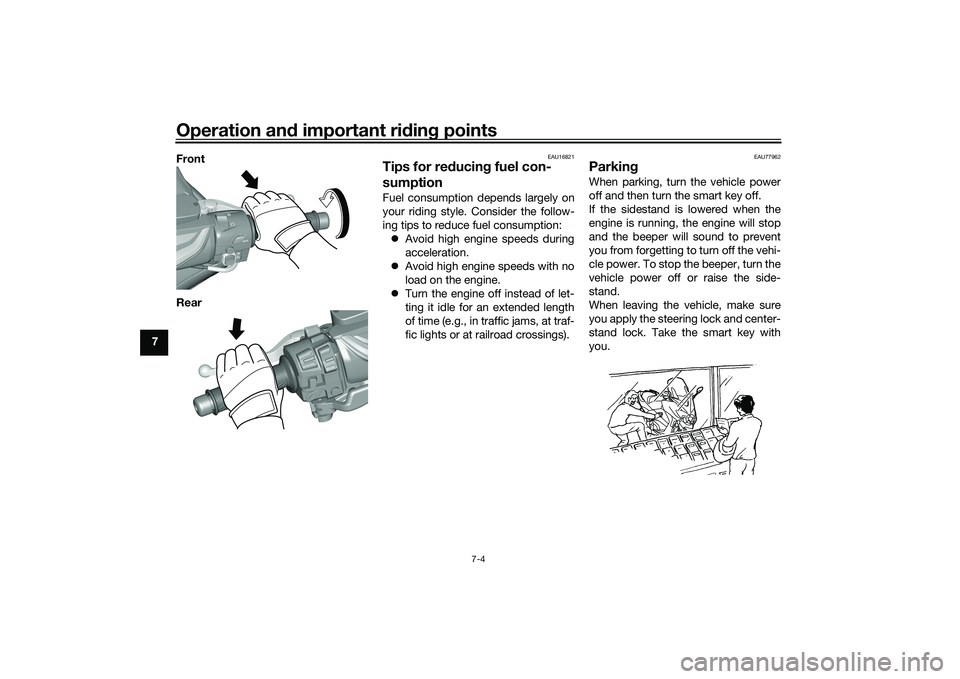
7 Front
Rear
EAU16821
Tips for re
ducin g fuel con-
sumptionFuel consumption depends largely on
your riding style. Consider the follow-
ing tips to reduce fuel consumption:
Avoid high engine speeds during
acceleration.
Avoid high engine speeds with no
load on the engine.
Turn the engine off instead of let-
ting it idle for an extended length
of time (e.g., in traffic jams, at traf-
fic lights or at railroad crossings).
EAU77962
Parkin gWhen parking, turn the vehicle power
off and then turn the smart key off.
If the sidestand is lowered when the
engine is running, the engine will stop
and the beeper will sound to prevent
you from forgetting to turn off the vehi-
cle power. To stop the beeper, turn the
vehicle power off or raise the side-
stand. When leaving the vehicle, make sure
you apply the steering lock and center-
stand lock. Take the smart key with
you.
UB3TE1E0.book Page 4 Friday, September 11, 2020 8:48 AM
Page 76 of 124

Periodic maintenance an d a djustment
8-5
8
EAU71353
General maintenance an d lu brication chartNO. ITEM CHECK OR MAINTENANCE JOB ODOMETER READING
ANNUAL
CHECK
1000 km
(600 mi) 10000 km
(6000 mi) 20000 km
(12000 mi) 30000 km
(18000 mi) 40000 km
(24000 mi)
1 *Dia
gnostic system
check • Perform dynamic inspection us-
ing Yamaha diagnostic tool.
• Check the error codes. √√√√√√
2 *Air filter element • Replace. √√
3 *Air filter case check
hose • Clean.
√√√√√
4 *V-
belt case air filter
elements • Clean.
√√
• Replace. √√
5 *Front brake • Check operation, fluid level, and
for fluid leakage.
• Replace brake pads if necessary. √√√√√√
6 *Rear brake • Check operation, fluid level, and
for fluid leakage.
• Replace brake pads if necessary. √√√√√√
7 *Brake hoses • Check for cracks or damage.
√√√√√
• Replace. Every 4 years
8 *Brake flui d • Change. Every 2 years
9 Rear
brake lock ca-
b le • Check cable length.
• Adjust if necessary. At the initial interval and 4000 km (2400 mi) after the initial 1000 km (600 mi)
and every 5000 km (3000 mi) thereafter.
10 *Rear brake lock • Check operation.
•Adjust. √√√√√√
11 *Wheels • Check runout and for damage.
• Replace if necessary. √√√√
UB3TE1E0.book Page 5 Friday, September 11, 2020 8:48 AM
Page 83 of 124

Periodic maintenance an d a djustment
8-12
8
TIPIf a torque wrench is not available
when installing a spark plug, a good
estimate of the correct torque is 1/4–
1/2 turn past finger tight. However, the
spark plug should be tightened to the
specified torque as soon as possible.
EAU36112
CanisterThis model is equipped with a canister
to prevent the discharging of fuel vapor
into the atmosphere. Before operating
this vehicle, make sure to check the
following:
Check each hose connection.
Check each hose and canister for
cracks or damage. Replace if
damaged.
Make sure that the canister
breather is not blocked, and if
necessary, clean it.
EAU77364
Engine oil an d oil filter car-
tri dgeThe engine oil level should be checked
before each ride. In addition, the oil
must be changed and the oil filter car-
tridge replaced at the intervals speci-
fied in the periodic maintenance and
lubrication chart.
To check the en gine oil level
1. Place the vehicle on the center- stand. A slight tilt to the side can
result in a false reading.
2. Start the engine, warm it up for two minutes, and then turn it off.
3. Wait two minutes until the oil level settles.
4. Check the oil level through the check window located at the bot-
tom-left side of the crankcase.TIPThe engine oil should be between the
minimum and maximum level marks.
1. Canister
2. Canister breather
12
UB3TE1E0.book Page 12 Friday, September 11, 2020 8:48 AM
Page 92 of 124

Periodic maintenance an d a djustment
8-21
8 ageing. Old and aged tires shall be
checked by tire specialists to ascertain
their suitability for further use.
WARNING
EWA16101
The front an d rear tires shoul d
b e of the same make an d d e-
si gn, otherwise the han dlin g
characteristics of the vehicle
may be different, which coul d
lea d to an acci dent.
Always make sure that the valve
caps are securely installed to
prevent air pressure leakag e.
Use only the tire valves an d
valve cores listed below to
avoi d tire d eflation durin g a ri de.After extensive tests, only the tires list-
ed below have been approved for this
model by Yamaha.
EAU51921
Cast wheelsTo maximize the performance, durabil-
ity, and safe operation of your vehicle,
note the following points regarding the
specified wheels.
The wheel rims should be
checked for cracks, bends, warp-
age or other damage before each
ride. If any damage is found, have
a Yamaha dealer replace the
wheel. Do not attempt even the
smallest repair to the wheel. A de-
formed or cracked wheel must be
replaced.
The wheel should be balanced
whenever either the tire or wheel
has been changed or replaced. An
unbalanced wheel can result in
poor performance, adverse han-
dling characteristics, and a short-
ened tire life.
After repairing or replacing the
front tire, tighten the valve stem
nut and locknut to the specified
torques.
Front tire:
Size:
120/70R15M/C 56H
Manufacturer/model:
BRIDGESTONE/BATTLAX SCF
Tire air valve: PVR59A
Valve core: #9100 (original)
Rear tire:
Size:160/60R15M/C 67H
Manufacturer/model:
BRIDGESTONE/BATTLAX SCR
Tire air valve: TR412
Valve core: #9100 (original)
UB3TE1E0.book Page 21 Friday, September 11, 2020 8:48 AM
Page 93 of 124
Periodic maintenance an d a djustment
8-22
8
EAU50861
Checkin g the front an d rear
b rake lever free playFront
Rear There should be no free play at the
brake lever ends. If there is free play,
have a Yamaha dealer inspect the
brake system.
WARNING
EWA14212
A soft or spon
gy feelin g in the b rake
lever can in dicate the presence of
air in the hy draulic system. If there is
air in the hy draulic system, have a
Yamaha dealer blee d the system be-
fore operatin g the vehicle. Air in the
hy draulic system will diminish the
b rakin g performance, which may re-
sult in loss of control an d an acci-
d ent.
1. Valve stem nut
2. Valve stem locknutTi ghtenin g torques:
Valve stem nut: 2.0 N·m (0.20 kgf·m, 1.5 lb·ft)
Valve stem locknut:
3.0 N·m (0.30 kgf·m, 2.2 lb·ft)
1
2
1. No brake lever free play
1. No brake lever free play
1
1
UB3TE1E0.book Page 22 Friday, September 11, 2020 8:48 AM
Page 94 of 124

Periodic maintenance an d a djustment
8-23
8
EAU53033
A djustin g the rear brake lock
ca blePeriodically check the rear brake lock
cable length and adjust if necessary.
1. Release the rear brake lock lever.
2. To increase the rear brake lock ca- ble length, turn the adjusting nut at
the rear brake caliper in direction
(a). To decrease the rear brake
lock cable length, turn the adjust-
ing nut in direction (b). 3. Confirm that the rear brake lock
lever (page 5-18) functions prop-
erly and that the rear wheel rotates
freely when unlocked.
WARNING
EWA20290
If proper a djustment cannot be o b-
taine d as d escri bed , have a Yamaha
d ealer make this ad justment.
EAU52293
Checking the rear brake lockThe rear brake lock must be checked
at the intervals specified in the periodic
maintenance and lubrication chart.
1. Adjust the rear brake lock cable.
2. Apply the rear brake lock, and then try to push the vehicle to con-
firm that the rear brake lock func-
tions properly.
3. The rear brake lock caliper is pro- vided with a wear indicator, which
allows you to check the rear brake
lock pads. To check the rear brake
lock pads, check the position of
the indicator when the rear brake
lock lever is applied. If the indica-
tor has passed the wear indicator
groove, have a Yamaha dealer
check the rear brake lock.
4. Make sure that there are no tears or cracks on the rubber boot.
1. Adjusting nut
2. Rear brake lock cable lengthRear brake lock cab le length:
43–45 mm (1.69–1.77 in)
1
2
(b)
(a)
UB3TE1E0.book Page 23 Friday, September 11, 2020 8:48 AM
Page 96 of 124

Periodic maintenance an d a djustment
8-25
8
EAU22584
Checkin g the brake flui d levelBefore riding, check that the brake fluid
is above the minimum level mark.TIPMake sure the reservoir is parallel to
the ground when checking.NOTICE
ECA17641
Brake fluid may damag e painted
surfaces or plastic parts. Always
clean up spille d flui d imme diately.Front brake Rear
brake
As the brake pads wear, it is normal for
the brake fluid level to gradually go
down. A low brake fluid level may indi-
cate worn brake pads or brake
system leakage; therefore, be sure
to check the brake pads for wear
and the brake system for leakage.
If the brake fluid level goes down
suddenly, have a Yamaha dealer
check the cause before further rid-
ing.
WARNING
EWA15991
Improper maintenance can result in
loss of b raking a bility. O bserve
these precautions:
Insufficient brake flui d may al-
low air to enter the brake sys-
tem, re ducin g brakin g
performance.
Clean the filler cap before re-
movin g. Use only DOT 4 brake
flui d from a seale d container.
Use only the specified b rake flu-
i d ; otherwise, the ru bber seals
may deteriorate, causin g leak-
a g e.
Refill with the same type of
brake flui d. A ddin g a brake flui d
other than DOT 4 may result in a
harmful chemical reaction.
Be careful that water d oes not
enter the brake flui d reservoir
when refillin g. Water will si gnifi-
cantly lower the boilin g point of
the flui d an d may result in vapor
lock.
Specifie d b rake flui d:
DOT 41. Minimum level mark
LOWER
1
1. Minimum level mark
LOWER
1
UB3TE1E0.book Page 25 Friday, September 11, 2020 8:48 AM
Page 109 of 124

Periodic maintenance an d a djustment
8-38
8
EAU86420
En gine overheatin g
WARNING
EWAT1041
Do not remove the ra diator cap when the en gine an d ra diator are hot. Scal din g hot flui d an d steam may be
b lown out un der pressure, which coul d cause serious injury. Be sure to wait until the en gine has coole d.
Place a thick rag , like a towel, over the ra diator cap, an d then slowly rotate the cap counterclockwise to the
d etent to allow any resi dual pressure to escape. When the hissin g soun d has stopped , press down on the cap
while turnin g it counterclockwise, an d then remove the cap.TIPIf coolant is not available, tap water can be temporarily used instead, provided that it is changed to the recommended cool-
ant as soon as possible.
Wait until the
engine has cooled.
Check the coolant level in the
reservoir and radiator.
The coolant level
is OK.The coolant level is low.
Check the cooling system
for leakage.
Have a Yamaha dealer checkand repair the cooling system.Add coolant. (See TIP.)
Start the engine. If the engine overheats again,
have a
Yamaha dealer check
and repair the cooling system.
There is
leakage.
There is
no leakage.
UB3TE1E0.book Page 38 Friday, September 11, 2020 8:48 AM