Page 459 of 592

4596-3. Do-it-yourself maintenance
6
Maintenance and care
4RUNNER (U)■
Replacing the following bulbs
If any of the lights listed below has burnt out, have it replac
ed by
your Toyota dealer.
● Headlight low beams (if equipped)
● Headlight low/high beams (if equipped)
● Fog lights
● Side turn signal lights
● Stop/tail lights
● Rear side marker lights
● High mounted stoplight
● Outer foot lights (if equipped)
■LED light bulbs
The headlight low beams (if equipped), headlight low/high beams (if
equipped), fog lights, side turn signal lights, stop/tail light s, rear side marker
lights, high mounted stoplight and outer foot lights consist of a number of
LEDs. If any LEDs burn out, take your vehicle to your Toyota de aler to have
the light replaced.
■ Condensation build-up on the inside of the lens
Temporary condensation build-up on the inside of the lens does not indicate a
malfunction. Contact your Toyota dealer for more information in the following
situations:
● Large drops of water have built up on the inside of the lens.
● Water has built up inside the lens.
WARNING
■Replacing light bulbs
● Turn off the lights. Do not attempt to replace the bulb immedia tely after
turning off the lights.
The bulbs become very hot and may cause burns.
● Do not touch the glass portion of the light bulb with bare hands. When it is
unavoidable to hold the glass portion, use and hold with a clea n dry cloth
to avoid getting moisture and oils on the bulb.
Also, if the bulb is scratched or dropped, it may blow out or crack.
● Fully install light bulbs and any parts used to secure them. Fa ilure to do so
may result in heat damage, fire, or water entering the headligh t unit. This
may damage the headlights or cause condensation to build up on the lens.
■ To prevent damage or fire
● Make sure bulbs are fully seated and locked.
● Check the wattage of the bulb before installing to prevent heat damage.
Page 464 of 592
4647-1. Essential information
4RUNNER (U)
WARNING
■If the engine has to be tu rned off while driving
● Power assist for the brakes and steering wheel will be lost, ma king the
brake pedal harder to depress and the steering wheel heavier to turn.
Decelerate as much as possible before turning off the engine.
● Vehicles without a smart key system:
Never attempt to remove the key, as doing so will lock the stee ring wheel.
Page 467 of 592

4677-2. Steps to take in an emergency
7
When trouble arises
4RUNNER (U)
WARNING
■While towing
● When towing using cables or chains, avoid sudden starts, etc. w hich place
excessive stress on the towing eyelets, cables or chains. The towing eye-
lets, cables or chains may become damaged, broken debris may hit peo-
ple, and cause serious damage.
● Vehicles with a smart key system: Do not turn the engine switch off.
There is a possibility that the steering wheel is locked and ca nnot be oper-
ated.
● Vehicles without a smart key system: Do not turn the engine switch to the
“LOCK” position.
There is a possibility that the steering wheel is locked and ca nnot be oper-
ated.
NOTICE
■ To prevent damage to the vehicle when towing using a wheel-lift type
truck
● Vehicles with a smart key system: Do not tow the vehicle from the rear
when the engine switch is off. The steering lock mechanism is n ot strong
enough to hold the front wheels straight.
● Vehicles without a smart key system: Do not tow the vehicle fro m the rear
when the engine switch is in the “LOCK” position or the key is removed.
The steering lock mechanism is not strong enough to hold the front wheels
straight.
● When raising the vehicle, ensure adequate ground clearance for towing at
the opposite end of the raised vehicle. Without adequate clearance, the
vehicle could be damaged while being towed.
■ To prevent damage to the vehicle when towing with a sling-type truck
Do not tow with a sling-type truck, either from the front or re ar.
■ To prevent damage to the vehic le during emergency towing
Do not secure cables or chains to the suspension components.
■ Recreational towing (behind mo tor home, etc.) (4WD models)
Never dinghy tow your vehicle to prevent
causing serious damage to the transmis-
sion. (P. 208)
Page 468 of 592
4687-2. Steps to take in an emergency
4RUNNER (U)
The following may indicate a problem with your transmission. Contact
your Toyota dealer or commercial towing service before towing.
● The engine is running but t he vehicle does not move.
● The vehicle makes an abnormal sound.
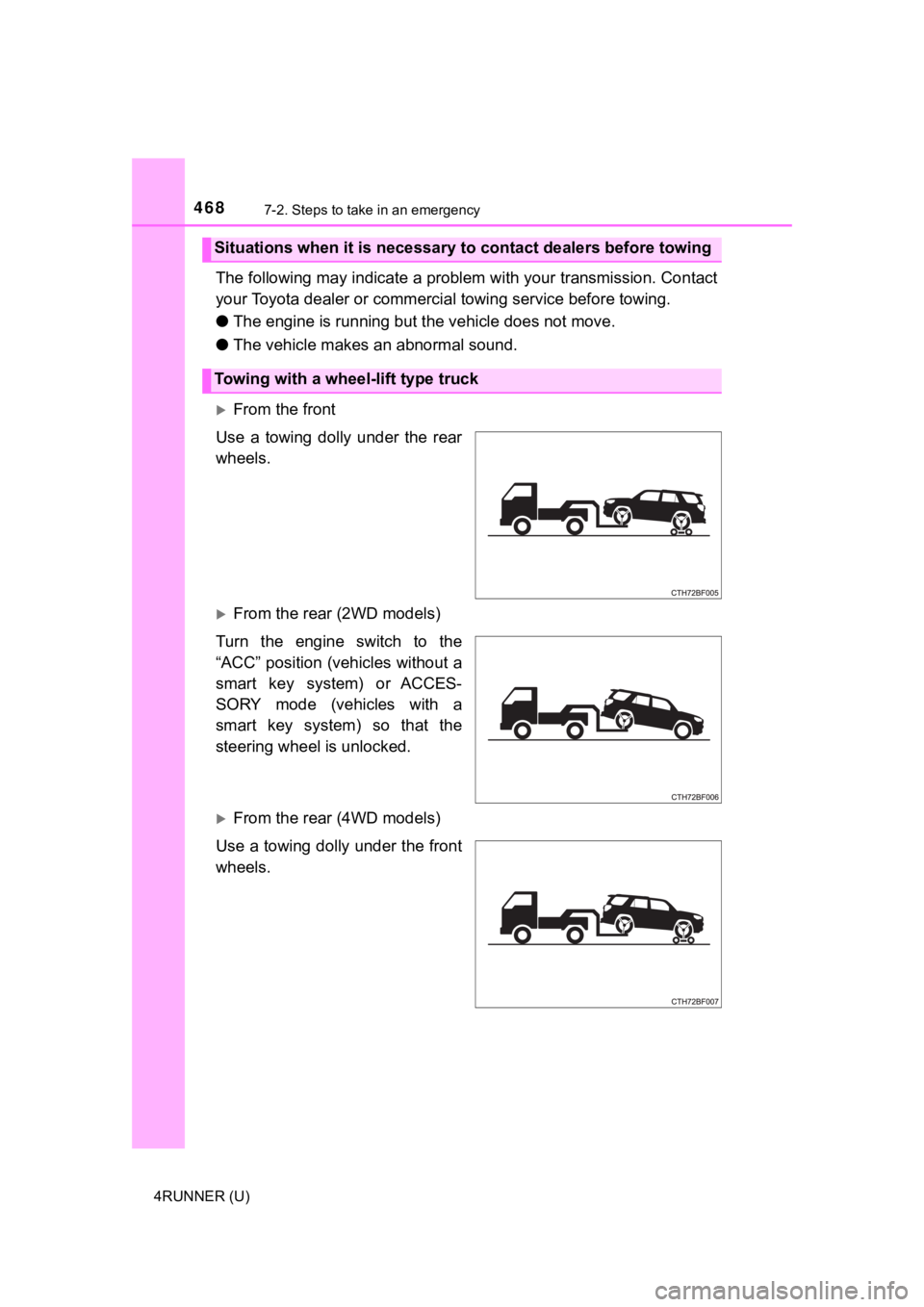
From the front
Use a towing dolly under the rear
wheels.
From the rear (2WD models)
Turn the engine switch to the
“ACC” position (vehicles without a
smart key system) or ACCES-
SORY mode (vehicles with a
smart key system) so that the
steering wheel is unlocked.
From the rear (4WD models)
Use a towing dolly under the front
wheels.
Situations when it is necessary to contact dealers before towing
Towing with a wheel-lift type truck
Page 469 of 592
4697-2. Steps to take in an emergency
7
When trouble arises
4RUNNER (U)
When using a flat-bed truck to transport the vehicle, use tire strapping
belts. Refer to the owner's manual of the flat-bed truck for th e tire
strapping method.
Vehicles with a smart key system: In order to suppress vehicle move-
ment during transportation, set the parking brake and turn the engine
switch off.
Vehicles without a smart key system: In order to suppress vehic le
movement during transportation, set the parking brake and turn the
engine switch to the “LOCK” position.
If a tow truck is not available in an emergency, your vehicle m ay be
temporarily towed using cables or chains secured to the emergen cy
towing hooks. This should only be attempted on hard surfaced roads
for at most 80 km (50 miles) at under 30 km/h (18 mph).
A driver must be in the vehicle to steer and operate the brakes . The
vehicle’s wheels, drive train, a xles, steering and brakes must be in
good condition.
NOTICE
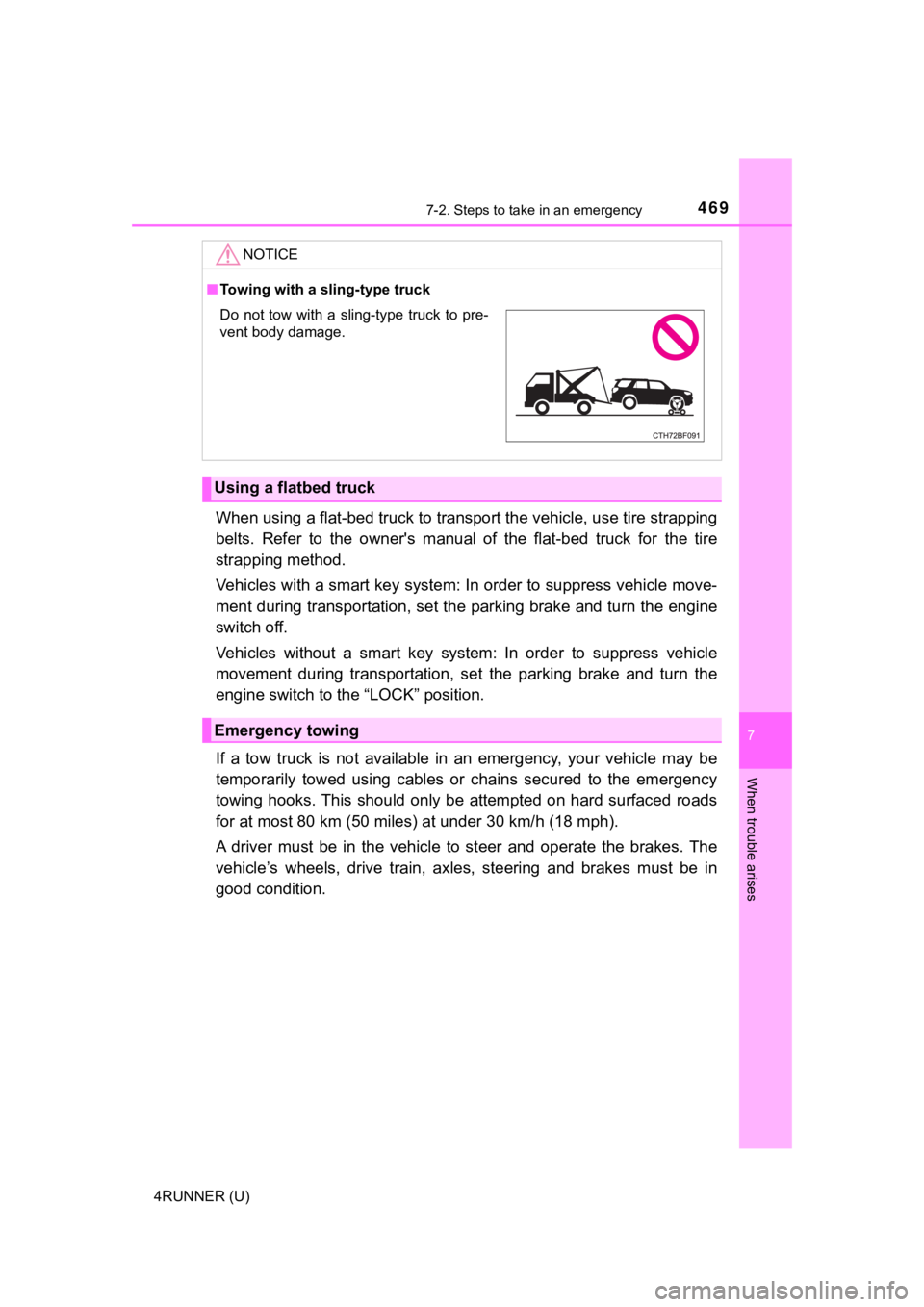
■ Towing with a sling-type truck
Using a flatbed truck
Emergency towing
Do not tow with a sling-type truck to pre-
vent body damage.
Page 471 of 592
4717-2. Steps to take in an emergency
7
When trouble arises
4RUNNER (U)
Part-time 4WD models:
Ty p e A
Shift the front-wheel drive control lever to H2.
Ty p e B
Push the “UNLOCK” button and turn the front-wheel drive control
switch to H2.
Full-time 4WD models: Push the “UNLOCK” button and turn the
four-wheel drive control switch to H4F. (The center differentia l is
unlocked.)
Shift the shift lever to N and release the parking brake.
When the shift lever cannot be shifted: P. 2 2 1
■While towing
If the engine is not running, the power assist for the brakes a nd steering will
not function, making steering and braking more difficult.
4
5
Page 473 of 592
4737-2. Steps to take in an emergency
7
When trouble arises
4RUNNER (U)
Follow the procedure below to restart the engine after the system is
activated.
Vehicles without a smart key system
Turn the engine switch to the “ACC” or “LOCK” position.
Restart the engine.
Vehicles with a smart key system
Turn the engine switch to ACCESSORY mode or turn it off.
Restart the engine.
Fuel pump shut off system
To minimize the risk of fuel leakage when the engine stalls or
when an airbag inflates upon collision, the fuel pump shut off
system stops the supply of fuel to the engine.
NOTICE
■ Before starting the engine
Inspect the ground under the vehicle.
If you find that fuel has leaked onto the ground, the fuel system has been
damaged and is in need of repair. Do not restart the engine.
1
2
1
2
Page 475 of 592
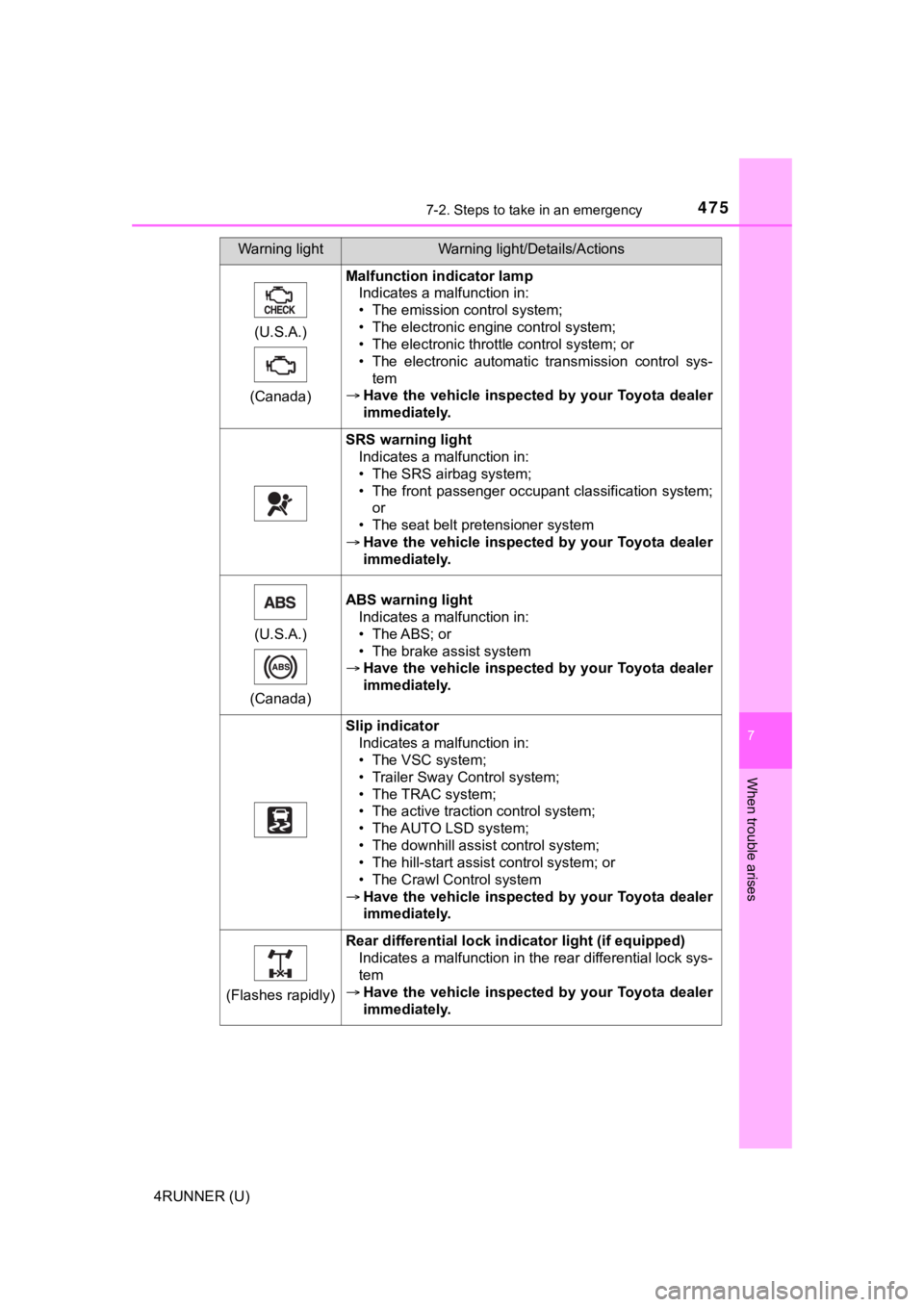
4757-2. Steps to take in an emergency
7
When trouble arises
4RUNNER (U)(U.S.A.)
(Canada)
Malfunction indicator lamp Indicates a malfunction in:
• The emission control system;
• The electronic engine control system;
• The electronic throttle control system; or
• The electronic automatic transmission control sys-
tem
Have the vehicle inspected by your Toyota dealer
immediately.
SRS warning light
Indicates a malfunction in:
• The SRS airbag system;
• The front passenger occupant classification system;or
• The seat belt pretensioner system
Have the vehicle inspected by your Toyota dealer
immediately.
(U.S.A.)
(Canada) ABS warning light
Indicates a malfunction in:
• The ABS; or
• The brake assist system
Have the vehicle inspected by your Toyota dealer
immediately.
Slip indicator
Indicates a malfunction in:
• The VSC system;
• Trailer Sway Control system;
• The TRAC system;
• The active traction control system;
• The AUTO LSD system;
• The downhill assist control system;
• The hill-start assist control system; or
• The Crawl Control system
Have the vehicle inspected by your Toyota dealer
immediately.
(Flashes rapidly)
Rear differential lock indi cator light (if equipped)
Indicates a malfunction in the rear differential lock sys-
tem
Have the vehicle inspected by your Toyota dealer
immediately.
Warning lightWarning light/Details/Actions