Page 212 of 288

210IN CASE OF EMERGENCY
AUTOMATIC TRANSMISSION
The FCA US LLC recommends towing your
vehicle with all four wheels OFF the ground
using a flatbed.
If flatbed equipment is not available, and the
transmission is operable, this vehicle may be
towed (with front wheels on the ground) under
the following conditions:
The transmission must be in NEUTRAL (N).
The towing speed must not exceed 25 mph
(40 km/h).
The towing distance must not exceed
15 miles (24 km).
If the transmission is not operable, or the
vehicle must be towed faster than 25 mph
(40 km/h) or farther than 15 miles (24 km), tow
with the front wheels OFF the ground (using a
flatbed truck, or wheel lift equipment with the
front wheels raised).
ENHANCED ACCIDENT RESPONSE SYSTEM
(EARS)
This vehicle is equipped with an Enhanced
Accident Response System.
This feature is a communication network that
takes effect in the event of an impact
Ú page 179.
EVENT DATA RECORDER (EDR)
This vehicle is equipped with an Event Data
Recorder (EDR). The main purpose of an EDR is
to record data that will assist in understanding
how a vehicle’s systems performed under
certain crash or near crash-like situations, such
as an air bag deployment or hitting a road
obstacle Ú page 180.
CAUTION!
Towing faster than 25 mph (40 km/h) or
farther than 15 miles (24 km) with front
wheels on the ground can cause severe
transmission damage. Damage from
improper towing is not covered under the
New Vehicle Limited Warranty.
Towing this vehicle in violation of the above
requirements can cause severe transmis -
sion damage. Damage from improper
towing is not covered under the New
Vehicle Limited Warranty.
21_VF_OM_EN_USC_t.book Page 210
Page 216 of 288

214SERVICING AND MAINTENANCE
Flush and replace the engine
coolant at 10 years or
150,000 miles (240,000 km)
whichever comes first. X
X
Change the automatic
transmission fluid and filter. X
X
Inspect and replace the PCV valve
if necessary. X
1. The brake fluid change interval is time based only, mileage intervals do not apply.
2. The spark plug change interval is mileage based only, yearly intervals do not apply.
Mileage or time passed
(whichever comes first)
20,000
30,000
40,000
50,000
60,000
70,000
80,000
90,000
100,000
110,000
120,000
130,000
140,000
150,000
Or Years: 2 3 4 5 6 7 8 9 10 11 12 13 14 15
Or Kilometers:
32,000
48,000
64,000
80,000
96,000
112,000
128,000
144,000
160,000
176,000
192,000
208,000
224,000
240,000
WARNING!
You can be badly injured working on or around a motor vehicle. Do only service work for which you have the knowledge and the right equipment.
If you have any doubt about your ability to perform a service job, take your vehicle to a competent mechanic.
Failure to properly inspect and maintain your vehicle could result in a component malfunction and effect vehicle handling and performance.
This could cause an accident.
21_VF_OM_EN_USC_t.book Page 214
Page 228 of 288

226SERVICING AND MAINTENANCE
(Continued)
BRAKE SYSTEM
In order to ensure brake system performance,
all brake system components should be
inspected periodically Úpage 212.
Fluid Level Check — Brake Master Cylinder
The fluid level of the master cylinder should be
checked when performing under the hood
service or immediately if the brake system
warning lamp indicates system failure. If
necessary, add fluid to bring level within the
designated marks on the side of the reservoir of
the brake master cylinder. Be sure to clean the
top of the master cylinder area before removing
cap. With disc brakes the fluid level can be
expected to fall as the brake linings wear. However, an unexpected drop in fluid level may
be caused by a leak and a system check should
be conducted Ú
page 268.
AUTOMATIC TRANSMISSION
Selection Of Lubricant
It is important to use the proper transmission
fluid to ensure optimum transmission
performance and life. Use only the
manufacturer’s specified transmission fluid
Ú
page 270. It is important to maintain the
WARNING!
Riding the brakes can lead to brake failure
and possibly a collision. Driving with your foot
resting or riding on the brake pedal can result
in abnormally high brake temperatures,
excessive lining wear, and possible brake
damage. You would not have your full braking
capacity in an emergency.
WARNING!
Use only FCA's recommended brake fluid
Ú page 268. Using the wrong type of brake
fluid can severely damage your brake
system and/or impair its performance. The
proper type of brake fluid for your vehicle is
also identified on the original factory
installed hydraulic master cylinder
reservoir.
To avoid contamination from foreign matter
or moisture, use only new brake fluid or
fluid that has been in a tightly closed
container. Keep the master cylinder reser -
voir cap secured at all times. Brake fluid in
a open container absorbs moisture from
the air resulting in a lower boiling point. This
may cause it to boil unexpectedly during
hard or prolonged braking, resulting in
sudden brake failure. This could result in a
collision.
Overfilling the brake fluid reservoir can
result in spilling brake fluid on hot engine
parts, causing the brake fluid to catch fire.
Brake fluid can also damage painted and
vinyl surfaces, care should be taken to
avoid its contact with these surfaces.
Do not allow petroleum based fluid to
contaminate the brake fluid. Brake seal
components could be damaged, causing
partial or complete brake failure. This could
result in a collision.
WARNING! (Continued)
21_VF_OM_EN_USC_t.book Page 226
Page 229 of 288

SERVICING AND MAINTENANCE227
transmission fluid at the correct level using the
recommended fluid. No chemical flushes should
be used in any transmission; only the approved
lubricant should be used.
Special Additives
The manufacturer strongly recommends
against using any special additives in the
transmission. Automatic Transmission Fluid
(ATF) is an engineered product and its
performance may be impaired by supplemental
additives. Therefore, do not add any fluid
additives to the transmission. The only exception to this policy is the use of special dyes
for diagnosing fluid leaks in six-speed
transmissions. Avoid using transmission
sealers as they may adversely affect seals.
Fluid Level Check
The fluid level is preset at the factory and does
not require adjustment under normal operating
conditions. Routine fluid level checks are not
required, therefore the transmission filler tube
is capped and no dipstick is provided. Your
authorized dealer can check your transmission
fluid level using a special service dipstick. If you
notice fluid leakage or transmission
malfunction, visit your authorized dealer immediately to have the transmission fluid level
checked. Operating the vehicle with an
improper fluid level can cause severe
transmission damage.
Fluid And Filter Changes
For the proper maintenance intervals
Ú
page 212.
In addition, change the fluid and filter if the fluid
becomes contaminated (with water, etc.), or if
the transmission is disassembled for any
reason.
CAUTION!
Using a transmission fluid other than the
manufacturer’s recommended fluid may
cause deterioration in transmission shift
quality and/or torque converter shudder, and
will require more frequent fluid and filter
changes Ú page 270.
CAUTION!
Do not use chemical flushes in your
transmission as the chemicals can damage
your transmission components. Such damage
is not covered by the New Vehicle Limited
Warranty.
CAUTION!
If a transmission fluid leak occurs, visit an
authorized dealer immediately. Severe
transmission damage may occur. An
authorized dealer has the proper tools to
adjust the fluid level accurately.
8
21_VF_OM_EN_USC_t.book Page 227
Page 231 of 288
SERVICING AND MAINTENANCE229
Underhood Fuses
The Front Power Distribution Center is located
on the driver’s side of the engine compartment.
To access the fuses, remove the cover.
Front Power Distribution Center
The ID number of the electrical component
corresponding to each fuse can be found on the
back of the cover.
Cavity
Maxi Fuse Mini Fuse Description
F0140 Amp Orange –Electronic Stability Control (ESC) Pump
F02 20 Amp Yellow
(3.6 Gasoline Engine) –
Starter Relay 3.6L (3.6 Gasoline Engine)
F04 50 Amp Red
(3.6 Gasoline Engine) –Secondary Power Distribution Center (PDC) (Trans Power Relay,
Vacuum Pump, KL30 for the Shifter Transmission Module [STM])
(3.6 Gasoline Engine)
F06 40 Amp Orange (non A/C)
60 Amp Blue (A/C) –
Engine Cooling Fan - 2nd Speed
F07 50 Amp Red (non A/C)
60 Amp Blue (A/C) –
Engine Cooling Fan - 1st Speed
F08 40 Amp Orange –Passenger Compartment Blower
F09 –15 Amp Blue Rear Power Outlet
8
21_VF_OM_EN_USC_t.book Page 229
Page 232 of 288
230SERVICING AND MAINTENANCE
F10–15 Amp Blue Horn
F14 –20 Amp Yellow Power Outlet
F15 –7.5 Amp Brown USB Charger
F16 –7.5 Amp Brown KL15 Shifter Transmission Module (STM) (3.6), KL15 Starter Relay
Coil (3.6 Gasoline Engine)
F17 –20 Amp Yellow Engine Control Module (ECM), Injectors (3.6 Gasoline Engine)
F18 –7.5 Amp Brown KL30 Engine Control Module (ECM), KL30 Main Relay Coil
(3.6 Gasoline Engine)
F19 –7.5 Amp Brown A/C Compressor — If Equipped
F20 –30 Amp Green Windshield Wiper
F21 –15 Amp Blue Fuel Pump
F22 –20 Amp Yellow Engine Control Module (ECM), Ignition Coils (3.6 Gasoline Engine)
F23 –20 Amp Yellow Electronic Stability Control (ESC) Valves
F24 –7.5 Amp Brown KL15 Vacuum Pump Relay Coil (3.6 Gasoline Engine) — If Equipped
F30 –15 Amp Blue Heated Mirrors
CavityMaxi Fuse Mini Fuse Description
21_VF_OM_EN_USC_t.book Page 230
Page 233 of 288
SERVICING AND MAINTENANCE231
Front PDC Additional Fuses
The additional fuse box is located inside the
front PDC Box.
Front Power Distribution Center Additional Fuses
CavityMini Fuse Description
F6120 Amp YellowVacuum Pump (3.6 Gasoline Engine)
F62 30 Amp GreenTransmission Power RELE (3.6 Gasoline Engine)
F66 5 Amp BeigeShifter Transmission Module (STM) (3.6 Gasoline Engine)
8
21_VF_OM_EN_USC_t.book Page 231
Page 272 of 288
270TECHNICAL SPECIFICATIONS
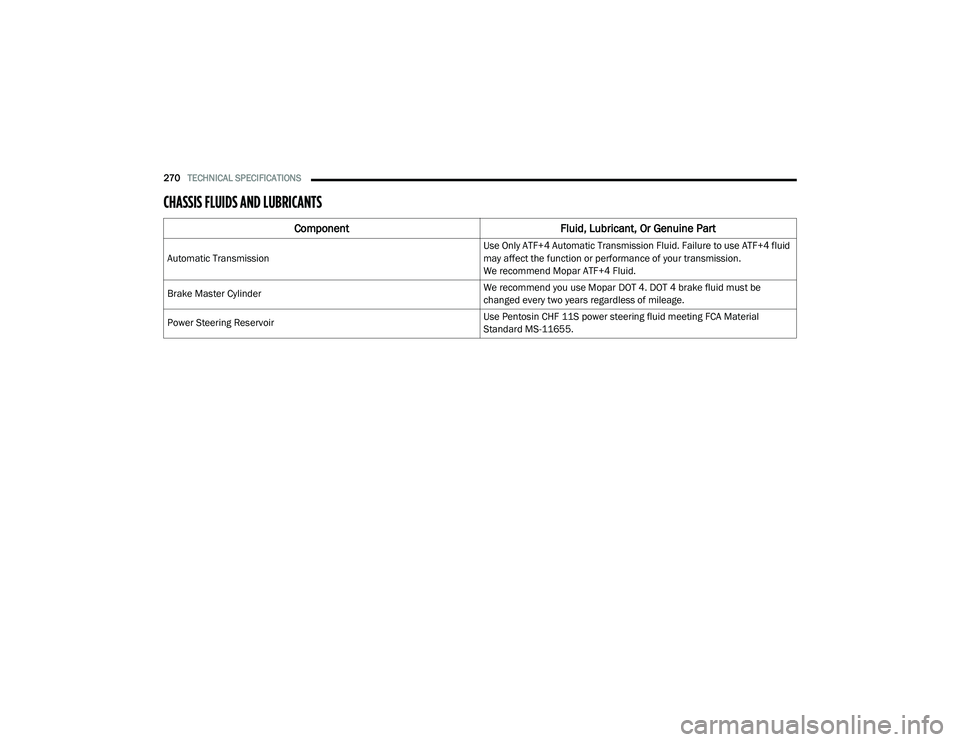
CHASSIS FLUIDS AND LUBRICANTS
Component Fluid, Lubricant, Or Genuine Part
Automatic Transmission Use Only ATF+4 Automatic Transmission Fluid. Failure to use ATF+4 fluid
may affect the function or performance of your transmission.
We recommend Mopar ATF+4 Fluid.
Brake Master Cylinder We recommend you use Mopar DOT 4. DOT 4 brake fluid must be
changed every two years regardless of mileage.
Power Steering Reservoir Use Pentosin CHF 11S power steering fluid meeting FCA Material
Standard MS-11655.
21_VF_OM_EN_USC_t.book Page 270