Page 98 of 492
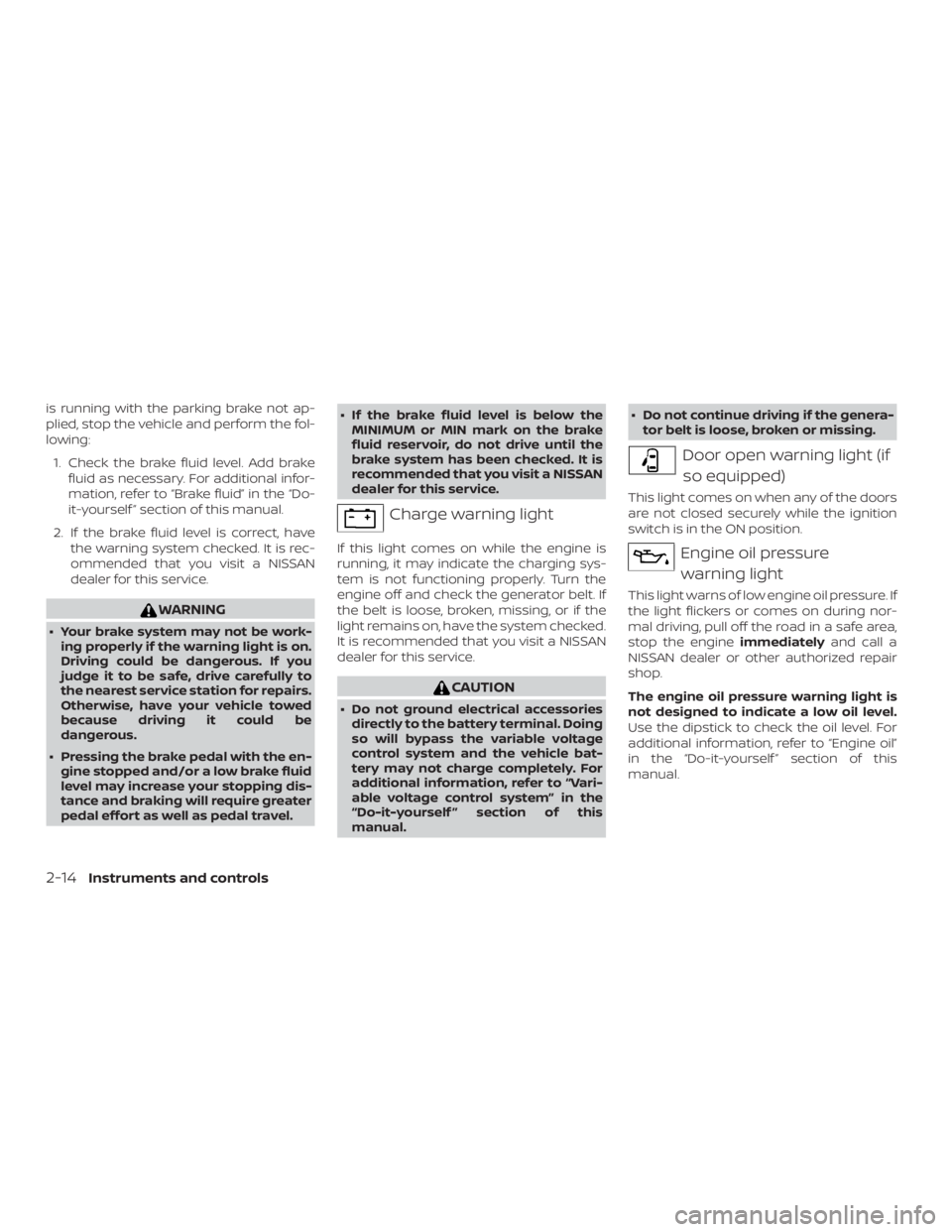
is running with the parking brake not ap-
plied, stop the vehicle and perform the fol-
lowing:1. Check the brake fluid level. Add brake fluid as necessary. For additional infor-
mation, refer to “Brake fluid” in the “Do-
it-yourself ” section of this manual.
2. If the brake fluid level is correct, have the warning system checked. It is rec-
ommended that you visit a NISSAN
dealer for this service.
Page 273 of 492
WARNING
Apply the parking brake if the shif t lever
is in any position while the engine is not
running. Failure to do so could cause
the vehicle to move unexpectedly or roll
away and result in serious personal in-
jury or property damage.
If the ignition switch is placed in the OFF or
AUTO ACC position for any reason while the
vehicle is in N (Neutral), or any drive position,
the ignition switch cannot be placed in the
LOCK position. If this occurs, perform the
following steps: 1. Apply the parking brake when the ve- hicle is stopped.
2. Move the shif t lever into P (Park) to park the vehicle and place the ignition
switch in the LOCK position.
P (Park)
Page 278 of 492
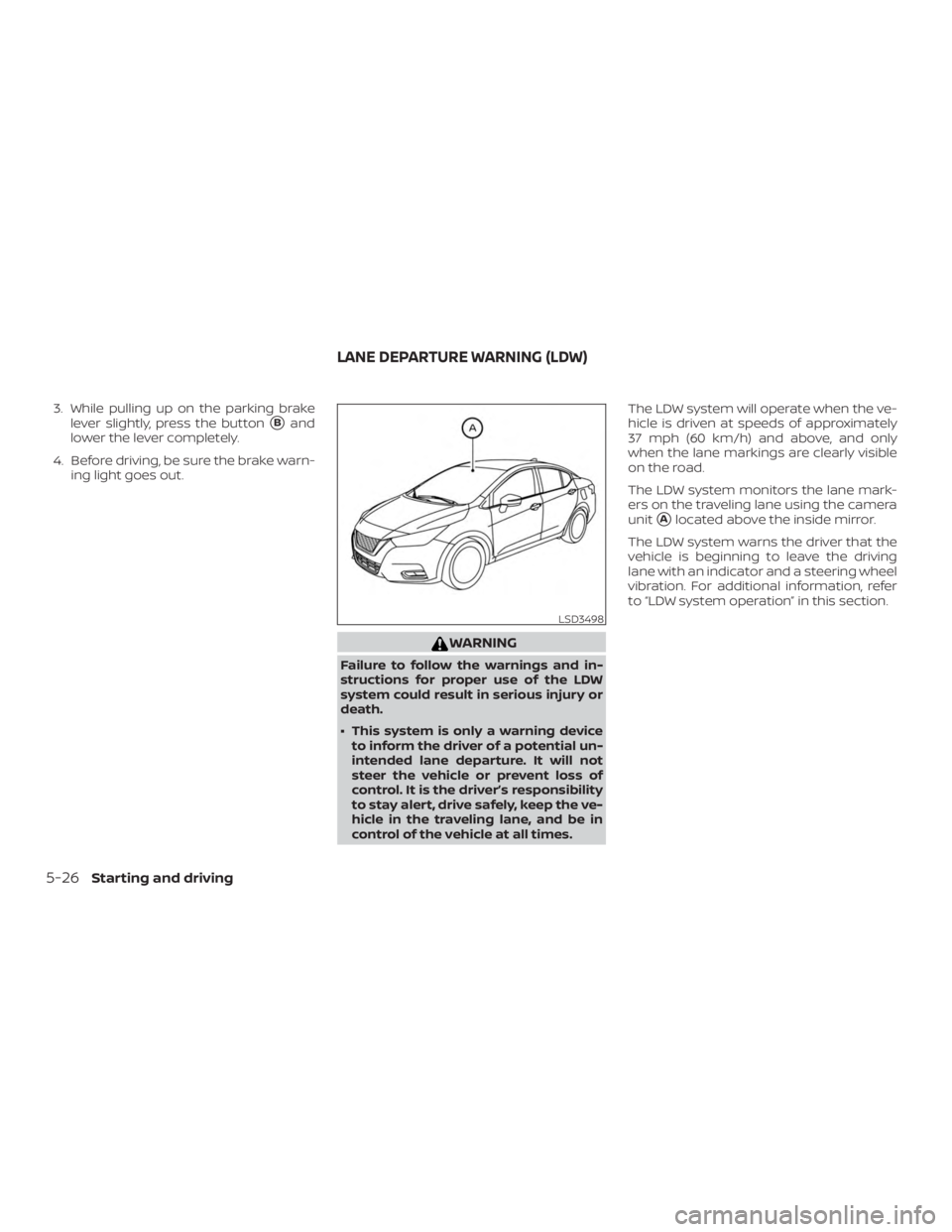
3. While pulling up on the parking brakelever slightly, press the button
�Band
lower the lever completely.
4. Before driving, be sure the brake warn- ing light goes out.
Page 335 of 492

∙ The RAB system may not operate inthe following conditions:
– There is rain, snow, ice, dirt, etc., at- tached to the sonar sensors.
– A loud sound is heard in the area around the vehicle.
– The surface of the obstacle is di- agonal to the rear of the vehicle.
∙ The RAB system may unintentionally operate in the following conditions:
– There is overgrown grass in the area around the vehicle.
– There is a structure (e.g., a wall, toll gate equipment, a narrow tunnel, a
parking lot gate) near the side of
the vehicle.
– There are bumps, protrusions, or manhole covers on the road
surface.
– The vehicle drives through a draped flag or a curtain.
– There is an accumulation of snow or ice behind the vehicle.
– An ultrasonic wave source, such as another vehicle’s sonar, is near the
vehicle. ∙ Once the automatic brake control op-
erates, it does not operate again if the
vehicle approaches the same
obstacle.
∙ The automatic brake control can only operate for a short period of time.
Therefore, the driver must depress
the brake pedal.
∙ In the following situations, the RAB system may not operate properly or
may not function sufficiently:
– The vehicle is driven in bad weather (rain, fog, snow, etc.).
– The vehicle is driven on a steep hill.
– The vehicle’s posture is changed (e.g., when driving over a bump).
– The vehicle is driven on a slippery road.
– The vehicle is turned sharply by turning the steering wheel fully.
– Snow chains are used.
– Wheels or tires other than NISSAN recommended are used.
– The brakes are cold at low ambient temperatures or immediately af ter
driving has started. – The braking force becomes poor
due to wet brakes af ter driving
through a puddle or washing the
vehicle.
∙ Turn the RAB system off in the follow- ing conditions to prevent the occur-
rence of an unexpected accident re-
sulting from sudden system
operation:
– The vehicle is towed.
– The vehicle is carried on a flatbed truck.
– The vehicle is on the chassis dynamometer.
– The vehicle drives on an uneven road surface.
– Suspension parts other than those designated as Genuine NISSAN
parts are used. (If the vehicle
height or the vehicle body inclina-
tion is changed, the system may
not detect an obstacle correctly.)
∙ Excessive noise (e.g., audio system volume, an open vehicle window) will
interfere with the chime sound, and it
may not be heard.
Starting and driving5-83
Page 366 of 492
WARNING
∙ Do not stop or park the vehicle overflammable materials such as dry
grass, waste paper or rags. They may
ignite and cause a fire. ∙ Safe parking procedures require that
both the parking brake be set and the
transmission placed into P (Park) or in
an appropriate gear for manual trans-
mission (M/T) models. Failure to do so
could cause the vehicle to move unex-
pectedly or roll away and result in an
accident. Make sure the shif t lever has
been pushed as far forward as it can
go and cannot be moved without de-
pressing the foot brake pedal.
∙ Never leave the engine running while the vehicle is unattended. ∙ Do not leave children unattended in-
side the vehicle. They could unknow-
ingly activate switches or controls or
make the vehicle move. Unattended
children could become involved in se-
rious accidents.
∙ To help avoid risk of injury or death through unintended operation of the
vehicle and/or its systems, do not
leave children, people who require the
assistance of others or pets unat-
tended in your vehicle. Additionally,
the temperature inside a closed ve-
hicle on a warm day can quickly be-
come high enough to cause a signifi-
cant risk of injury or death to people
and pets.
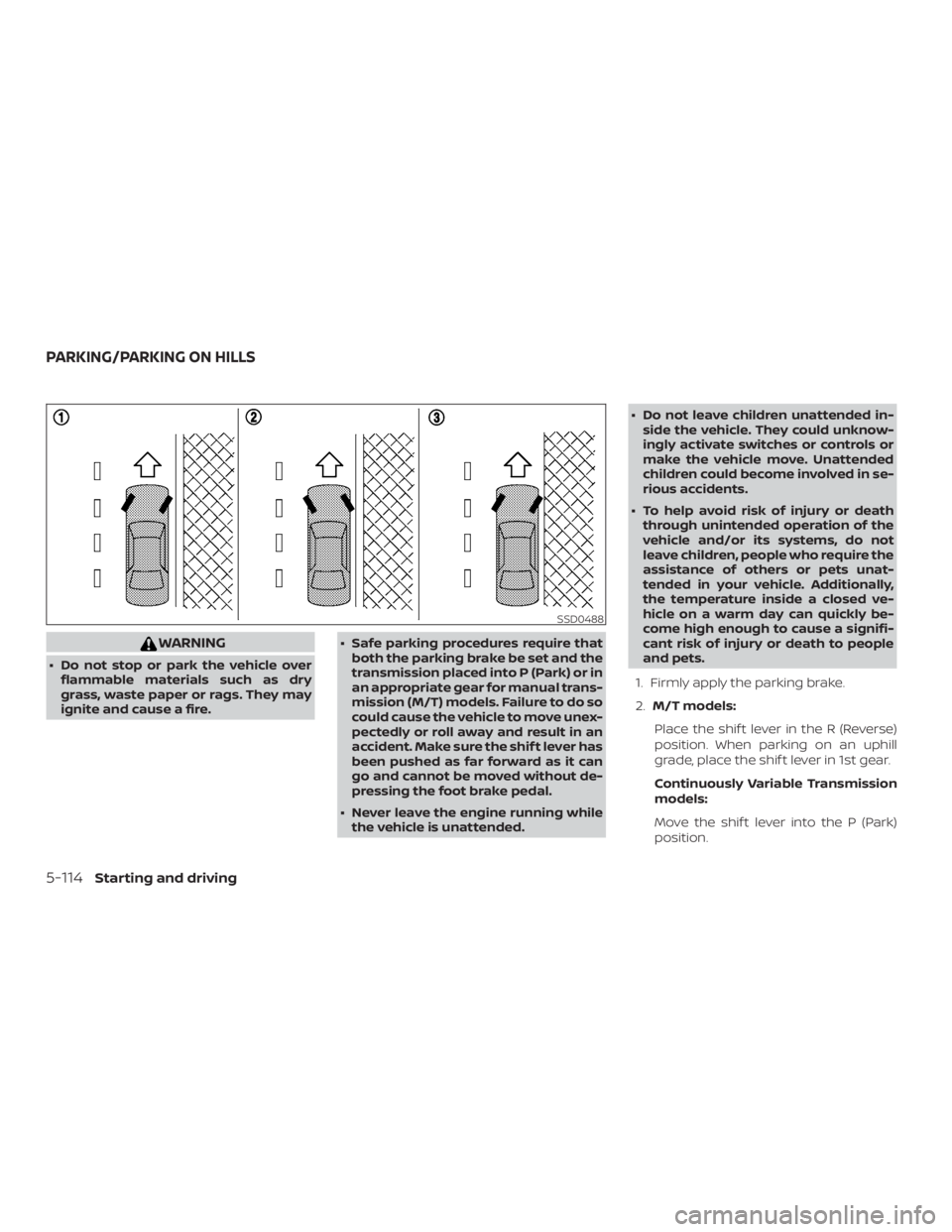
1. Firmly apply the parking brake.
2. M/T models:
Place the shif t lever in the R (Reverse)
position. When parking on an uphill
grade, place the shif t lever in 1st gear.
Continuously Variable Transmission
models:
Move the shif t lever into the P (Park)
position.
Page 374 of 492

WARNING
∙ The RSS is a convenience but it is not asubstitute for proper parking.
∙ The driver is always responsible for safety during parking and other ma-
neuvers. Always look around and
check that it is safe to do so before
parking.
∙ Read and understand the limitations of the RSS as contained in this section.
The colors of the corner sonar indica-
tor and the distance guide lines in the
rear view indicate different distances
to the object.
∙ Inclement weather or ultrasonic sources such as an automatic car
wash, a truck’s compressed-air
brakes or a pneumatic drill may affect
the function of the system; this may
include reduced performance or a
false activation.
∙ This function is designed as an aid to the driver in detecting large station-
ary objects to help avoid damaging
the vehicle. ∙ The system is not designed to prevent
contact with small or moving objects.
Always move slowly. The system will
not detect small objects below the
bumper, and may not detect objects
close to the bumper or on the ground.
∙ The system may not detect the fol- lowing objects: fluff y objects such as
snow, cloth, cotton, glass, wool, etc.;
thin objects such as rope, wire and
chain, etc.; or wedge-shaped objects.
If your vehicle sustains damage to the
bumper fascia, leaving it misaligned or
bent, the sensing zone may be altered
causing inaccurate measurement of ob-
stacles or false alarms.
Page 386 of 492
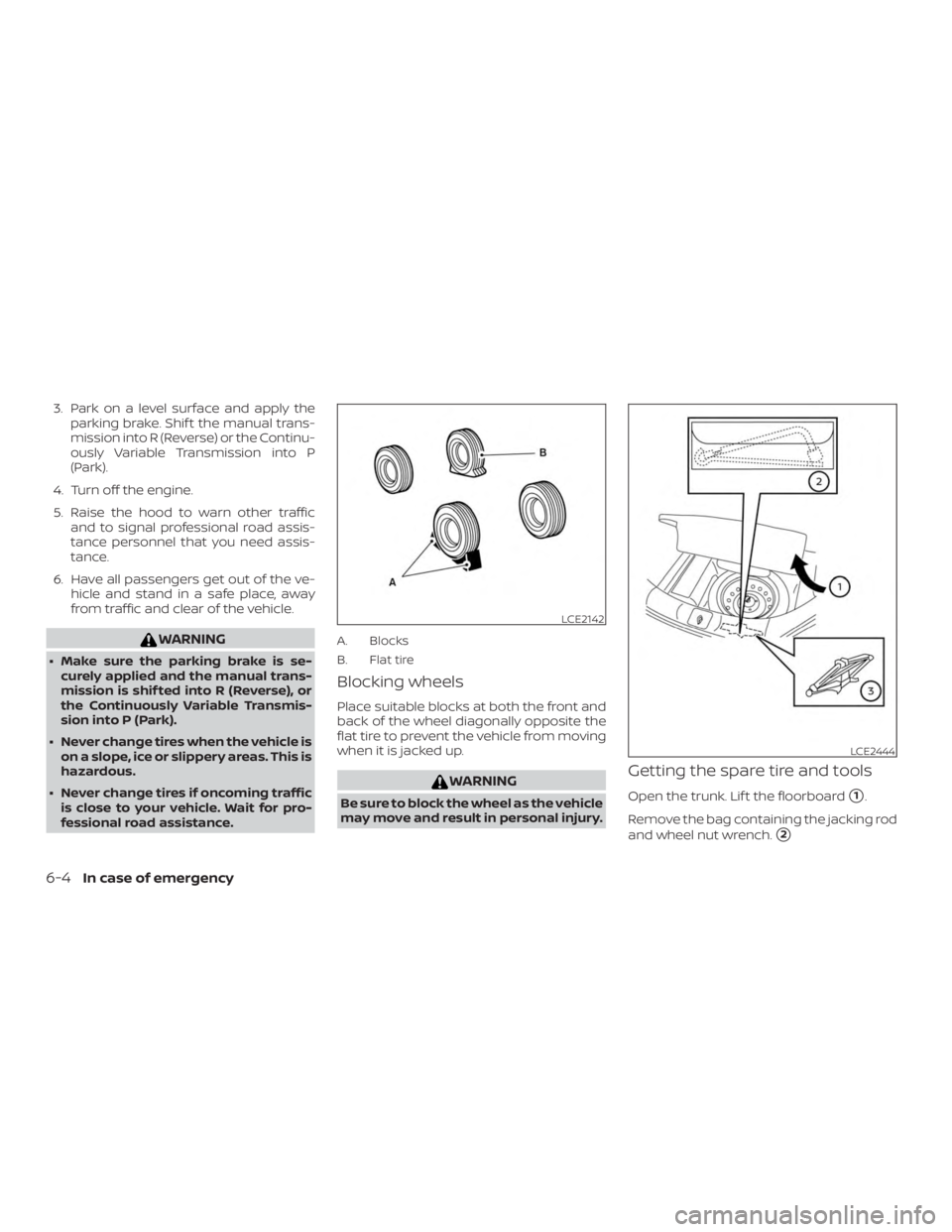
3. Park on a level surface and apply theparking brake. Shif t the manual trans-
mission into R (Reverse) or the Continu-
ously Variable Transmission into P
(Park).
4. Turn off the engine.
5. Raise the hood to warn other traffic and to signal professional road assis-
tance personnel that you need assis-
tance.
6. Have all passengers get out of the ve- hicle and stand in a safe place, away
from traffic and clear of the vehicle.
Page 392 of 492
WARNING
Always follow the instructions below.
Failure to do so could result in damage
to the charging system and cause per-
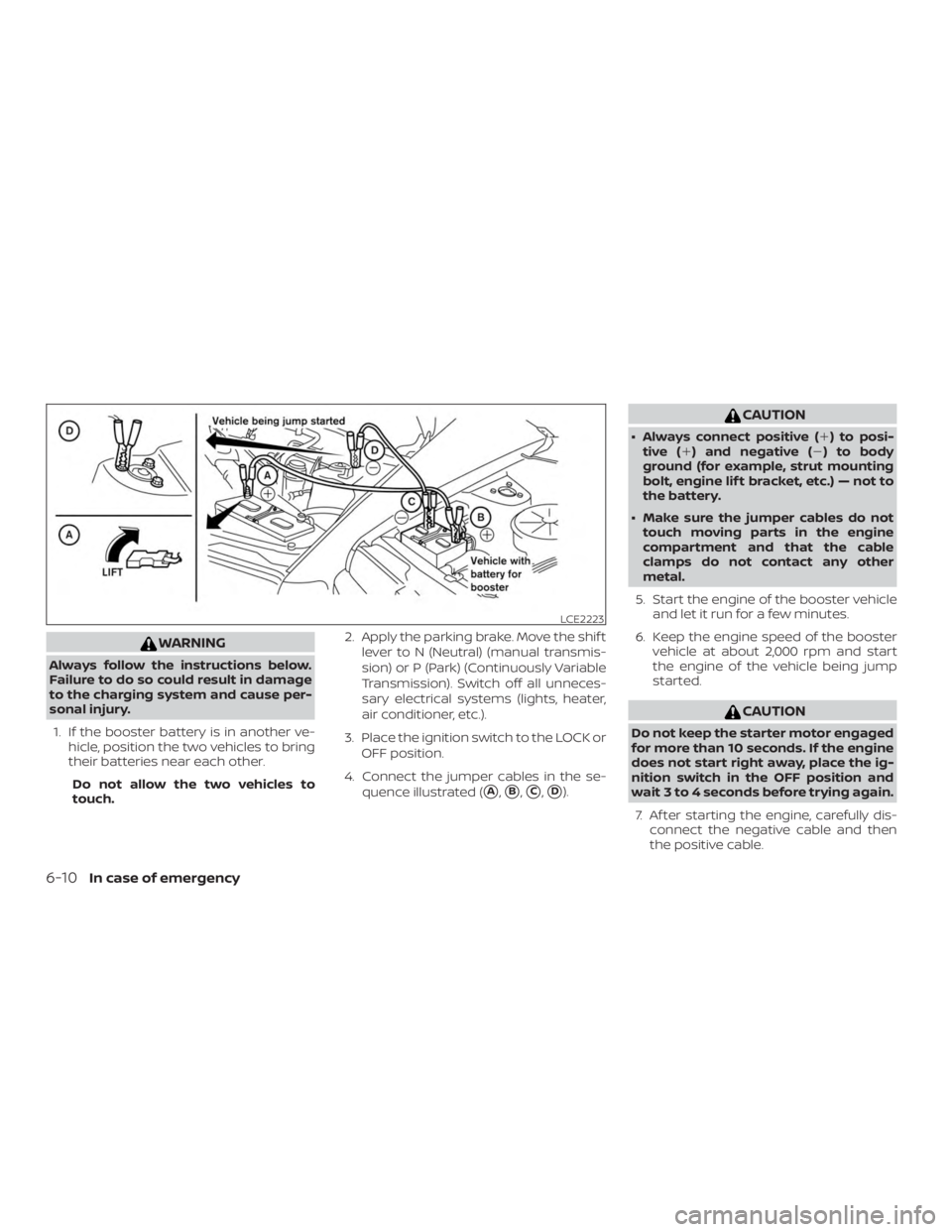
sonal injury.1. If the booster battery is in another ve- hicle, position the two vehicles to bring
their batteries near each other.
Do not allow the two vehicles to
touch. 2. Apply the parking brake. Move the shif t
lever to N (Neutral) (manual transmis-
sion) or P (Park) (Continuously Variable
Transmission). Switch off all unneces-
sary electrical systems (lights, heater,
air conditioner, etc.).
3. Place the ignition switch to the LOCK or OFF position.
4. Connect the jumper cables in the se- quence illustrated (
�A,�B,�C,�D).