2021 NISSAN PATHFINDER trailer
[x] Cancel search: trailerPage 454 of 482

WARNING
Trailer hitch components have specific
weight ratings. Your vehicle may be ca-
pable of towing a trailer heavier than the
weight rating of the hitch components.
Never exceed the weight rating of the
hitch components. Doing so can cause se-
rious personal injury or property damage.
Hitch ball
Choose a hitch ball of the proper size and
weight rating for your trailer:∙ The required hitch ball size is stamped on most trailer couplers. Most hitch
balls also have the size printed on the
top of the ball.
∙ Choose the proper class hitch ball based on the trailer weight.
∙ The diameter of the threaded shank of the hitch ball must be matched to the
ball mount hole diameter. The hitch ball
shank should be no more than 1/16”
smaller than the hole in the ball mount.
∙ The threaded shank of the hitch ball must be long enough to be properly
secured to the ball mount. There should
be at least 2 threads showing beyond
the lock washer and nut.
Ball mount
The hitch ball is attached to the ball mount
and the ball mount is inserted into the
hitch receiver. Choose a proper class ball
mount based on the trailer weight. Addi-
tionally, the ball mount should be chosen to
keep the trailer tongue level with the
ground.
Weight carrying hitches
A weight carrying or “dead weight” ball
mount is one that is designed to carry the
whole amount of tongue weight and gross
weight directly on the ball mount and on
the receiver.
Weight distribution hitch
This type of hitch is also called a “load-
leveling” or “equalizing” hitch. A set of bars
attach to the ball mount and to the trailer
to distribute the tongue weight (hitch
weight) of your trailer. Many vehicles can’t
carry the full tongue weight of a given
trailer, and need some of the tongue
weight transferred through the frame and
pushing down on the front wheels. This
gives stability to the tow vehicle. A weight-distributing hitch system (Class
IV) is recommended if you plan to tow trail-
ers with a maximum weight over 5,000 lbs.
(2,268 kg). Check with the trailer and towing
equipment manufacturers to determine if
they recommend the use of a weight-
distributing hitch system.
NOTE:
A weight-distributing hitch system may
affect the operation of trailer surge
brakes. If you are considering use of a
weight-distributing hitch system with a
surge brake-equipped trailer, check with
the surge brake, hitch or trailer manufac-
turer to determine if and how this can be
done.
Follow the instructions provided by the
manufacturer for installing and using the
weight-distributing hitch system.
General set-up instructions are as follows:
1. Park unloaded vehicle on a level sur- face. With the ignition on and the doors
closed, allow the vehicle to stand for
several minutes so that it can level.
2. Measure the height of a reference point on the front and rear bumpers at the
center of the vehicle.
10-22Technical and consumer information
Page 455 of 482

3. Attach the trailer to the vehicle and ad-just the hitch equalizers so that the
front bumper height is within 0 -
.5 inches (0 – 13 mm) of the reference
height measured in step 2. The rear
bumper should be no higher than the
reference height measured in step 2.
Page 456 of 482

∙ To reduce the possibility of additionaldamage if your vehicle is struck from
the rear, where practical, remove the
receiver when not in use.
∙ Regularly check that all trailer hitch mounting bolts are securely
mounted.
Tire pressures
∙ When towing a trailer, inflate the
vehicle tires to the recom-
mended cold tire pressure indi-
cated on the Tire and Loading In-
formation label.
∙ Trailer tire condition, size, load rat- ing and proper inflation pressure
should be in accordance with the
trailer and tire manufacturer’s
specifications.
Safety chains
Always use suitable safety chains between
your vehicle and the trailer. The safety
chains should be crossed and should be
attached to the hitch, not to the vehicle
bumper or axle. The safety chains can be
attached to the bumper if the hitch ball is mounted to the bumper. Be sure to leave
enough slack in the chains to permit turn-
ing corners.
Trailer lights
Page 457 of 482
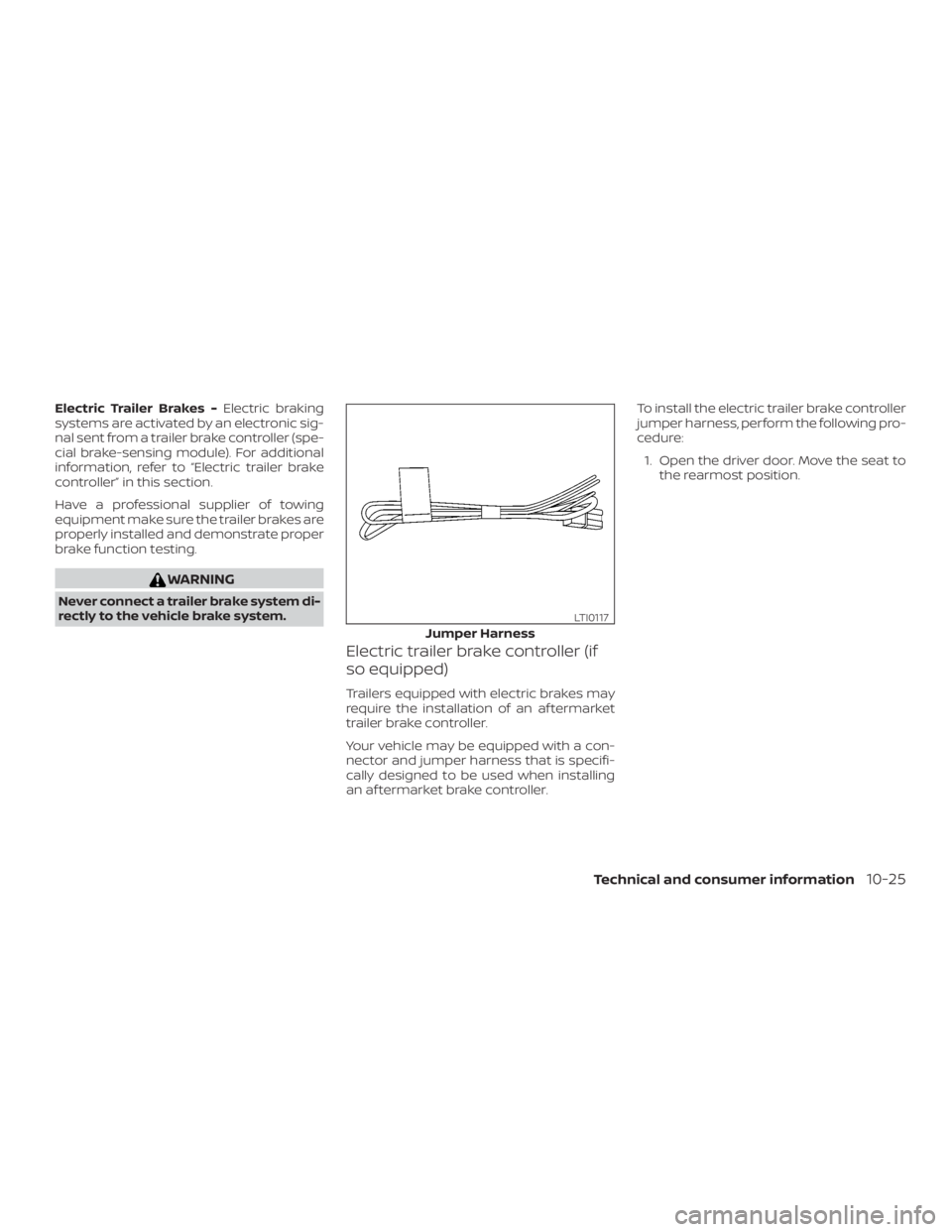
Electric Trailer Brakes -Electric braking
systems are activated by an electronic sig-
nal sent from a trailer brake controller (spe-
cial brake-sensing module). For additional
information, refer to “Electric trailer brake
controller” in this section.
Have a professional supplier of towing
equipment make sure the trailer brakes are
properly installed and demonstrate proper
brake function testing.
Page 459 of 482

Pre-towing tips
∙ Be certain your vehicle maintains a levelposition when a loaded and/or un-
loaded trailer is hitched. Do not drive the
vehicle if it has an abnormal nose-up or
nose-down condition; check for im-
proper tongue load, overload, worn sus-
pension or other possible causes of ei-
ther condition.
∙ Always secure items in the trailer to pre- vent load shif t while driving.
∙ Keep the cargo load as low as possible in the trailer to keep the trailer center of
gravity low.
∙ Load the trailer so approximately 60% of the trailer load is in the front half and
40% is in the back half. Also make sure
the load is balanced side to side.
∙ Check your hitch, trailer tire pressure, vehicle tire pressure, trailer light opera-
tion, and trailer wheel lug nuts every
time you attach a trailer to the vehicle.
∙ Be certain your rearview mirrors con- form to all federal, state or local regula-
tions. If not, install any mirrors required
for towing before driving the vehicle. ∙ Determine the overall height of the ve-
hicle and trailer so the required clear-
ance is known.
Trailer towing tips
In order to gain skill and an understanding
of the vehicle’s behavior, you should prac-
tice turning, stopping and backing up in an
area which is free from traffic. Steering sta-
bility and braking performance will be
somewhat different than under normal
driving conditions.
∙ Always secure items in the trailer to pre- vent load shif t while driving.
∙ Lock the trailer hitch coupler with a pin or lock to prevent the coupler from in-
advertently becoming unlatched.
∙ Avoid abrupt starts, acceleration or stops.
∙ Avoid sharp turns or lane changes.
∙ Always drive your vehicle at a moderate speed. ∙ When backing up, hold the bottom of
the steering wheel with one hand. Move
your hand in the direction in which you
want the trailer to go. Make small cor-
rections and back up slowly. If possible,
have someone guide you when you are
backing up.
Always block the wheels on both vehicle
and trailer when parking. Parking on a
slope is not recommended; however, if you
must do so:
Page 461 of 482

∙ Avoid holding the brake pedal down toolong or too frequently. This could cause
the brakes to overheat, resulting in re-
duced braking efficiency.
∙ Increase your following distance to al- low for greater stopping distances
while towing a trailer. Anticipate stops
and brake gradually.
∙ NISSAN recommends that the cruise control not be used while towing a
trailer.
∙ Some states or provinces have specific regulations and speed limits for ve-
hicles that are towing trailers. Obey the
local speed limits.
∙ Check your hitch, trailer wiring harness connections, and trailer wheel lug nuts
af ter 50 miles (80 km) of travel and at
every break.
∙ When launching a boat, don’t allow the water level to go over the exhaust tail
pipe or rear bumper.
∙ Make sure you disconnect the trailer lights before backing the trailer into the
water or the trailer lights may burn out.
When towing a trailer, final drive gear oil
should be replaced and transmission oil/fluid should be changed more fre-
quently. For additional information, refer
to the “Do-it-yourself ” section in this
manual.
Tow mode
Using tow mode is recommended when
pulling a heavy trailer or hauling a heavy
load. Push the TOW MODE switch to acti-
vate tow mode. Push the TOW MODE
switch again to turn tow mode off. Tow
mode is automatically canceled when the
ignition switch is turned off.
Tow mode includes the following features:
∙ Grade logic — Adjusts transmission shif ts when pulling a trailer or hauling a
load up a grade.
∙ Downhill Speed Control (DSC) — auto- matically downshif ts when driving
down a grade with a trailer or heavy
load to help control vehicle speed.
Driving the vehicle in the tow mode with no
trailer/load or light trailer/light load will not
cause any damage. However, fuel
economy may be reduced and the
transmission/engine driving characteris-
tics may feel unusual. When towing a trailer, final drive gear oil
should be replaced and transmission
oil/fluid should be changed more fre-
quently. For additional information, refer
to the “Do-it-yourself ” section of this
manual.FLAT TOWING FOR 4–WHEEL DRIVE
VEHICLE (if so equipped)
Towing your vehicle with all four wheels on
the ground is sometimes called flat towing.
This method is sometimes used when
towing a vehicle behind a recreational ve-
hicle, such as a motor home.
Page 472 of 482

Seats2nd row bench seat adjustment .....1-9
Adjustment ..................1-2
Armrests...................1-10
Automatic drive positioner ....3-39,3-41
Frontseats..................1-2
Heatedseats................2-45
Manual front seat adjustment ......1-3
Security indicator light ............2-18
Security system (NISSAN Vehicle Immobilizer
System), engine start ..........2-35,5-14
Security systems Vehicle security system .........2-34
Self-adjustingbrakes.............8-20
Service manual order form .........10-34
Servicing air conditioner ...........4-41
Sonar Rear system ................5-79
Spark plug replacement ...........8-17
Spark plugs ...................8-17
Specifications .................10-8
Speedometer ................2-4,2-5
Speedometer and odometer ........2-4
Spotlights(Seemaplight)..........2-73
SRS warning label ...............1-72
Standard maintenance ..........9-7,9-8
Starting Before starting the engine ........5-15
Jumpstarting............6-10,8-16
Precautions when starting and
driving .....................5-2
Push starting ................6-12
Starting the engine ............5-15
Starting the engine ..............5-15
Steering Powersteeringfluid............8-11 Powersteeringsystem..........5-72
Steering wheel .................3-33
Stoplight....................8-26
Storage.....................2-58
Storagebin...................2-64
Storagetray ..................2-59
Sunglasses case ................2-61
Sunglasses holder ...............2-61
Sunroof ...................2-69,7-5
Sunvisors....................3-34
Supplemental air bag warning labels . . .1-72
Supplemental air bag warning
light.................... .1-73, 2-16
Supplemental front impact air bag
system ..................... .1-61
Supplemental restraint system Information and warning labels .....1-72
Precautions on supplemental restraint
system ................... .1-53
Supplemental restraint system
(Supplemental air bag system) .......1-53
Switch Autolightswitch..............2-41
Automatic power window switch . . .2-68
Foglightswitch..............2-44
Hazard warning flasher switch ......6-2
Headlight and turn signal switch ....2-40
Headlightcontrolswitch.........2-40
Hill descent control switch .......2-50
Instrument brightness control .....2-43
Power door lock switch ..........3-6
Powerinverterswitch ..........2-52
Rear window and outside mirror
defrosterswitch..............2-39
Rear window wiper and washer
switches ...................2-38 Tow mode switch
.............2-53
Turn signal switch .............2-43
T
Tachometer ...................2-6
T
emperature gauge Engine coolant temperature gauge . .2-6
Thef t (NISSAN Vehicle Immobilizer System),
engine start ...............2-35, 5-14
Three-waycatalyst...............5-2
Tire Flattire....................6-3
Spare tire ................6-5,8-39
Tire and Loading Information label . .10-12
Tire chains .................8-35
Tire pressure ................8-28
Tirerotation ................8-36
Tires of 4-wheel drive ...........8-38
Types of tires ................8-34
Uniform tire quality grading ......10-30
Wheels and tires ..........8-28,10-9
Wheel/tire size ...............10-9
Tire pressure Low tire pressure warning light .....2-13
Tire Pressure Monitoring System (TPMS) . .5-3
Toptetherstrapchildrestraint.......1-34
Towing 2-wheel drive models ...........6-15
Flattowing.............10-29,10-30
Towing load/specification .......10-20
Towtrucktowing .............6-13
Trailertowing ...............10-17
Towingatrailer................10-17
Tow mode switch ...............2-53
11-6