2021 NISSAN MURANO Section 2
[x] Cancel search: Section 2Page 423 of 508
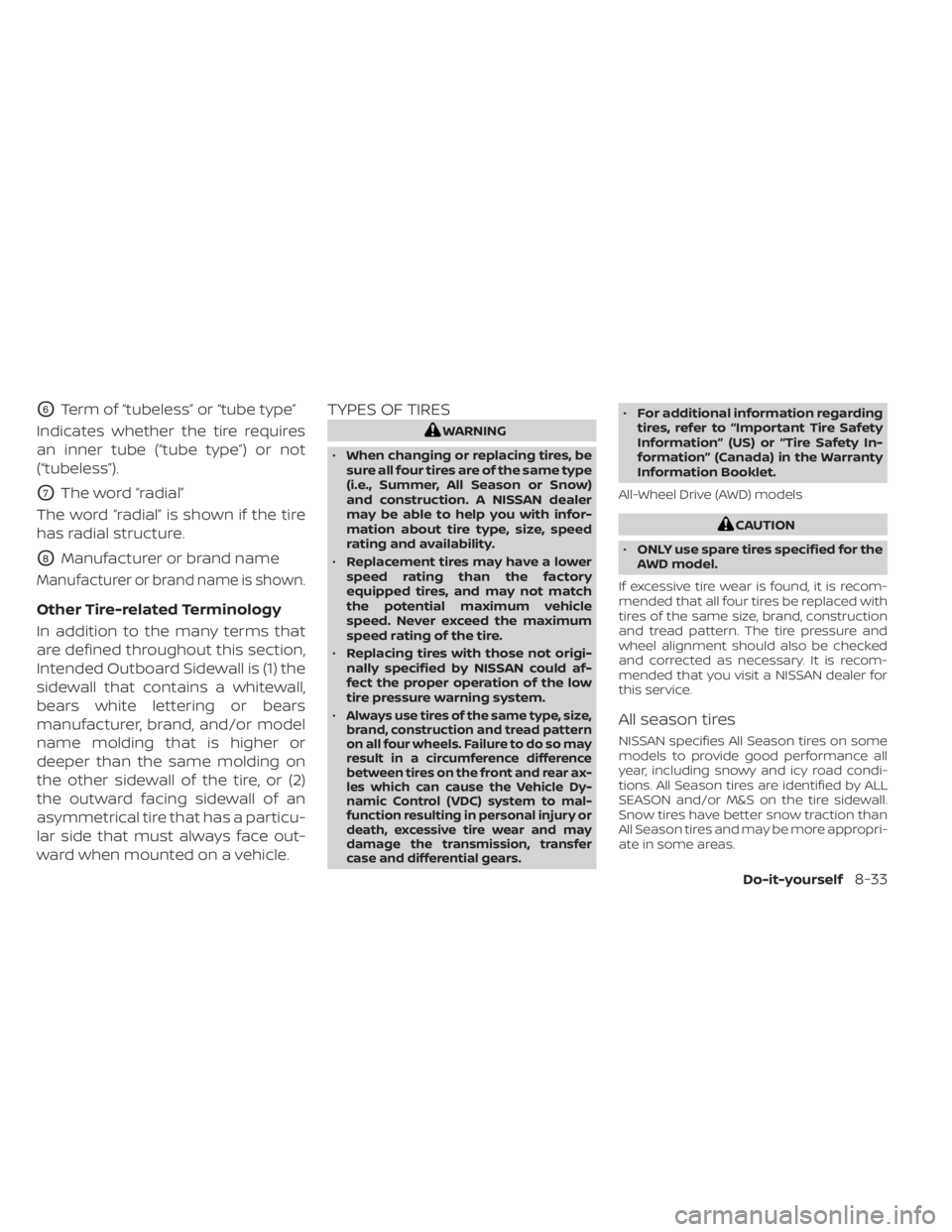
O6Term of “tubeless” or “tube type”
Indicates whether the tire requires
an inner tube (“tube type”) or not
(“tubeless”).
O7The word “radial”
The word “radial” is shown if the tire
has radial structure.
O8Manufacturer or brand name
Manufacturer or brand name is shown.
Other Tire-related Terminology
In addition to the many terms that
are defined throughout this section,
Intended Outboard Sidewall is (1) the
sidewall that contains a whitewall,
bears white lettering or bears
manufacturer, brand, and/or model
name molding that is higher or
deeper than the same molding on
the other sidewall of the tire, or (2)
the outward facing sidewall of an
asymmetrical tire that has a particu-
lar side that must always face out-
ward when mounted on a vehicle.
TYPES OF TIRES
WARNING
• When changing or replacing tires, be
sure all four tires are of the same type
(i.e., Summer, All Season or Snow)
and construction. A NISSAN dealer
may be able to help you with infor-
mation about tire type, size, speed
rating and availability.
• Replacement tires may have a lower
speed rating than the factory
equipped tires, and may not match
the potential maximum vehicle
speed. Never exceed the maximum
speed rating of the tire.
• Replacing tires with those not origi-
nally specified by NISSAN could af-
fect the proper operation of the low
tire pressure warning system.
•
Always use tires of the same type, size,
brand, construction and tread pattern
on all four wheels. Failure to do so may
result in a circumference difference
between tires on the front and rear ax-
les which can cause the Vehicle Dy-
namic Control (VDC) system to mal-
function resulting in personal injury or
death, excessive tire wear and may
damage the transmission, transfer
case and differential gears.
• For additional information regarding
tires, refer to “Important Tire Safety
Information” (US) or “Tire Safety In-
formation” (Canada) in the Warranty
Information Booklet.
All-Wheel Drive (AWD) models
CAUTION
• ONLY use spare tires specified for the
AWD model.
If excessive tire wear is found, it is recom-
mended that all four tires be replaced with
tires of the same size, brand, construction
and tread pattern. The tire pressure and
wheel alignment should also be checked
and corrected as necessary. It is recom-
mended that you visit a NISSAN dealer for
this service.
All season tires
NISSAN specifies All Season tires on some
models to provide good performance all
year, including snowy and icy road condi-
tions. All Season tires are identified by ALL
SEASON and/or M&S on the tire sidewall.
Snow tires have better snow traction than
All Season tires and may be more appropri-
ate in some areas.
Do-it-yourself8-33
Page 430 of 508
Some day-to-day and regular mainte-
nance is essential to maintain your vehicle
good mechanical condition, as well as its
emissions and engine performance.
It is the owner's responsibility to make sure
that the scheduled maintenance, as well as
general maintenance, is performed.
As the vehicle owner, you are the only one
who can ensure that your vehicle receives
proper maintenance. You are a vital link in
the maintenance chain.
GENERAL MAINTENANCE
General maintenance includes those items
which should be checked during normal
day-to-day operation. They are essential
for proper vehicle operation. It is your re-
sponsibility to perform these procedures
regularly as prescribed.
Performing general maintenance checks
requires minimal mechanical skill and only
a few general automotive tools.
These checks or inspections can be done
by yourself, a qualified technician or, if you
prefer, a NISSAN dealer.
SCHEDULED MAINTENANCE
The maintenance items listed in this sec-
tion are required to be serviced at regular
intervals. However under severe driving
conditions, additional or more frequent
maintenance will be required.
WHERE TO GO FOR SERVICE
If maintenance service is required or your
vehicle appears to malfunction, have the
systems checked and serviced. It is recom-
mended that you visit a NISSAN dealer for
this service.
NISSAN technicians are well-trained spe-
cialists and are kept up-to-date with the
latest service information through techni-
cal bulletins, service tips and training pro-
grams. They are fully qualified to work on
NISSAN vehiclesbeforework begins.
If your vehicle is involved in a collision, it is
recommended that you ask your NISSAN
dealer where the nearest NISSAN Certified
Collision Center is located, or go to
http://collision.nissanusa.com.
You can be confident that a NISSAN deal-
er's service department can perform the
service needed to meet the maintenance
requirements on your vehicle. During the normal day-to-day operation of
the vehicle, general maintenance should
be performed regularly as prescribed in
this section. If you detect any unusual
sounds, vibrations or smells, be sure to
check for the cause or have it checked
promptly. In addition, it is recommended
that you visit a NISSAN dealer if you think
that repairs are required.
When performing any checks or mainte-
nance work, closely observe the “Mainte-
nance precautions” in the “Do-it-yourself ”
section of this manual.
EXPLANATION OF GENERAL
MAINTENANCE ITEMS
WARNING
Failure to follow the procedures listed
within this section may result in per-
sonal injury.
Additional information on the following
items with“*”isf ound in the “Do-it-
yourself ” section of this manual.
MAINTENANCE REQUIREMENTS GENERAL MAINTENANCE
9-2Maintenance and schedules
Page 433 of 508
Engine valve clearance*:Inspect if valve
noise increases.
Exhaust system: Make sure there are no
loose supports, cracks or holes. If the
sound of the exhaust seems unusual or
there is a smell of exhaust fumes, immedi-
ately have the exhaust system inspected. It
is recommended that you visit a NISSAN
dealer for this service. For additional infor-
mation, see “Exhaust gas (carbon monox-
ide)” (P. 5-4).
Fluid leaks: Check under the vehicle for
fuel, oil, water or other fluid leaks af ter the
vehicle has been parked for a while. Water
dripping from the air conditioner af ter use
is normal. If you should notice any leaks or if
fuel fumes are evident, check for the cause
and have it corrected immediately.
Power steering fluid level* and lines:
Check the level when the fluid is cold, with
the engine off. Check the lines for proper
attachment, leaks, cracks, etc.
Radiator and hoses: Check the front of the
radiator and clean off any dirt, insects,
leaves, etc., that may have accumulated.
Make sure the hoses have no cracks, defor-
mation, rot or loose connections. Underbody:
The underbody is frequently
exposed to corrosive substances such as
those used on icy roads or to control dust. It
is very important to remove these sub-
stances, otherwise rust may form on the
floor pan, frame, fuel lines and around the
exhaust system. At the end of winter, the
underbody should be thoroughly flushed
with plain water, being careful to clean
those areas where mud and dirt may accu-
mulate. For additional information, see
“Cleaning exterior” (P. 7-2).
Windshield-washer fluid*: Check that
there is adequate fluid in the reservoir. The following descriptions are provided to
give you a better understanding of the
scheduled maintenance items that should
be regularly checked or replaced. The
maintenance schedule indicates at which
mileage/time intervals each item requires
service.
In addition to scheduled maintenance,
your vehicle requires that some items be
checked during normal day-to-day opera-
tion. For additional information, see “Gen-
eral maintenance” (P. 9-2).
Items marked with
“*”are recommended
by NISSAN for reliable vehicle operation.
You are not required to perform mainte-
nance on these items in order to maintain
the warranties which come with your
NISSAN. Other maintenance items and in-
tervals are required.
When applicable, additional information
can be found in the “Do-it-yourself ” section
of this manual.
EXPLANATION OF SCHEDULED
MAINTENANCE ITEMS
Maintenance and schedules9-5
Page 462 of 508
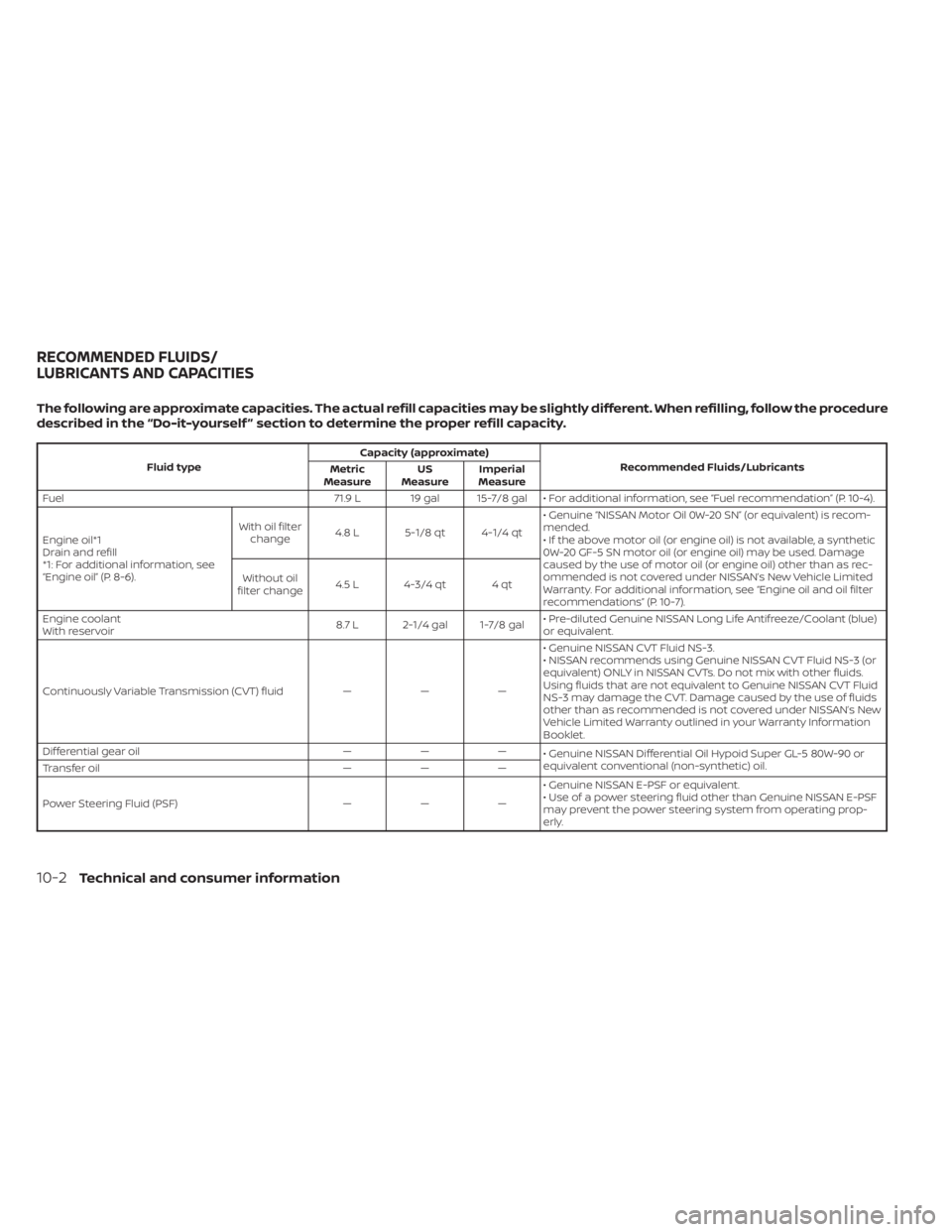
The following are approximate capacities. The actual refill capacities may be slightly different. When refilling, follow the procedure
described in the “Do-it-yourself ” section to determine the proper refill capacity.
Fluid typeCapacity (approximate)
Recommended Fluids/Lubricants
Metric
Measure US
Measure Imperial
Measure
Fuel 71.9 L 19 gal 15-7/8 gal • For additional information, see “Fuel recommendation” (P. 10-4).
Engine oil*1
Drain and refill
*1: For additional information, see
“Engine oil” (P. 8-6). With oil filter
change 4.8 L 5-1/8 qt 4-1/4 qt • Genuine “NISSAN Motor Oil 0W-20 SN” (or equivalent) is recom-
mended.
• If the above motor oil (or engine oil) is not available, a synthetic
0W-20 GF-5 SN motor oil (or engine oil) may be used. Damage
caused by the use of motor oil (or engine oil) other than as rec-
ommended is not covered under NISSAN’s New Vehicle Limited
Warranty. For additional information, see “Engine oil and oil filter
recommendations” (P. 10-7).
Without oil
filter change 4.5 L 4-3/4 qt 4 qt
Engine coolant
With reservoir 8.7 L 2-1/4 gal 1-7/8 gal• Pre-diluted Genuine NISSAN Long Life Antifreeze/Coolant (blue)
or equivalent.
Continuously Variable Transmission (CVT) fluid — — — • Genuine NISSAN CVT Fluid NS-3.
• NISSAN recommends using Genuine NISSAN CVT Fluid NS-3 (or
equivalent) ONLY in NISSAN CVTs. Do not mix with other fluids.
Using fluids that are not equivalent to Genuine NISSAN CVT Fluid
NS-3 may damage the CVT. Damage caused by the use of fluids
other than as recommended is not covered under NISSAN’s New
Vehicle Limited Warranty outlined in your Warranty Information
Booklet.
Differential gear oil — — — • Genuine NISSAN Differential Oil Hypoid Super GL-5 80W-90 or
equivalent conventional (non-synthetic) oil.
Transfer oil — — —
Power Steering Fluid (PSF) — — — • Genuine NISSAN E-PSF or equivalent.
• Use of a power steering fluid other than Genuine NISSAN E-PSF
may prevent the power steering system from operating prop-
erly.
RECOMMENDED FLUIDS/
LUBRICANTS AND CAPACITIES
10-2Technical and consumer information
Page 479 of 508
MEASUREMENT OF WEIGHTS
Secure loose items to prevent
weight shif ts that could affect the
balance of your vehicle. When the ve-
hicle is loaded, drive to a scale and
weigh the front and the rear wheels
separately to determine axle loads.
Individual axle loads should not ex-
ceed either of the Gross Axle Weight
Ratings (GAWR). The total of the axle
loads should not exceed the Gross
Vehicle Weight Rating (GVWR). These
ratings are given on the vehicle cer-
tification label. If weight ratings are
exceeded, move or remove items to
bring all weights below the ratings.
WARNING
Overloading or improper loading of a
trailer and its cargo can adversely af-
fect vehicle handling, braking and per-
formance and may lead to accidents.
CAUTION
• Do not tow a trailer or haul a heavy
load for the first 500 miles (805 km).
Your engine, axle or other parts could
be damaged.
• For the first 500 miles (805 km) that
you tow a trailer, do not drive over 50
mph (80 km/h) and do not make
starts at full throttle. This helps the
engine and other parts of your ve-
hicle wear in at the heavier loads.
NOTE:
Tow hitches are available as an acces-
sory for this vehicle. If a tow hitch is in-
stalled, the lif tgate electronic control
unit (ECU) needs to be replaced with an
ECU programmed with towing logic for
the Motion-Activated Lif tgate to func-
tion properly. Your new vehicle was designed to be used
primarily to carry passengers and cargo.
Remember that towing a trailer places ad-
ditional loads on your vehicle's engine,
drive train, steering, braking and other
systems.
A NISSAN Towing Guide (U.S. only) is avail-
able on the website at
www.nissanusa.com. This guide includes
information on trailer towing capability and
the special equipment required for proper
towing.
MAXIMUM LOAD LIMITS
Maximum trailer loads
Never allow the total trailer load to exceed
the value specified in the “Towing Load/
Specification” chart found in this section.
The total trailer load equals trailer weight
plus its cargo weight.
The maximum Gross Combined Weight
Rating (GCWR) should not exceed the value
specified in the following Towing Load/
Specification Chart.
TOWING A TRAILER
Technical and consumer information10-19
Page 481 of 508
Maximum Gross Vehicle Weight
(GVW)/maximum Gross Axle
Weight (GAW)
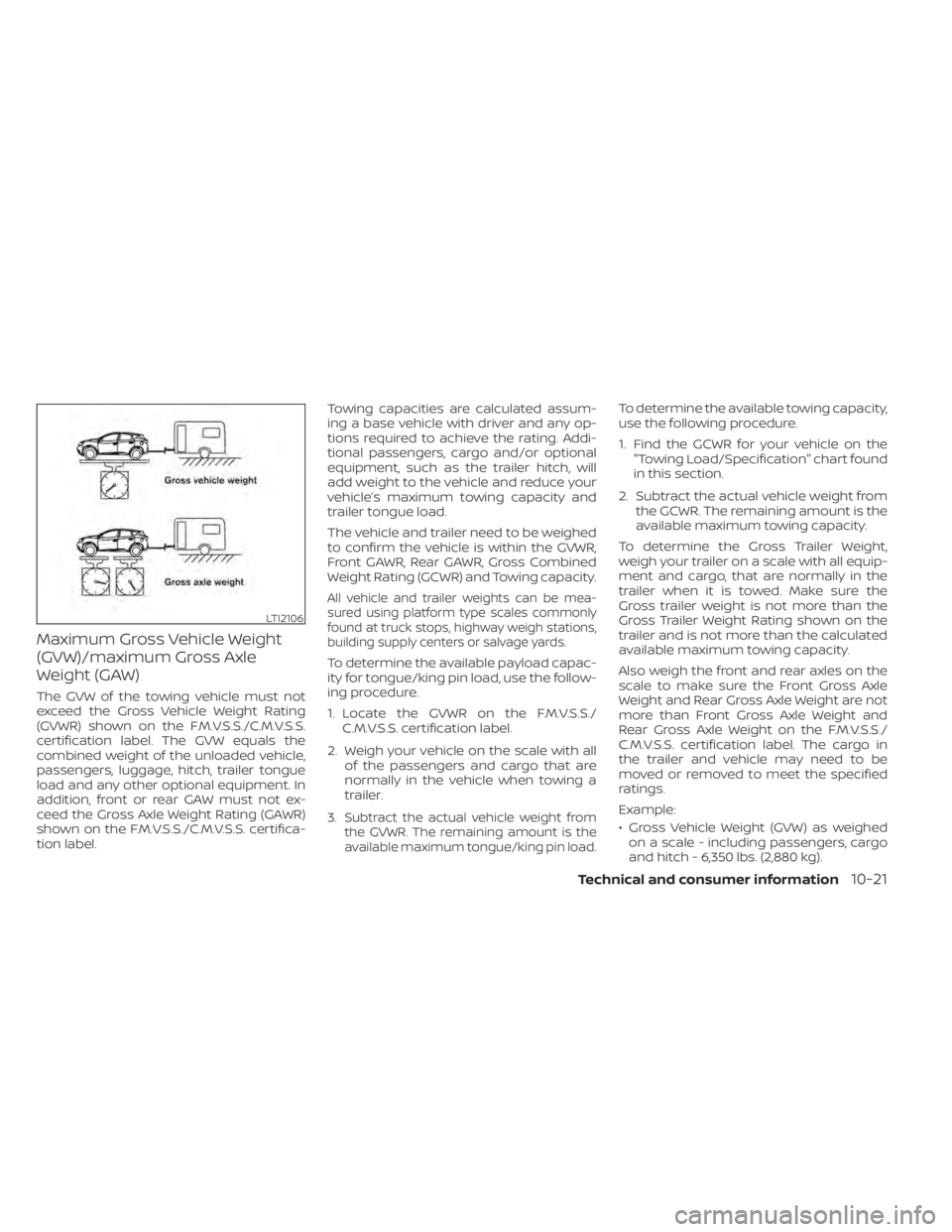
The GVW of the towing vehicle must not
exceed the Gross Vehicle Weight Rating
(GVWR) shown on the F.M.V.S.S./C.M.V.S.S.
certification label. The GVW equals the
combined weight of the unloaded vehicle,
passengers, luggage, hitch, trailer tongue
load and any other optional equipment. In
addition, front or rear GAW must not ex-
ceed the Gross Axle Weight Rating (GAWR)
shown on the F.M.V.S.S./C.M.V.S.S. certifica-
tion label.Towing capacities are calculated assum-
ing a base vehicle with driver and any op-
tions required to achieve the rating. Addi-
tional passengers, cargo and/or optional
equipment, such as the trailer hitch, will
add weight to the vehicle and reduce your
vehicle’s maximum towing capacity and
trailer tongue load.
The vehicle and trailer need to be weighed
to confirm the vehicle is within the GVWR,
Front GAWR, Rear GAWR, Gross Combined
Weight Rating (GCWR) and Towing capacity.
All vehicle and trailer weights can be mea-
sured using platform type scales commonly
found at truck stops, highway weigh stations,
building supply centers or salvage yards.
To determine the available payload capac-
ity for tongue/king pin load, use the follow-
ing procedure.
1. Locate the GVWR on the F.M.V.S.S./
C.M.V.S.S. certification label.
2. Weigh your vehicle on the scale with all of the passengers and cargo that are
normally in the vehicle when towing a
trailer.
3.
Subtract the actual vehicle weight from
the GVWR. The remaining amount is the
available maximum tongue/king pin load.
To determine the available towing capacity,
use the following procedure.
1. Find the GCWR for your vehicle on the "Towing Load/Specification" chart found
in this section.
2. Subtract the actual vehicle weight from the GCWR. The remaining amount is the
available maximum towing capacity.
To determine the Gross Trailer Weight,
weigh your trailer on a scale with all equip-
ment and cargo, that are normally in the
trailer when it is towed. Make sure the
Gross trailer weight is not more than the
Gross Trailer Weight Rating shown on the
trailer and is not more than the calculated
available maximum towing capacity.
Also weigh the front and rear axles on the
scale to make sure the Front Gross Axle
Weight and Rear Gross Axle Weight are not
more than Front Gross Axle Weight and
Rear Gross Axle Weight on the F.M.V.S.S./
C.M.V.S.S. certification label. The cargo in
the trailer and vehicle may need to be
moved or removed to meet the specified
ratings.
Example:
• Gross Vehicle Weight (GVW) as weighed on a scale - including passengers, cargo
and hitch - 6,350 lbs. (2,880 kg).
LTI2106
Technical and consumer information10-21
Page 487 of 508
• When backing up, hold the bottom of thesteering wheel with one hand. Move your
hand in the direction in which you want
the trailer to go. Make small corrections
and back up slowly. If possible, have
someone guide you when you are back-
ing up.
Always block the wheels on both vehicle
and trailer when parking. Parking on a
slope is not recommended; however, if you
must do so:
CAUTION
If you move the shif t lever to the P
(Park) position before blocking the
wheels and applying the parking brake,
transmission damage could occur.
1. Apply and hold the brake pedal.
2. Have someone place blocks on the downhill side of the vehicle and trailer
wheels.
3. Af ter the wheel blocks are in place, slowly release the brake pedal until the
blocks absorb the vehicle load.
4. Apply the parking brake.
5. Shif t the transmission into P (Park).
6. Turn off the engine. To drive away:
1. Start the vehicle.
2. Apply and hold the brake pedal.
3. Shif t the transmission into gear.
4. Release the parking brake.
5. Drive slowly until the vehicle and trailer
are clear from the blocks.
6. Apply and hold the brake pedal.
7. Have someone retrieve and store the blocks.
• While going downhill, the weight of the trailer pushing on the tow vehicle may
decrease overall stability. Therefore, to
maintain adequate control, reduce your
speed and shif t to a lower gear. Avoid
long or repeated use of the brakes when
descending a hill, as this reduces their
effectiveness and could cause overheat-
ing. Shif ting to a lower gear instead pro-
vides “engine braking” and reduces the
need to brake as frequently.
• If the engine coolant temperature rises to a high temperature, see “If your vehicle
overheats” (P. 6-12).
• Trailer towing requires more fuel than normal circumstances. • Avoid towing a trailer for your vehicle's
first 500 miles (805 km).
• For the first 500 miles (805 km) that you do tow, do not drive over 50 mph (80
km/h).
• Have your vehicle serviced more of ten than at intervals specified in the recom-
mended Maintenance Schedule in the
“Maintenance and schedules” section of
this manual.
• When making a turn, your trailer wheels will be closer to the inside of the turn than
your vehicle wheels. To compensate for
this, make a larger than normal turning
radius during the turn.
• Crosswinds and rough roads will ad- versely affect vehicle/trailer handling,
possibly causing vehicle sway. When be-
ing passed by larger vehicles, be pre-
pared for possible changes in crosswinds
that could affect vehicle handling.
Do the following if the trailer begins to
sway:
1. Take your foot off the accelerator pedal to allow the vehicle to coast and steer as
straight ahead as the road conditions
allow. This combination will help stabilize
the vehicle
Technical and consumer information10-27
Page 488 of 508
– Do not correct trailer sway by steeringor applying the brakes.
2. When the trailer sway stops, gently apply the brakes and pull to the side of the
road in a safe area.
3. Try to rearrange the trailer load so it is balanced as described in this section.
• Be careful when passing other vehicles. Passing while towing a trailer requires
considerably more distance than normal
passing. Remember, the length of the
trailer must also pass the other vehicle
before you can safely change lanes.
• Downshif t the transmission to a lower gear for engine braking when driving
down steep or long hills. This will help
slow the vehicle without applying the
brakes.
• Avoid holding the brake pedal down too long or too frequently. This could cause
the brakes to overheat, resulting in re-
duced braking efficiency.
• Increase your following distance to allow for greater stopping distances while tow-
ing a trailer. Anticipate stops and brake
gradually.
• NISSAN recommends that the cruise control not be used while towing a trailer. • Some states or provinces have specific
regulations and speed limits for vehicles
that are towing trailers. Obey the local
speed limits.
• Check your hitch, trailer wiring harness connections, and trailer wheel lug nuts
af ter 50 miles (80 km) of travel and at
every break.
• When launching a boat, don't allow the water level to go over the exhaust tail
pipe or rear bumper.
• Make sure you disconnect the trailer lights before backing the trailer into the
water or the trailer lights may burn out.
When towing a trailer, final drive gear oil
should be replaced and transmission oil/
fluid should be changed more fre-
quently. For additional information, see
“Do-it-yourself ” (P. 8-2).
FLAT TOWING FOR ALL–WHEEL
DRIVE VEHICLE (if so equipped)
Towing your vehicle with all four wheels on
the ground is sometimes called flat towing.
This method is sometimes used when
towing a vehicle behind a recreational ve-
hicle, such as a motor home.
CAUTION
• Failure to follow these guidelines can
result in severe transmission
damage.
• Never flat tow your All-Wheel Drive
(AWD) vehicle.
• DO NOT tow your All-Wheel Drive
(AWD) vehicle with any wheels on the
ground. Doing so may cause serious
and expensive damage to the
powertrain.
• For emergency towing procedures
see “Towing recommended by
NISSAN” (P. 6-13).
FLAT TOWING FOR FRONT WHEEL
DRIVE VEHICLE (if so equipped)
Towing your vehicle with all four wheels on
the ground is sometimes called flat towing.
This method is sometimes used when
towing a vehicle behind a recreational ve-
hicle, such as a motor home.
10-28Technical and consumer information