2021 NISSAN MAXIMA spare tire
[x] Cancel search: spare tirePage 413 of 476
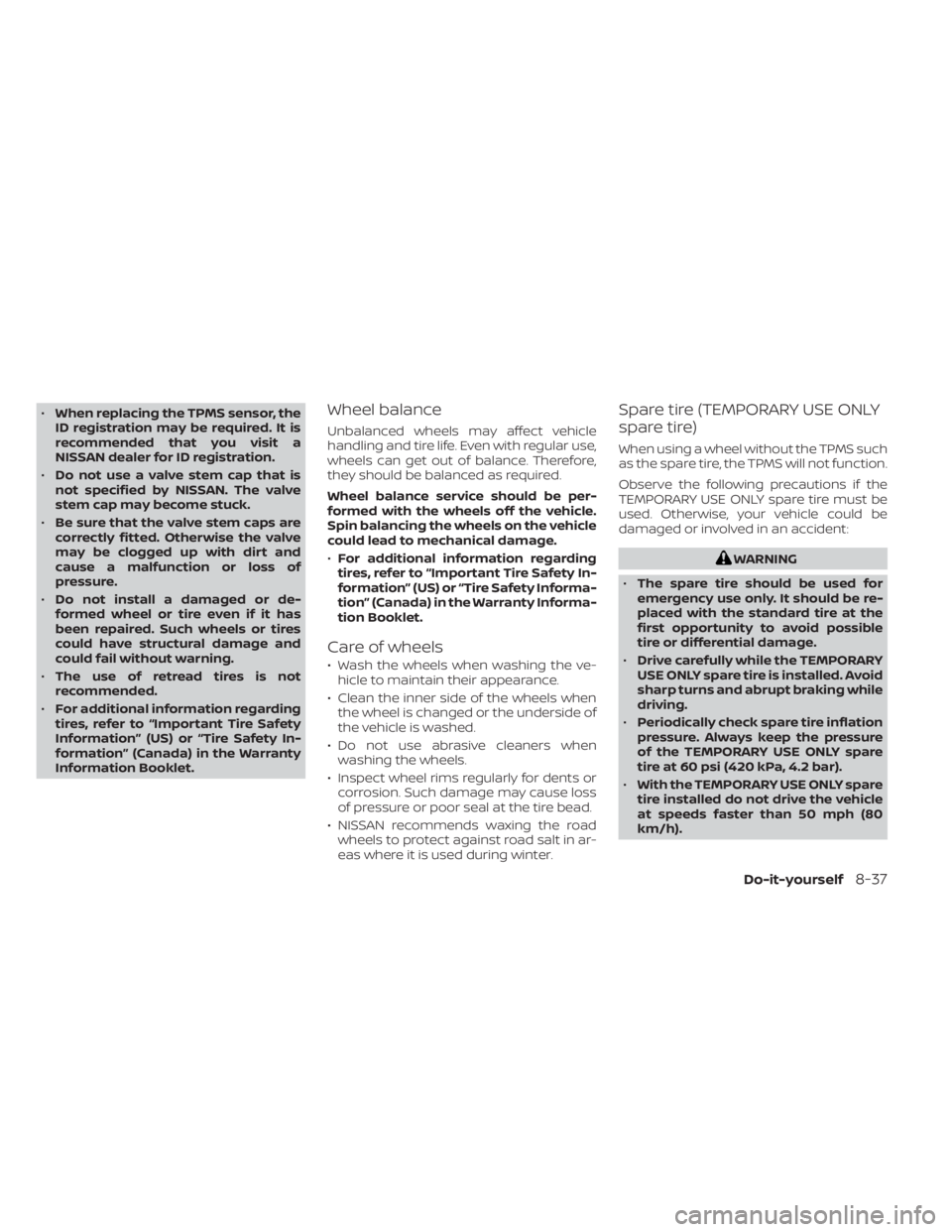
•When replacing the TPMS sensor, the
ID registration may be required. It is
recommended that you visit a
NISSAN dealer for ID registration.
• Do not use a valve stem cap that is
not specified by NISSAN. The valve
stem cap may become stuck.
• Be sure that the valve stem caps are
correctly fitted. Otherwise the valve
may be clogged up with dirt and
cause a malfunction or loss of
pressure.
• Do not install a damaged or de-
formed wheel or tire even if it has
been repaired. Such wheels or tires
could have structural damage and
could fail without warning.
• The use of retread tires is not
recommended.
• For additional information regarding
tires, refer to “Important Tire Safety
Information” (US) or “Tire Safety In-
formation” (Canada) in the Warranty
Information Booklet.Wheel balance
Unbalanced wheels may affect vehicle
handling and tire life. Even with regular use,
wheels can get out of balance. Therefore,
they should be balanced as required.
Wheel balance service should be per-
formed with the wheels off the vehicle.
Spin balancing the wheels on the vehicle
could lead to mechanical damage.
• For additional information regarding
tires, refer to “Important Tire Safety In-
formation” (US) or “Tire Safety Informa-
tion” (Canada) in the Warranty Informa-
tion Booklet.
Care of wheels
• Wash the wheels when washing the ve- hicle to maintain their appearance.
• Clean the inner side of the wheels when the wheel is changed or the underside of
the vehicle is washed.
• Do not use abrasive cleaners when washing the wheels.
• Inspect wheel rims regularly for dents or corrosion. Such damage may cause loss
of pressure or poor seal at the tire bead.
• NISSAN recommends waxing the road wheels to protect against road salt in ar-
eas where it is used during winter.
Spare tire (TEMPORARY USE ONLY
spare tire)
When using a wheel without the TPMS such
as the spare tire, the TPMS will not function.
Observe the following precautions if the
TEMPORARY USE ONLY spare tire must be
used. Otherwise, your vehicle could be
damaged or involved in an accident:
WARNING
• The spare tire should be used for
emergency use only. It should be re-
placed with the standard tire at the
first opportunity to avoid possible
tire or differential damage.
• Drive carefully while the TEMPORARY
USE ONLY spare tire is installed. Avoid
sharp turns and abrupt braking while
driving.
• Periodically check spare tire inflation
pressure. Always keep the pressure
of the TEMPORARY USE ONLY spare
tire at 60 psi (420 kPa, 4.2 bar).
• With the TEMPORARY USE ONLY spare
tire installed do not drive the vehicle
at speeds faster than 50 mph (80
km/h).
Do-it-yourself8-37
Page 414 of 476

•When driving on roads covered with
snow or ice, the TEMPORARY USE
ONLY spare tire should be used on the
rear wheels and the original tire used
on the front wheels (drive wheels).
• Tire tread of the TEMPORARY USE
ONLY spare tire will wear at a faster
rate than the standard tire. Replace
the spare tire as soon as the tread
wear indicators appear.
• Do not use the spare tire on other
vehicles.
• Do not use more than one spare tire
at the same time.
• Do not tow a trailer when the TEMPO-
RARY USE ONLY spare tire is installed.CAUTION
• Do not use tire chains on a TEMPO-
RARY USE ONLY spare tire. Tire chains
will not fit properly and may cause
damage to the vehicle.
• Because the TEMPORARY USE ONLY
spare tire is smaller than the original
tire, ground clearance is reduced. To
avoid damage to the vehicle, do not
drive over obstacles. Also, do not
drive the vehicle through an auto-
matic car wash since it may get
caught.
8-38Do-it-yourself
Page 417 of 476

Outside the vehicle
The maintenance items listed here should
be performed from time to time, unless
otherwise specified.
Doors and engine hood:
Check that the
doors and engine hood operate properly.
Also ensure that all latches lock securely. Lu-
bricate hinges, latches, latch pins, rollers and
links if necessary. Make sure that the sec-
ondary latch keeps the hood from opening
when the primary latch is released.
When driving in areas using road salt or
other corrosive materials, check lubrica-
tion frequently.
Check that the gas stays or struts properly
and securely hold the hood, trunk, or rear
hatch fully open. If the hood, trunk, or rear
hatch is not held open, have the gas stays
or struts replaced.
Lights*: Clean the headlights on a regular
basis. Make sure that the headlights, stop
lights, tail lights, turn signal lights, and other
lights are all operating properly and in-
stalled securely. Also check headlight aim.
Road wheel nuts (lug nuts)*: When check-
ing the tires, make sure no wheel nuts are
missing, and check for any loose wheel
nuts. Tighten if necessary. Tire rotation*:
Rotate tires at the specified
interval shown in the maintenance
schedule.
Tires*: Check the pressure with a gauge
of ten and always prior to long distance
trips. If necessary, adjust the pressure in all
tires, including the spare, to the pressure
specified. Check carefully for damage, cuts
or excessive wear.
Tire Pressure Monitoring System (TPMS)
transmitter components: Replace the
TPMS transmitter grommet seal, valve core
and cap when the tires are replaced due to
wear or age.
Wheel alignment and balance: If the ve-
hicle should pull to either side while driving
on a straight and level road, or if you detect
uneven or abnormal tire wear, there may
be a need for wheel alignment. If the steer-
ing wheel or seat vibrates at normal high-
way speeds, wheel balancing may be
needed.
For additional information regarding tires,
refer to “Important Tire Safety Information”
(US) or “Tire Safety Information” (Canada) in
the Warranty Information Booklet.
Windshield: Clean the windshield on a
regular basis. Check the windshield at least
every six months for cracks or other dam- age. Have a damaged windshield repaired
by a qualified repair facility. It is recom-
mended that you have a damaged wind-
shield repaired by a NISSAN dealer, or a
NISSAN Certified Collision Center. To locate
a collision center in your area, refer to
http://collision.nissanusa.com.
Windshield wiper blades*:
Check for
cracks or wear if they do not wipe properly.
Inside the vehicle
The maintenance items listed here should
be checked on a regular basis, such as
when performing scheduled maintenance,
cleaning the vehicle, etc.
Accelerator pedal: Check the pedal for
smooth operation and make sure the
pedal does not catch or require uneven
effort. Keep the floor mat away from the
pedal.
Brake pedal: Check the pedal for smooth
operation. If the brake pedal suddenly goes
down further than normal, the pedal feels
spongy or the vehicle seems to take longer
to stop, have your vehicle checked imme-
diately. It is recommended that you visit a
NISSAN dealer for this service. Keep the
floor mat away from the pedal.
Maintenance and schedules9-3
Page 447 of 476

WHEELS AND TIRES
WheelsSize Offset in (mm)
Aluminum 18 x 8.0J 1.97 (50)
Aluminum 19 x 8.0J 1.97 (50)
Aluminum 19 x 8.5J 1.97 (50)
Spare wheel steel 17 x 4T 1.18 (30)
Tires 245/45R18
245/40R19
Spare tires T145/80D17
DIMENSIONS AND WEIGHTS
Overall length in (mm) 192.8 (4,897)
Overall width in (mm) 73.2 (1,860)
Overall height in (mm) 56.5 (1,436)
Front Track in (mm) 62.4 (1,585)
Rear Track in (mm) 62.4 (1,585)
Wheelbase in (mm) 109.3 (2,775)
Gross vehicle weight rating lbs. (kg) Refer to the
“F.M.V.S.S./
C.M.V.S.S. certifi-
cation label” on
the center pillar
between the
driver's side
front and rear
doors.
Gross axle weight rating
Front lbs. (kg)
Rear lbs. (kg)
Technical and consumer information10-9
Page 452 of 476

WARNING
• It is extremely dangerous to
ride in a cargo area inside a ve-
hicle. In a collision, people rid-
ing in these areas are more
likely to be seriously injured or
killed.
• Do not allow people to ride in
any area of your vehicle that is
not equipped with seats and
seat belts.
• Be sure everyone in your ve-
hicle is in a seat and using a
seat belt properly.TERMS
It is important to familiarize yourself
with the following terms before
loading your vehicle:
• Curb Weight (actual weight of your vehicle) - vehicle weight including:
standard and optional equipment,
fluids, emergency tools, and spare
tire assembly. This weight does
not include passengers and cargo.
• GVW (Gross Vehicle Weight) - curb weight plus the combined weight
of passengers and cargo. • GVWR (Gross Vehicle Weight Rat-
ing) - maximum total combined
weight of the unloaded vehicle,
passengers, luggage, hitch, trailer
tongue load and any other op-
tional equipment. This information
is located on the F.M.V.S.S./
C.M.V.S.S. certification label.
• GAWR (Gross Axle Weight Rating) - maximum weight (load) limit
specified for the front or rear axle.
This information is located on the
F.M.V.S.S./C.M.V.S.S. certification
label.
• GCWR (Gross Combined Weight Rating) - The maximum total
weight rating of the vehicle, pas-
sengers, cargo, and trailer.
VEHICLE LOADING INFORMATION
10-14Technical and consumer information
Page 466 of 476
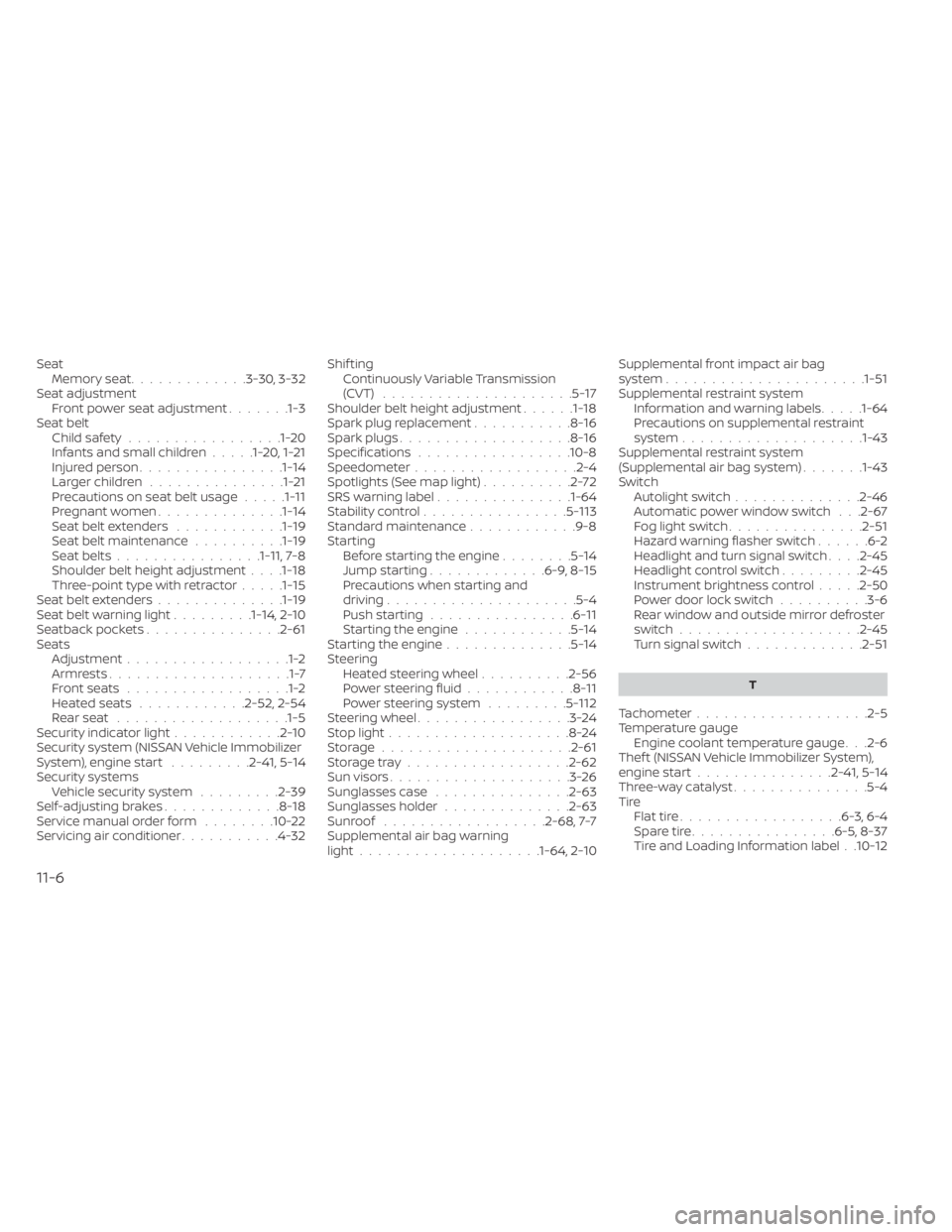
SeatMemory seat.............3-30, 3-32Seat adjustmentFront power seat adjustment.......1-3Seat beltChild safety.................1-20Infants and small children.....1-20,1-21Injured person................1-14Larger children...............1-21Precautions on seat belt usage.....1-11Pregnant women..............1-14Seat belt extenders............1-19Seat belt maintenance..........1-19Seat belts................1-11,7-8Shoulder belt height adjustment. . . .1-18Three-point type with retractor.....1-15Seat belt extenders..............1-19Seat belt warning light.........1-14,2-10Seatback pockets...............2-61SeatsAdjustment..................1-2Armrests....................1-7Front seats..................1-2Heated seats............2-52, 2-54Rear seat.................. .1-5Security indicator light............2-10Security system (NISSAN Vehicle Immobilizer
System), engine start.........2-41, 5-14Security systems
Vehicle security system.........2-39Self-adjusting brakes.............8-18Service manual order form........10-22Servicing air conditioner...........4-32
Shif tingContinuously Variable Transmission
(CVT)
.....................5-17Shoulder belt height adjustment......1-18Spark plug replacement...........8-16Spark plugs...................8-16Specifications................ .10-8Speedometer................. .2-4Spotlights (See map light)..........2-72SRS warning label...............1-64Stability control................5-113Standard maintenance............9-8Starting
Before starting the engine........5-14Jump starting.............6-9, 8-15Precautions when starting and
driving.................... .5-4Push starting................6-11Starting the engine............5-14Starting the engine..............5-14Steering
Heated steering wheel..........2-56Power steering fluid............8-11Power steering system.........5-112Steering wheel.................3-24Stop light....................8-24Storage.................... .2-61Storage tray..................2-62Sun visors....................3-26Sunglasses case...............2-63Sunglasses holder..............2-63Sunroof..................2-68, 7-7Supplemental air bag warning
light................... .1-64, 2-10
Supplemental front impact air bag
system..................... .1-51Supplemental restraint system
Information and warning labels.....1-64Precautions on supplemental restraint
system................... .1-43Supplemental restraint system
(Supplemental air bag system).......1-43Switch
Autolight switch..............2-46Automatic power window switch. . .2-67Fog light switch...............2-51Hazard warning flasher switch......6-2Headlight and turn signal switch. . . .2-45Headlight control switch.........2-45Instrument brightness control.....2-50Power door lock switch..........3-6Rear window and outside mirror defroster
switch................... .2-45Turn signal switch.............2-51
T
Tachometer...................2-5Temperature gauge
Engine coolant temperature gauge. . .2-6Thef t (NISSAN Vehicle Immobilizer System),
engine start...............2-41, 5-14Three-way catalyst...............5-4TireFlat tire................. .6-3, 6-4Spare tire................6-5, 8-37Tire and Loading Information label. .10-12
11-6