Page 34 of 492
NON-ADJUSTABLE HEAD
RESTRAINT/HEADREST
COMPONENTS
1. Removable head restraint/headrest
2. Single notch
3. Lock knob
4. Stalks
REMOVE
Use the following procedure to remove the
head restraint/headrest:
1. Pull the head restraint/headrest up tothe highest position.
2. Push and hold the lock knob.
3. Remove the head restraint/headrest from the seat.
4. Store the head restraint/headrest prop- erly in a secure place so it is not loose in
the vehicle. 5. Reinstall and properly adjust the head
restraint/headrest before an occupant
uses the seating position.
LRS2299LRS2302
1-12Safety-Seats, seat belts and supplemental restraint system
Page 36 of 492
Raise
To raise the head restraint/headrest, pull it
up.
Make sure the head restraint/headrest is
positioned so the lock knob is engaged in
the notch before riding in that designated
seating position.
Lower
To lower, push and hold the lock knob and
push the head restraint/headrest down.
Make sure the head restraint/headrest is
positioned so the lock knob is engaged in
the notch before riding in that designated
seating position.
FRONT-SEAT ACTIVE HEAD
RESTRAINTS
LRS2306SPA1025
1-14Safety-Seats, seat belts and supplemental restraint system
Page 37 of 492
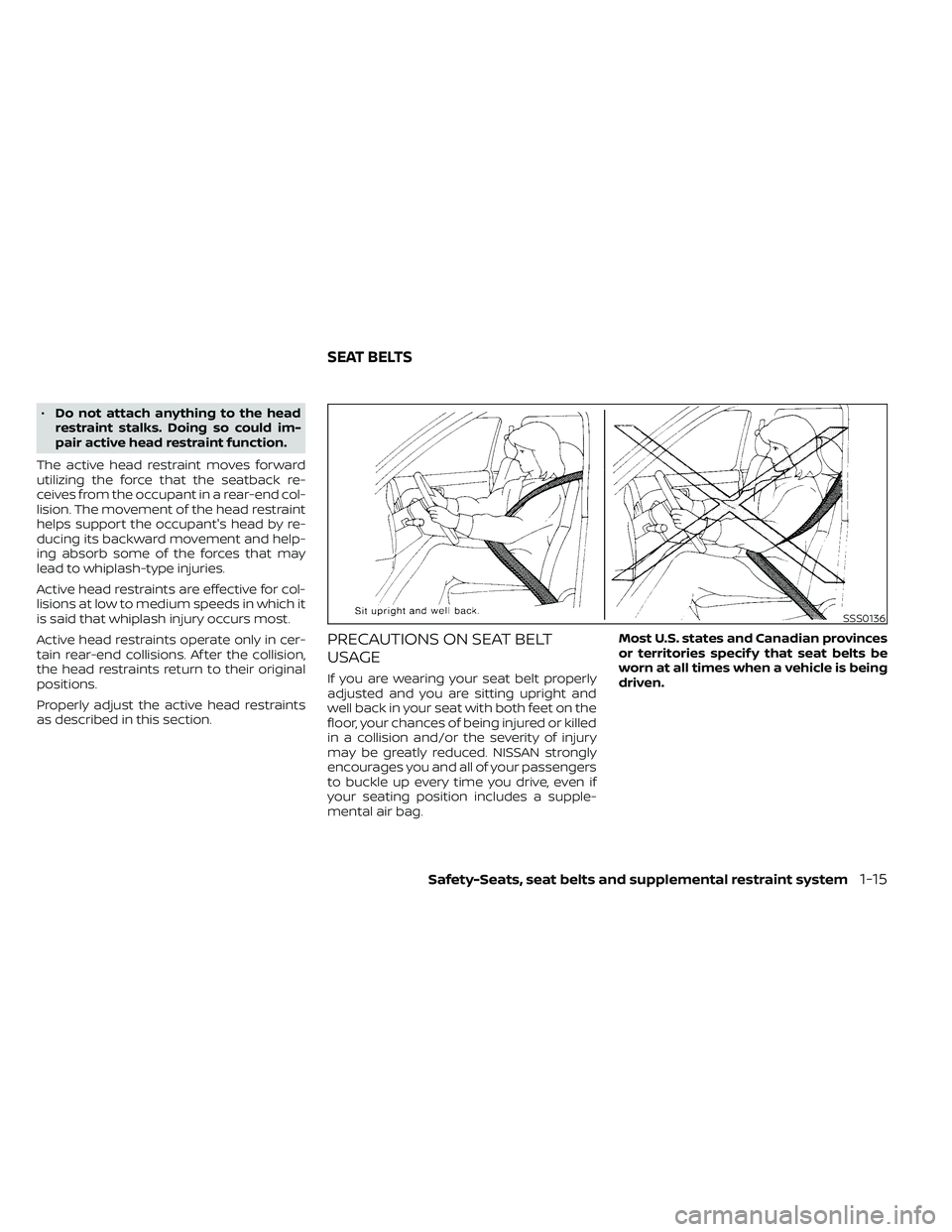
•Do not attach anything to the head
restraint stalks. Doing so could im-
pair active head restraint function.
The active head restraint moves forward
utilizing the force that the seatback re-
ceives from the occupant in a rear-end col-
lision. The movement of the head restraint
helps support the occupant's head by re-
ducing its backward movement and help-
ing absorb some of the forces that may
lead to whiplash-type injuries.
Active head restraints are effective for col-
lisions at low to medium speeds in which it
is said that whiplash injury occurs most.
Active head restraints operate only in cer-
tain rear-end collisions. Af ter the collision,
the head restraints return to their original
positions.
Properly adjust the active head restraints
as described in this section.
PRECAUTIONS ON SEAT BELT
USAGE
If you are wearing your seat belt properly
adjusted and you are sitting upright and
well back in your seat with both feet on the
floor, your chances of being injured or killed
in a collision and/or the severity of injury
may be greatly reduced. NISSAN strongly
encourages you and all of your passengers
to buckle up every time you drive, even if
your seating position includes a supple-
mental air bag. Most U.S. states and Canadian provinces
or territories specif y that seat belts be
worn at all times when a vehicle is being
driven.
Safety-Seats, seat belts and supplemental restraint system1-15
Page 38 of 492
WARNING
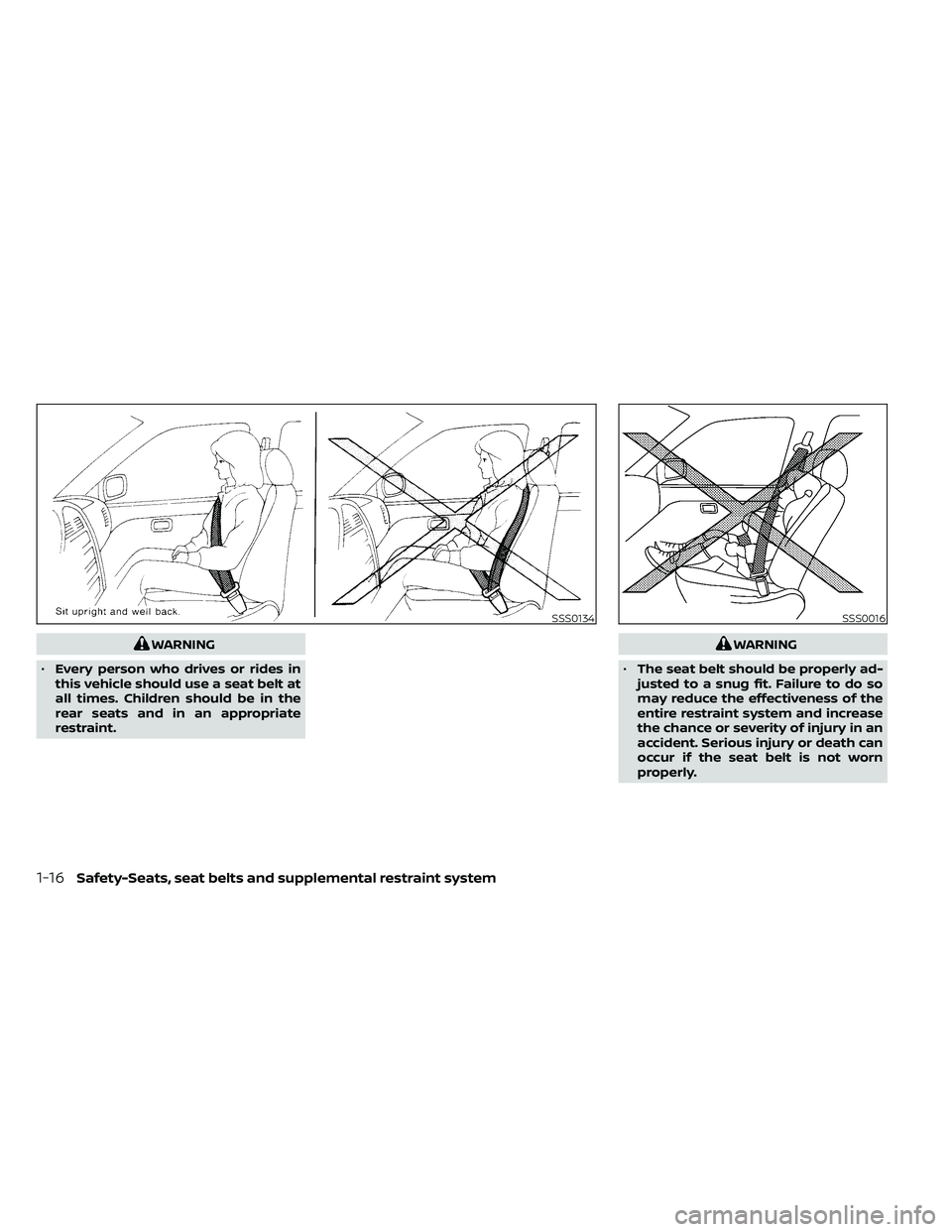
• Every person who drives or rides in
this vehicle should use a seat belt at
all times. Children should be in the
rear seats and in an appropriate
restraint.WARNING
• The seat belt should be properly ad-
justed to a snug fit. Failure to do so
may reduce the effectiveness of the
entire restraint system and increase
the chance or severity of injury in an
accident. Serious injury or death can
occur if the seat belt is not worn
properly.
SSS0016
1-16Safety-Seats, seat belts and supplemental restraint system
Page 40 of 492
SEAT BELT WARNING LIGHT AND
CHIME
The driver and front passenger seat is
equipped with an enhanced seat belt re-
minder function. If your vehicle is equipped
with an enhanced seat belt reminder func-
tion, a visual and audible alert (Driver’s seat
only) will operate if a driver or front passen-
ger seat belt is unbuckled at speeds of ap-
proximately 9 mph (15 km/h) or more un-
der the following conditions:
• If the driver seat belt is not fastened.• The front passenger’s seat belt is not fas-
tened and the seat is occupied by a pas-
senger for 7 seconds af ter the ignition
switch is placed in the ON position.
• The front passenger’s seat belt is not fas- tened and objects or external force on
the passenger seat change the seat belt
reminder classification to Occupied.
The seat belt warning light will flash under
the conditions shown above until the nec-
essary seat belt is securely fastened.
A warning chime will sound for approxi-
mately 90 seconds or until one of the fol-
lowing conditions is met:
• The unbuckled front occupant’s seat belt is securely fastened.
• The ignition is turned off.
The below situations could result in the
seat belt reminder light being illuminated
and the chime sounding (Driver’s seat only),
even with no occupant present in the pas-
senger seat:
• Heavy objects placed on the seat.
• Someone pushing or pulling on the front passenger seat. • An object placed under the front passen-
ger seat.
• An object placed between the seat cush- ion and center console or between the
seat cushion and the door.
• An object hanging on the seat or placed in the seatback pocket.
• A child restraint or other object pressing against the rear of the seatback.
PREGNANT WOMEN
NISSAN recommends that pregnant
women use seat belts. The seat belt should
be worn snug and always position the lap
belt as low as possible around the hips, not
the waist. Place the shoulder belt over your
shoulder and across your chest. Never run
the lap/shoulder belt over your abdominal
area. Contact your doctor for specific rec-
ommendations.
INJURED PERSONS
NISSAN recommends that injured persons
use seat belts. Check with your doctor for
specific recommendations.
LRS0786
1-18Safety-Seats, seat belts and supplemental restraint system
Page 41 of 492
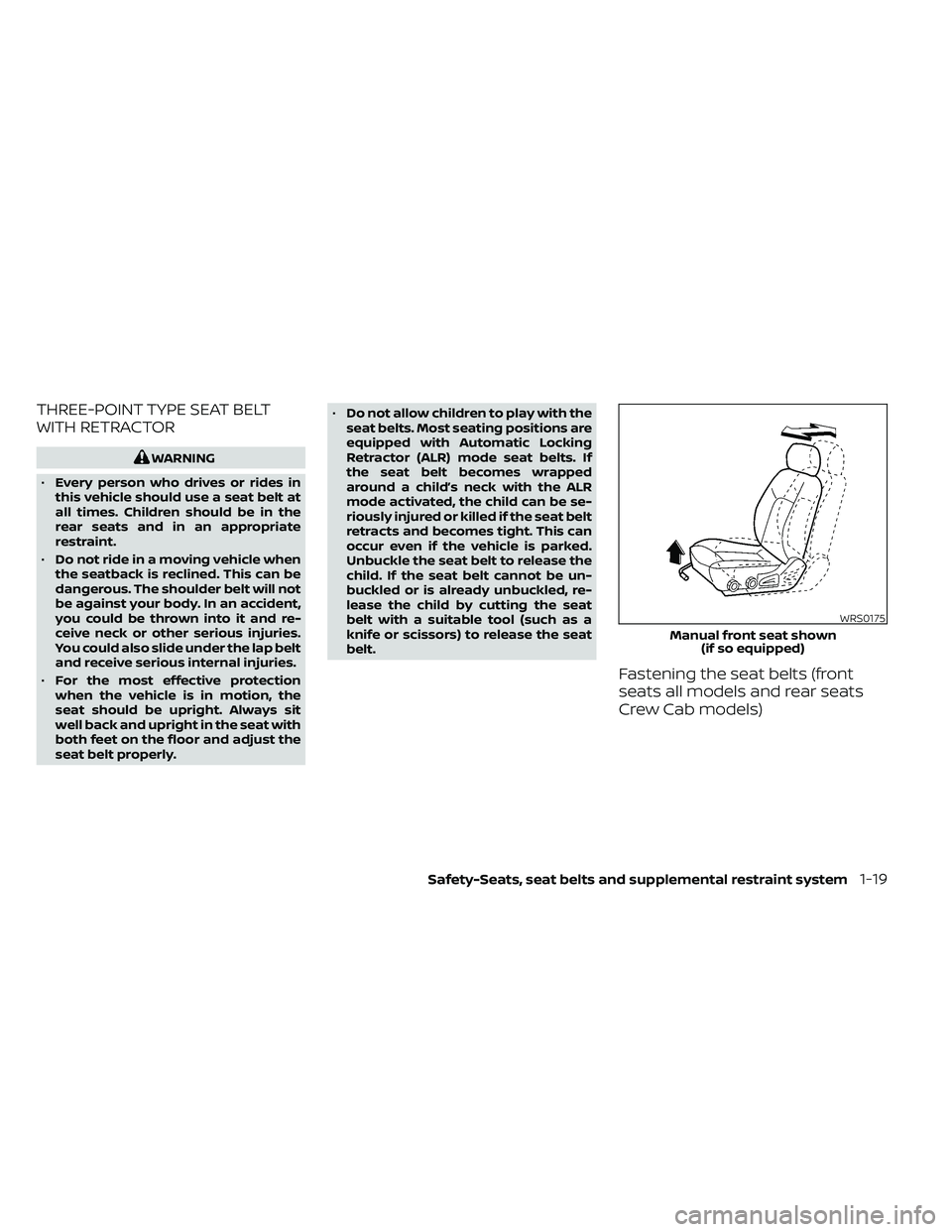
THREE-POINT TYPE SEAT BELT
WITH RETRACTOR
WRS0175
Manual front seat shown(if so equipped)
Safety-Seats, seat belts and supplemental restraint system1-19
Page 42 of 492
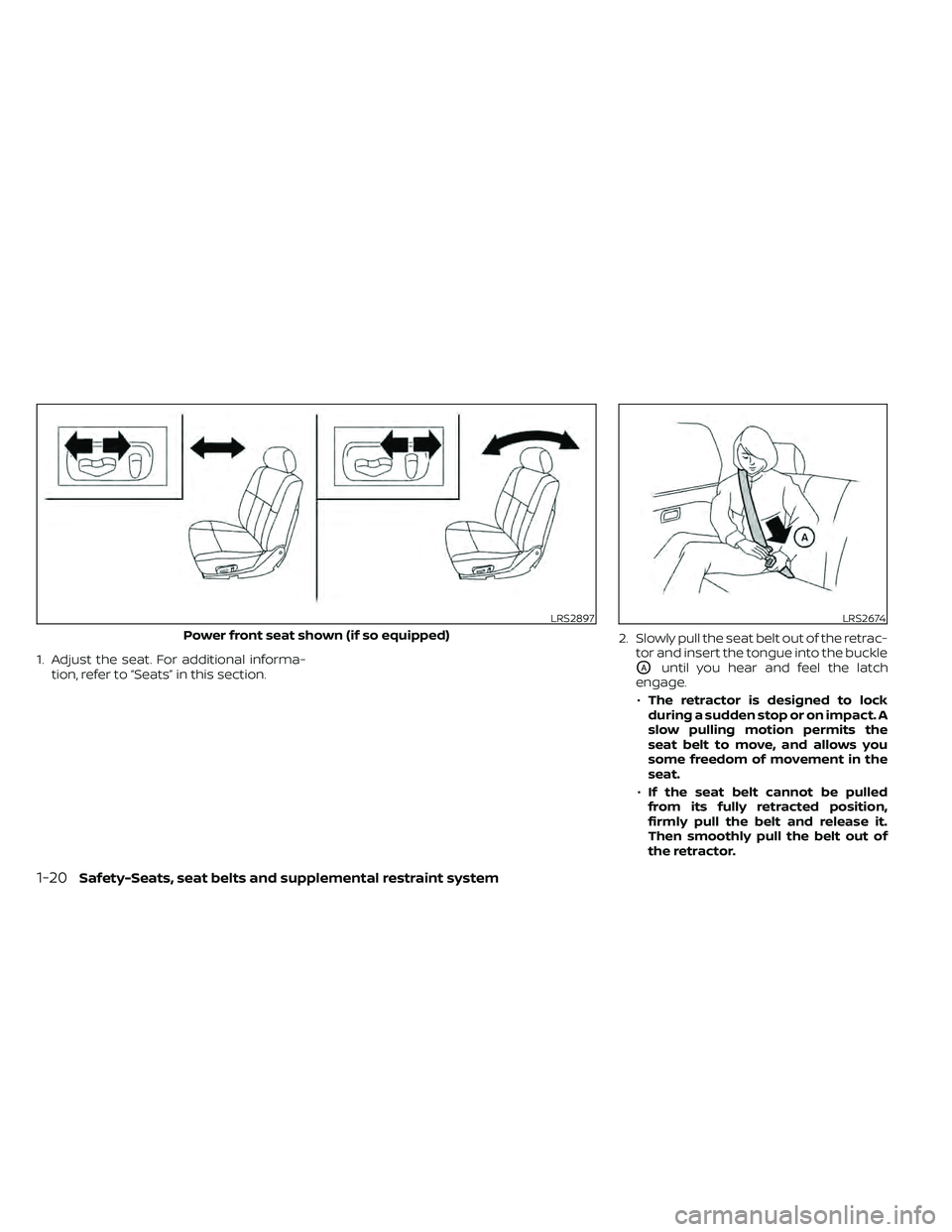
1. Adjust the seat. For additional informa-tion, refer to “Seats” in this section. 2. Slowly pull the seat belt out of the retrac-
tor and insert the tongue into the buckleOAuntil you hear and feel the latch
engage.
• The retractor is designed to lock
during a sudden stop or on impact. A
slow pulling motion permits the
seat belt to move, and allows you
some freedom of movement in the
seat.
• If the seat belt cannot be pulled
from its fully retracted position,
firmly pull the belt and release it.
Then smoothly pull the belt out of
the retractor.
1-20Safety-Seats, seat belts and supplemental restraint system
Page 44 of 492
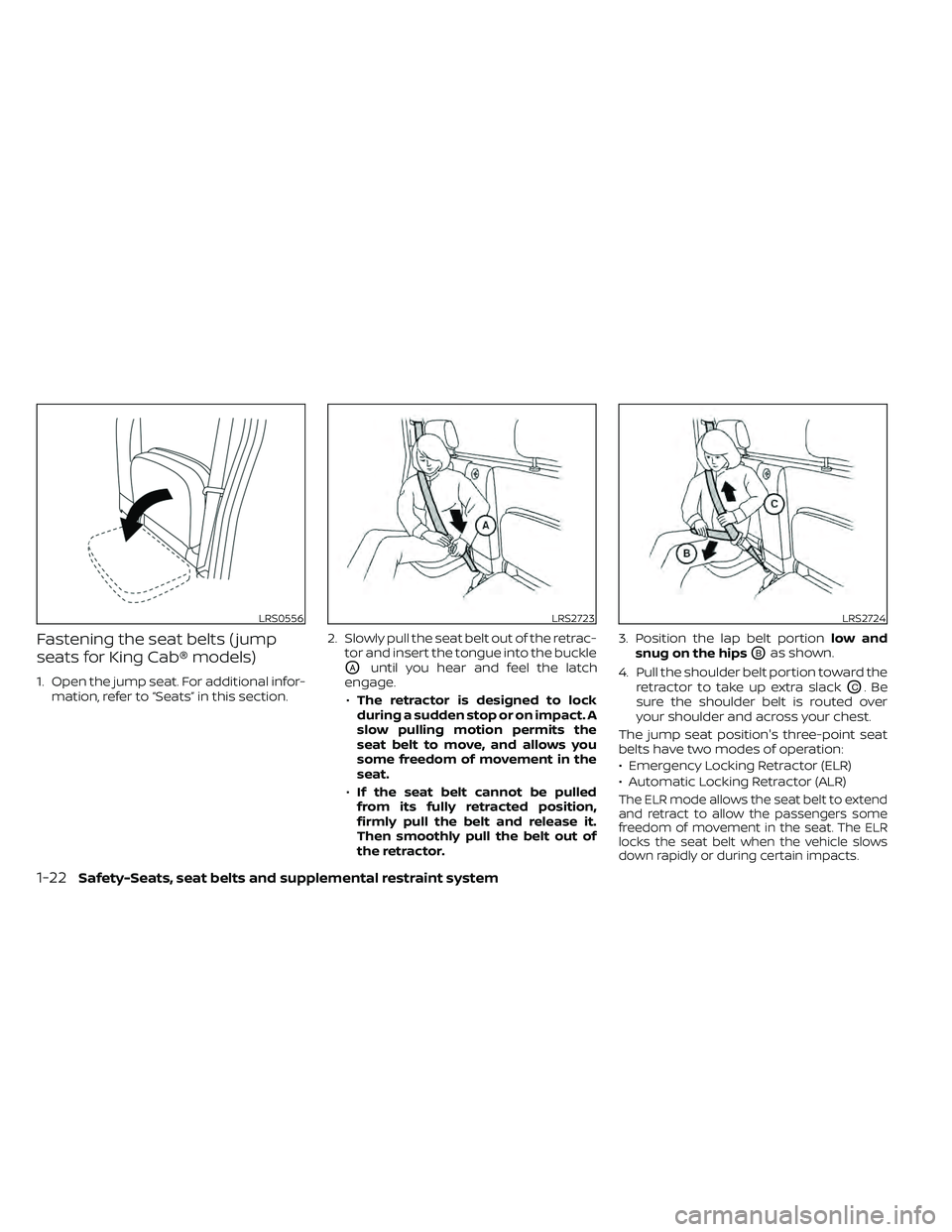
Fastening the seat belts ( jump
seats for King Cab® models)
1. Open the jump seat. For additional infor-mation, refer to “Seats” in this section. 2. Slowly pull the seat belt out of the retrac-
tor and insert the tongue into the buckleOAuntil you hear and feel the latch
engage.
• The retractor is designed to lock
during a sudden stop or on impact. A
slow pulling motion permits the
seat belt to move, and allows you
some freedom of movement in the
seat.
• If the seat belt cannot be pulled
from its fully retracted position,
firmly pull the belt and release it.
Then smoothly pull the belt out of
the retractor. 3. Position the lap belt portion
low and
snug on the hipsOBas shown.
4. Pull the shoulder belt portion toward the retractor to take up extra slack
OC.Be
sure the shoulder belt is routed over
your shoulder and across your chest.
The jump seat position's three-point seat
belts have two modes of operation:
• Emergency Locking Retractor (ELR)
• Automatic Locking Retractor (ALR)
The ELR mode allows the seat belt to extend
and retract to allow the passengers some
freedom of movement in the seat. The ELR
locks the seat belt when the vehicle slows
down rapidly or during certain impacts.
LRS0556LRS2723LRS2724
1-22Safety-Seats, seat belts and supplemental restraint system