2021 MERCEDES-BENZ GLS position
[x] Cancel search: positionPage 65 of 510
NEVER
useare ar wa rd-faci ng child restra int
sy stem onaseat withan ENABL EDFRONT
AIRB AG;DE ATHor SERIOU SINJU RYtothe
CH ILD can occur . Obser
vethespecif icins truction sfo rre ar wa rd-
fa cing andforw ard-f acin gch ild restra int systems
(/ page63).
Alw aysobser vethest atus ofthefront passeng er
airbag onthePA SSENGER AIRBAGOF Find ica‐
to rlam p:
R When using are ar wa rd-faci ng child restra int
sy stem onthefront passeng erseat, thefront
passeng erairbag mustalw aysbe disabl ed.
This isonl yth ecase ifth ePA SSENGER AIR
BA GOF Find icat orlam pis lit con tinuousl y
(/ page47 ).
R Ifth ePA SSENGER AIRBAGOF Find icat or
lam pis off,th efront passeng erairbag isena‐
bled. Thefront passeng erairbag maydeplo y
dur ing anacciden t. Secur
ingthech ild restra int system withth e
seat beltonthefront passeng erseat
When installing abelt- secur edchild restra int
sy stem onthefront passeng erseat, always
obser vethefo llo wing:
0073 Obser
vethech ild restra int system manuf ac‐
tur er's installation andopera tingins truc‐
tion s.
0073 When
usingafo rw ard-f acin gch ild restra int
sy stem incat egor yI: re mo vethehead
re stra int from there spectiv eseat, ifpossi‐
ble.
Af terth ech ild restra int system has been
re mo ved, replace thehead restra int immed i‐
at elyand adjus tall head restra int scor ‐
re ctl y.
0073 The
backres tof thefo rw ard-f acin gch ild
re stra int system mus t,as faras possi ble,be
re sting ontheseat backres tof thefront
passeng erseat.
0073 Fo
rcer tain child restra int systems inwe ight
cat egor yII or III,th er ema ybe restrictions
on themaximum sizesetting, e.g. due to
possible contact with thero of. 0073
The
child restra int system mus tno tbe put
under stra in be tween thero of and theseat
cushion and/orbeinstalled facing the
wr ong direct ion.
0073 The
child restra int system mus tno tbe put
under stra in by thehead restra int .Ad jus t
th ehead restra int sacc ording ly.
0073 Ne
verpla ceobjects (e.g.cushi ons)under or
behi ndthech ild restra int system.
The seat beltonthefront passeng erside is
eq uipped withach ild seat safetyfe atur e.
When enabled,thech ild seat safetyfe atur e
ens ures that theseat beltdoes notslac kenonce
th ech ild seat issecur ed(/ page56). #
Setth efront passeng erseat asfarbac kas
possi bleand movetheseat intoth ehighes t
position ifpossible. #
Fully re tract theseat cushion lengthadjus t‐
ment . #
Adjus tth eseat cushion inclination sothat
th efront edgeof theseat cushion isin the
highes tposition andthere ar edg eof the
seat cushion isin thelowe stposition . Occ
upant safety 63
Page 66 of 510
#
Setth eseat backres tto themos tve rtical
posit ionpossible . #
Installth ech ild restra int system.
The entire base ofthech ild restra int system
mus talw aysre st on thesitt ing surface ofthe
fr ont passeng ersea t. #
Alw aysmak esur eth at theshoulder belt
st ra pis cor rectly routed from theseat belt
outle tof theve hicle totheshoulder belt
guide onthech ild restra int system.
The shoulder beltstra pmus tbe routed for‐
wa rdsand down wardsfrom theseat beltout‐
le t. #
Ifneces sary,adjus tth eseat beltoutle tand
th efront passeng erseat accor dingly. Child
safetyloc ks Ac
tiv atin gor deac tivatin gthe child safety
loc kfo rthe rear door s &
WARNIN GRisk ofacci dent andinjury
due tochildr enleftunat tende din the
ve hicle
If ch ildr enarelef tunsuper visedintheve hi‐
cle, they cou ld,in pa rticular :
R Open doors,ther eb yendang ering other
per sons orroad user s.
R Getout and bestru ck byoncom ingtraf‐
fi c.
R Ope rate vehicle equipment andbecome
tr apped, forex am ple.
In addit ion,th ech ildr encould alsosetth e
ve hicle inmo tion, forex am ple by:
R Releasing thepar king brak e.
R Chang eth etransmission position.
R Startth eve hicle. #
Neverlea vechildr enunat tende din the
ve hicle. #
When leaving theve hicle, alwaysta ke
th eSmar tKey wit hyo uand lockth e
ve hicle. #
Keep theSmar tKey out ofreac hof chil‐
dr en. &
WARNIN GRisk offata linj urydue to
ex posur eto extreme heat or col din the
ve hicle
If people –par ticular lych ildr en–ar e
ex posed toextreme temp eratur esover an
ex tende dpe riod oftime, ther eis arisk of
ser ious oreve nfa ta linj ury. #
Neverlea veanyone –pa rticular lych il‐
dr en –unat tende din theve hicle. #
Neverlea veanim alsintheve hicle unat‐
te nde d. 64
Occupant safety
Page 69 of 510
Smar
tKey Ov
ervie wof Smar tKey functio ns &
WARNIN GRisk ofacci dent andinjury
due tochildr enleftunat tende din the
ve hicle
If ch ildr enarelef tunsuper visedintheve hi‐
cle, they cou ld,in pa rticular :
R Open doors,ther eb yendang ering other
per sons orroad user s.
R Getout and bestru ck byoncom ingtraf‐
fi c.
R Ope rate vehicle equipment andbecome
tr apped, forex am ple.
In addit ion,th ech ildr encould alsosetth e
ve hicle inmo tion, forex am ple by:
R Releasing thepar king brak e.
R Chang eth etransmission position.
R Startth eve hicle. #
Neverlea vechildr enunat tende din the
ve hicle. #
When leaving theve hicle, alwaysta ke
th eSmar tKey wit hyo uand lockth e
ve hicle. #
Keep theSmar tKey out ofreac hof chil‐
dr en. *
NO
TEDama getotheSmar tKey cau sed
by magne ticfields #
Keep theSmar tKey away from stro ng
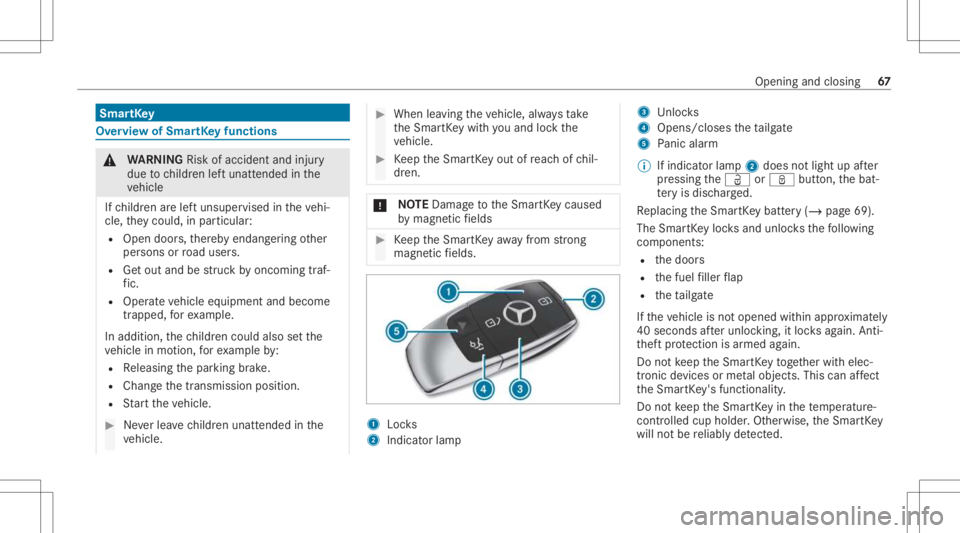
ma gne ticfields. 1
Locks
2 Indicat orlam p 3
Unloc ks
4 Opens/closes theta ilg ate
5 Panic alar m
% Ifind icatorlam p2 does notlig ht up afte r
pr essing theÜ orß button,thebat‐
te ry isdisc harged.
Re placing theSmar tKey batt ery(/ page69).
The Smar tKey loc ksand unlocksth efo llo wing
com pone nts:
R thedoor s
R thefuel filler flap
R theta ilg ate
If th eve hicle isno topened within appr oximat ely
40 seco ndsafte runloc king,itloc ksagain. Anti-
th eftpr otect ion isarmed again.
Do notke ep theSmar tKey toge ther wit helec‐
tr onic devices orme talobje cts. This canaffect
th eSmar tKey 's functionality .
Do notke ep theSmar tKey inthete mp eratur e-
con trolled cupholder .Ot her wise, theSmar tKey
will notbe reliably detected. Ope
ning andclosing 67
Page 71 of 510
Re
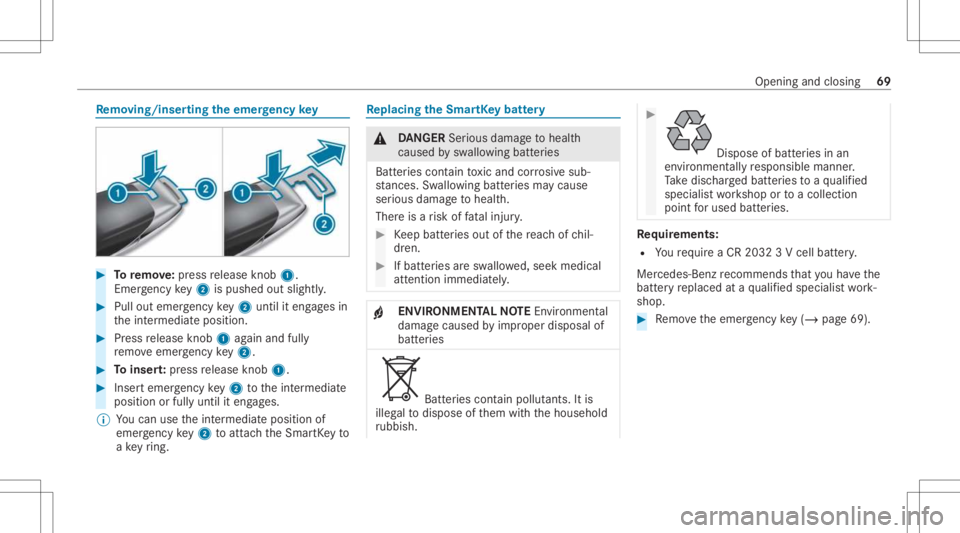
mo ving /ins ertin gthe eme rgency key #
Toremo ve:pr ess release knob 1.
Em erge ncy key2 ispush edout slightly. #
Pull outemer gency key2 untilit en gage sin
th eint ermediat eposition . #
Press release knob 1 again and fully
re mo veemer gency key2. #
Toinser t:press release knob 1. #
Insertemer gency key2 totheint ermediat e
position orfull yuntil iteng ages.
% Youcan usetheint ermediat eposition of
emer gency key2 toatt achth eSmar tKey to
a ke yring. Re
plac ingthe Smar tKey batt ery &
DANG ER Serious damag eto healt h
caused byswallo wing batteries
Batt eries cont aintoxic and corrosiv esub‐
st anc es.Swallo wing batteries ma ycause
ser ious damag eto healt h.
Ther eis arisk offata linj ury. #
Keep batt eries out ofthere ac hof chil‐
dr en. #
Ifbatt eries aresw allo wed,seek medical
att ent ion immediat ely. +
ENVIR
ONMEN TALNO TEEnvironme ntal
da ma gecau sed byimproper disposal of
batt eries Bat
teries con tain polluta nts. Itis
illeg alto dispose ofthem withth ehousehold
ru bbish. #
Dispose
ofbatt eries inan
en vironmen tally re sponsible manner.
Ta ke disc hargedbatt eries toaqu alif ied
spec ialistwo rkshop ortoacol lection
poin tfo rused batteries. Re
quirement s:
R Youre qu ire aCR 203 23V cell battery.
Mer cedes-Ben zre comme ndsthat youha ve the
batt eryre placed ataqu alif ied spec ialistwo rk‐
shop. #
Remo vetheemer gency key(/ pag e69 ). Ope
ning and closing 69
Page 76 of 510
#
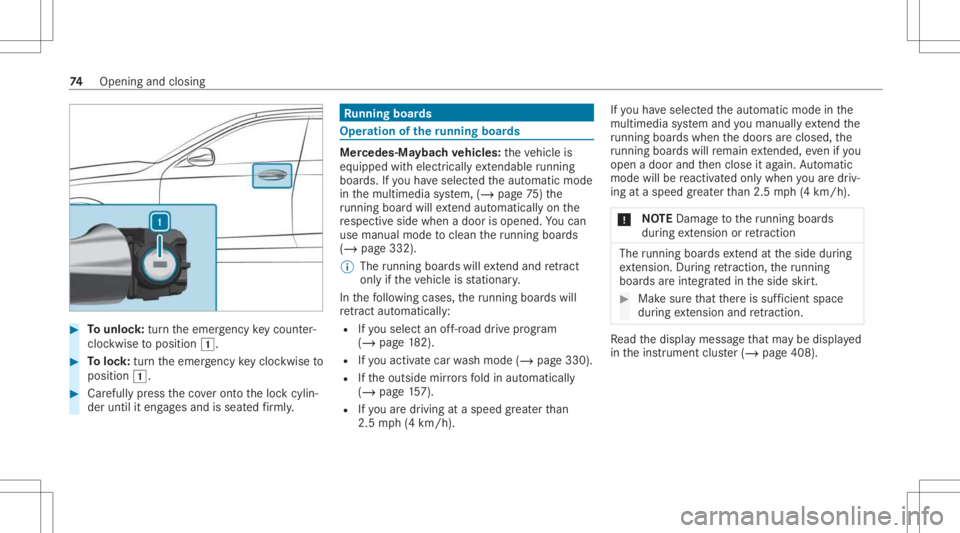
Tounlo ck:tur nth eemer gency keyco unt er-
clo ckwise toposition 0047. #
Toloc k:tur nth eemer gency keyclo ckwise to
position 0047. #
Carefully press theco veront oth eloc kcyli n‐
der until iteng ages and isseat edfirm ly. Ru
nning boards Oper
ation oftheru nning boards Mer
cedes-Ma ybachve hicl es:theve hicle is
eq uipped withelectr icallyex tenda ble ru nning
bo ards. Ifyo uha ve select edtheaut omatic mode
in themultimedia system, (/page75 )th e
ru nning board willex tend automatical lyon the
re spectiv eside when adoor isopened. Youcan
use man ualmod eto cle an theru nning boards
(/ page 332) .
% The running boards willex tend and retract
only ifth eve hicle isstatio nary.
In thefo llo wing cases ,th eru nning boards will
re tract automatical ly:
R Ifyo usele ctan off-ro ad drive pr ogram
(/ page18 2).
R Ifyo uact ivat ecar wash mode (/page330).
R Ifth eoutside mirrors fold inaut omat ically
(/ page15 7).
R Ifyo uar edr ivin gat aspee dgr ea terth an
2. 5mp h(4 km/h). If
yo uha ve select edtheaut omatic modeinthe
multime diasystem and youman uallyex tend the
ru nning boards when thedoor sar eclosed, the
ru nning boards willre main extende d,eve nif yo u
open adoor andthen close itag ain. Automatic
mode willbe react ivat ed onlywhen youar edr iv‐
ing ataspee dgr ea terth an 2.5mp h(4 km/h) .
* NO
TEDama getotheru nning boards
du ring extensi on orretracti on The
running boards extend attheside during
ex tensi on. During retracti on, theru nning
bo ards areint egr ated intheside skirt. #
Mak esur eth at ther eis suf ficie ntspa ce
du ring extensi on and retracti on. Re
ad thedispla ymessag eth at ma ybe displa yed
in theins trument cluster(/ page408). 74
Opening andclosing
Page 78 of 510
#
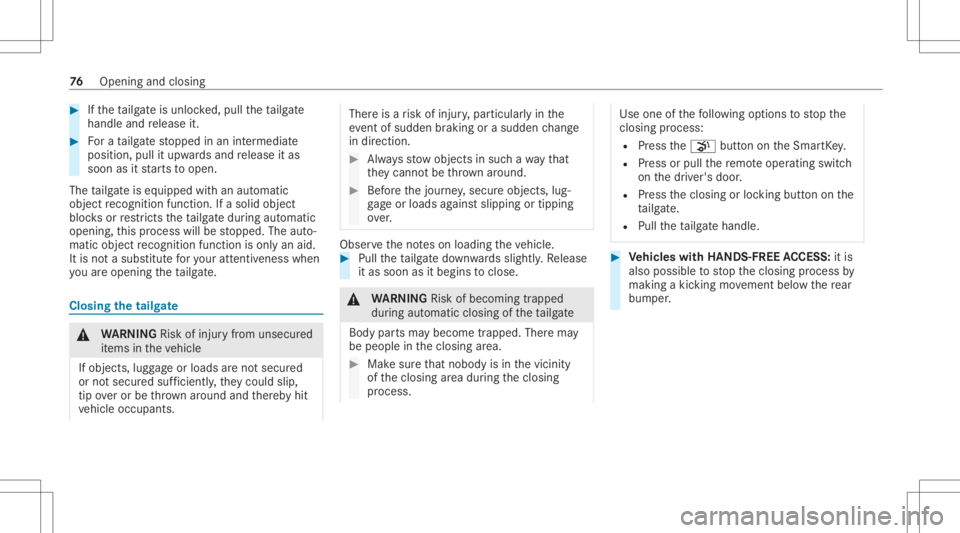
Ifth eta ilg ateis unloc ked, pull theta ilg ate
handle andrelease it. #
Fora ta ilg atestopped inan intermediat e
position, pullitupw ards and release itas
soon asitstar ts to open.
The tailg ateis eq uipped withan aut omat ic
obje ctrecogni tionfuncti on.Ifasol idobje ct
bl oc ks orrestricts theta ilg atedur ing automat ic
open ing,this proces swill bestopped. Theauto‐
matic object recogni tionfuncti onisonly anaid.
It is no ta su bs titu teforyo ur att entiven ess when
yo uar eopen ingtheta ilg ate. Closing
thetailg ate &
WARNIN GRisk ofinju ryfrom unsecu red
it ems intheve hicle
If object s,lugg ageor loads areno tsecur ed
or notsecur edsuf ficie ntly,they cou ldslip,
tip ove ror be throw nar ou nd and ther eb yhit
ve hicle occupants. Ther
eis arisk ofinjur y,par ticular lyin the
ev ent ofsudden braking orasudden chang e
in dir ect ion. #
Alw aysst ow object sin suc hawa yth at
th ey canno tbe thro wn around . #
Beforeth ejour ney,secur eobjects, lug‐
ga ge orloads agains tslipping ortipping
ove r. Obser
vetheno teson loadi ngtheve hicle. #
Pull theta ilg atedo wn wardsslightly .Re lease
it as soon asitbegin sto clos e. &
WARNIN GRisk ofbeco ming trap ped
du ring automatic closing oftheta ilg ate
Body partsma ybecom etrapped. Therema y
be people intheclosing area. #
Mak esur eth at nobody isin thevicinit y
of theclosing area dur ing theclosing
pr ocess. Use
oneofthefo llo wing option sto stop the
clos ingproces s:
R Press the008B buttonontheSmar tKey .
R Press orpull there mo teoper ating switch
on thedr iver's door .
R Press theclosing orloc king buttononthe
ta ilg ate.
R Pull theta ilg atehandle. #
Vehicl eswith HANDS -FREEACCESS: itis
also possibletostop theclosing process by
making akic king movement belowthere ar
bum per. 76
Opening andclosing
Page 82 of 510
Limit
ingtheopenin gang leof thetailg ate Ac
tiv atin gthe opening ang lelimit er
Yo ucan limit theopening angleof theta ilg atein
th eto phalf ofits openin gra ng eto appr ox‐
imat ely8 in (20 cm) beforeth eend position . #
Stop theopening procedur eof theta ilg ateat
th edesir edposition . #
Press and hold theclosing buttonontheta il‐
ga te unt ilyo uhear asho rtacous ticsign al.
The open ingang lelimit erwill beact ivat ed.
The tailg atewill then stop inthestor ed posi‐
tion when opened.
To open thetai lgat efull y,pull thehandle onthe
outside oftheta ilg ateag ain afte rit has stopped
aut omaticall y.
Deact ivat ing theopen inganglelim iter #
Press and hold theclosing buttonontheta il‐
ga te unt iltw osho rtacous ticsign alssoun d. Re
leasing thetailg atein an emer gency Re
quirement s:
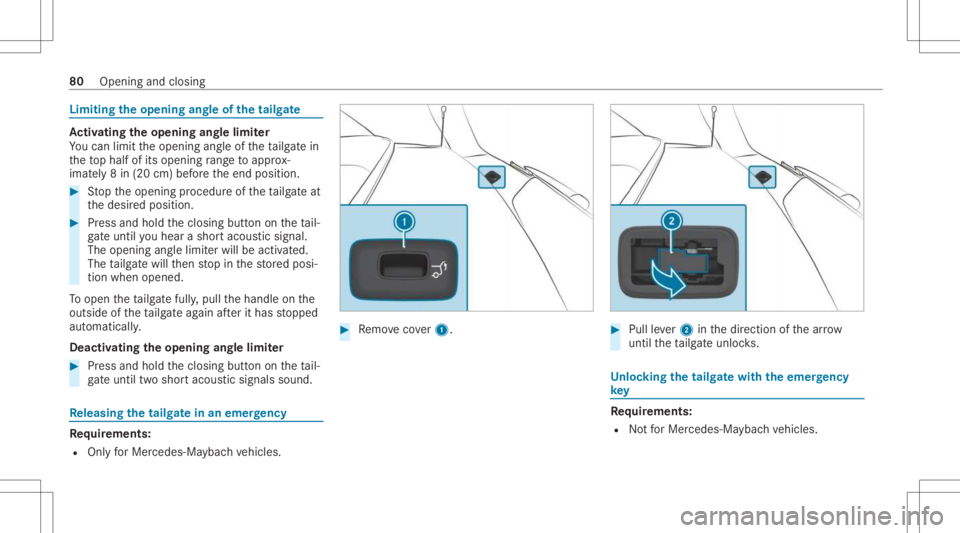
R Onlyfo rMer cedes-Ma ybachvehicles. #
Remo vecover1. #
Pullle ve r2 inthedir ect ion ofthear ro w
unt ilth eta ilg ateunloc ks. Un
loc king thetailg atewit hth eemer gency
ke y Re
quirement s:
R Notfo rMer cedes-Ma ybachvehicles. 80
Opening andclosing
Page 96 of 510
No
teson thecor rect driver' sseat position &
WARNIN GRisk ofacci dent dueto
adjus tingve hicle settin gswhile theve hi‐
cle isin mo tion
Yo uco uld lose contro lof theve hicle inthe
fo llo wing situat ionsinpar ticular :
R Ifyo uadj ustth edr iver's seat, thehead
re stra int s,thesteer ing wheel orthemir‐
ro rwhi letheve hicle isin mo tion.
R Ifyo ufa sten your seat beltwhile theve hi‐
cle isin mo tion. #
Beforest ar tin gth eengine: adjustth e
dr iver's seat, thehead restra int s,the
st eer ing wheel andthemir rorand fas‐
te nyo ur seat belt. En
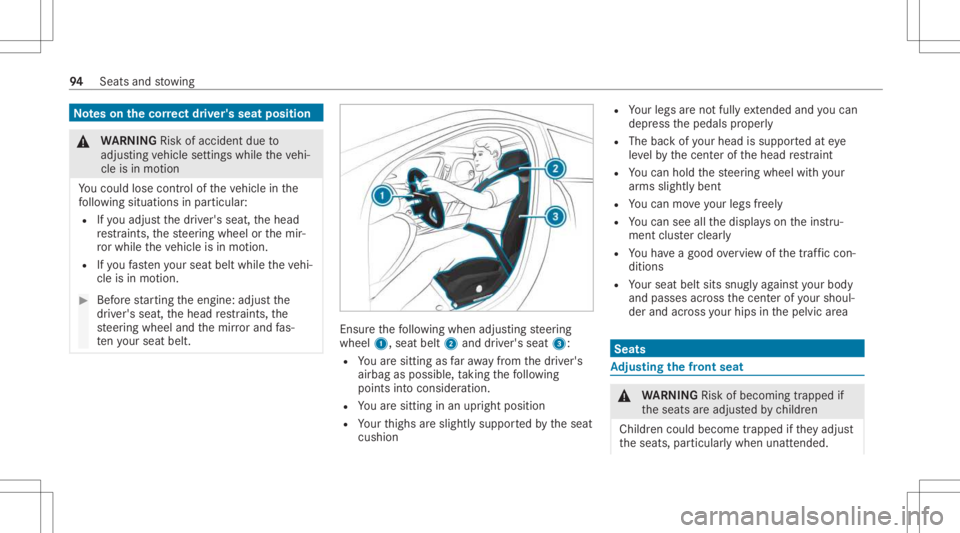
sur eth efo llo wing when adjustingst eer ing
wheel 1,seat belt2and driver's seat 3:
R Youar esit tin gas faraw ay from thedr iver's
airbag aspossible, taking thefo llo wing
point sint ocon sider ation .
R Youar esit tin gin an upr ight position
R Your thighs areslight lysuppor tedby theseat
cushion R
Your legs areno tfull yex tende dand youcan
depr essthepedals proper ly
R The backof your head issuppo rted ateye
le ve lby thecent erofthehead restra int
R Youcan hold thesteer ing wheel withyo ur
ar ms sligh tly ben t
R Youcan moveyour legs freel y
R Youcan seeallthedispla yson theins tru‐
ment clusterclea rly
R Youha ve agood overvie wof thetra ffic con ‐
dition s
R Your seat beltsitssn ug lyag ains tyo ur body
and pass esacr oss thecent erofyour sho ul‐
der and across your hips inthepelvic area Seats
Ad
jus tingthe fron tse at &
WARNIN GRisk ofbeco ming trap ped if
th eseats areadjus tedby childr en
Childr encould becom etrapped ifth ey adjus t
th eseats, particular lywhen unattende d. 94
Seatsand stow ing