*
N
N O
OTE
TE Damage caused bynume rous or
ex tended attem ptsto start the engine Numerous or
extended attem ptsto start the
engine may damage the catalytic con verter
due tonon-combusted fuel. #
Avoid numerous and extended attem pts
to start the engine. Obser
vethefo llowing points during starting assis-
ta nce and when charging the batter y:
R Only use undamaged jump lead/charging
cables with a su�1cient cross-section and
insulated term inal clamps.
R Non-insulated parts of thete rm inal clamps
must not come into contact with other me tal
parts while the jump lead/charging cable is
connected tothe battery/jump-start connec-
tion point.
R The jump lead/charging cable must not come
into contact with any parts which may mo ve
when the engine is running.
R Always make sure that nei ther you nor the bat-
te ry is electros tatically charge d. R
Keep awa y from �/re and naked �0ames.
R Do not lean overth e batter y.
Obser vethe additional following points when
ch arging the batter y:
R Only use battery charge rs tested and
appro vedfo r Mercedes-Benz.
R Read the battery charge r's operating inst ruc-
tions before charging the batter y.
Obser vethe additional following points during
starting assistance:
R For starting assistance, only use batteries with
a nominal voltage of 12 V.
R The vehicles must not touch.
R P
P e
etr
tr ol engine:
ol engine: only accept starting assistance
if th e engine and exhaust system are cold. S
S
t
tar
ar ting assist
ting assist ance and c
ance and c har
harging t
ging t he 12 V batt
he 12 V batt ery
ery R
R
eq
eq uir
uir ements:
ements:
R The vehicle is secured with the electric par k-
ing brake. R
A
Aut
ut omatic tr
omatic tr ansmission:
ansmission: the transmission is in
position j.
R The vehicle and all elect rical consume rsare
switched o�..
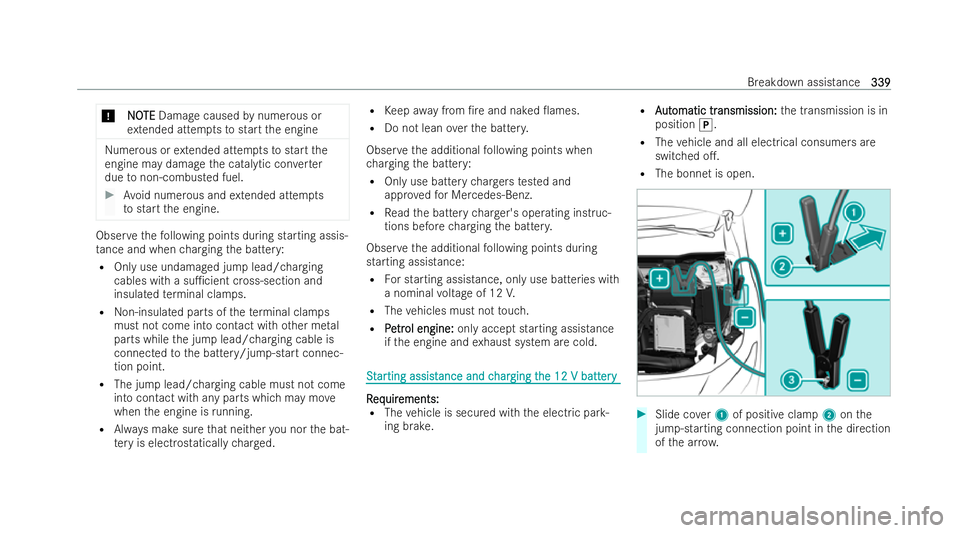
R The bonnet is open. #
Slide co ver1 of positive clamp 2onthe
jump-starting connection point in the direction
of the ar row. Breakd
own assistance
339
339
#
Connect positive clamp 2onyour vehicle to
th e positive pole of the donor battery using
th e jump lead/charging cable. Alw ays begin
with positive clamp 2onyour ow nve hicle
�/rst. #
Dur
During st
ing st ar
arting assist
ting assist ance:
ance:startthe engine of
th e donor vehicle and run at idle speed. #
Connect the negative pole of the donor bat-
te ry and ear thpoint 3ofyour ow nve hicle by
using the jump lead/charging cable. Begin
with the donor battery �/rst. #
Dur
During st
ing st ar
arting assist
ting assist ance:
ance:startthe engine of
yo ur ow nve hicle. #
Dur
During t
ing t he c
he char
harging pr
ging pr ocess:
ocess: startthech arg-
ing process. #
Dur
During st
ing st ar
arting assist
ting assist ance:
ance:letthe engines run
fo r se veral minutes. #
Dur
During st
ing st ar
arting assist
ting assist ance:
ance:before disconnect-
ing the jump lead, switch on an electrical con-
sumer on your ow nve hicle, e.g. there ar win-
dow heater or lighting.
When the starting assistance/charging process is
comple te: #
Firs t, re mo vethe jump lead/charging cable
from ear thpoint 3and the negative pole of
th e donor batter y,then from positive clamp
2 and the positive pole of the donor batter y.
Begin ea chtime with the contacts on your
ow nve hicle �/rst. #
A�Ter removing the jump lead/charging cable,
close co ver1 of positive clamp 2.
Fu rther information can be obtained at a quali�/ed
specialist workshop. R
R
eplacing t
eplacing t he 12 V batt
he 12 V batt ery
ery #
Obser vethe no tes on the 12 V battery
(/ page 336).
Mercedes-Benz recommends that you ha vethe
12 V battery replaced at a quali�/ed specialist
wo rkshop, e.g. at a Mercedes-Benz Se rvice
Centre. Obser
vethefo llowing no tes if youwa nttoreplace
th e battery yourself:
R Alwaysre place a faulty battery with a battery
which meets the speci�/c vehicle requ ire-
ments.
The vehicle is equipped with a �0eece batter y.
Fu llve hicle functionality is only guaranteed
with a �0eece batter y.Fo r saf etyre asons,
Mercedes-Benz recommends that you only
use batteries which ha vebeen tested and
appro vedfo ryo ur vehicle byMercedes-Benz.
R Use de tach able parts such as vent hoses,
elbow �/ttings or term inal co vers from the bat-
te ry which is tobe replaced.
R Make sure that theve nt hose is alw ays con-
nected tothe original opening on the side of
th e batter y.
Fi t any existing or supplied cell caps.
Otherwise, gases or battery acid could
escape.
R Make sure that de tach able parts are recon-
nected in the same way. 340 340
Breakdown assistance