2021 LEXUS RX450h fuel pressure
[x] Cancel search: fuel pressurePage 1 of 528

RX450hL-RX450h_U
1
2
3
4
5
6
7
8
9
Pictorial indexSearch by illustration
For safety
and securityMake sure to read through them
(Main topics: Child seat, theft deterrent system)
Vehicle status
information and
indicatorsReading driving-related information
(Main topics: Meters, multi-information display)
Before drivingOpening and closing the doors and windows,
adjustment before driving
(Main topics: Keys, doors, seats)
DrivingOperations and advice which are necessary for driving
(Main topics: Starting hybrid system, refueling)
Interior featuresUsage of the interior features
(Main topics: Air conditioner, storage features)
Maintenance
and careCaring for your vehicle and maintenance procedures
(Main topics: Interior and exterior, light bulbs)
When trouble
arisesWhat to do in case of malfunction and emergency
(Main topics: Battery discharge, flat tire)
Vehicle
specificationsVehicle specifications, customizable features
(Main topics: Fuel, oil, tire inflation pressure)
For ownersReporting safety defects for U.S. owners, and seat belt,
SRS airbag and headlight aim instructions for Canadian
owners
IndexSearch by symptom
Search alphabetically
Page 4 of 528

4TABLE OF CONTENTS
6-1. Maintenance and careCleaning and protecting the vehi-cle exterior ................................... 356
Cleaning and protecting the vehi- cle interior .................................... 359
6-2. Maintenance Maintenance requirements ..... 362
General maintenance ................ 363
Emission inspection and mainte- nance (I/M) programs ............ 366
6-3. Do-it-yourself maintenance Do-it-yourself service precautions........................................................... 367
Hood.................................................. 369
Positioning a floor jack............... 369
Engine compartment................... 371
12-volt battery................................ 376
Tires ................................................... 380
Tire inflation pressure ................. 387
Wheels.............................................. 389
Air conditioning filter..................390
Windshield wiper inserts........... 392
Electronic key battery ................ 393
Checking and replacing fuses ........................................................... 395
Headlight aim................................. 397
Light bulbs ....................................... 399
7-1. Essential information Emergency flashers...................... 410
If your vehicle has to be stopped in an emergency .............................. 410If the vehicle is trapped in rising
water ................................................. 411
7-2. Steps to take in an emergency If your vehicle needs to be towed............................................................ 413
If you think something is wrong ............................................................ 417
If a warning light turns on or a warn- ing buzzer sounds...................... 418
If a warning messa ge is displayed
.......................................................... 428
If you have a flat tire .................... 432
If the hybrid syst em will not start
.......................................................... 444
If you lose your keys.................... 446
If the fuel filler door cannot be opened .......................................... 446
If the electronic key does not oper- ate properly ................................. 447
If the 12-volt battery is discharged .......................................................... 449
If your vehicle overheats ........... 454
If the vehicle becomes stuck ... 457
8-1. Specifications Maintenance data (fuel, oil level, etc.) ................................................. 460
Fuel information............................ 469
Tire information .............................. 471
8-2. Customization Customizable features .............. 480
8-3. Init
ialization
Items to initialize ........................... 493
6Maintenance and care
7When trouble arises
8Vehicle specifications
Page 13 of 528

13Pictorial index
Precautions for winter season .......................................................................................P.291
To prevent freezing (windshield wiper de-icer)
*.................................................... P.311
Precautions for car wash ............................................................................................... P.357
Fuel filler door ........................................................................................................... P.211
Refueling method ............................................................................................................... .P.211
Fuel type/fuel tank capacity ...... ................................................................................... P.462
Tires.......................................................................................................................... .P.380
Tire size/inflation pressure ............................ ................................................... P.380, 466
Winter tires/tire chains ....................................................................................................P.2 91
Checking/rotation/tire pressure warning system............................................. P.380
Coping with flat tires........................................................................................................ P .432
Hood ..........................................................................................................................P.369
Opening ........................................................................................................................ ....... P.369
Engine oil ..................................................................................................................... ......... P.463
Coping with overheating ............................................................................................... P.454
Warning messages .......................................................................................................... P.428
Headlights/front turn signal lights/front side marker lights ........... P.194, 200
Side turn signal lights ............................................................................................. P.194
Parking lights/daytime running lights............................................................. P.200
Fog lights/cornering lights
*.....................................................................P.200, 206
Rear side marker lights ....................................................................................... P.200
Stop/tail lights ........................................................................................................ P.200
Back-up lights/rear turn signal lights ..................................................... P.194, 200
Shifting the shift lever to R ................................................................................................ P. 191
License plate lights ............................................................................................... P.200
*:If equipped
Light bulbs of the exterior lights for driving
(Replacing method: P.399, Watts: P.468)
E
F
G
H
I
J
K
L
M
N
O
Page 79 of 528

792-1. Instrument cluster
2
Vehicle status information and indicators
Warning lights inform the driver of mal-
functions in the indicated vehicle’s sys-
tems.
Warning lights
(U.S.A.)
Brake system warning light*1
( P.418)
(red)
(Canada)
Brake system warning light*1
( P.418)
(yellow)
Brake system warning light*1
( P.418)
High coolant temperature
warning light
*2 ( P.418)
Hybrid system overheat warn-
ing light
*2 ( P.419)
Charging system warning
light
*3 ( P.419)
Low engine oil pressure warn-
ing light
*2 ( P.419)
(U.S.A.)
Malfunction indicator lamp*1
( P.419)
(Canada)
Malfunction indicator lamp*1
( P.419)
SRS warning light
*1 ( P.420)
(U.S.A.)
ABS warning light*1 ( P.420)
(Canada)
ABS warning light*1 ( P.420)
Brake Override System warn-
ing light/Drive-Start Control
warning light
*2 ( P.420)
(red)
Electric power steering system
warning light
*1 ( P.421)
(yellow)
Electric power steering system
warning light
*1 ( P.421)
Low fuel level warning light
( P.421)
Driver’s and front passenger’s
seat belt reminder light
( P.421)
(RX450h)
Rear passengers’ seat
belt reminder light
*4
( P.422)
(RX450hL)
Rear passengers’ seat
belt reminder
light
*4( P.422)
Tire pressure warning light
*1
( P.422)
(orange)
LTA indicator ( P.422)
(flashes)
Intuitive parking assist OFF indi-
cator
*1 (if equipped) ( P.423)
(flashes)
RCTA OFF indicator*1 (if
equipped) ( P.423)
(flashes)
PKSB OFF indicator*1 (if
equipped) ( P.423)
(flashes or
illuminates)PCS warning light*1 ( P.424)
Slip indicator
*1 ( P.424)
(flashes)
(U.S.A.)
Parking brake indicator
( P.424)
Page 91 of 528
912-1. Instrument cluster
2
Vehicle status information and indicators
*4: This distance is computed based on your average fuel consumption. As a
result, the actual distance that can be
driven may differ from that displayed.
■Energy monitor
P.99
■AWD Control
Displays the driving force applied to
each wheel using segments.
The greater the number of segments
displayed, the greater the driving force
applied.
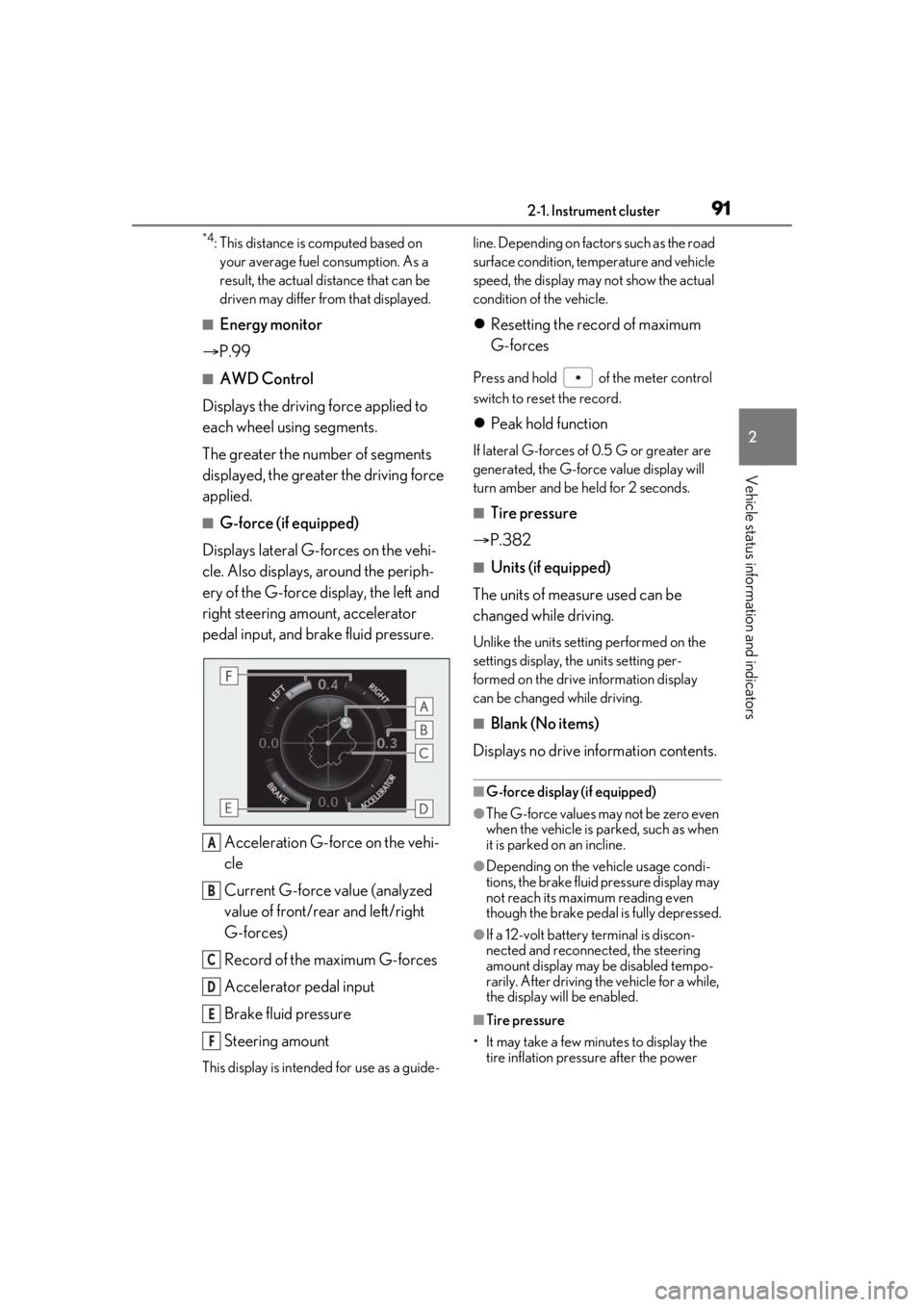
■G-force (if equipped)
Displays lateral G-forces on the vehi-
cle. Also displays, around the periph-
ery of the G-force display, the left and
right steering amount, accelerator
pedal input, and brake fluid pressure.
Acceleration G-force on the vehi-
cle
Current G-force value (analyzed
value of front/rear and left/right
G-forces)
Record of the maximum G-forces
Accelerator pedal input
Brake fluid pressure
Steering amount
This display is intended for use as a guide- line. Depending on fact
ors such as the road
surface condition, temperature and vehicle
speed, the display may not show the actual
condition of the vehicle.
Resetting the record of maximum
G-forces
Press and hold of the meter control
switch to reset the record.
Peak hold function
If lateral G-forces of 0.5 G or greater are
generated, the G-forc e value display will
turn amber and be held for 2 seconds.
■Tire pressure
P.382
■Units (if equipped)
The units of measure used can be
changed while driving.
Unlike the units sett ing performed on the
settings display, th e units setting per-
formed on the drive information display
can be changed while driving.
■Blank (No items)
Displays no drive information contents.
■G-force display (if equipped)
●The G-force values may not be zero even
when the vehicle is parked, such as when
it is parked on an incline.
●Depending on the vehicle usage condi-
tions, the brake fluid pressure display may
not reach its maximum reading even
though the brake pedal is fully depressed.
●If a 12-volt battery terminal is discon-
nected and reconnect ed, the steering
amount display may be disabled tempo-
rarily. After driving th e vehicle for a while,
the display will be enabled.
■Tire pressure
• It may take a few minutes to display the tire inflation pressu re after the power
A
B
C
D
E
F
Page 211 of 528

2114-4. Refueling
4
Driving
4-4.Refueling
Close all the doors and windows,
and turn the power switch off.
Confirm the type of fuel.
■Fuel types
P.469
■Fuel tank opening for unleaded gasoline
To help prevent incorrect fueling, your vehi-
cle has a fuel tank opening that only accom-
modates the special nozzle on unleaded
fuel pumps.
Opening the fuel tank cap
The fuel tank of your vehicle has a
special structure, which requires a
reduction in fuel tank pressure
before refueling. After the opener
switch has been pressed, it will take
several seconds until the vehicle is
ready for refueling.
Before refueling the vehicle
WARNING
■When refueling the vehicle
Observe the following precautions while
refueling the vehicle. Failure to do so may
result in death or serious injury.
●After exiting the vehicle and before
opening the fuel door, touch an
unpainted metal surface to discharge
any static electricity. It is important to
discharge static electricity before refu-
eling because sparks resulting from
static electricity can cause fuel vapors
to ignite while refueling.
●Always hold the grips on the fuel tank
cap and turn it slowly to remove it.
A whooshing sound may be heard
when the fuel tank cap is loosened.
Wait until the sound cannot be heard
before fully removing the cap. In hot
weather, pressurized fuel may spray
out of the filler neck and cause injury.
●Do not allow anyone that has not dis-
charged static electricity from their
body to come close to an open fuel
tank.
●Do not inhale vaporized fuel.
Fuel contains substances that are
harmful if inhaled.
●Do not smoke while refueling the vehi-
cle.
Doing so may cause the fuel to ignite
and cause a fire.
●Do not return to the vehicle or touch
any person or object that is statically
charged.
This may cause static electricity to
build up, resulting in a possible ignition
hazard.
■When refueling
Observe the following precautions to
prevent fuel overflowing from the fuel
tank:
●Securely insert the fuel nozzle into the
fuel filler neck.
●Stop filling the tank after the fuel noz-
zle automatically clicks off.
●Do not top off the fuel tank.
NOTICE
■Refueling
●Finish refueling within 30 minutes. If
more than 30 minutes passes, the
internal valve closes. In this condition,
fuel may overflow during the refueling
process.
Press the fuel filler door opener switch
again.
Page 290 of 528

2904-6. Driving tips
Control and maintain the vehicle at a
constant speed. Before stopping at a
toll booth or similar, allow plenty of
time to release the accelerator and
gently apply the brakes. A greater
amount of electrical energy can be
regenerated when slowing down.
Use the air conditioning only when
necessary. Doing so can help reduce
excessive gasoline consumption.
In summer: When the ambient tem-
perature is high, use the recirculated
air mode. Doing so will help to reduce
the burden on the air conditioning sys-
tem and reduce fuel consumption as
well.
In winter: Because the gasoline engine
will not automatically cut out until it and
the interior of the vehicle are warm, it
will consume fuel. Also, fuel consump-
tion can be improved by avoiding over-
use of the heater.
Make sure to check the tire inflation
pressure frequently. Improper tire infla-
tion pressure can cause poor fuel
economy.
Also, as snow tires can cause large
amounts of friction, their use on dry
roads can lead to poor fuel economy.
Use tires that are appropriate for the
season. Carrying heavy luggage will lead to
poor fuel economy. Avoid carrying
unnecessary luggage.
Installing a large
roof rack will also cause poor fuel
economy.
Since the gasoline engine starts up and
cuts out automatically when cold,
warming up the engine is unnecessary.
Moreover, frequently driving short dis-
tances will cause the engine to repeat-
edly warm up, which can lead to excess
fuel consumption.
Highway driving
Air conditioning
Checking tire inflation pressure
Luggage
Warming up before driving
Page 368 of 528

3686-3. Do-it-yourself maintenance
Light bulbs
( P.399)
•Bulb with same num-
ber and wattage rat-
ing as original
•Flathead screw- driver
•Wrench
Radiator and con-
denser ( P.374)
Tire inflation pres-
sure ( P.387)• Tire pressure gauge
•Compressed air
source
Washer fluid
( P.375)
• Water or washer
fluid containing anti-
freeze (for winter
use)
• Funnel (used only for adding water or
washer fluid)
WARNING
The engine compartment contains many
mechanisms and fluids that may move
suddenly, become hot, or become elec-
trically energized. To avoid death or seri-
ous injury, observe the following
precautions.
■When working on the engine com-
partment
●Make sure that the “ACCESSORY” or
“IGNITION ON” on the multi-infor-
mation display and the “READY” indi-
cator are both off.
●Keep hands, clothi ng and tools away
from the moving fan and engine drive
belt.
●Be careful not to touch the engine,
power control unit, radiator, exhaust
manifold, etc. right after driving as they
may be hot. Oil and other fluids may
also be hot.
ItemsParts and tools●Do not leave anything that may burn
easily, such as paper and rags, in the
engine compartment.
●Do not smoke, cause sparks or expose
an open flame to fuel. Fuel fumes are
flammable.
■When working near the electric cool-
ing fan or radiator grille
Be sure the power switch is off.
With the power switch in ON mode, the
electric cooling fans may automatically
start to run if the air conditioning is on
and/or the coolant temperature is high.
( P.374)
■Safety glasses
Wear safety glasses to prevent flying or
falling material, fluid spray, etc. from get-
ting in your eyes.
NOTICE
■If you remove the air cleaner filter
Driving with the air cleaner filter
removed may cause excessive engine
wear due to dirt in the air.