2021 LEXUS RX350 interior lights
[x] Cancel search: interior lightsPage 314 of 508

3145-5. Using the storage features
1Open (press the button)
2 Unlock with the mechanical key
3 Lock with the mechanical key
■Glove box light
The glove box light turns on when the tail
lights are on.
■When cleaning the interior
Remove to clean it.
When installing , engage the left and
right claws and then engage the center
claw.
Push the knob.
Lift by hand to fully open the console box.
■Console box light
The console box light turns on when the tail
lights are on.
■Pen holder
A pen can be stored in the pen holder on
the underside of the lid.
WARNING
■When storage compartments are not
in use
When driving or when the storage com-
partments are not in use, keep the lids
closed.
In the event of sudden braking or sudden
swerving, an accident may occur due to
an occupant being struck by an open lid
or the items stored inside.
Glove box
Smartphone holder
Console box
A
A
Page 324 of 508

3245-6. Using the other interior features
memorized.
2Place a portable device on the
charging area with its charging sur-
face facing down.
While charging, the operation indicator
light (orange) will be illuminated.
If charging does not begin, move the porta-
ble device as close to the center of the
charging area as possible.
When charging is complete, the operation
indicator light (green) will illuminate.
■Recharging function
If a certain amount of time has
elapsed since charging completed
and the portable device has not
been moved, the wireless charger
will restart charging.
If the portable device is moved
within the charging area, charging
will stop temporarily then restart.
■Operation indicator light status
*: Depending on the portable device, the
operation indicator light may stay illumi-
nated (orange) afte r charging has com-
pleted.
■If the operation indicator light
blinks
If an error is dete cted, the operation
indicator light will blink (orange). Take
the appropriate measures according to
the table below.
Blinks (orange) at a one second
interval continuously
Blinks (orange) 3 times repeatedly
Operation indica-
tor lightState
OffThe Wireless charger
is off
Green (illumi-
nated)
Standby (charging is
possible)
Charging is complete*
Orange (illumi-
nated)
A portable device has
been placed on the
charging area (identi-
fying the portable
device)
Charging in progress
Suspected causesMeasure
Vehicle to char-
ger communica-
tion failure.Contact your Lexus
dealer.
Page 333 of 508
3335-6. Using the other interior features
5
Interior features
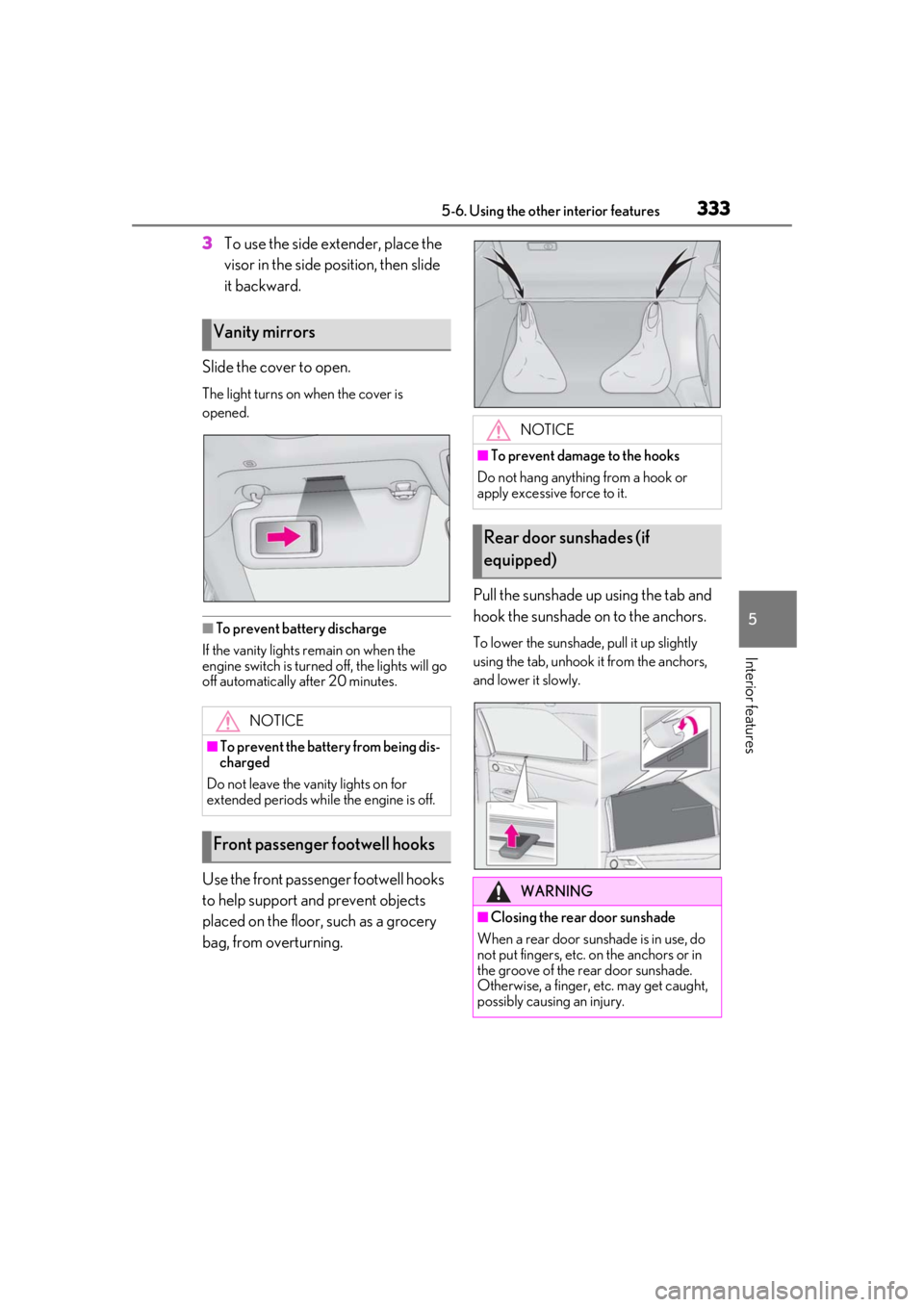
3To use the side extender, place the
visor in the side position, then slide
it backward.
Slide the cover to open.
The light turns on when the cover is
opened.
■To prevent battery discharge
If the vanity lights remain on when the
engine switch is turned off, the lights will go
off automatically after 20 minutes.
Use the front passenger footwell hooks
to help support and prevent objects
placed on the floor, such as a grocery
bag, from overturning. Pull the sunshade up using the tab and
hook the sunshade on to the anchors.
To lower the sunshade, pull it up slightly
using the tab, unhook it from the anchors,
and lower it slowly.
Vanity mirrors
NOTICE
■To prevent the battery from being dis-
charged
Do not leave the vanity lights on for
extended periods while the engine is off.
Front passenger footwell hooks
NOTICE
■To prevent damage to the hooks
Do not hang anything from a hook or
apply excessive force to it.
Rear door sunshades (if
equipped)
WARNING
■Closing the rear door sunshade
When a rear door sunshade is in use, do
not put fingers, etc. on the anchors or in
the groove of the rear door sunshade.
Otherwise, a finger, etc. may get caught,
possibly causing an injury.
Page 352 of 508
3526-2. Maintenance
Radiator/con-
denser
The radiator and con-
denser should be free
from foreign objects.
( P.362)
Washer fluid
Is there sufficient
washer fluid?
( P.364)
Vehicle interior
ItemsCheck points
Accelerator
pedal
• The accelerator
pedal should move
smoothly (without
uneven pedal effort
or catching).
Automatic trans-
mission “Park”
mechanism
•When parked on a slope and the shift
lever is in P, is the
vehicle securely
stopped?
Brake pedal
• Does the brake pedal move
smoothly?
• Does the brake pedal have appro-
priate clearance
from the floor?
• Does the brake pedal have the cor-
rect amount of free
play?
ItemsCheck points
Brakes
• The vehicle should not pull to one side
when the brakes are
applied.
•The brakes should work effectively.
• The brake pedal should not feel
spongy.
• The brake pedal should not get too
close to the floor
when the brakes are
applied.
Head restraints
•Do the head restraints move
smoothly and lock
securely?
Indicators/buzz-
ers•Do the indicators and buzzers function
properly?
Lights
• Do all the lights come on?
• Are the headlights aimed correctly?
( P.382)
Parking brake
• Does the parking
brake switch oper-
ate normally?
• When parked on a slope and the park-
ing brake is on, is the
vehicle securely
stopped?
Seat belts
• Do the seat belts operate smoothly?
• The seat belts should not be damaged.
ItemsCheck points
Page 428 of 508
4287-2. Steps to take in an emergency
One of the following may be the cause
of the problem:
There may not be sufficient fuel in
the vehicle’s tank.
Refuel the vehicle.
The engine may be flooded.
Try to restart the engine again fol-
lowing correct starting procedures.
( P.174)
There may be a malfunction in the
engine immobilizer system.
( P.66)
One of the following may be the cause
of the problem:
The battery may be discharged.
( P.433)
The battery terminal connections
may be loose or corroded.
( P.363)
NOTICE
■Proper storage of the spare tire
(RX350L)
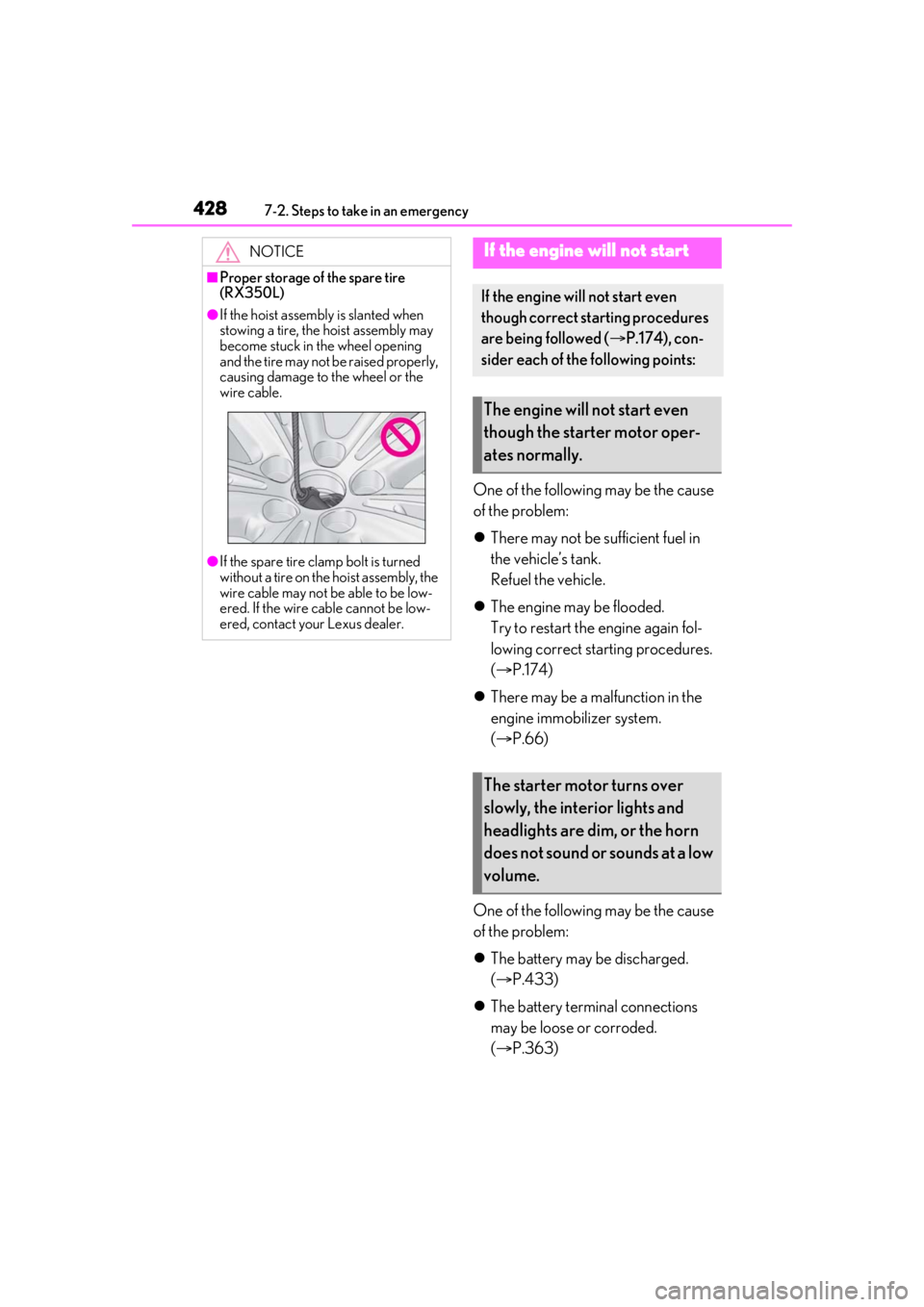
●If the hoist assembly is slanted when
stowing a tire, the hoist assembly may
become stuck in the wheel opening
and the tire may not be raised properly,
causing damage to the wheel or the
wire cable.
●If the spare tire clamp bolt is turned
without a tire on the hoist assembly, the
wire cable may not be able to be low-
ered. If the wire cable cannot be low-
ered, contact your Lexus dealer.
If the engine will not start
If the engine will not start even
though correct starting procedures
are being followed ( P.174), con-
sider each of the following points:
The engine will not start even
though the starter motor oper-
ates normally.
The starter motor turns over
slowly, the interior lights and
headlights are dim, or the horn
does not sound or sounds at a low
volume.
Page 429 of 508

4297-2. Steps to take in an emergency
7
When trouble arises
The engine starting system may be
malfunctioning due to an electrical
problem such as electronic key battery
depletion or a blown fuse. However, an
interim measure is available to start the
engine. (P.429)
One of the following may be the cause
of the problem:
One or both of the battery terminals
may be disconnected. ( P.363)
The battery may be discharged.
( P.433)
There may be a malfunction in the
steering lock system.
Contact your Lexus dealer if the problem
cannot be repaired, or if repair procedures
are unknown.
When the engine does not start, the
following steps can be used as an
interim measure to start the engine if
the engine switch is functioning nor-
mally.
Do not use this starting procedure
except in cases of emergency.
1 Turn the engine switch to IGNI-
TION ON mode and check that the parking brake is set. (
P.177,
183)
2 Shift the shift lever to P.
3 Turn the engine switch to ACCES-
SORY mode.
4 Press and hold the engine switch
for about 15 seconds while
depressing the brake pedal firmly.
Even if the engine can be started using
the above steps, the system may be
malfunctioning. Have the vehicle
inspected by your Lexus dealer.
The starter motor does not turn
over
The starter motor does not turn
over, the interior lights and head-
lights do not turn on, or the horn
does not sound.
Starting the engine in an emer-
gency
Page 449 of 508

4498-1. Specifications
8
Vehicle specifications
Type B
A: Wedge base bulbs (amber)
B: Wedge base bulbs (clear)
*1: Vehicles with sing le-beam headlights
*2: Vehicles without door trim ornament lights
Tire size235/55R20 102V, T165/90D18 107M (spare)
Tire inflation pressure
(Recommended cold tire
inflation pressure)
Front tire
33 psi (230 kPa, 2.3 kgf/cm
2 or bar)
Rear tire
33 psi (230 kPa, 2.3 kgf/cm
2 or bar)
Spare tire
60 psi (420 kPa, 4.2 kgf/cm
2 or bar)
Driving at high speeds (above 100 mph [160 km/h]) (in
countries where such speeds are permitted by law)
Add 11 psi (70 kPa, 0.7 kgf/cm
2 or bar) to the front and rear
tires. Never exceed the maximum cold tire inflation pres-
sure indicated on the tire sidewall.
Wheel size20 8J, 18 4T (spare)
Wheel nut torque76 ft•lbf (103 N•m, 10.5 kgf•m)
Light bulbs
Light bulbsBulb No.WType
Exterior
Front side marker lights*1W5W5B
Front turn signal lights*17444NA28/8A
Rear turn signal lights*1WY21W21A
Back-up lights*192116B
InteriorDoor courtesy lights*25B
Vanity lights8B
Page 494 of 508

494Alphabetical Index
Bottle holders..................................................316
BrakeBrake hold...................................................... 186
Fluid ...................................................... 362, 447
Parking brake ............................................... 183
Warning light ...............................................403
Brake assist .....................................................274
Break-in tips.................................................... 155
Brightness control Instrument panel light control ................80
BSM (Blind Spot Monitor)....................... 236
Buzzer Hands off steering wheel warning (LTA)......................................................................... 223
C
Care Exterior ........................................................... 344
Interior ............................................................. 347
Seat belts........................................................ 347
Wheels and wheel ornaments............ 344
Cargo capacity.....................................159, 162
Cargo hooks ................................................... 317
Cargo net hooks ............................................ 317
Center Display .............................................288
Chains ................................................................281
Child restraint system Fixed with a LATCH system .................. 54
Fixed with a seat belt...................................50
Front passenger occupant classification system ............................................................. 39
Points to remember .................................... 45
Riding with children ..................................... 45
Types of child restraint system installation method ........................................................... 46
Using an anchor bracket .......................... 57
Child safety Airbag precautions...................................... 36
Battery precautions ......................364, 436
Child restraint system................................. 46
Heated steering wheel and seat heater precautions................................................306 How your child should wear the seat belt
............................................................................. 27
Moon roof precautions............................ 148
Panoramic moon roof precautions ..... 151
Power back door precautions ............. 103
Power window lock switch .................... 146
Power window precautions .................. 145
Rear door child-protectors ................... 102
Seat belt extender precautions.............. 27
Seat belt precautions .................................. 45
Child-protectors............................................102
Cleaning Exterior............................................................ 344
Interior ............................................................. 347
Radar sensor ................................................203
Seat belts ........................................................ 347
Wheels and wheel ornaments ............344
Clock ..........................................................77, 331
Coat hooks.......................................................331
Coin box............................................................316
Compass ......................................................... 340
Condenser ..................................................... 362
Console box ....................................................314
Consumption screen .................................... 92
Cooling system...............................................361 Engine overheating................................... 437
Cornering lights ............................................ 190 Replacing light bulbs ............................... 385
Cruise control Dynamic radar cruise control with full-speed range ...................................... 227
Cup holders .....................................................315
Current fuel consumption .......................... 82
Curtain shield airbags .................................. 30
Customizable features ................................461
D
Daytime running light system .................. 188
Defogger Outside rear view mirrors..................... 294
Rear window ................................................ 294
Windshield .................................................... 294