2021 LEXUS RCF trunk
[x] Cancel search: trunkPage 289 of 408

2896-4. Do-it-yourself maintenance
6
Maintenance and care
Stop/tail lights
Back-up lights
High mounted stoplight
License plate lights
■LED light bulbs
The lights other than the rear turn signal
lights each consist of a number of LEDs. If
any of the LEDs burn out, take your vehicle
to your Lexus dealer to have the light
replaced.
■Condensation build-up on the inside of
the lens
Temporary condensation build-up on the
inside of the headlight lens does not indi-
cate a malfunction. Contact your Lexus
dealer for more information in the following
situations:
●Large drops of water ha ve built up on the
inside of the lens.
●Water has built up inside the headlight.
■When replacing light bulbs
P.287
■Rear turn signal lights
1 Open the trunk and apply protec-
tive tape to the peripheral of the
taillight and the vehicle body
around the taillight.
Use masking tape, etc. Do not use duct
tape, as it may leave residue or damage the paint when removed.
2
Using a flathead screwdriver,
remove the cover.
To prevent scratching the vehicle, wrap the
tip of the flathead scre wdriver with a cloth,
etc.
3 Remove the 2 screws.Replacing light bulbs
Page 299 of 408

2997-2. Steps to take in an emergency
7
When trouble arises
To have your vehicle towed by another
vehicle, the towing eyelet must be
installed to your vehicle. Install the tow-
ing eyelet using the following proce-
dure.
1Take out the towing eyelet.
(P.314, 320)
2 Remove the eyelet cover using a
flathead screwdriver.
To protect the bodywork, place a rag
between the screwdriver and the vehicle
body as shown in the illustration.
3Insert the towing eyelet into the
hole and tighten partially by hand. 4
Tighten down the towing eyelet
securely using a phillips-head
screwdriver or hard metal bar.
5 Securely attach cables or chains to
the towing eyelet.
Take care not to damage the vehi-
cle body.
6 Enter the vehicle being towed and
start the engine.
If the engine does not start, turn the
engine switch to IGNITION ON
mode.
7 Shift the shift lever to N and release
the parking brake.
When the shift lever cannot be
shifted: P.133
■While towing
If the engine is not running, the power assist
for the brakes and steering will not function,
making steering and braking more difficult.
■Wheel nut wrench
Wheel nut wrench is installed in trunk.
( P.314, 320)
Emergency towing procedure
Page 306 of 408

3067-2. Steps to take in an emergency
■Automatic headlight leveling system warning light
■Open door warning light (warning buzzer)*
*: Open door warning buzzer: P.94
■Low fuel level warning light
■Driver’s and front passenger’s seat belt reminder light (warning buzzer)*
*: Driver’s seat belt warning buzzer:
The driver’s seat belt warning buzzer sounds to al ert the driver that his or her seat belt is not
fastened. Once the engine switch is turned to IGNITION ON mode, the buzzer sounds.
If the seat belt is still unfastened, the buzzer sounds intermittently for a certain period of
time after the vehicle reaches a certain speed.
Front passenger’s seat belt warning buzzer:
The front passenger’s seat belt warning buzzer sounds to alert the front passenger that his
or her seat belt is not fastened. If the seat belt is unfastened, the buzzer sounds intermit-
tently for a certain period of time af ter the vehicle reaches a certain speed.
Warning lightDetails/Actions
Indicates a malfunction in the automatic headlight leveling system
Have the vehicle inspected by your Lexus dealer immediately.
Warning lightDetails/Actions
Indicates that a door or th e trunk is not fully closed
Check that both side doors and the trunk are closed.
Warning lightDetails/Actions
Indicates that remaining fuel is approximately 2.6 gal. (10 L, 2.2 Imp.
gal.) or less
Refuel the vehicle.
Warning lightDetails/Actions
Warns the driver and/or front pass enger to fasten their seat belts
Fasten the seat belt.
If the front passenger’s seat is occupied, the front passenger’s seat
belt also needs to be fastened to make the warning light (warning
buzzer) turn off.
Page 315 of 408

3157-2. Steps to take in an emergency
7
When trouble arises
1Remove the luggage mat.
2 Take out the jack.
1 For tightening 2
For loosening
If the jack is too tightly installed to be
removed by hand, insert a tool, such as the
screwdriver included wi th the vehicle, into
the hole of the jack (portion ) and
loosen the jack.
1 Remove the luggage mat.
2 Loosen the center fastener that
secures the spare tire.
If the center fastener cannot be turned by
hand, use the wheel nut wrench that is
stored in the trunk. (To secure the tire,
tighten the center fastener by hand. Do not
use the wrench or other tools.)
WARNING
●Do not start the engine or drive the
vehicle while the vehicle is supported
by the jack.
●Do not raise the vehicle while some-
one is inside.
●When raising the vehicle, do not put an
object on or under the jack.
●Do not raise the vehicle to a height
greater than that required to replace
the tire.
●Use a jack stand if it is necessary to get
under the vehicle.
●When lowering the vehicle, make sure
that there is no-one near the vehicle. If
there are people nearby, warn them
vocally before lowering.
Taking out the jack
NOTICE
■To prevent damage to luggage mat
When closing the trunk lid, do not leave
the luggage mat lever hooked onthe
edge of the trunk.
Taking out the spare tire
A
Page 323 of 408
3237-2. Steps to take in an emergency
7
When trouble arises
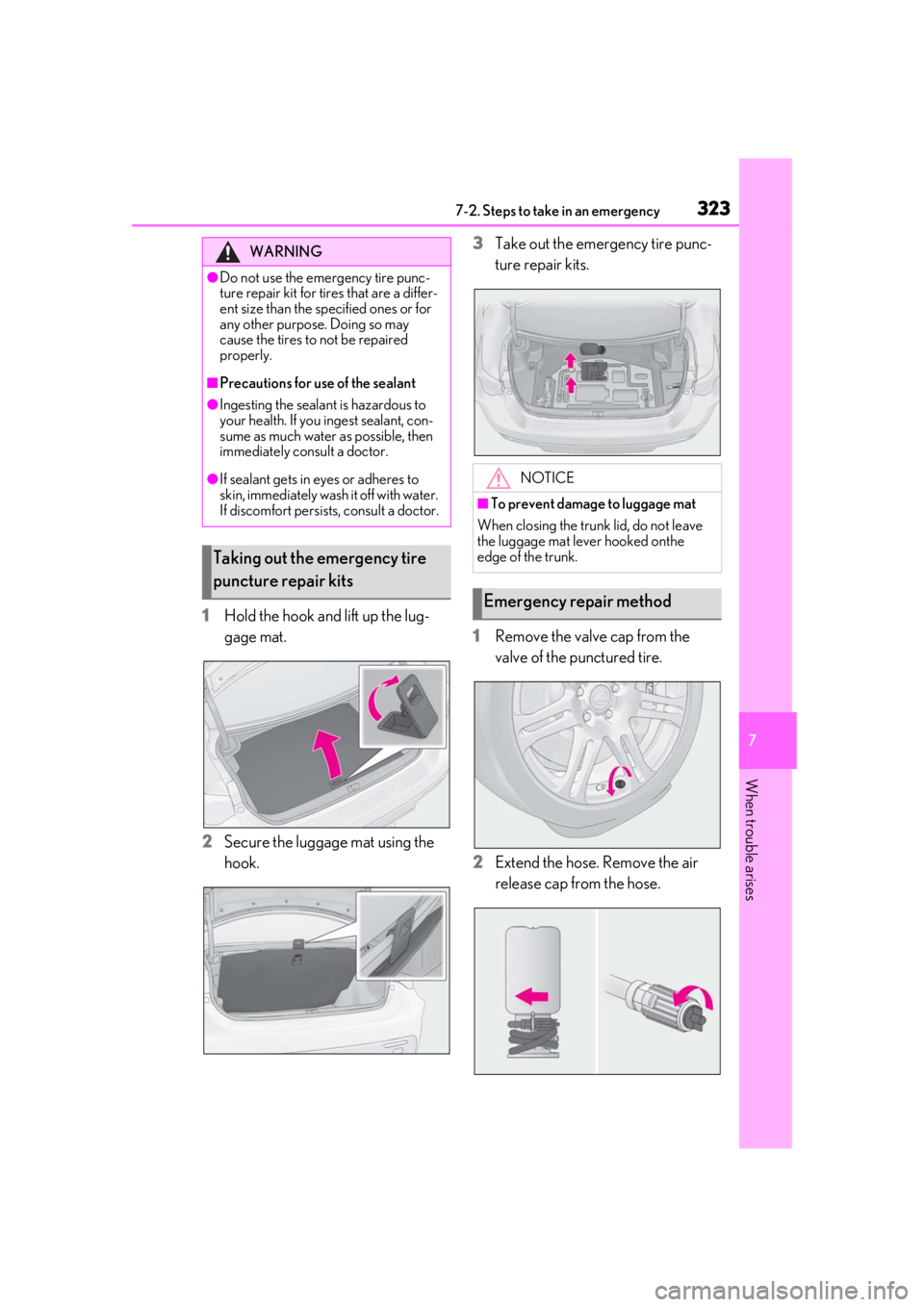
1Hold the hook and lift up the lug-
gage mat.
2 Secure the luggage mat using the
hook. 3
Take out the emergency tire punc-
ture repair kits.
1 Remove the valve cap from the
valve of the punctured tire.
2 Extend the hose. Remove the air
release cap from the hose.
WARNING
●Do not use the emergency tire punc-
ture repair kit for ti res that are a differ-
ent size than the specified ones or for
any other purpose. Doing so may
cause the tires to not be repaired
properly.
■Precautions for use of the sealant
●Ingesting the sealant is hazardous to
your health. If you ingest sealant, con-
sume as much water as possible, then
immediately consult a doctor.
●If sealant gets in eyes or adheres to
skin, immediately wash it off with water.
If discomfort persists, consult a doctor.
Taking out the emergency tire
puncture repair kits
NOTICE
■To prevent damage to luggage mat
When closing the trunk lid, do not leave
the luggage mat lever hooked onthe
edge of the trunk.
Emergency repair method
Page 326 of 408

3267-2. Steps to take in an emergency
Turn the compressor switch off and then
check the tire inflation pressure. Being
careful not to over inflate, check and
repeat the inflation pr ocedure until the rec-
ommended tire inflation pressure is
reached.
If the tire inflation pre ssure is still lower than
the recommended level after inflation for
10 minutes (35 minutes at low tempera-
ture) with the switch on, the tire is too dam-
aged to be repaired. Turn the compressor
switch off and contact your Lexus dealer.
If the tire inflation pressure exceeds the
recommended level, let out some air to
adjust the tire inflation pressure. ( P.327,
347)
14 With the compressor switch off, dis-
connect the hose from the valve on
the tire and then pull out the power
plug from the power outlet socket.
Some sealant may leak when the hose is
removed.
15Install the valve cap onto the valve
of the emergency repaired tire.
16 Attach the air release cap to the
end of the hose.
If the air release cap is not attached, the
sealant may leak and the vehicle may get
dirty.
17Temporarily store the bottle in the
trunk while it is connected to the
compressor.
18 To spread the liquid sealant evenly
within the tire, immediately drive safely for about 3 miles (5 km)
below 50 mph (80 km/h).
19 After driving, stop your vehicle in a
safe place on a hard, flat surface
and reconnect the compressor.
20 Turn the compressor switch on and
wait for several seconds, then turn it
off. Check the tire inflation pres-
sure.
If the tire inflatio n pressure is below
19 psi (130 kPa, 1.3 kgf/cm
2 or bar):
The puncture cannot be repaired.
Contact your Lexus dealer.
If the tire inflation pressure is
between 19 psi (130 kPa, 1.3
kgf/cm
2 or bar) and a point below
the recommended level: The tire
can be repaired. Proceed to step
21 .
If the tire inflation pressure is at the
recommended level: Proceed to
A
B
C
Page 327 of 408

3277-2. Steps to take in an emergency
7
When trouble arises
step 22.
21 Turn the compressor switch on to
inflate the tire until the recom-
mended tire inflation pressure is
reached. Drive for about 3 miles (5
km) and then perform step 19 .
22 Attach the air release cap to the
end of the hose.
If the air release cap is not attached, the
sealant may leak and the vehicle may get
dirty.
23Store the bottle in the trunk while it
is connected to the compressor.
24 Taking precautions to avoid sud-
den braking, sudd en acceleration
and sharp turns, drive carefully at
under 50 mph (80 km/h) to your
Lexus dealer that is less than 62
miles (100 km) away for tire repair
or replacement.
■After a tire is repaired with the emer-
gency tire puncture repair kit
●The tire pressure warning valve and
transmitter should be replaced.
●Even if the tire inflat ion pressure is at the
recommended level, the tire pressure
warning light may come on/flash.
■If the tire is inflated to more than the
recommended level
1 Disconnect the hose from the valve.
2 Install the air release cap to the end of
the hose and push th e protrusion on the air release cap into the valve to let some
air out.
3 Disconnect the hose from the valve,
remove the air release cap from the
hose and then reconnect the hose.
4 Turn the compressor switch on and wait
for several seconds, then turn it off.
Check that the air pressure indicator
shows the recommended level.
( P.347)
If the air pressure is lower than the rec-
ommended level, turn the compressor
switch on again and repeat the inflation
procedure until the recommended
pressure is reached.
WARNING
■When fixing the flat tire
Observe the following precautions.
Failure to do so may result in death or
serious injury.
●Stop your vehicle in a safe and flat
area.
●Do not touch the wheels or the area
around the brakes immediately after
the vehicle has been driven.
After the vehicle has been driven, the
wheels and the area around the brakes
may be extremely hot. Touching these
areas with hands, feet or other body
parts may result in burns.
●Connect the valve and hose securely
with the tire installed on the vehicle.
• If the hose is not properly connected to the valve, air leakage may occur or
sealant may be sprayed out.
Page 329 of 408

3297-2. Steps to take in an emergency
7
When trouble arises
One of the following may be the cause
of the problem:
There may not be sufficient fuel in
the vehicle’s tank.
Refuel the vehicle.
The engine may be flooded.
Try to restart the engine again fol-
lowing correct starting procedures.
( P.128)
There may be a malfunction in the
engine immobilizer system.
( P.57)
One of the following may be the cause
of the problem:
The battery may be discharged.
( P.334)
The battery terminal connections
may be loose or corroded.
( P.271)
NOTICE
●Store the emergency tire puncture
repair kit in the trunk. The kit may be
thrown around during sudden braking
and so forth, damaging the kit.
●Store the kit in its assigned place out of
reach of children.
●Do not disassemble or modify the kit.
Do not subject parts such as the air
pressure indicator to impacts. This may
cause a malfunction.
■To avoid damage to the tire pressure
warning valves and transmitters
When a tire is repaired with liquid seal-
ants, the tire pressu re warning valve and
transmitter may not operate properly. If a
liquid sealant is used , contact your Lexus
dealer as soon as possible. After use of
liquid sealant, make sure to replace the
tire pressure warnin g valve and transmit-
ter when repairing or replacing the tire.
(
P.277)
If the engine will not start
If the engine will not start even
though correct starting procedures
are being followed ( P.128), con-
sider each of the following points:
The engine will not start even
though the starter motor oper-
ates normally.
The starter motor turns over
slowly, the interior lights and
headlights are dim, or the horn
does not sound or sounds at a low
volume.