2021 LEXUS RCF light
[x] Cancel search: lightPage 316 of 408

3167-2. Steps to take in an emergency
1Chock the tires.
2 Slightly loosen the wheel nuts (one
turn). 3
Turn the tire jack portion by
hand until the notch of the jack is in
contact with the jack point.
The jack point guides are located under
the rocker panel. They indicate the jack
point positions.
4 Raise the vehicle until the tire is
slightly raised off the ground.
5 Remove all the wheel nuts and the
tire.
When resting the tire on the ground, place
the tire so that the wheel design faces up to
avoid scratching the wheel surface.
WARNING
■When storing the spare tire
Be careful not to catch fingers or other
body parts between the spare tire and
the body of the vehicle.
Replacing a flat tire
Flat tireWheel chock posi- tions
Front left-hand sideBehind the rear
right-hand side tire
Front right-hand
sideBehind the rear
left-hand side tire
Rear left-hand sideIn front of the front
right-hand side tire
Rear right-hand sideIn front of the front
left-hand side tire
A
Page 318 of 408
3187-2. Steps to take in an emergency
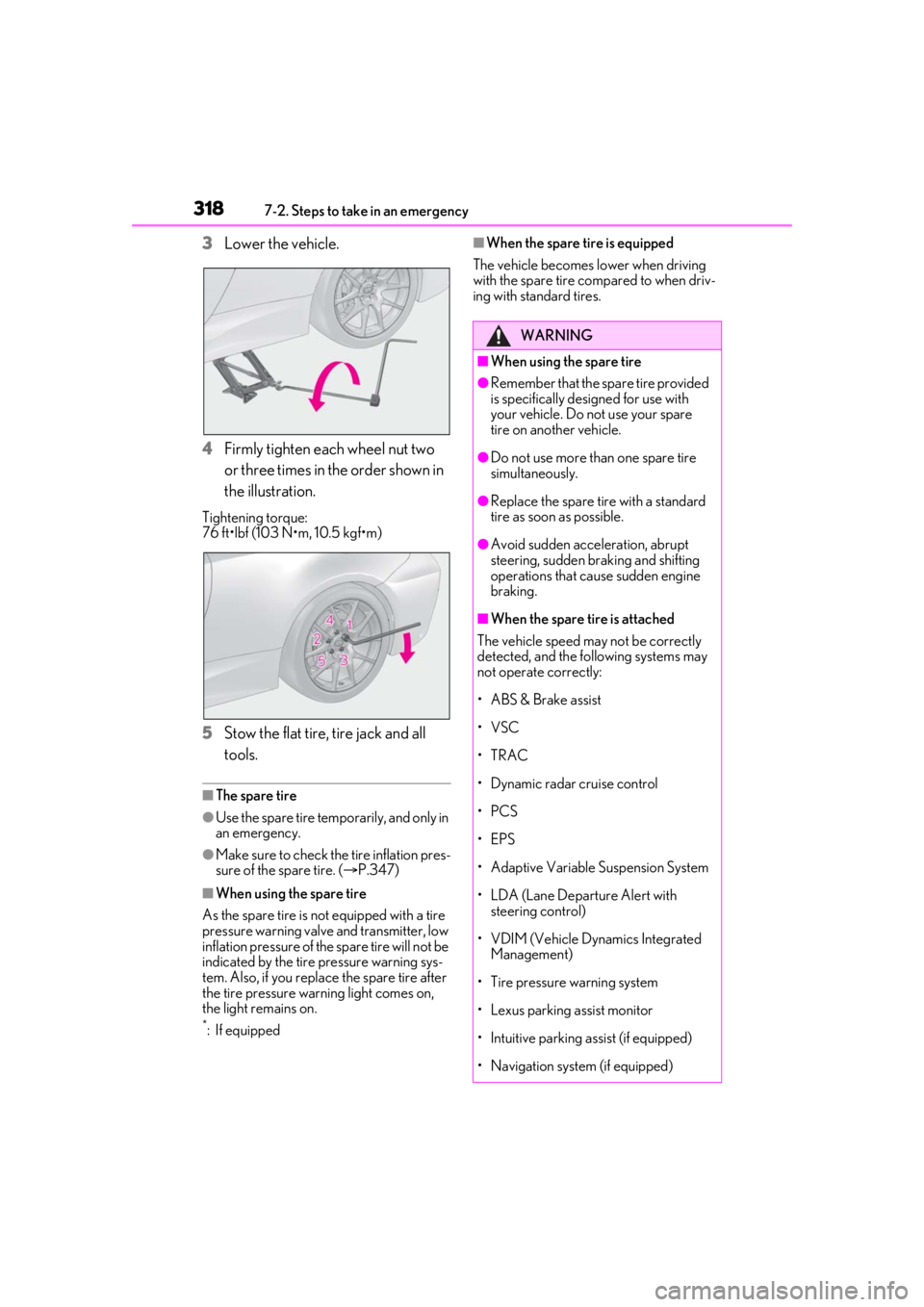
3Lower the vehicle.
4 Firmly tighten each wheel nut two
or three times in the order shown in
the illustration.
Tightening torque:
76 ft•lbf (103 N•m, 10.5 kgf•m)
5Stow the flat tire, tire jack and all
tools.
■The spare tire
●Use the spare tire temporarily, and only in
an emergency.
●Make sure to check the tire inflation pres-
sure of the spare tire. ( P.347)
■When using the spare tire
As the spare tire is not equipped with a tire
pressure warning valve and transmitter, low
inflation pressure of the spare tire will not be
indicated by the tire pressure warning sys-
tem. Also, if you replace the spare tire after
the tire pressure warning light comes on,
the light remains on.
*:If equipped
■When the spare tire is equipped
The vehicle becomes lower when driving
with the spare tire compared to when driv-
ing with standard tires.
WARNING
■When using the spare tire
●Remember that the sp are tire provided
is specifically designed for use with
your vehicle. Do not use your spare
tire on another vehicle.
●Do not use more than one spare tire
simultaneously.
●Replace the spare tire with a standard
tire as soon as possible.
●Avoid sudden acceleration, abrupt
steering, sudden br aking and shifting
operations that cause sudden engine
braking.
■When the spare tire is attached
The vehicle speed may not be correctly
detected, and the following systems may
not operate correctly:
• ABS & Brake assist
•VSC
•TRAC
• Dynamic radar cruise control
•PCS
•EPS
• Adaptive Variable Suspension System
• LDA (Lane Departure Alert with steering control)
• VDIM (Vehicle Dynamics Integrated Management)
• Tire pressure warning system
• Lexus parking assist monitor
• Intuitive parking assist (if equipped)
• Navigation system (if equipped)
Page 327 of 408

3277-2. Steps to take in an emergency
7
When trouble arises
step 22.
21 Turn the compressor switch on to
inflate the tire until the recom-
mended tire inflation pressure is
reached. Drive for about 3 miles (5
km) and then perform step 19 .
22 Attach the air release cap to the
end of the hose.
If the air release cap is not attached, the
sealant may leak and the vehicle may get
dirty.
23Store the bottle in the trunk while it
is connected to the compressor.
24 Taking precautions to avoid sud-
den braking, sudd en acceleration
and sharp turns, drive carefully at
under 50 mph (80 km/h) to your
Lexus dealer that is less than 62
miles (100 km) away for tire repair
or replacement.
■After a tire is repaired with the emer-
gency tire puncture repair kit
●The tire pressure warning valve and
transmitter should be replaced.
●Even if the tire inflat ion pressure is at the
recommended level, the tire pressure
warning light may come on/flash.
■If the tire is inflated to more than the
recommended level
1 Disconnect the hose from the valve.
2 Install the air release cap to the end of
the hose and push th e protrusion on the air release cap into the valve to let some
air out.
3 Disconnect the hose from the valve,
remove the air release cap from the
hose and then reconnect the hose.
4 Turn the compressor switch on and wait
for several seconds, then turn it off.
Check that the air pressure indicator
shows the recommended level.
( P.347)
If the air pressure is lower than the rec-
ommended level, turn the compressor
switch on again and repeat the inflation
procedure until the recommended
pressure is reached.
WARNING
■When fixing the flat tire
Observe the following precautions.
Failure to do so may result in death or
serious injury.
●Stop your vehicle in a safe and flat
area.
●Do not touch the wheels or the area
around the brakes immediately after
the vehicle has been driven.
After the vehicle has been driven, the
wheels and the area around the brakes
may be extremely hot. Touching these
areas with hands, feet or other body
parts may result in burns.
●Connect the valve and hose securely
with the tire installed on the vehicle.
• If the hose is not properly connected to the valve, air leakage may occur or
sealant may be sprayed out.
Page 329 of 408

3297-2. Steps to take in an emergency
7
When trouble arises
One of the following may be the cause
of the problem:
There may not be sufficient fuel in
the vehicle’s tank.
Refuel the vehicle.
The engine may be flooded.
Try to restart the engine again fol-
lowing correct starting procedures.
( P.128)
There may be a malfunction in the
engine immobilizer system.
( P.57)
One of the following may be the cause
of the problem:
The battery may be discharged.
( P.334)
The battery terminal connections
may be loose or corroded.
( P.271)
NOTICE
●Store the emergency tire puncture
repair kit in the trunk. The kit may be
thrown around during sudden braking
and so forth, damaging the kit.
●Store the kit in its assigned place out of
reach of children.
●Do not disassemble or modify the kit.
Do not subject parts such as the air
pressure indicator to impacts. This may
cause a malfunction.
■To avoid damage to the tire pressure
warning valves and transmitters
When a tire is repaired with liquid seal-
ants, the tire pressu re warning valve and
transmitter may not operate properly. If a
liquid sealant is used , contact your Lexus
dealer as soon as possible. After use of
liquid sealant, make sure to replace the
tire pressure warnin g valve and transmit-
ter when repairing or replacing the tire.
(
P.277)
If the engine will not start
If the engine will not start even
though correct starting procedures
are being followed ( P.128), con-
sider each of the following points:
The engine will not start even
though the starter motor oper-
ates normally.
The starter motor turns over
slowly, the interior lights and
headlights are dim, or the horn
does not sound or sounds at a low
volume.
Page 330 of 408

3307-2. Steps to take in an emergency
The engine starting system may be
malfunctioning due to an electrical
problem such as electronic key battery
depletion or a blown fuse. However, an
interim measure is available to start the
engine. (P.330)
One of the following may be the cause
of the problem:
One or both of the battery terminals
may be disconnected. ( P.271)
The battery may be discharged.
( P.334)
There may be a malfunction in the
steering lock system.
Contact your Lexus dealer if the problem
cannot be repaired, or if repair procedures
are unknown.
When the engine does not start, the
following steps can be used as an
interim measure to start the engine if
the engine switch is functioning nor-
mally:
1 Set the parking brake.
2 Shift the shift lever to P.
3 Turn the engine switch to ACCES-
SORY mode. 4
Press and hold the engine switch
for about 15 seconds while
depressing the brake pedal firmly.
Even if the engine can be started using
the above steps, the system may be
malfunctioning. Have the vehicle
inspected by your Lexus dealer.
The starter motor does not turn
over
The starter motor does not turn
over, the interior lights and head-
lights do not turn on, or the horn
does not sound.
Emergency start function
Page 335 of 408

3357-2. Steps to take in an emergency
7
When trouble arises
raise the front of the engine cover
to remove the front clips.
4 Connect a positive jumper cable clamp to on your vehicle and connect the
clamp on the other end of the positive cab le to on the second vehicle. Then,
connect a negative cable clamp to on the second vehicle and connect the
clamp at the other end of the negative cable to .
Positive (+) battery terminal (your vehicle)
Positive (+) battery terminal (second vehicle)
Negative (-) battery terminal (second vehicle)
Solid, stationary, unpainted metallic poin t away from the battery and any mov-
ing parts as shown in the illustration
5 Start the engine of the second vehi-
cle. Increase the engine speed
slightly and maintain at that level for
approximately 5 minutes to
recharge the battery of your vehi-
cle.
6 Open and close any of the door of
your vehicle with the engine switch
off. 7
Maintain the engine speed of the
second vehicle and start the engine
of your vehicle by turning the
engine switch to IGNITION ON
mode.
8 Once the vehicle’s engine has
started, remove the jumper cables
in the exact reverse order from
which they were connected.
A
B
C
D
A
B
C
D
Page 336 of 408

3367-2. Steps to take in an emergency
Once the engine starts, have the vehi-
cle inspected at your Lexus dealer as
soon as possible.
■Starting the engine when the battery is
discharged
The engine cannot be started by push-start-
ing.
■To prevent battery discharge
●Turn off the headlights and the audio sys-
tem while the engine is off.
●Turn off any unnecessary electrical com-
ponents when the vehicle is running at a
low speed for an extended period, such
as in heavy traffic.
■Charging the battery
The electricity stored in the battery will dis-
charge gradually even when the vehicle is
not in use, due to natural discharge and the
draining effects of certain electrical appli-
ances. If the vehicle is left for a long time,
the battery may discharge, and the engine
may be unable to start. (The battery
recharges automatically during driving.)
■When recharging or replacing the bat-
tery
●In some cases, it may not be possible to
unlock the doors using the smart access
system with push-button start when the
battery is discharged. Use the wireless
remote control or the mechanical key to
lock or unlock the doors.
●The engine may not start on the first
attempt after the battery has recharged
but will start normally after the second
attempt. This is not a malfunction.
●The engine switch mode is memorized by
the vehicle. When the battery is recon-
nected, the system will return to the
mode it was in before the battery was dis-
charged. Before di sconnecting the bat-
tery, turn the engine switch off.
If you are unsure what mode the engine
switch was in befo re the battery dis-
charged, be especially careful when
reconnecting the battery.
■When replacing the battery
●Use a battery that conforms to European
regulations.
●Use a battery that tha case size is same as
the previous one (LN3), 20 hour rate
capacity (20HR) is equivalent (70Ah) or
greater, and performance rating (CCA)
is equivalent (592A) or greater.
• If the sizes differ, the battery cannot be properly secured.
• If the 20 hour rate capacity is low, even if the time period where the vehicle is not
used is a short time, battery may dis-
charge and the engine may not be able to
start.
●For details, consult your Lexus dealer.
WARNING
■Avoiding battery fires or explosions
Observe the following precautions to
prevent accidentally igniting the flamma-
ble gas that may be emitted from the bat-
tery:
●Make sure each jumper cable is con-
nected to the correct terminal and that
it is not unintentionally in contact with
any other than the intended terminal.
●Do not allow the other end of the
jumper cable connected to the “+” ter-
minal to come into contact with any
other parts or meta l surfaces in the
area, such as brackets or unpainted
metal.
●Do not allow the + and - clamps of the
jumper cables to come into contact
with each other.
●Do not smoke, use matches, cigarette
lighters or allow open flame near the
battery.
■Battery precautions
The battery contains poisonous and cor-
rosive acidic electrol yte, while related
parts contain lead and lead compounds.
Observe the following precautions when
handling the battery:
Page 345 of 408
3458-1. Specifications
8
Vehicle specifications
If replacement is necessary, contact your Lexus dealer.
■Spark plug
*: The fluid capacity is a reference quantity.If replacement is necessary, contact your Lexus dealer.
Ignition system (spark plug)
MakeDENSO FK20HBR-J8
Gap0.031 in. (0.8 mm)
NOTICE
■Iridium-tipped spark plugs
Use only iridium-tipped spark plugs. Do not adjust the spark plug gap.
Electrical system (battery)
Open voltage at 68°F (20°C):
12.3 V or higher
If the voltage is lower than the standard value,
charge the battery.
(Voltage is checked 20 minutes after the engine
and all lights are turned off.)
Charging rates5 A max.
Automatic transmission
Fluid capacity*11.8 qt. (11.2 L, 9.9 Imp. qt.)
Fluid typeToyota Genuine ATF WS
NOTICE
■Automatic transmission fluid type
Using transmission fluid other than the above type may cause abnormal noise or vibra-
tion, or damage the transmission of your vehicle.