Page 70 of 635

701-2. Child safety
LX570_OM_OM60T33U_(U)
If the child restraint has a top tether strap, follow the child restraint manu-
facturer’s operation manual regarding the installation, using the top tether
strap to latch onto the top tether strap anchor. ( P. 71)
After installing the child restraint system, rock it back and forth to ensure
that it is installed securely. ( P. 67)
■Laws and regulations pertaining to anchors
The LATCH system conforms to FMVSS225 or CMVSS210.2.
Child restraint systems conforming to FMV SS213 or CMVSS213 specifications can be
used.
This vehicle is designed to conform to SAE J1819.
WARNING
■When installing a child restraint system
Observe the following precautions.
Failure to do so may result in death or serious injury.
●When using the LATCH anchors, be sure that there are no foreign objects around the
anchors and that the seat belt is not ca ught behind the child restraint system.
●Follow all installation instructions provided by the child restraint system manufacturer.
●When securing some types of child restraint systems in second or third row seats, it
may not be possible to properly use the se at belts in positions next to the child
restraint without interfering with it or affe cting seat belt effectiveness. Be sure your
seat belt fits snugly across your shoulder and low on your hips. If it does not, or if it
interferes with the child restraint, move to a different position. Failure to do so may
result in death or serious injury.
●If the seat is adjusted, reconfirm the security of the child restraint system.
5
6
Page 71 of 635

711-2. Child safety
LX570_OM_OM60T33U_(U)
1
For safety and security
■Anchor brackets (for top tether strap)
Anchor brackets are provided for all second seats.
Use anchor brackets when fixing the
top tether strap.
■Fixing the top tether strap to the anchor bracket
Install the child restraint system in accordance to the operation manual
enclosed with the child restraint system.
Second outboard seats
Adjust the head restraint to the
upmost position.
If the head restra int interferes with
the child restraint system installation
and the head restraint can be
removed, remove th e head restraint.
( P. 161)
Open the anchor bracket cover,
latch the hook onto the anchor
bracket and tighten the top tether
strap.
Make sure the top tether strap is
securely latched. ( P. 67)
When installing th e child restraint
system with the he ad restraint being
raised, be sure to have the top tether
strap pass underneath the head
restraint.
Using an anchor bracket (for top tether strap)
1
Hook
Top tether strap2
Page 115 of 635
115
LX570_OM_OM60T33U_(U)
3
Operation of
each component
3-1. Key information
Keys .................................................... 116
3-2. Opening, closing and locking the doors
Side doors ........................................ 121
Back door....................................... 128
Smart access system with push-button start ...................... 138
3-3. Adjusting the seats Front seats...................................... 146
Rear seats....................................... 148
Driving position memory ..........157
Head restraints .............................. 161
3-4. Adjusting the steering wheel and mirrors
Steering wheel ............................. 164
Inside rear view mirror ............. 166
Outside rear view mirrors....... 168
3-5. Opening, closing the windows and moon roof
Power windows ............................. 171
Moon roof .......................................174
Page 127 of 635

LX570_OM_OM60T33U_(U)
1273-2. Opening, closing and locking the doors
3
Operation of each component
■Impact detection door lock release system
In the event that the vehicle is subject to a strong impact, all the doors are unlocked.
Depending on the force of the impact or the type of accident, however, the system may
not operate.
■Using the mechanical key
The doors can also be locked and unlocked with the mechanical key. ( P. 550)
■Conditions affecting the oper ation of the smart access system with push-button start
or wireless remote control
P. 140
■Customization
Settings (e.g. unlocking function using a key) can be changed.
(Customizable features: P. 584)
WARNING
■To prevent an accident
Observe the following precautions while driving the vehicle.
Failure to do so may result in a door open ing and an occupant being thrown out of the
vehicle, resulting in death or serious injury.
●Ensure that all doors are properly closed and locked.
●Do not pull the inside handle of the doors while driving.
Be especially careful for the front doors, as the doors may be opened even if the
inside lock buttons are in locked position.
●Set the rear door child-protector locks when children are seated in the rear seats.
Page 146 of 635
146
LX570_OM_OM60T33U_(U)3-3. Adjusting the seats
Front seats
Seat position adjustment switch
Seatback angle adjustment switch
Seat cushion (front) an
gle adjustment switch
Vertical height adjustment switch
Lumber support adjustment switch
Seat cushion length adjustment switch (driver’s side only)
When the occupant’s lower back
presses against the seatback during a
rear-end collision, the head restraint
moves slightly forward and upward to
help reduce the risk of whiplash on the
seat occupant.
Adjustment procedure
Active head restraints
1
2
3
4
5
6
Page 147 of 635
LX570_OM_OM60T33U_(U)
1473-3. Adjusting the seats
3
Operation of each component
■Power easy access system
The driver’s seat and steering wheel move in accordance with engine switch mode and
the driver’s seat belt condition. ( P. 157)
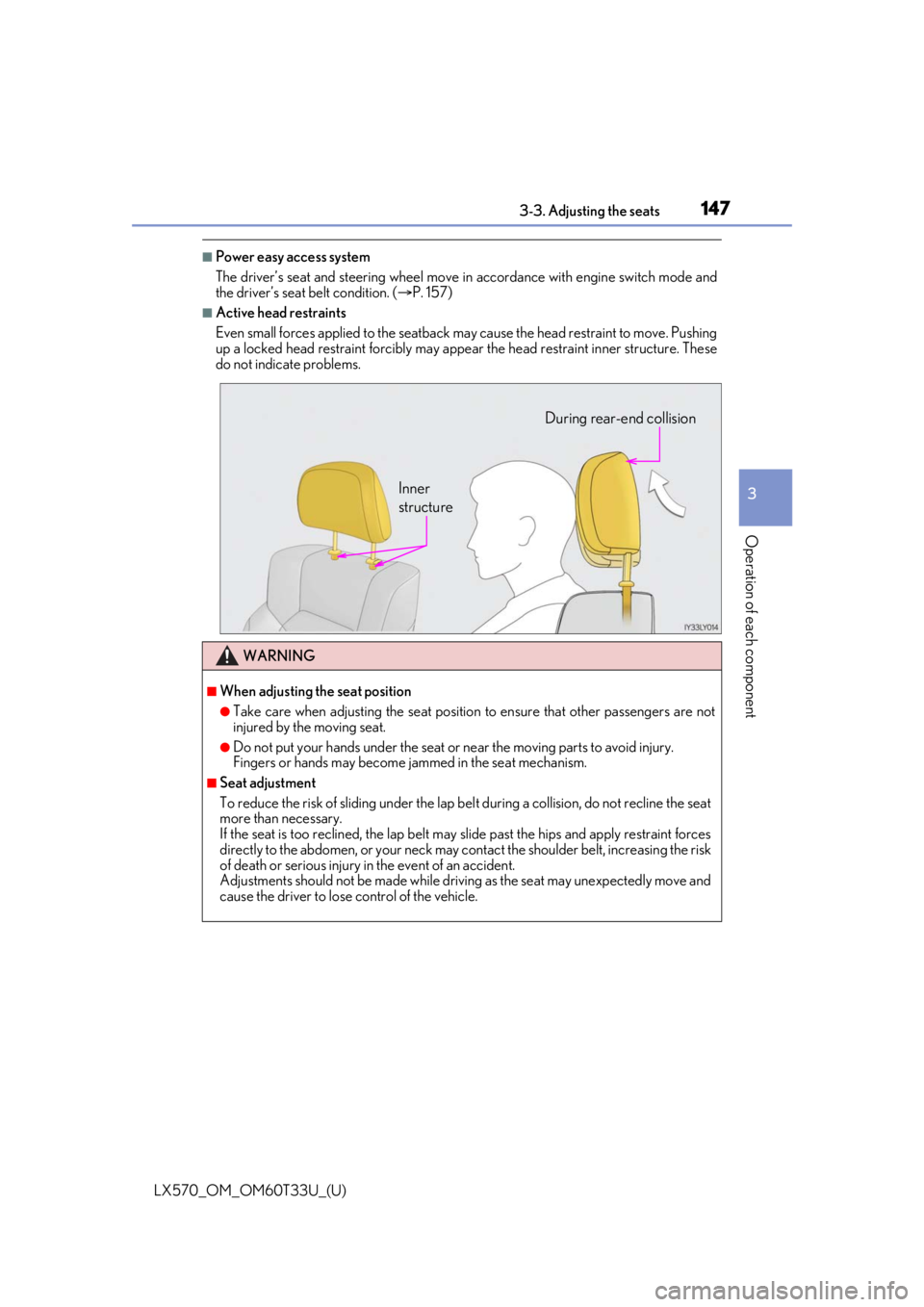
■Active head restraints
Even small forces applied to the seatback may cause the head restraint to move. Pushing
up a locked head restraint fo rcibly may appear the head re straint inner structure. These
do not indicate problems.
WARNING
■When adjusting the seat position
●Take care when adjusting the seat position to ensure that other passengers are not
injured by the moving seat.
●Do not put your hands under the seat or near the moving parts to avoid injury.
Fingers or hands may become jammed in the seat mechanism.
■Seat adjustment
To reduce the risk of sliding under the lap be lt during a collision, do not recline the seat
more than necessary.
If the seat is too reclined, the lap belt may slide past the hips and apply restraint forces
directly to the abdomen, or your neck may contact the shou lder belt, increasing the risk
of death or serious injury in the event of an accident.
Adjustments should not be made while drivin g as the seat may unexpectedly move and
cause the driver to lose control of the vehicle.
Inner
structure During rear-end collision
Page 148 of 635
148
LX570_OM_OM60T33U_(U)3-3. Adjusting the seats
Rear seats
Second seats
Seatback angle adjustment lever
Seat position adjustment switch
Third seats (if equipped)
Seatback angle adjustment lever
Adjustment procedure
1
2
1
Page 149 of 635
LX570_OM_OM60T33U_(U)
1493-3. Adjusting the seats
3
Operation of each component
For easy access to the third seat (if equipped), perform in “Tumbling the sec-
ond seats” (P. 150).
■Before tumbling the second seats
Stow the seat belt buckles and
lower the head restraints to the
lowest position.
Pass the outer seat belts through
the seat belt hangers and secure
the seat belt plates.
This prevents the shoulder belt from
being damaged.
Make sure that th e seat belts are
removed from the hangers before
using them.
Vehicles with rear seat entertain-
ment system: Install the display
cover for the rear seat entertain-
ment system.
Pass the cover belt under the dis-
play and slide the cover up.
Slide the cover down from the top
of the display to cover it.
Tumbling the second seats and third seat entry
1
1
2
3


