2021 LEXUS LS500 air condition
[x] Cancel search: air conditionPage 418 of 520
4187-1. Essential information
7-1.Essential information
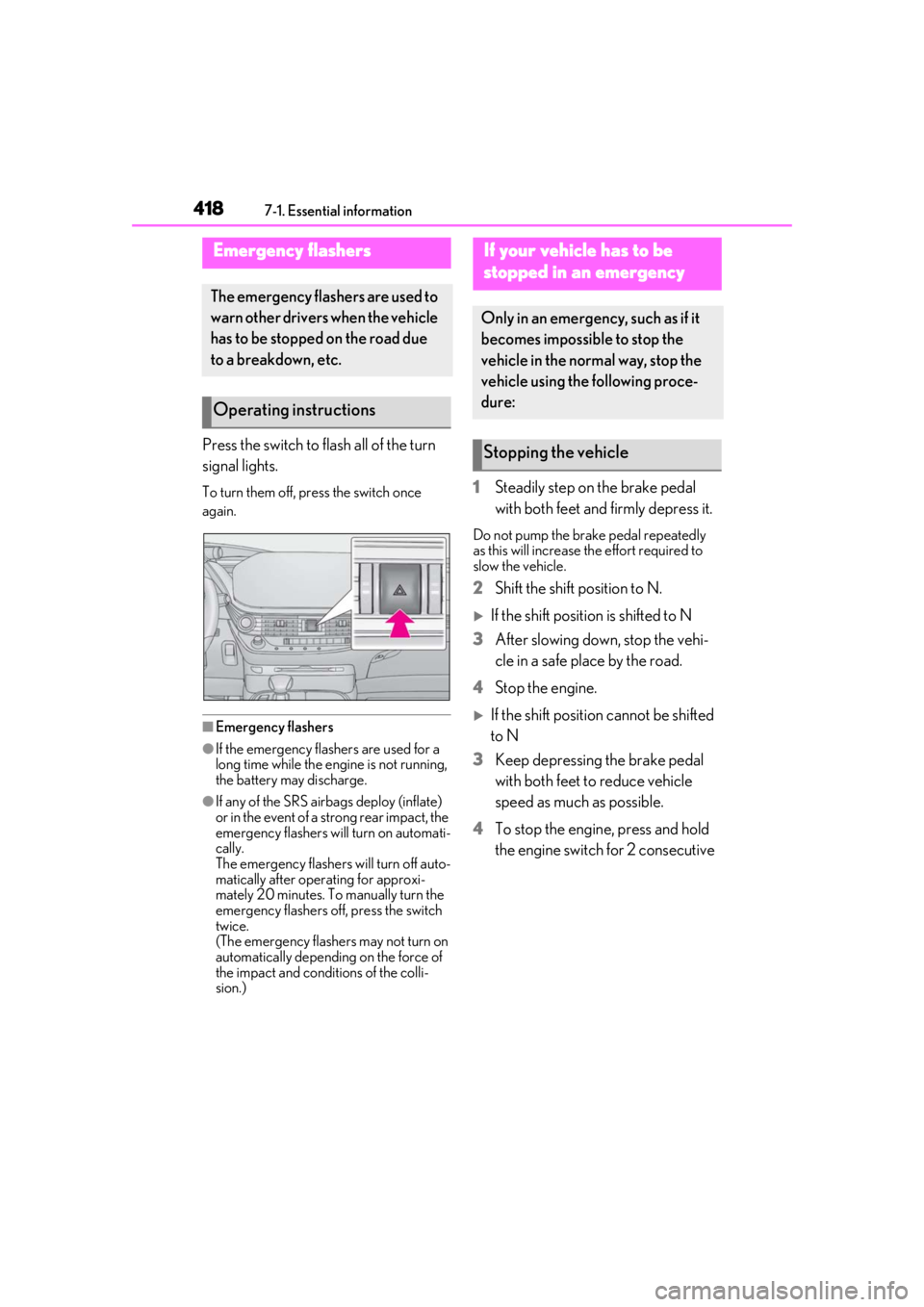
Press the switch to flash all of the turn
signal lights.
To turn them off, press the switch once
again.
■Emergency flashers
●If the emergency flashers are used for a
long time while the engine is not running,
the battery may discharge.
●If any of the SRS airbags deploy (inflate)
or in the event of a strong rear impact, the
emergency flashers will turn on automati-
cally.
The emergency flashers will turn off auto-
matically after operating for approxi-
mately 20 minutes. To manually turn the
emergency flashers off, press the switch
twice.
(The emergency flashers may not turn on
automatically depending on the force of
the impact and conditions of the colli-
sion.)
1 Steadily step on the brake pedal
with both feet and firmly depress it.
Do not pump the brake pedal repeatedly
as this will increase the effort required to
slow the vehicle.
2Shift the shift position to N.
If the shift position is shifted to N
3 After slowing down, stop the vehi-
cle in a safe place by the road.
4 Stop the engine.
If the shift position cannot be shifted
to N
3 Keep depressing the brake pedal
with both feet to reduce vehicle
speed as much as possible.
4 To stop the engine, press and hold
the engine switch for 2 consecutive
Emergency flashers
The emergency flashers are used to
warn other drivers when the vehicle
has to be stopped on the road due
to a breakdown, etc.
Operating instructions
If your vehicle has to be
stopped in an emergency
Only in an emergency, such as if it
becomes impossible to stop the
vehicle in the normal way, stop the
vehicle using the following proce-
dure:
Stopping the vehicle
Page 434 of 520

4347-2. Steps to take in an emergency
■When the tire pressure warning light
comes on
Inspect the tires to check if a tire is punc-
tured.
If a tire is punctured: P.438
If none of the tires are punctured:
Turn the engine switch off then turn it to
IGNITION ON mode. Check if the tire
pressure warning light comes on or blinks.
If the tire pressure wa rning light blinks for
approximately 1 minute then stays on
There may be a malfunction in the tire
pressure warning syst em. Have the vehicle
inspected by your Lexus dealer immedi-
ately.
If the tire pressure warning light comes
on
1 After the temperature of the tires has
lowered sufficiently, check the inflation
pressure of each tire and adjust them to
the specified level.
2 If the warning light does not turn off
even after several minutes have
elapsed, check that the inflation pres-
sure of each tire is at the specified level
and perform initialization. ( P.399)
■The tire pressure warning light may
come on due to natural causes
The tire pressure wa rning light may come
on due to natural causes such as natural air
leaks and tire inflation pressure changes
caused by temperature. In this case, adjust-
ing the tire inflation pressure will turn off the
warning light (after a few minutes).
■Conditions that the tire pressure warn-
ing system may not function properly
P.396
WARNING
■If both the ABS and the brake system
warning lights remain on
Stop your vehicle in a safe place immedi-
ately and contact your Lexus dealer.
The vehicle will become extremely
unstable during br aking, and the ABS
system may fail, which could cause an
accident resulting in death or serious
injury.
■When the electric power steering
system warning light comes on
When the light comes on yellow, the
assist to the power st eering is restricted.
When the light comes on red, the assist
to the power steering is lost and handling
operations of the steering wheel become
extremely heavy.
When steering wheel operations are
heavier than usual, grip the steering
wheel firmly and operate it using more
force than usual.
■If the tire pressure warning light
comes on
Be sure to observe the following precau-
tions.
Failure to do so could cause a loss of
vehicle control and result in death or
serious injury.
●Decelerate to the lowest appropriate
speed as soon as possible. Do not
drive over 50 mph (80 km/h).
●Check and adjust the tire inflation
pressure immediately.
●If the tire pressure warning light comes
on even after tire inflation pressure
adjustment, it is prob able that you have
a flat tire. Have the flat tire replaced by
the nearest Lexus dealer.
●Avoid abrupt maneuvering and brak-
ing.
If the vehicle tires deteriorate, you
could lose control of the steering
wheel or the brakes.
Page 439 of 520
4397-2. Steps to take in an emergency
7
When trouble arises
■In some conditions (such as at high tem-
peratures)
For XXX/XXRXX size tires: You cannot
continue driving for up to 80 miles (50
km).
For XXX/XXRFXX size tires: You cannot
continue driving for up to 160 miles (100
km).
■For the detailed information on run-flat
tires
See the tire warranty booklet.
One of the following may be the cause
of the problem:
There may not be sufficient fuel in
the vehicle’s tank.
Refuel the vehicle.
The engine may be flooded.
Try to restart the engine again fol-
lowing correct starting procedures.
( P.174)
There may be a malfunction in the
engine immobilizer system.
( P.64)
There may be a malfunction in the
shift control system.
* ( P.177, 437)
*: It may not be possible to shift the shift
position from P.
One of the following may be the cause
of the problem:
The battery may be discharged.
NOTICE
■When replacing the tires
When removing or fitting the wheels,
tires or the tire pressure warning valve
and transmitter, contact your Lexus
dealer as the tire pr essure warning valve
and transmitter may be damaged if not
handled correctly.
■When driving over bumps
If a vehicle has a flat tire, the vehicle
height will be lower than usual. Ensure
that nothing strikes the bottom of the
vehicle.
■To avoid damage to the tire pressure
warning valves and transmitters
When a tire is repaired with liquid seal-
ants, the tire pressu re warning valve and
transmitter may not operate properly. If a
liquid sealant is used , contact your Lexus
dealer or other qualified service shop as
soon as possible. Make sure to replace
the tire pressure warning valve and trans-
mitter when replacing the tire. ( P.398)
If the engine will not start
If the engine will not start even
though correct starting procedures
are being followed (P.174), con-
sider each of the following points:
The engine will not start even
though the starter motor oper-
ates normally.
The starter motor turns over
slowly, the interior lights and
headlights are dim, or the horn
does not sound or sounds at a low
volume.
Page 449 of 520

4497-2. Steps to take in an emergency
7
When trouble arises
1Stop the vehicle in a safe place and
turn off the air conditioning system,
and then stop the engine.
2 If you see steam:
Carefully lift the hood after the
steam subsides.
If you do not see steam:
Carefully lift the hood.
3 After the engine has cooled down
sufficiently, inspect the hoses and
WARNING
■After recharging the battery
Have the battery inspected at your Lexus
dealer as soon as possible.
If the battery is dete riorating, continued
use may cause the battery to emit a mal-
odorous gas, which may be detrimental
to the health of passengers.
■When replacing the battery
●When the vent plug and indicator are
close to the hold down clamp, the bat-
tery fluid (sulfuric acid) may leak.
●For information regarding battery
replacement, contact your Lexus
dealer.
●After replacing, securely attach the
exhaust hose and exhaust hole plug to
the exhaust hole of the replaced bat-
tery. If not properly installed, gases
(hydrogen) may leak into the vehicle
interior, and there is the possible dan-
ger of the gas igniting and exploding.
NOTICE
■When handling jumper cables
When connecting the jumper cables,
ensure that they do not become entan-
gled in the cooling fan or engine drive
belt.
■To prevent damaging the vehicle
The exclusive jump starting terminal is to
be used when charging the battery from
another vehicle in an emergency. It can-
not be used to jump start another vehicle.
If your vehicle overheats
The following may indicate that
your vehicle is overheating.
The engine coolant temperature
gauge ( P.75, 78) is in the red
zone or a loss of engine power is
experienced. (For example, the
vehicle speed does not increase.)
“Engine Coolant Temp High Stop
in a Safe Place See Owner’s
Manual” is shown on the
multi-information display.
Steam comes out from under the
hood.
Correction procedures
Page 451 of 520

4517-2. Steps to take in an emergency
7
When trouble arises
6Start the engine and turn the air
conditioning system on to check
that the radiator cooling fan oper-
ates and to check for coolant leaks
from the radiator or hoses.
The fan operates when the air conditioning
system is turned on immediately after a
cold start. Confirm that the fan is operating
by checking the fan sound and air flow. If it
is difficult to check these, turn the air con-
ditioning system on and off repeatedly.
(The fan may not operate in freezing tem-
peratures.)
7 If the fan is not operating:
Stop the engine immediately and
contact your Lexus dealer.
If the fan is operating:
Have the vehicle inspected at the
nearest Lexus dealer.
■When adding engine coolant
Add coolant in accordance with the follow-
ing procedure. 1
Remove the engine compartment
cover.
2 Remove the engine cover. ( P.384)
3 Remove the caps and .
4 Add coolant through the inlet of the cap
up to the “F” line , and then
replace the cap .
5 Add coolant through the inlet of the cap
until it is full, and then replace the
cap .
6 Install the engine compartment cover
and engine cover. ( P.385)
WARNING
■When inspecting under the hood of
your vehicle
Observe the following precautions.
Failure to do so may result in serious
injury such as burns.
AB
AC
A
B
B
Page 471 of 520

4718-1. Specifications
8
Vehicle specifications
Curb weight
The weight of a motor vehicle with standard equip-
ment, including the maximum capacity of fuel, oil
and coolant, and if so equipped, air conditioning
and additional weight optional engine
Maximum loaded vehicle weight
The sum of:
(a) Curb weight
(b) Accessory weight
(c) Vehicle capacity weight
(d) Production options weight
Normal occupant weight
150 lb. (68 kg) times the number of occupants
specified in the second column of Table 1
* that fol-
lows
Occupant distributionDistribution of occupants in a vehicle as specified in
the third column of Table 1
* below
Production options weight
The combined weight of installed regular produc-
tion options weighing over 5 lb. (2.3 kg) in excess of
the standard items which they replace, not previ-
ously considered in curb weight or accessory
weight, including heavy duty brakes, ride levelers,
roof rack, heavy duty battery, and special trim
RimA metal support for a tire or a tire and tube assem-
bly upon which the tire beads are seated
Rim diameter (Wheel diameter)Nominal diameter of the bead seat
Rim size designationRim diameter and width
Rim type designationThe industry manufacturer’s designation for a rim
by style or code
Rim widthNominal distance between rim flanges
Vehicle capacity weight (Total load
capacity)The rated cargo and luggage load plus 150 lb. (68
kg) times the vehicle’s designated seating capacity
Vehicle maximum load on the tire
The load on an individual ti re that is determined by
distributing to each axle its share of the maximum
loaded vehicle weight, and dividing by two
Tire related termMeaning
Page 487 of 520

4878-2. Customization
8
Vehicle specifications
■Driving mode select switch (P.299)
*:If equipped
■Electronically modulated air suspension* ( P.301)
*:If equipped
■Automatic air conditioning system ( P.323)
■Seat heater/seat ventilators*1 ( P.336)
FunctionDefault settingCustomized set-
ting
Powertrain control in custom
mode
*NormalPowerO———Eco
Chassis control in custom
mode
*NormalSportO———Comfort
Air conditioning operation in
custom mode
*NormalEcoO———
FunctionDefault settingCustomized set-ting
Vehicle height controlOnOff—O——
Ingress/egress height control
functionOnOff—O——
FunctionDefault settingCustomized set-ting
A/C auto switch operationOnOffO——O
Exhaust gas sensor sensitivityStandard-3 to 3O——O
FunctionDefault settingCustomized set-ting
Driver’s seat temperature
preference in automatic
mode
Standard-2 (cooler) to 2 (warmer)O——O
Passenger’s seat tempera-
ture preference in automatic
mode
Standard-2 (cooler) to 2 (warmer)O——O
ABCD
ABCD
ABCD
ABCD
Page 507 of 520

507Alphabetical Index
Alphabetical Index
A
A/CAir conditioning filter ...............................409
Front automatic air conditioning system......................................................................... 323
Front seat concentr ated airflow mode
(S-FLOW).................................................330
Micro dust and pollen filter...................330
Rear automatic air conditioning system ......................................................................... 333
ABS (Anti-lock Brake System).............. 304 Warning light ............................................... 429
Active stabilizer suspension system .... 304
Adaptive Front-lighting System (AFS) .192
Adaptive Variable Suspension System304
AFS (Adaptive Front-lighting System) .192
AHB (Automatic High Beam) .................193
Air conditioning filter ................................. 409
Air conditioning system Air conditioning filter ...............................409
Front automatic air conditioning system......................................................................... 323
Front seat concentr ated airflow mode
(S-FLOW).................................................330
Micro dust and pollen filter...................330
Rear automatic air conditioning system ......................................................................... 333
Airbags Airbag operating conditions..................... 31
Airbag precautions for your child ........ 34
Correct driving posture .............................23
Curtain shield airbag operating condi- tions ...................................................................32
Curtain shield airbag precautions ....... 34
Front passenger occupant classification system ............................................................. 40
General airbag precautions ................... 34
Locations of airbags.................................... 29
Modification and disposal of airbags . 36
Side airbag operating conditions ..........32
Side airbag precautions ............................ 34 Side and curtain shie
ld airbags operating
conditions ...................................................... 32
Side and curtain shield airbags precau- tions .................................................................. 34
SRS airbags...................................................... 29
SRS warning light.......................................428
Alarm ................................................................... 66 Warning buzzer ......................................... 427
Anchor brackets ..................................... 46, 55
Antennas (smart acc ess system with
push-button start)........................................ 113
Anti-lock Brake System (ABS).............. 304 Warning light ............................................... 429
Approach warning...................................... 260
Armrest............................................................ 353
Assist grips ..................................................... 353
Audio system-linked display ...................... 87
Automatic headlight leveling system ..... 191
Automatic High Beam ................................193
Automatic light control system................. 191
Automatic transmission ..............................178 M mode ........................................................... 183
Paddle shift switches .......................182, 183
Snow mode.................................................... 182
Auxiliary boxes ................................. 348, 350
Average fuel economy................................. 84
Average vehicle speed ................................ 84
B
Back-up lights Replacing light bulbs ................................. 416
Battery Battery checking ......................................... 391
If the battery is discharged .................... 444
Preparing and checking before winter......................................................................... 309
Warning light ...............................................428
Blind Spot Monitor (BSM)....................... 264
Boost gauge...................................................... 86
Brake Brake hold ......................................................188
Fluid........................................................ 389, 461