2021 Lexus IS350 fluid type
[x] Cancel search: fluid typePage 243 of 436

2434-6. Driving tips
4
Driving
4-6.Driving tips
Use fluids that are appropriate to
the prevailing outside temperatures.
•Engine oil
• Engine coolant
•Washer fluid
Have a service technician inspect
the condition of the battery.
Have the vehicle fitted with four
snow tires or purchase a set of tire
chains for the rear tires.
*
Ensure that all tires are the specified size
and brand, and that chains match the size
of the tires.
*: Tire chains cannot be mounted on vehi-
cles with front and rear tires of differing
sizes.
Perform the following according to the
driving conditions:
Do not try to forcibly open a window
Winter driving tips
Carry out the necessary prepara-
tions and inspections before driving
the vehicle in winter. Always drive
the vehicle in a manner appropriate
to the prevailing weather condi-
tions.
Preparation for winter
WARNING
■Driving with snow tires
Observe the following precautions to
reduce the risk of accidents.
Failure to do so may result in a loss of
vehicle control and cause death or seri-
ous injury.
●Use tires of the specified size.
●Maintain the recommended level of air
pressure.
●Do not drive in excess of 75 mph (120
km/h), regardless of the type of snow
tires being used.
●Use snow tires on all, not just some
wheels.
■Driving with tire chains (vehicles with
front and rear tires of the same size)
Observe the following precautions to
reduce the risk of accidents.
Failure to do so may result in the vehicle
being unable to be driven safely, and may
cause death or serious injury.
●Do not drive in excess of the speed
limit specified for the tire chains being
used, or 30 mph (50 km/h), which-
ever is lower.
●Avoid driving on bumpy road surfaces
or over potholes.
●Avoid sudden acceleration, abrupt
steering, sudden br aking and shifting
operations that cause sudden engine
braking.
●Slow down sufficiently before entering
a curve to ensure that vehicle control is
maintained.
●Do not use LTA (Lane Tracing Assist)
system.
NOTICE
■Repairing or replacing snow tires
Request repairs or replacement of snow
tires from Lexus dealers or legitimate tire
retailers.
This is because the removal and attach-
ment of snow tires affects the operation
of the tire pressure warning valves and
transmitters.
Before driving the vehicle
Page 300 of 436

3006-3. Do-it-yourself maintenance
Check the radiator, condenser and
intercooler radiator (if equipped) and
clear away any foreign objects.
If any of the above parts are extremely
dirty or you are not sure of their condi-
tion, have your vehicle inspected by
your Lexus dealer.
■Checking fluid level
The brake fluid level should be
between the “MAX” and “MIN” lines
on the tank.
■Adding fluid
Make sure to check the fluid type and
prepare the necessary item.
Fluid type
SAE J1703 or FMVSS No.116 DOT 3
brake fluid
Item
Clean funnel
■Brake fluid can absorb moisture from
the air
Excess moisture in the brake fluid can cause
a dangerous loss of braking efficiency. Use
only newly opened brake fluid.
WARNING
■When the engine is hot
Do not remove the engine coolant reser-
voir cap, intercooler coolant reservoir
cap (IS300), or coolant inlet cap.
( P.367)
The cooling system may be under pres-
sure and may spray hot coolant if the cap
is removed, causing serious injuries, such
as burns.
NOTICE
■When adding coolant
Coolant is neither plain water nor
straight antifreeze. The correct mixture
of water and antifreeze must be used to
provide proper lubrication, corrosion
protection and cooling. Be sure to read
the antifreeze or coolant label.
■If you spill coolant
Be sure to wash it off with water to pre-
vent it from damagi ng parts or paint.
Checking the radiator, con-
denser and intercooler radiator
(if equipped)
WARNING
■When the engine is hot
Do not touch the radiator, condenser or
intercooler radiator (if equipped) as they
may be hot and cause serious injuries,
such as burns.
Checking and adding the brake
fluid
WARNING
■When filling the reservoir
Take care as brake fluid can harm your
hands and eyes and damage painted sur-
faces.
If fluid gets on your hands or in your eyes,
flush the affected area with clean water
immediately.
If you still experience discomfort, see a
doctor.
Page 323 of 436
3236-3. Do-it-yourself maintenance
6
Maintenance and care
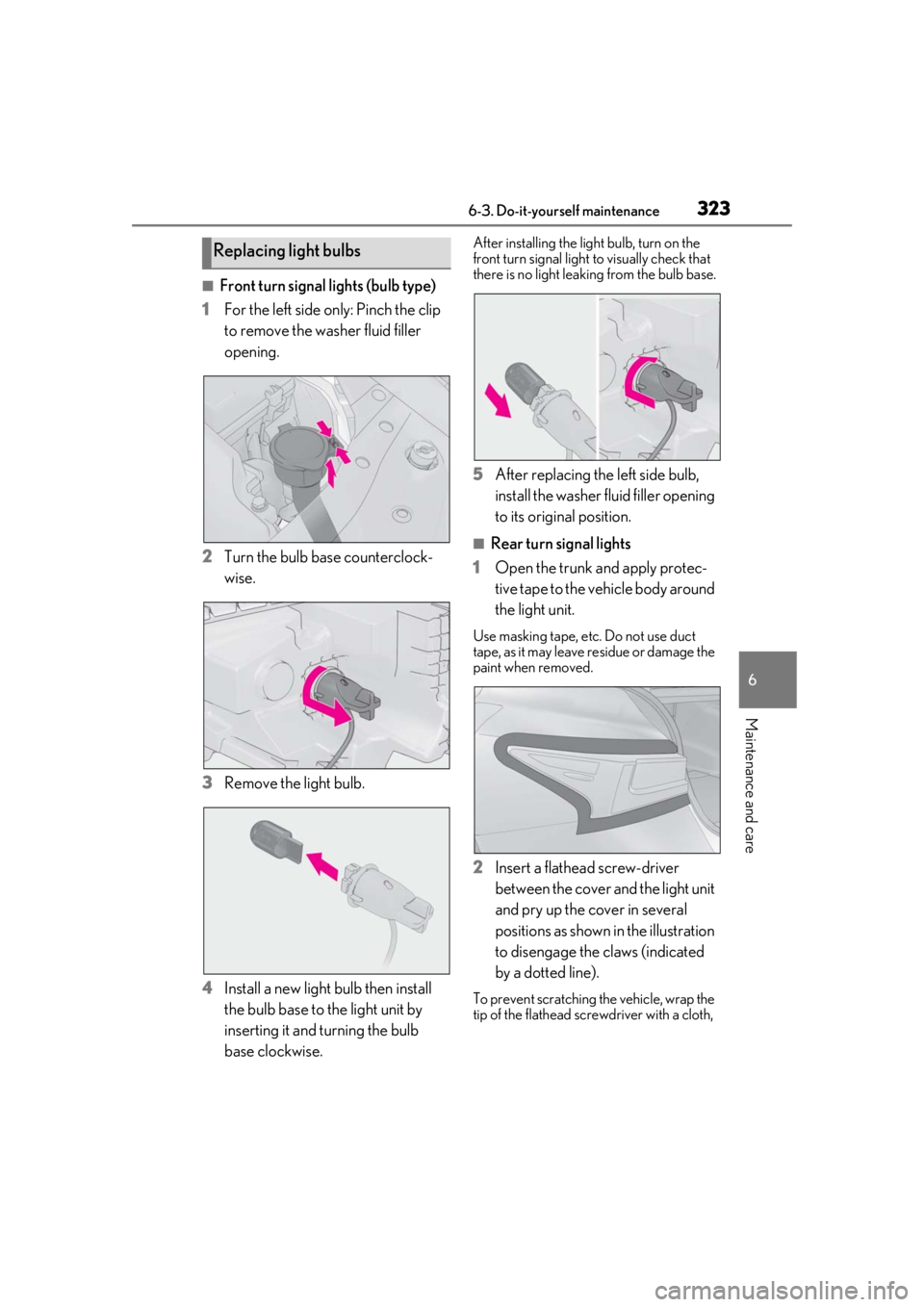
■Front turn signal lights (bulb type)
1 For the left side only: Pinch the clip
to remove the washer fluid filler
opening.
2 Turn the bulb base counterclock-
wise.
3 Remove the light bulb.
4 Install a new light bulb then install
the bulb base to the light unit by
inserting it and turning the bulb
base clockwise.
After installing the light bulb, turn on the
front turn signal light to visually check that
there is no light leaking from the bulb base.
5 After replacing the left side bulb,
install the washer fluid filler opening
to its original position.
■Rear turn signal lights
1 Open the trunk and apply protec-
tive tape to the vehicle body around
the light unit.
Use masking tape, etc. Do not use duct
tape, as it may leave residue or damage the
paint when removed.
2Insert a flathead screw-driver
between the cover and the light unit
and pry up the cover in several
positions as shown in the illustration
to disengage the claws (indicated
by a dotted line).
To prevent scratching the vehicle, wrap the
tip of the flathead scre wdriver with a cloth,
Replacing light bulbs
Page 325 of 436
3256-3. Do-it-yourself maintenance
6
Maintenance and care
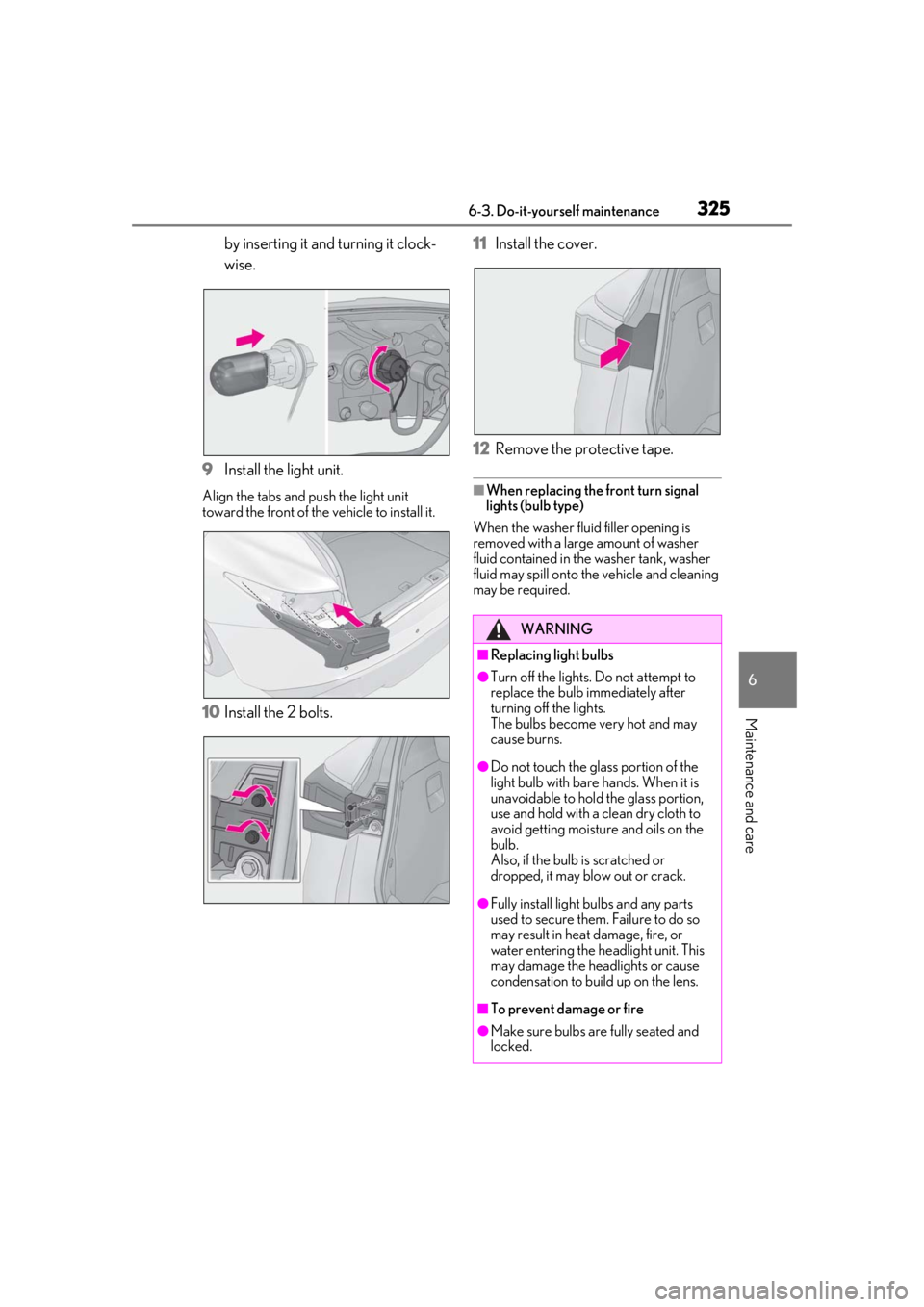
by inserting it and turning it clock-
wise.
9 Install the light unit.
Align the tabs and push the light unit
toward the front of the vehicle to install it.
10Install the 2 bolts. 11
Install the cover.
12 Remove the protective tape.
■When replacing the front turn signal
lights (bulb type)
When the washer fluid filler opening is
removed with a large amount of washer
fluid contained in the washer tank, washer
fluid may spill onto the vehicle and cleaning
may be required.
WARNING
■Replacing light bulbs
●Turn off the lights. Do not attempt to
replace the bulb immediately after
turning off the lights.
The bulbs become very hot and may
cause burns.
●Do not touch the glass portion of the
light bulb with bare hands. When it is
unavoidable to hold the glass portion,
use and hold with a clean dry cloth to
avoid getting moisture and oils on the
bulb.
Also, if the bulb is scratched or
dropped, it may blow out or crack.
●Fully install light bulbs and any parts
used to secure them. Failure to do so
may result in heat damage, fire, or
water entering the he adlight unit. This
may damage the headlights or cause
condensation to build up on the lens.
■To prevent damage or fire
●Make sure bulbs are fully seated and
locked.
Page 376 of 436

3768-1. Specifications
*: The fluid capacity is a reference quantity.If replacement is necessary, contact your Lexus dealer.
Cooling system
Capacity*
IS350
AWD/IS350
/IS300 AWD
9.8 qt. (9.3 L, 8.2 Imp. qt.)
IS300
Engine
9.1 qt. (8.6 L, 7.6 Imp. qt.)
Intercooler
3.0 qt. (2.8 L, 2.5 Imp. qt.)
Coolant type
Use either of the following:
“Toyota Super Long Life Coolant”
Similar high-quality ethylene glycol-based non-silicate,
non-amine, non-nitrite, and non-borate coolant with
long-life hybrid orga nic acid technology
Do not use plain water alone.
Ignition system (spark plug)
IS350 AWD/IS350/IS300 AWDIS300
MakeDENSO FK20HBR8NGK DILFR7K9G
Gap0.031 in. (0.8 mm)0.035 in. (0.9 mm)
NOTICE
■Iridium-tipped spark plugs
Use only iridium-tipped spark plugs. Do not adjust the spark plug gap.
Electrical system (battery)
Open voltage at 68°F (20°C):
12.3 V or higher
(Check the voltage 20 minutes after the engine
and all lights are turned off.)
If the voltage is lower than the standard value,
charge the battery.
Charging rates5 A max.
Page 377 of 436
3778-1. Specifications
8
Vehicle specifications
*: The fluid capacity is a reference quantity.If replacement is necessary, contact your Lexus dealer.
*: Your Lexus vehicle is filled with “Toyota Genu ine Differential Gear Oil” at the factory.
Use Lexus approved “Toyota Ge nuine Differential Gear Oil” or an equivalent oil of
matching quality to satisfy th e above specification. Please contact your Lexus dealer for
further details.
IS350 AWD/IS350/IS300 AWD/IS300 (veh icles without LSD [Limited Slip
Differential])
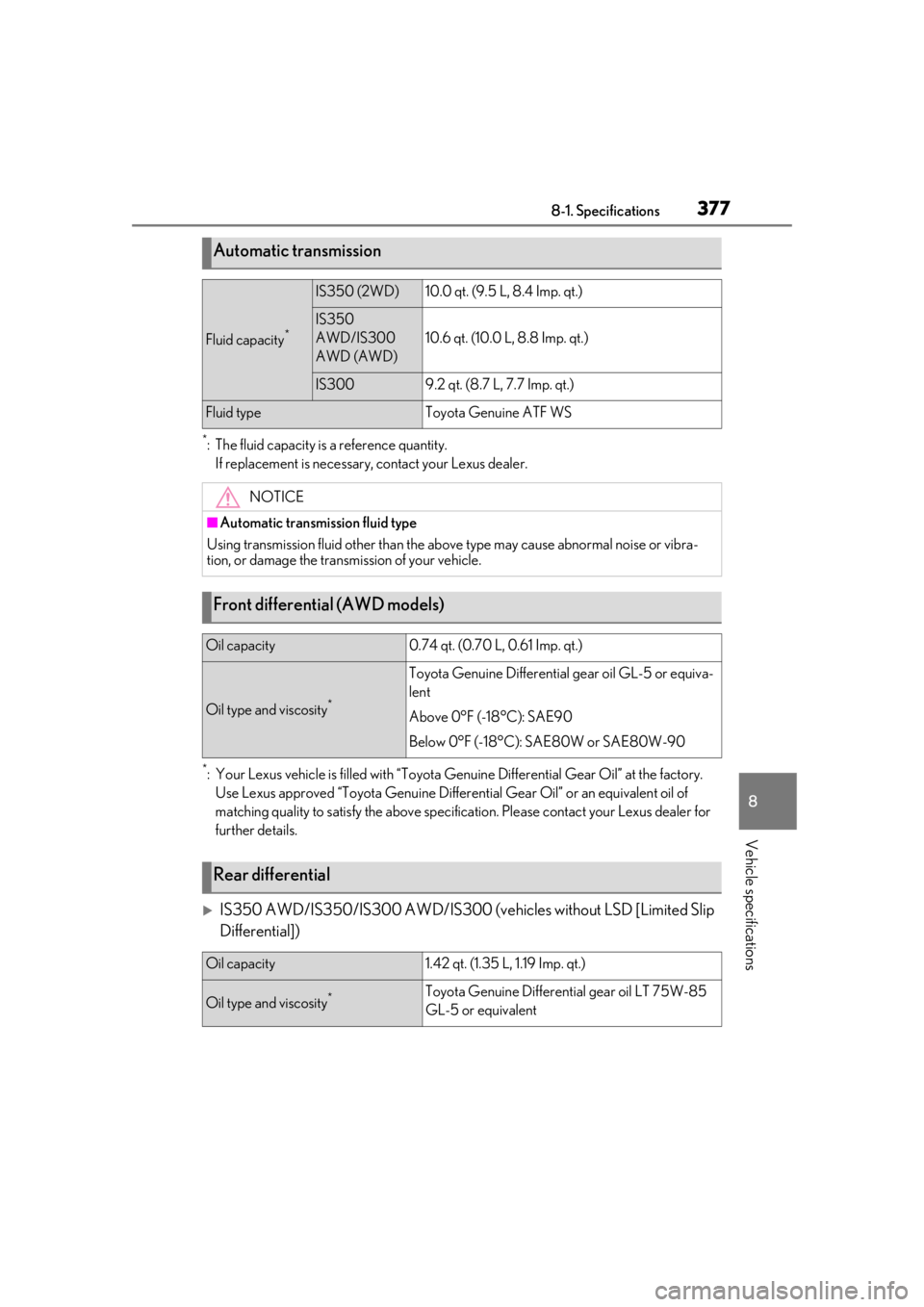
Automatic transmission
Fluid capacity*
IS350 (2WD)10.0 qt. (9.5 L, 8.4 Imp. qt.)
IS350
AWD/IS300
AWD (AWD)
10.6 qt. (10.0 L, 8.8 Imp. qt.)
IS3009.2 qt. (8.7 L, 7.7 Imp. qt.)
Fluid typeToyota Genuine ATF WS
NOTICE
■Automatic transmission fluid type
Using transmission fluid other than the above type may cause abnormal noise or vibra-
tion, or damage the transmission of your vehicle.
Front differential (AWD models)
Oil capacity0.74 qt. (0.70 L, 0.61 Imp. qt.)
Oil type and viscosity*
Toyota Genuine Differential gear oil GL-5 or equiva-
lent
Above 0°F (-18°C): SAE90
Below 0°F (-18°C): SAE80W or SAE80W-90
Rear differential
Oil capacity1.42 qt. (1.35 L, 1.19 Imp. qt.)
Oil type and viscosity*Toyota Genuine Differential gear oil LT 75W-85
GL-5 or equivalent
Page 378 of 436
![Lexus IS350 2021 Owners Manual / LEXUS 2021 IS 300, IS 350 OWNERS MANUAL (OM53E98U) 3788-1. Specifications
IS350 (vehicles with LSD [Limited Slip Differential])
*: Your Lexus vehicle is filled with “Toyota Genu ine Differential Gear Oil” at the factory.
Use Lexus approved “](/manual-img/36/30039/w960_30039-377.png "Lexus IS350 2021 Owners Manual / LEXUS 2021 IS 300, IS 350 OWNERS MANUAL (OM53E98U) 3788-1. Specifications
IS350 (vehicles with LSD [Limited Slip Differential])
*: Your Lexus vehicle is filled with “Toyota Genu ine Differential Gear Oil” at the factory.
Use Lexus approved “")
3788-1. Specifications
IS350 (vehicles with LSD [Limited Slip Differential])
*: Your Lexus vehicle is filled with “Toyota Genu ine Differential Gear Oil” at the factory.
Use Lexus approved “Toyota Ge nuine Differential Gear Oil” or an equivalent oil of
matching quality to satisfy th e above specification. Please contact your Lexus dealer for
further details.
*: Minimum pedal clearance when depressed with a force of 112.4 lbf (500 N, 51.0 kgf)
while the engine is running.
Oil capacity1.42 qt. (1.35 L, 1.19 Imp. qt.)
Oil type and viscosity*Toyota Genuine Differential gear oil LX 75W-85
GL-5 or equivalent
Brakes
Pedal clearance*
2WD
4.0 in. (104 mm) Min.
AWD
4.5 in. (115 mm) Min.
Pedal free play0.04 0.24 in. (1.0 6.0 mm)
Brake pad wear limit0.04 in. (1 mm)
Parking brake lining wear limit0.04 in. (1 mm)
Fluid typeSAE J1703 or FMVSS No. 116 DOT 3, or SAE
J1704 or FMVSS No. 116 DOT 4
Steering
Free playLess than 1.2 in. (30 mm)
Page 424 of 436

424Alphabetical Index
Hood................................................................ 293
How to start the engine............................134
Identification number ............................... 373
If the engine will not start ....................... 357
If your vehicle has to be stopped in an
emergency ................................................ 328
Ignition switch (engine switch) ............. 134
Overheating.................................................365
Tachometer ............................................... 71, 72
Engine coolant Capacity ......................................................... 376
Checking .......................................................298
Preparing and checking before winter......................................................................... 243
Engine coolant temperature gauge . 71, 72
Engine immobilizer system ........................ 60
Engine oil Capacity ......................................................... 374
Checking ....................................................... 296
Preparing and checking before winter......................................................................... 243
Warning light ...............................................338
Engine oil maintenance data .................. 298
Engine oil pressure gauge .......................... 80
Engine oil temperature gauge .................. 80
Engine switch ..................................................134 Auto power off function ...........................136
Changing the engine switch modes..136
If your vehicle has to be stopped in an
emergency ................................................ 328
Enhanced Vehicle Stability Control (Enhanced VSC) ...................................... 238
Enhanced VSC (Enhanced Vehicle Stabil- ity Control) .................................................. 238
EPS (Electric Power Steering) .............. 238 Warning light ...............................................340
Event data recorder (EDR) ............................7
F
First-aid kit storage belt ............................ 268
Flat tire Tire pressure warning system ............ 305 Vehicles with a spare tire.......................349
Floor mats ...........................................................22
Fluid Automatic transmission .......................... 377
Brake ................................................................378
Washer ...........................................................302
Footwell lights ............................................... 263 Wattage ........................................................... 381
Front passenger occupant classification system .............................................................. 36
Front seats Adjustment ..................................................... 106
Cleaning .........................................................283
Correct driving posture ............................ 23
Driving position memory ........................ 108
Head restraints................................................. 111
Memory recall function............................ 109
Power easy access system .................... 108
Seat heaters ....................................................261
Seat position memory ..............................108
Seat ventilators ..............................................261
Front side marker light Light switch .................................................... 149
Replacing light bulbs ................................ 322
Front turn signal lights Replacing light bulbs .................... 322, 323
Turn signal lever ...........................................142
Wattage ........................................................... 381
Fuel Capacity ......................................................... 374
Fuel gauge ..................................................71, 72
Fuel pump shut off system.....................336
Information ....................................................382
Refueling............................................................ 161
Type .................................................................. 374
Warning light .............................................. 340
Fuel consumption Average fuel economy .............................. 79
Current fuel consumption ........................ 79
Fuel filler door If the fuel filler do or cannot be opened
......................................................................... 359