2021 LEXUS IS300 fuel
[x] Cancel search: fuelPage 85 of 436

852-1. Instrument cluster
2
Vehicle status information and indicators
■History
Displays the average fuel consumption
and highest fuel consumption.
Page 123 of 436

123
4
4
Driving
Driving
.4-1. Before drivingDriving the vehicle ..................... 124
Cargo and luggage ................... 130
Vehicle load limits ...................... 132
Trailer towing ............................... 132
Dinghy towing ............................. 133
4-2. Driving procedures Engine (ignition) switch ........... 134
Automatic transmission........... 138
Turn signal lever.......................... 142
Parking brake .............................. 143
Brake Hold.................................... 146
ASC (Active Sound Control) ......................................................... 147
4-3. Operating the lights and wipers Headlight switch ......................... 149
AHB (Automatic High Beam) .......................................................... 151
Windshield wipers and washer ......................................................... 154
4-4. Refueling Opening the fuel tank cap....... 161
4-5. Using the driving support sys- tems
Lexus Safety System + 2.5 ..... 164
PCS (Pre-Collision System) ......................................................... 170
LTA (Lane Tracing Assist)...... 180
RSA (Road Sign Assist) ........... 189Dynamic radar cruise control with
full-speed range....................... 192
BSM (Blind Spot Monitor) .... 202
PKSA (Parking Support Alert) ....................................................... 208
Intuitive parking assist .............. 210
RCTA (Rear Cross Traffic Alert) function........................................ 216
PKSB (Parking Support Brake) ......................................................... 221
Parking Support Brake function (static objects) ......................... 226
Parking Support Brake function (rear-crossing vehicles) ...... 232
Driving mode select switch .. 236
Driving assist systems.............. 238
4-6. Driving tips Winter driving tips .................... 243
Page 125 of 436

1254-1. Before driving
4
Driving
sport mode is selected
■Restraining the engine output (Brake
Override System)
●When the accelerator and brake pedals
are depressed at the same time, the
engine output may be restrained.
●A warning message is displayed on the
multi-information display while the sys-
tem is operating.
■Breaking in your new Lexus
To extend the life of the vehicle, observing
the following precautions is recommended:
●For the first 186 miles (300 km):
Avoid sudden stops.
●For the first 621 miles (1000 km):
• Do not drive at extremely high speeds.
• Avoid sudden acceleration.
• Do not drive continuously in low gears.
• Do not drive at a constant speed for extended periods.
■Operating your vehicle in a foreign
country
Comply with the relevant vehicle registra-
tion laws and confirm the availability of the
correct fuel. ( P.374)
■Idling time before engine stop (IS300)
To prevent damage to the turbocharger,
allow the engine to id le immediately after
high-speed driving or hill climbing.
Driving conditionIdling time
Normal city driving or
high-speed driving (at the
highway speed limit or rec- ommended speed)
Not neces-sary
Steep hill driving or continu-
ous driving (race track driving etc.)Approxi-mately 1 minute
WARNING
Observe the following precautions. Fail-
ure to do so may result in death or seri-
ous injury.
■When starting the vehicle
Always keep your foot on the brake
pedal while stopped with the engine run-
ning. This prevents the vehicle from
creeping.
■When driving the vehicle
●Do not drive if you are unfamiliar with
the location of the brake and accelera-
tor pedals to avoid depressing the
wrong pedal.
• Accidentally depressing the accelera- tor pedal instead of the brake pedal
will result in sudden acceleration that
may lead to an accident.
• When backing up, you may twist your body around, leading to a difficulty in
operating the pedals. Make sure to
operate the pedals properly.
• Make sure to keep a correct driving posture even when moving the vehicle
only slightly. This allows you to depress
the brake and accelerator pedals
properly.
• Depress the brake pedal using your right foot. Depressing the brake pedal
using your left foot may delay
response in an emer gency, resulting in
an accident.
●Do not drive the vehicle over or stop
the vehicle near flammable materials.
The exhaust system and exhaust gases
can be extremely hot. These hot parts
may cause a fire if there is any flamma-
ble material nearby.
●During normal driving, do not turn off
the engine. Turning the engine off
while driving will not cause loss of
steering or braking control, but the
power assist to these systems will be
lost. This will make it more difficult to
steer and brake, so you should pull
over and stop the vehicle as soon as it
is safe to do so.
However, in the event of an emer-
gency, such as if it becomes impossible
to stop the vehicle in the normal way:
P.328
Page 138 of 436

1384-2. Driving procedures
*1: To improve fuel efficiency and reduce noise, shift the shift lever to D for normal
driving.
*2: Any gear range can be fixed when driv-ing in M mode.
■To protect the automatic transmission
“High Transmission Fluid Temp See
Owner's Manual” is displayed on the
multi-information display and a function is
adopted that automatically selects a higher
shift range when the fluid temperature is
high. Have the vehicle inspected by your
Lexus dealer.
■When driving with dynamic radar cruise
control with full-speed range activated
Even when performing the following
actions with the intent of enabling engine
braking, engine braking will not activate
because dynamic radar cruise control with
full-speed range will not be canceled.
●8-speed models: While driving in the D
position, downshifting to 7, 6, 5 or 4.
( P.192)
●6-speed models: While driving in the D
position, downshifting to 5 or 4.
( P.192)
●When switching the driving mode to
sport mode while driving in the D position
( P.236)
■Restraining sudden start (Drive-Start
Control)
P.129
■Gear position display on the multi-infor-
mation display
When Gear positions is selected for a Drive
Information screen on the multi-information
display and the shift lever is in the D or M
position, the currently selected gear posi-
tion will be displayed on the multi-informa-
tion display. (The display changes
according to the shift lever position and
driving conditions.)
■AI-SHIFT
The AI-SHIFT automatica lly selects the suit-
able gear according to driver performance
and driving conditions.
The AI-SHIFT automatically operates when
the shift lever is in D position. (Shifting the
shift lever to the M position cancels the
function.)
Automatic transmission
Shift position purpose and func-
tions
Shift posi-
tionObjective or function
PParking the vehicle/starting the engine
RReversing
NNeutral (Condition in which
the power is not transmitted)
DNormal driving*1
MM mode driving*2 ( P.141)
WARNING
■When driving on slippery road sur-
faces
Be careful of downsh ifting and sudden
acceleration, as this could result in the
vehicle skidding to the side or spinning.
Page 149 of 436

1494-3. Operating the lights and wipers
4
Driving
4-3.Operating the lights and wipers
Operating the switch turns on
the lights as follows:U.S.A.
Canada
1 The side marker, parking, tail,
license plate, instrument panel
lights, and daytime running lights
( P.149) turn on.
2 The headlights and all lights
listed above (except daytime run-
ning lights) turn on.
3 The headlights, parking lights,
daytime running lights ( P.149) and all the lights listed above turn
on and off automatically. (When the
engine switch is in IGNITION ON
mode.)
4 (U.S.A.) Off
■Daytime running light system
●The daytime running lights illuminate
using the same lights as the parking lights
and illuminate brighter than the parking
lights.
●To make your vehicle more visible to
other drivers during daytime driving, the
daytime running lights turn on automati-
cally when all of the following conditions
are met. (The daytime running lights are
not designed for use at night.)
• The engine is running
• The parking brake is released
• The headlight switch is in the or
* position
*: When the surroundings are bright
The daytime running lights remain on after
they illuminate, even if the parking brake is
set again.
●For the U.S.A.: Daytime running lights
can be turned off by operating the switch.
●Compared to turning on the headlights,
the daytime running light system offers
greater durability and consumes less
electricity, so it can help improve fuel
economy.
■Headlight control sensor
The sensor may not function properly if an
object is placed on the sensor, or anything
that blocks the sensor is affixed to the wind-
shield.
Headlight switch
The headlights can be operated
manually or automatically.
Operating instructions
A
B
Page 161 of 436

1614-4. Refueling
4
Driving
4-4.Refueling
Close all the doors and windows,
and turn the engine switch off.
Confirm the type of fuel.
■Fuel types
P.382
■Fuel tank opening for unleaded gasoline
To help prevent incorrect fueling, your vehi-
cle has a fuel tank opening that only accom-
modates the special nozzle on unleaded
fuel pumps.
■If the malfunction indicator lamp illumi-
nates
The malfunction indicator lamp may illumi-
nate erroneously if refueling is performed
repeatedly when the fuel tank is nearly full.
Opening the fuel tank cap
Perform the following steps to open
the fuel tank cap:
Before refueling the vehicle
WARNING
■When refueling the vehicle
Observe the following precautions while
refueling the vehicle. Failure to do so may
result in death or serious injury.
●After exiting the vehicle and before
opening the fuel door, touch an
unpainted metal surface to discharge
any static electricity. It is important to
discharge static electricity before refu-
eling because sparks resulting from
static electricity can cause fuel vapors
to ignite while refueling.
●Always hold the grips on the fuel tank
cap and turn it slowly to remove it.
A whooshing sound may be heard
when the fuel tank cap is loosened.
Wait until the sound cannot be heard
before fully removing the cap. In hot
weather, pressurized fuel may spray
out the filler neck and cause injury.
●Do not allow anyone that has not dis-
charged static electricity from their
body to come close to an open fuel
tank.
●Do not inhale vaporized fuel.
Fuel contains substances that are
harmful if inhaled.
●Do not smoke while refueling the vehi-
cle.
Doing so may cause the fuel to ignite
and cause a fire.
●Do not return to the vehicle or touch
any person or object that is statically
charged.
This may cause static electricity to
build up, resulting in a possible ignition
hazard.
■When refueling
Observe the following precautions to
prevent fuel overflowing from the fuel
tank:
●Securely insert the fuel nozzle into the
fuel filler neck.
●Stop filling the tank after the fuel noz-
zle automatically clicks off.
●Do not top off the fuel tank.
NOTICE
■Refueling
Do not spill fuel during refueling.
Doing so may damage the vehicle, such
as causing the emission control system to
operate abnormally or damaging fuel
system components or the vehicle’s
painted surface.
Page 162 of 436
1624-4. Refueling
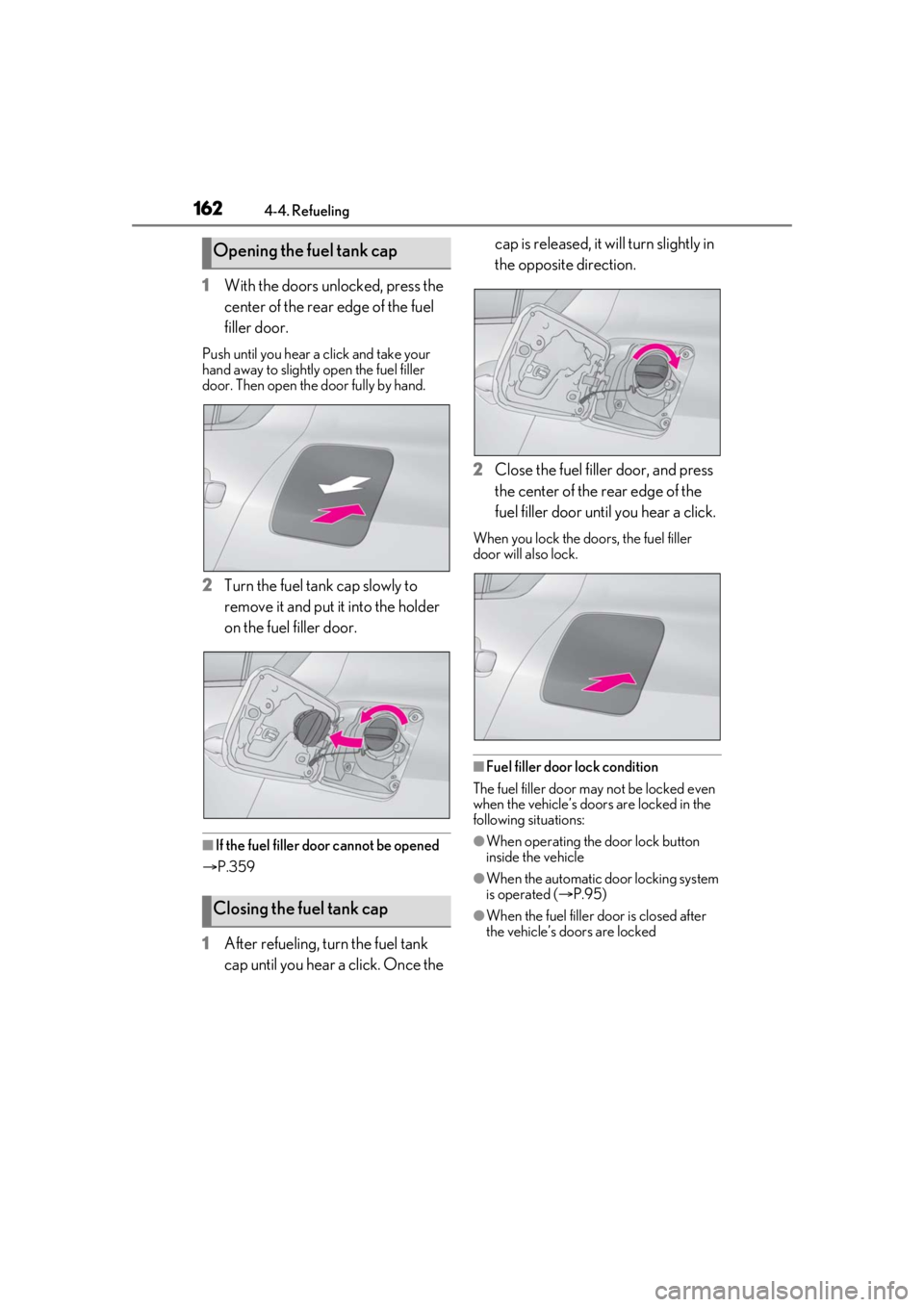
1With the doors unlocked, press the
center of the rear edge of the fuel
filler door.
Push until you hear a click and take your
hand away to slightly open the fuel filler
door. Then open the door fully by hand.
2Turn the fuel tank cap slowly to
remove it and put it into the holder
on the fuel filler door.
■If the fuel filler door cannot be opened
P.359
1 After refueling, turn the fuel tank
cap until you hear a click. Once the cap is released, it will turn slightly in
the opposite direction.
2 Close the fuel filler door, and press
the center of the rear edge of the
fuel filler door until you hear a click.
When you lock the doors, the fuel filler
door will also lock.
■Fuel filler door lock condition
The fuel filler door may not be locked even
when the vehicle’s doors are locked in the
following situations:
●When operating the door lock button
inside the vehicle
●When the automatic door locking system
is operated ( P.95)
●When the fuel filler door is closed after
the vehicle’s doors are locked
Opening the fuel tank cap
Closing the fuel tank cap
Page 163 of 436

1634-4. Refueling
4
Driving
WARNING
■When replacing the fuel tank cap
Do not use anything but a genuine Lexus
fuel tank cap designed for your vehicle.
Doing so may cause a fire or other inci-
dent which may result in death or serious
injury.