2021 KIA SPORTAGE seat adjustment
[x] Cancel search: seat adjustmentPage 19 of 631
Safety features of your vehicle
Important safety precautions . . . . . . . . . . . . . . . . . 3-2
• Always wear your seat belt . . . . . . . . . . . . . . . . . . . . . 3-2
• Restrain all children . . . . . . . . . . . . . . . . . . . . . . . . . . . 3-2
• Air bag hazards . . . . . . . . . . . . . . . . . . . . . . . . . . . . . . 3-2
• Driver distraction . . . . . . . . . . . . . . . . . . . . . . . . . . . . . 3-2
• Control your speed . . . . . . . . . . . . . . . . . . . . . . . . . . . . 3-3
• Keep your vehicle in safe condition . . . . . . . . . . . . . . 3-3
Seat. . . . . . . . . . . . . . . . . . . . . . . . . . . . . . . . . . . . \
. . . 3-4
• Front seat adjustment - manual. . . . . . . . . . . . . . . . . . 3-8
• Front seat adjustment - power . . . . . . . . . . . . . . . . . . 3-10
• Headrest (for front seat) . . . . . . . . . . . . . . . . . . . . . . . 3-12
• Seatback pocket . . . . . . . . . . . . . . . . . . . . . . . . . . . . . . 3-15
• Rear seat adjustment . . . . . . . . . . . . . . . . . . . . . . . . . 3-15
Seat belts . . . . . . . . . . . . . . . . . . . . . . . . . . . . . . . . . 3-20
• Seat belt restraint system . . . . . . . . . . . . . . . . . . . . . . 3-20
• Pre-tensioner seat belt . . . . . . . . . . . . . . . . . . . . . . . . 3-28
• Seat belt precautions . . . . . . . . . . . . . . . . . . . . . . . . . . 3-31
• Care of seat belts . . . . . . . . . . . . . . . . . . . . . . . . . . . . . 3-33
Child restraint system (CRS) . . . . . . . . . . . . . . . . 3-34
• Children Always in the Rear . . . . . . . . . . . . . . . . . . . 3-34
• Selecting a Child Restraint System (CRS) . . . . . . . . 3-35
• Installing a Child Restraint System (CRS) . . . . . . . . 3-38
Air bag - advanced supplemental restraint system . . . . . . . . . . . . . . . . . . . . . . . . . . . . . . . . . . 3-45\
• How does the air bag system operate? . . . . . . . . . . . 3-46 • Air bag warning light . . . . . . . . . . . . . . . . . . . . . . . . . 3-48
• SRS components and functions . . . . . . . . . . . . . . . . . 3-49
• Occupant Detection System (ODS) . . . . . . . . . . . . . . 3-52
• Driver's and passenger's front air bag . . . . . . . . . . . 3-60
• Side air bag . . . . . . . . . . . . . . . . . . . . . . . . . . . . . . . . . 3-62
• Curtain air bag . . . . . . . . . . . . . . . . . . . . . . . . . . . . . . 3-64
• SRS Care . . . . . . . . . . . . . . . . . . . . . . . . . . . . . . . . . . . 3-\
71
• Adding equipment to or modifying your
air bag-equipped vehicle. . . . . . . . . . . . . . . . . . . . . . 3-72
• Air bag warning label . . . . . . . . . . . . . . . . . . . . . . . . . 3-72
3
Page 22 of 631
Safety features of your vehicle
43
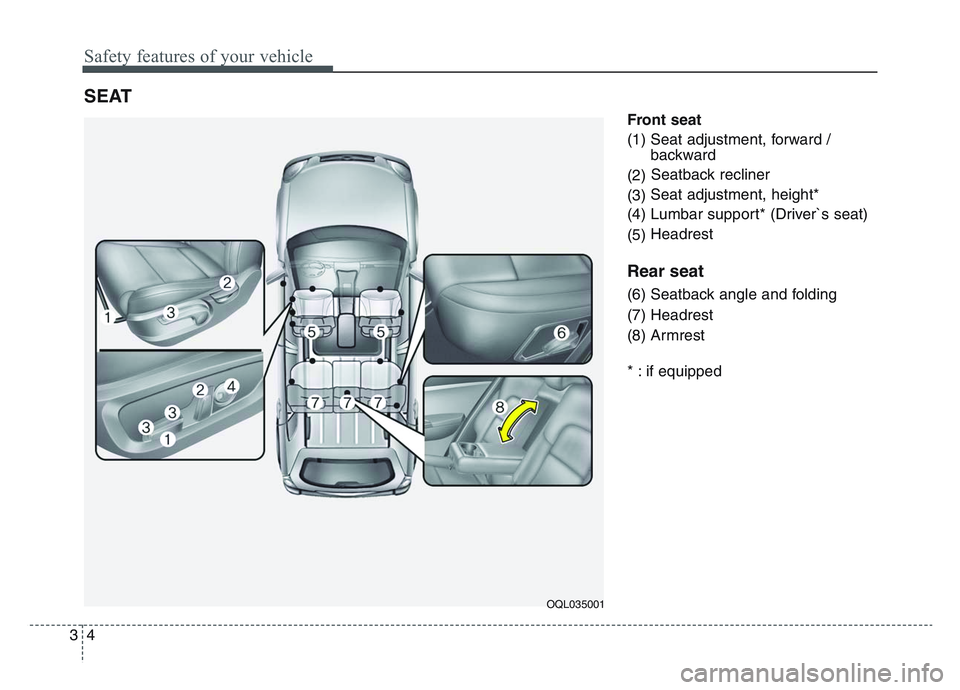
Front seat
(1) Seat adjustment, forward / backward
(2) Seatback recliner
(3) Seat adjustment, height*
(4) Lumbar support* (Driver`s seat)
(5) Headrest
Rear seat
(6) Seatback angle and folding
(7) Headrest
(8) Armrest
* : if equipped
SEAT
OQL035001
Page 25 of 631
37
Safety features of your vehicle
Feature of Seat Leather
• Leather is made from the outerskin of an animal, which goes
through a special process to be
available for use. Since it is a nat-
ural substance, each part differs in
thickness or density.
Wrinkles may appear as a natural
result of stretching and shrinking
depending on the temperature and
humidity.
• The seat cover is made of stretch- able material to improve comfort of
passengers.
• The parts contacting the body are curved and the side supporting
area is high which provides driving
comfort and stability.
• Wrinkles may appear naturally from usage. It is not a fault of the
product.
✽ NOTICE
Wrinkles or abrasions which appear
naturally from usage are not cov-
ered by warranty.
WARNING- Small
Objects
Use extreme caution when pick-
ing up small objects trapped
under the seats or between the
seat and the center console.
Your hands might be cut or
injured by the sharp edges of
the seats mechanism.
WARNING- Seat adjustment
• Do not adjust the seat while wearing seat belts. Moving the
seat forward will cause strong
pressure on the abdomen.
• Do not place your hand near the seat bottom or seat track
while adjusting the seat. Your
hand could get caught in the
seat mechanism.CAUTION
• Belts with metallic acces- sories, zippers or keys insidethe back pocket may damagethe seat fabric.
• Make sure not to wet the seat. It may change the nature ofnatural leather.
• Jeans or clothes which con- tain bleach may contaminatethe surface of the seat cover-ing fabric.
Page 26 of 631
Safety features of your vehicle
83
Front seat adjustment - manual
Forward and backward
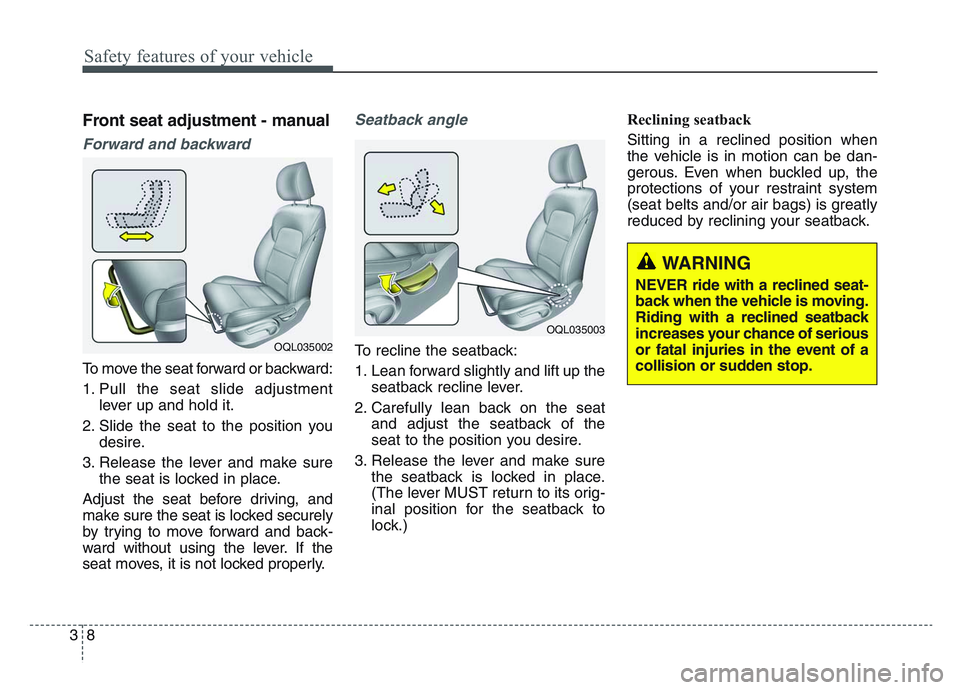
To move the seat forward or backward:
1. Pull the seat slide adjustmentlever up and hold it.
2. Slide the seat to the position you desire.
3. Release the lever and make sure the seat is locked in place.
Adjust the seat before driving, and
make sure the seat is locked securely
by trying to move forward and back-
ward without using the lever. If the
seat moves, it is not locked properly.
Seatback angle
To recline the seatback:
1. Lean forward slightly and lift up the seatback recline lever.
2. Carefully lean back on the seat and adjust the seatback of the
seat to the position you desire.
3. Release the lever and make sure the seatback is locked in place.
(The lever MUST return to its orig-
inal position for the seatback to
lock.) Reclining seatback
Sitting in a reclined position when
the vehicle is in motion can be dan-
gerous. Even when buckled up, the
protections of your restraint system
(seat belts and/or air bags) is greatly
reduced by reclining your seatback.OQL035002
OQL035003
WARNING
NEVER ride with a reclined seat-
back when the vehicle is moving.
Riding with a reclined seatback
increases your chance of serious
or fatal injuries in the event of a
collision or sudden stop.
Page 28 of 631
Safety features of your vehicle
103
Lumbar support (if equipped)
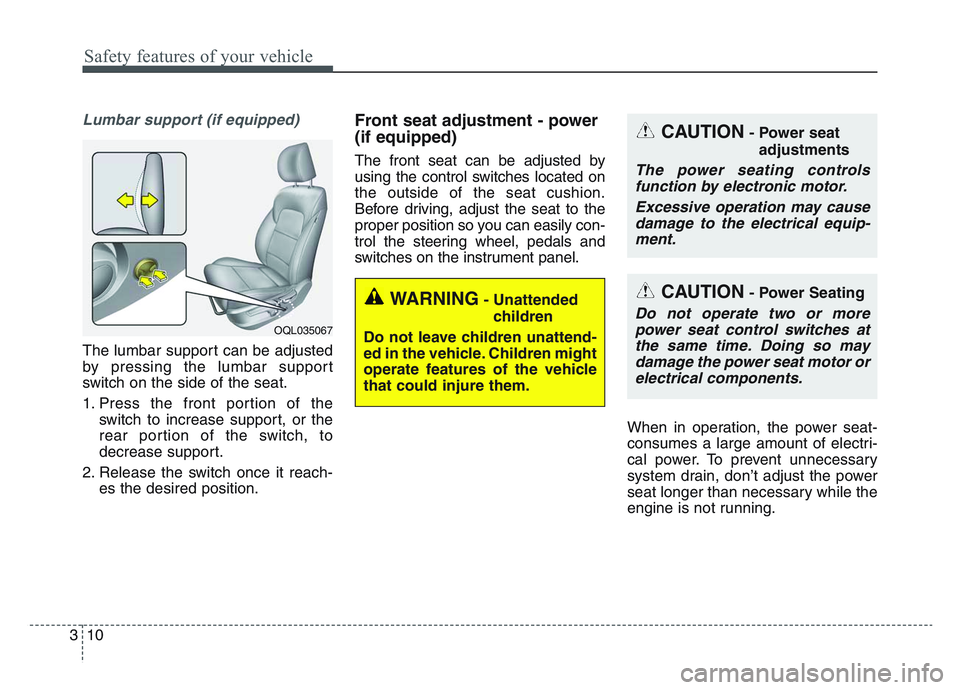
The lumbar support can be adjusted
by pressing the lumbar support
switch on the side of the seat.
1. Press the front portion of theswitch to increase support, or the
rear portion of the switch, to
decrease support.
2. Release the switch once it reach- es the desired position.
Front seat adjustment - power
(if equipped)
The front seat can be adjusted by
using the control switches located on
the outside of the seat cushion.
Before driving, adjust the seat to the
proper position so you can easily con-
trol the steering wheel, pedals and
switches on the instrument panel.
When in operation, the power seat-
consumes a large amount of electri-
cal power. To prevent unnecessary
system drain, don’t adjust the power
seat longer than necessary while the
engine is not running.
OQL035067
CAUTION- Power seatadjustments
The power seating controlsfunction by electronic motor.
Excessive operation may causedamage to the electrical equip-ment.
CAUTION- Power Seating
Do not operate two or morepower seat control switches atthe same time. Doing so maydamage the power seat motor orelectrical components.WARNING- Unattended
children
Do not leave children unattend-
ed in the vehicle. Children might
operate features of the vehicle
that could injure them.
Page 30 of 631
Safety features of your vehicle
123
Lumbar support (for driver’s seat,if equipped)
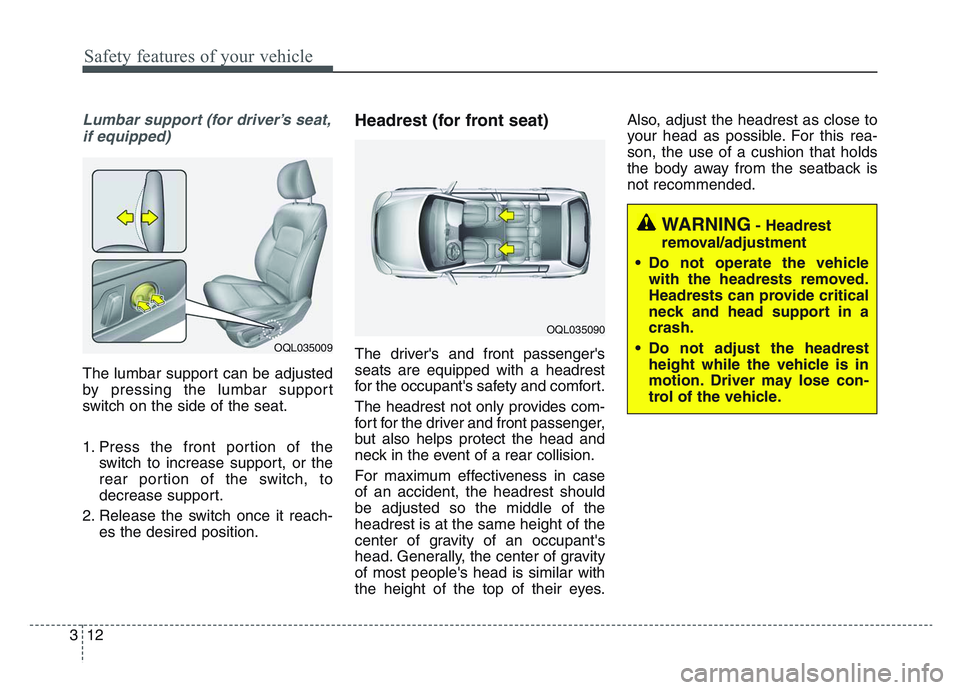
The lumbar support can be adjusted
by pressing the lumbar support
switch on the side of the seat.
1. Press the front portion of the switch to increase support, or the
rear portion of the switch, to
decrease support.
2. Release the switch once it reach- es the desired position.
Headrest (for front seat)
The driver's and front passenger's
seats are equipped with a headrest
for the occupant's safety and comfort.
The headrest not only provides com-
fort for the driver and front passenger,
but also helps protect the head and
neck in the event of a rear collision.
For maximum effectiveness in case
of an accident, the headrest should
be adjusted so the middle of the
headrest is at the same height of the
center of gravity of an occupant's
head. Generally, the center of gravity
of most people's head is similar with
the height of the top of their eyes. Also, adjust the headrest as close to
your head as possible. For this rea-
son, the use of a cushion that holds
the body away from the seatback is
not recommended.OQL035009
WARNING- Headrest
removal/adjustment
• Do not operate the vehicle with the headrests removed.
Headrests can provide critical
neck and head support in a
crash.
• Do not adjust the headrest height while the vehicle is in
motion. Driver may lose con-
trol of the vehicle.
OQL035090
Page 33 of 631
3 15
Safety features of your vehicle
Seatback pocket
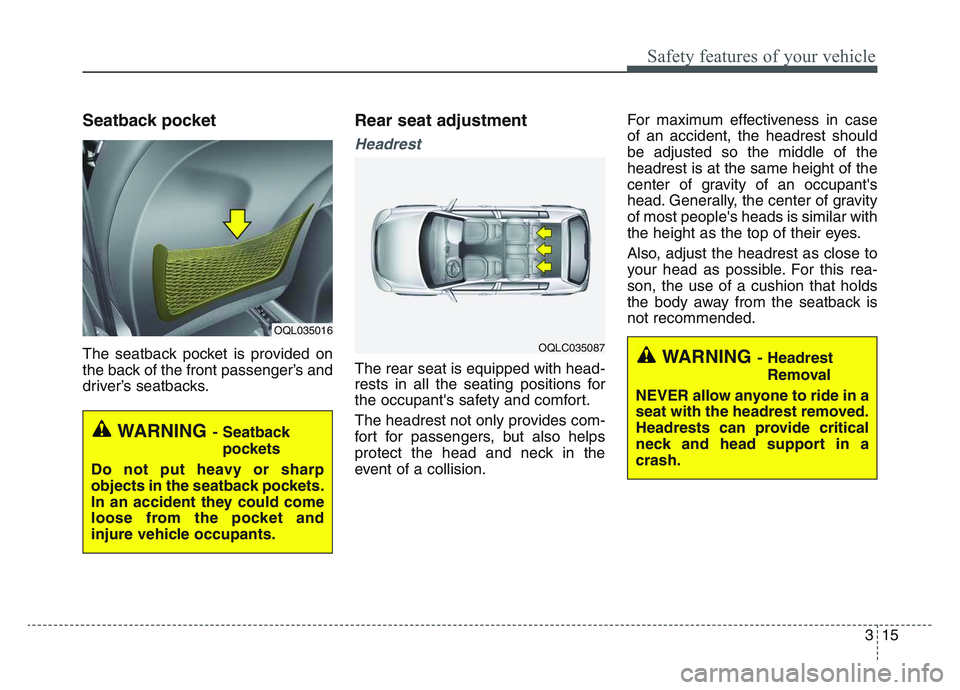
The seatback pocket is provided on
the back of the front passenger’s and
driver’s seatbacks.
Rear seat adjustment
Headrest
The rear seat is equipped with head-
rests in all the seating positions for
the occupant's safety and comfort.
The headrest not only provides com-
fort for passengers, but also helps
protect the head and neck in the
event of a collision.For maximum effectiveness in case
of an accident, the headrest should
be adjusted so the middle of the
headrest is at the same height of the
center of gravity of an occupant's
head. Generally, the center of gravity
of most people's heads is similar with
the height as the top of their eyes.
Also, adjust the headrest as close to
your head as possible. For this rea-
son, the use of a cushion that holds
the body away from the seatback is
not recommended.
OQL035016
WARNING- Seatback
pockets
Do not put heavy or sharp
objects in the seatback pockets.
In an accident they could come
loose from the pocket and
injure vehicle occupants.
WARNING- Headrest Removal
NEVER allow anyone to ride in a
seat with the headrest removed.
Headrests can provide critical
neck and head support in a
crash.OQLC035087
Page 41 of 631
3 23
Safety features of your vehicle
The seat belt automatically adjusts to
the proper length only after the lap
belt portion is adjusted manually so
that it fits snugly around your hips. If
you lean forward in a slow, easy
motion, the belt will extend and let
you move around. If there is a sud-
den stop or impact, however, the belt
will lock into position. It will also lock
if you try to lean forward too quickly.
✽ NOTICE
If you are not able to pull out the
seat belt from the retractor, firmly
pull the belt out and release it. Then
you will be able to pull the belt out
smoothly.
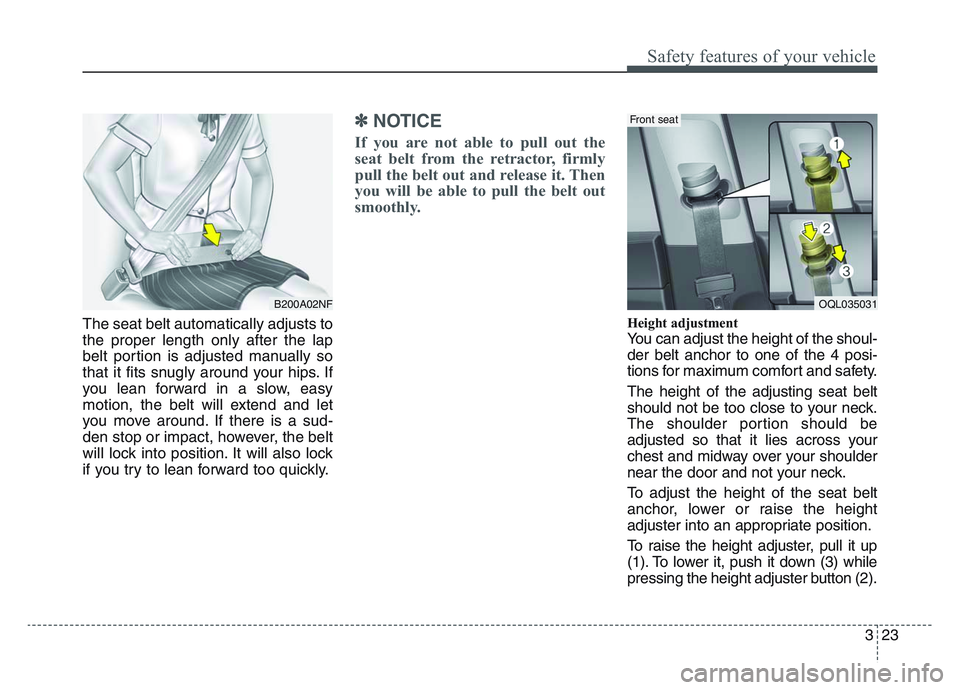
Height adjustment
You can adjust the height of the shoul-
der belt anchor to one of the 4 posi-
tions for maximum comfort and safety.
The height of the adjusting seat belt
should not be too close to your neck.
The shoulder portion should be
adjusted so that it lies across your
chest and midway over your shoulder
near the door and not your neck.
To adjust the height of the seat belt
anchor, lower or raise the height
adjuster into an appropriate position.
To raise the height adjuster, pull it up
(1). To lower it, push it down (3) while
pressing the height adjuster button (2).
B200A02NFOQL035031
Front seat