2021 KIA NIRO HYBRID EV tow
[x] Cancel search: towPage 525 of 667
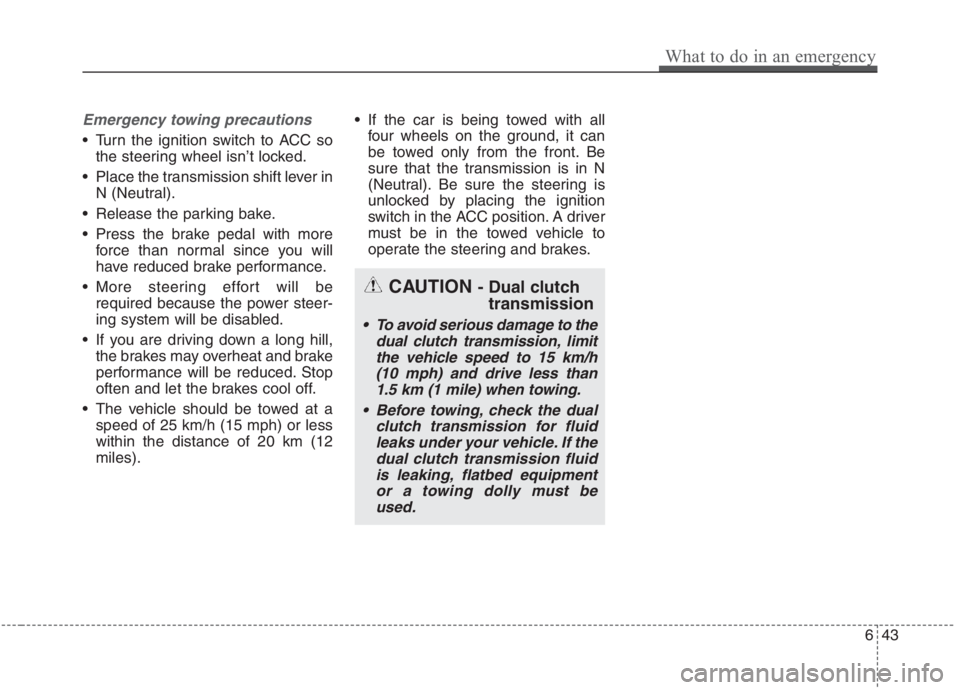
Emergency towing precautions
Turn the ignition switch to ACC so
the steering wheel isn’t locked.
Place the transmission shift lever in
N (Neutral).
Release the parking bake.
Press the brake pedal with more
force than normal since you will
have reduced brake performance.
More steering effort will be
required because the power steer-
ing system will be disabled.
If you are driving down a long hill,
the brakes may overheat and brake
performance will be reduced. Stop
often and let the brakes cool off.
The vehicle should be towed at a
speed of 25 km/h (15 mph) or less
within the distance of 20 km (12
miles). If the car is being towed with all
four wheels on the ground, it can
be towed only from the front. Be
sure that the transmission is in N
(Neutral). Be sure the steering is
unlocked by placing the ignition
switch in the ACC position. A driver
must be in the towed vehicle to
operate the steering and brakes.
CAUTION - Dual clutch
transmission
To avoid serious damage to the
dual clutch transmission, limit
the vehicle speed to 15 km/h
(10 mph) and drive less than
1.5 km (1 mile) when towing.
Before towing, check the dual
clutch transmission for fluid
leaks under your vehicle. If the
dual clutch transmission fluid
is leaking, flatbed equipment
or a towing dolly must be
used.
What to do in an emergency
43 6
Page 526 of 667
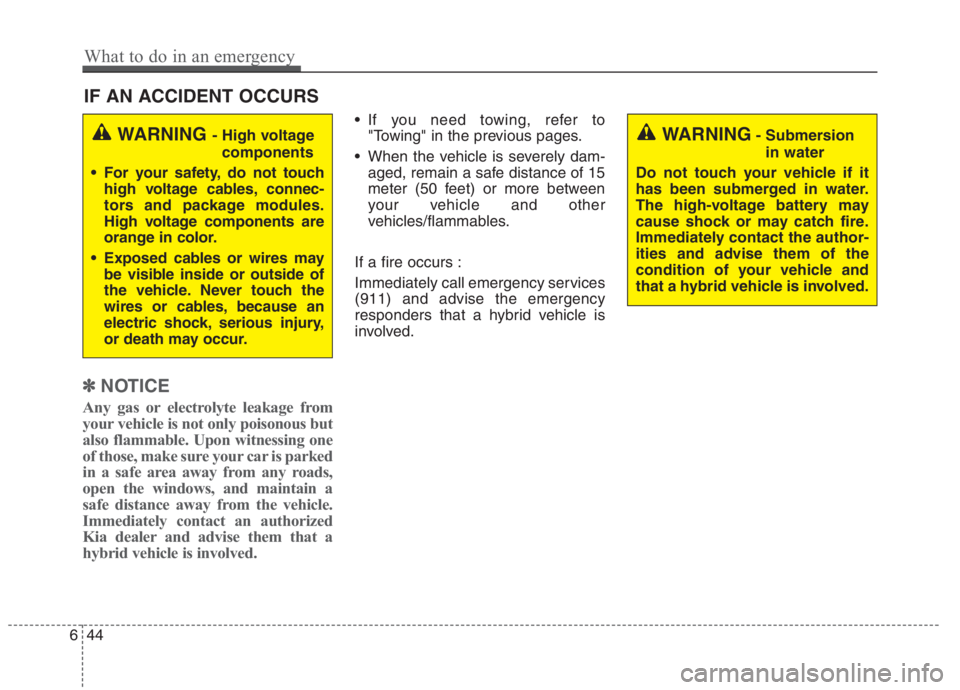
IF AN ACCIDENT OCCURS
✽ ✽
NOTICE
Any gas or electrolyte leakage from
your vehicle is not only poisonous but
also flammable. Upon witnessing one
of those, make sure your car is parked
in a safe area away from any roads,
open the windows, and maintain a
safe distance away from the vehicle.
Immediately contact an authorized
Kia dealer and advise them that a
hybrid vehicle is involved.
If you need towing, refer to
"Towing" in the previous pages.
When the vehicle is severely dam-
aged, remain a safe distance of 15
meter (50 feet) or more between
your vehicle and other
vehicles/flammables.
If a fire occurs :
Immediately call emergency services
(911) and advise the emergency
responders that a hybrid vehicle is
involved.
WARNING - High voltage
components
For your safety, do not touch
high voltage cables, connec-
tors and package modules.
High voltage components are
orange in color.
Exposed cables or wires may
be visible inside or outside of
the vehicle. Never touch the
wires or cables, because an
electric shock, serious injury,
or death may occur.WARNING- Submersion
in water
Do not touch your vehicle if it
has been submerged in water.
The high-voltage battery may
cause shock or may catch fire.
Immediately contact the author-
ities and advise them of the
condition of your vehicle and
that a hybrid vehicle is involved.
644
What to do in an emergency
Page 535 of 667
79
Maintenance
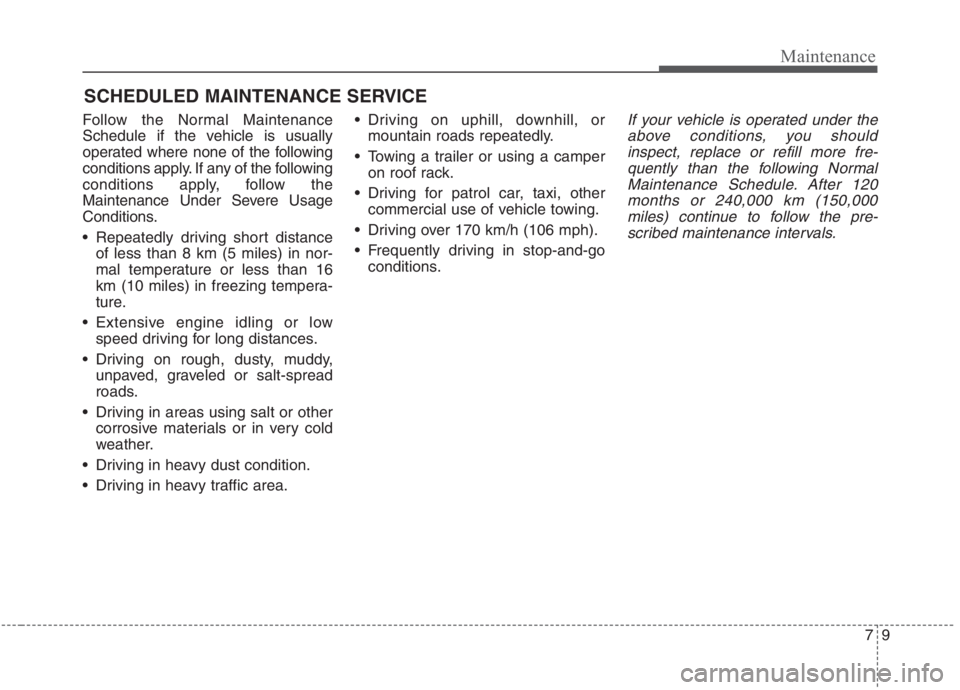
SCHEDULED MAINTENANCE SERVICE
Follow the Normal Maintenance
Schedule if the vehicle is usually
operated where none of the following
conditions apply. If any of the following
conditions apply, follow the
Maintenance Under Severe Usage
Conditions.
Repeatedly driving short distance
of less than 8 km (5 miles) in nor-
mal temperature or less than 16
km (10 miles) in freezing tempera-
ture.
Extensive engine idling or low
speed driving for long distances.
Driving on rough, dusty, muddy,
unpaved, graveled or salt-spread
roads.
Driving in areas using salt or other
corrosive materials or in very cold
weather.
Driving in heavy dust condition.
Driving in heavy traffic area. Driving on uphill, downhill, or
mountain roads repeatedly.
Towing a trailer or using a camper
on roof rack.
Driving for patrol car, taxi, other
commercial use of vehicle towing.
Driving over 170 km/h (106 mph).
Frequently driving in stop-and-go
conditions.If your vehicle is operated under the
above conditions, you should
inspect, replace or refill more fre-
quently than the following Normal
Maintenance Schedule. After 120
months or 240,000 km (150,000
miles) continue to follow the pre-
scribed maintenance intervals.
Page 540 of 667
Maintenance
14 7
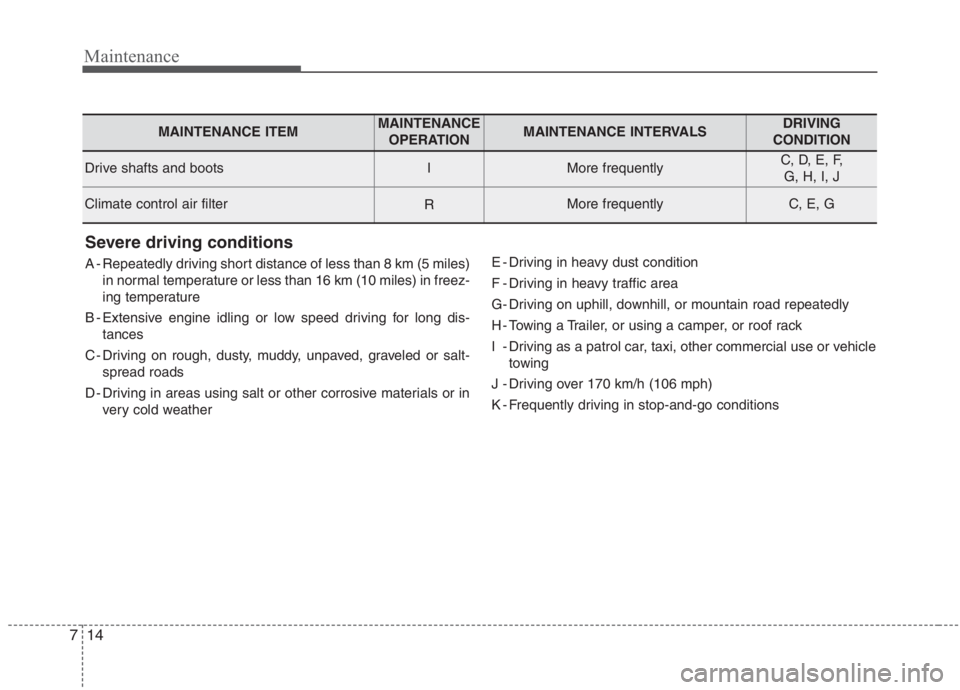
Severe driving conditions
A - Repeatedly driving short distance of less than 8 km (5 miles)
in normal temperature or less than 16 km (10 miles) in freez-
ing temperature
B - Extensive engine idling or low speed driving for long dis-
tances
C - Driving on rough, dusty, muddy, unpaved, graveled or salt-
spread roads
D - Driving in areas using salt or other corrosive materials or in
very cold weatherE - Driving in heavy dust condition
F - Driving in heavy traffic area
G- Driving on uphill, downhill, or mountain road repeatedly
H - Towing a Trailer, or using a camper, or roof rack
I - Driving as a patrol car, taxi, other commercial use or vehicle
towing
J - Driving over 170 km/h (106 mph)
K - Frequently driving in stop-and-go conditions
MAINTENANCE ITEMMAINTENANCE
OPERATIONMAINTENANCE INTERVALSDRIVING
CONDITION
Drive shafts and bootsIMore frequentlyC, D, E, F,
G, H, I, J
Climate control air filterRMore frequentlyC, E, G
Page 547 of 667
721
Maintenance
COOLANT
The high-pressure cooling system
has a reservoir filled with year round
antifreeze coolant. The reservoir is
filled at the factory.
Check the antifreeze protection and
coolant level at least once a year: at
the beginning of the winter season,
and before traveling to a colder cli-
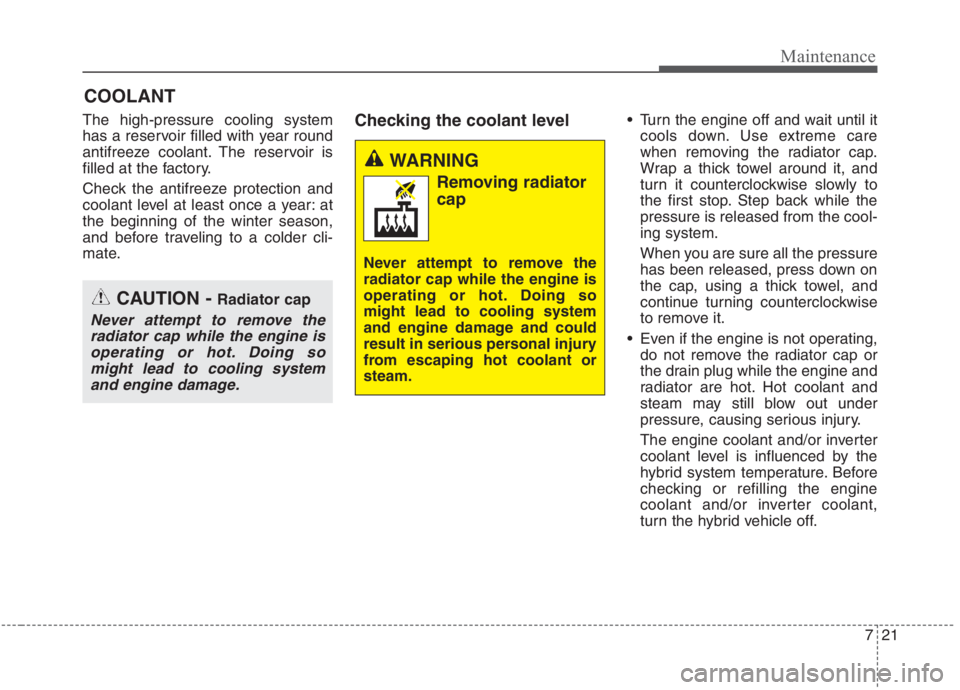
mate.Checking the coolant level Turn the engine off and wait until it
cools down. Use extreme care
when removing the radiator cap.
Wrap a thick towel around it, and
turn it counterclockwise slowly to
the first stop. Step back while the
pressure is released from the cool-
ing system.
When you are sure all the pressure
has been released, press down on
the cap, using a thick towel, and
continue turning counterclockwise
to remove it.
Even if the engine is not operating,
do not remove the radiator cap or
the drain plug while the engine and
radiator are hot. Hot coolant and
steam may still blow out under
pressure, causing serious injury.
The engine coolant and/or inverter
coolant level is influenced by the
hybrid system temperature. Before
checking or refilling the engine
coolant and/or inverter coolant,
turn the hybrid vehicle off.
WARNING
Removing radiator
cap
Never attempt to remove the
radiator cap while the engine is
operating or hot. Doing so
might lead to cooling system
and engine damage and could
result in serious personal injury
from escaping hot coolant or
steam.
CAUTION - Radiator cap
Never attempt to remove the
radiator cap while the engine is
operating or hot. Doing so
might lead to cooling system
and engine damage.
Page 666 of 667
Index
10I
Tire specification and pressure label . . . . . . . . . . . . . . 8-11
Tires and wheels . . . . . . . . . . . . . . . . . . . . . . . . . . 7-42, 8-5
All season tires . . . . . . . . . . . . . . . . . . . . . . . . . . . . . 7-54
Checking tire inflation pressure . . . . . . . . . . . . . . . . 7-43
Low aspect ratio tire. . . . . . . . . . . . . . . . . . . . . . . . . 7-56
Radial-ply tires . . . . . . . . . . . . . . . . . . . . . . . . . . . . . 7-55
Recommended cold tire inflation pressures . . . . . . . 7-42
Snow tires . . . . . . . . . . . . . . . . . . . . . . . . . . . . . . . . . 7-55
Summer tires . . . . . . . . . . . . . . . . . . . . . . . . . . . . . . 7-54
Tire care . . . . . . . . . . . . . . . . . . . . . . . . . . . . . . . . . . 7-42
Tire maintenance . . . . . . . . . . . . . . . . . . . . . . . . . . . 7-47
Tire pressure . . . . . . . . . . . . . . . . . . . . . . . . . . . . . . . 7-43
Tire replacement . . . . . . . . . . . . . . . . . . . . . . . . . . . . 7-46
Tire rotation . . . . . . . . . . . . . . . . . . . . . . . . . . . . . . . 7-44
Tire sidewall labeling . . . . . . . . . . . . . . . . . . . . . . . . 7-47
Tire terminology and definitions . . . . . . . . . . . . . . . 7-51
Tire traction . . . . . . . . . . . . . . . . . . . . . . . . . . . . . . . 7-47
Wheel alignment and tire balance . . . . . . . . . . . . . . 7-45
Wheel replacement . . . . . . . . . . . . . . . . . . . . . . . . . . 7-46
Towing . . . . . . . . . . . . . . . . . . . . . . . . . . . . . . . . . . . . . 6-39
Emergency towing . . . . . . . . . . . . . . . . . . . . . . . . . . 6-41
Removable towing hook. . . . . . . . . . . . . . . . . . . . . . 6-40
Towing service . . . . . . . . . . . . . . . . . . . . . . . . . . . . . 6-39
Trailer towing . . . . . . . . . . . . . . . . . . . . . . . . . . . . . . . 5-151Vehicle break-in process . . . . . . . . . . . . . . . . . . . . . . . . . 1-5
Vehicle certification label . . . . . . . . . . . . . . . . . . . . . . . 8-11
Vehicle data collection and event data recorders . . . . . . 1-6
Vehicle identification number (VIN) . . . . . . . . . . . . . . 8-10
Vehicle load limit . . . . . . . . . . . . . . . . . . . . . . . . . . . . 5-152
Certification label . . . . . . . . . . . . . . . . . . . . . . . . . . 5-155
Tire and loading information label. . . . . . . . . . . . . 5-152
Vehicle modifications . . . . . . . . . . . . . . . . . . . . . . . . . . . 1-5
Vehicle weight . . . . . . . . . . . . . . . . . . . . . . . . . . . . . . 5-156
Base curb weight . . . . . . . . . . . . . . . . . . . . . . . . . . 5-156
Cargo weight . . . . . . . . . . . . . . . . . . . . . . . . . . . . . 5-156
GAW (Gross Axle Weight). . . . . . . . . . . . . . . . . . . 5-156
GAWR (Gross Axle Weight Rating) . . . . . . . . . . . 5-156
GVW (Gross Vehicle Weight) . . . . . . . . . . . . . . . . 5-156
GVWR (Gross Vehicle Weight Rating) . . . . . . . . . 5-156
Vehicle curb weight . . . . . . . . . . . . . . . . . . . . . . . . 5-156
Warning and indicator lights. . . . . . . . . . . . . . . . . . . . 4-105
Indicator lights . . . . . . . . . . . . . . . . . . . . . . . . . . . . 4-114
Warning lights . . . . . . . . . . . . . . . . . . . . . . . . . . . . 4-105
Washer fluid . . . . . . . . . . . . . . . . . . . . . . . . . . . . . . . . . 7-30
Checking the washer fluid level . . . . . . . . . . . . . . . . 7-30V
W